Entrepreneurship – Grade 12
Alternative Delivery Mode
Quarter 1 - Module 5
First Edition, 2020
Republic Act 8293, section 176 states that: “No copyright shall subsist in any work of the Government of the Philippines. However, prior approval of the government agency or office wherein the work is created shall be necessary for exploitation of such work for profit. Such agency or office may, among other things, impose as a condition, payment of royalty.”
Borrowed materials included in this module are owned by the respective copyright holders. Effort has been exerted to locate and seek permission to use these materials from the respective copyright owners. The publisher and author do not represent nor claim ownership over them. Published by the Department of Education – Region X – Northern Mindanao Regional Director: Dr. Arturo B. Bayocot, CESO V
Development Team of the Module:Development Team of the Module
Authors: Joel Y. Yacas Janice B. Dominguez
Naneth M. Valdehuesa Ronee D. Quicho
Author: Mary Cris A. Maquilan Joel Y. Yacas Marylinda T. Puzon Janice B. Dominguez
Charity E. Parel Naneth M. Valdehuesa Ronee D. Quicho Denver E. Neri
Lorena Fe S. Anub Mary Cris A. Maquilan Marylinda T. Puzon Ethel Lalaine B. Morales
Charity E. Parel Denver E. Neri
Evaluators: Cherryl F. Descallar Lorena Fe S. Anub Ethel Lalaine B. Morales Eddy Lou T. Hamak
Evaluators: Sherriemae V. Reazol Cherryl F. Descallar
Eddy Lou T. Hamak
Reviewers:
Sherriemae V. Reazol
Illustrator: Illustrator: PSSg Edzel M. Dominguez PSSg Edzel M. Dominguez
Layout Artist:
Management Team:
Management Team:
Chairperson: Chairperson: Dr. Arturo B. Bayucot, CESO III Dr. Arturo B. Bayocot, CESO III
Regional Director
Regional Director
Co-Chairpersons: Dr. Victor G. De Gracia Jr., CESO V
Co-Chairpersons: Dr. Victor G. De Gracia Jr., CESO V Asst. Regional Director
Asst. Regional Director Mala Epra B. Magnaong
CES, CLMD
Mala Epra B. Magnaong
Members: Dr. Bienvenido U. Tagolimot, Jr. CES, CLMD Regional ADM Coordinator
Members: Dr. Bienvenido U. Tagolimot, Jr. Elson C. Jamero Rone Ray M. Portacion
EPS-ADM EPS-Designate-TLE EPS-LRMS
Printed in the Philippines by: Department of Education – Bureau of Learning Resources (DepEd-BLR) Printed in the Philippines by: Department of Education – Regional Office 10
Office Address:Office Address: Zone 1, Upper Balulang Cagayan de Oro City 9000 Masterson Avenue, Upper Balulang, Zone 1, Cagayan de Oro City, Cagayan de Oro,
Telefax: (088) 880-7071, (088) 880-7072Lalawigan ng Misamis Oriental E-mail Address: [email protected]
 TABLE
OF CONTENTS
TABLE
OF CONTENTS
What I Need to Know ………......................................... 3 4
What I Know ………......................................... 4 5
Lesson 1: The Marketing Mix (7P’s) in Relation to Business Opportunity
What’s In ……………………………………. 6 7
What’s New ……………………………………. 6 7
What is It ……………………………………. 7 8
The 7P’s of Marketing Mix.……………………………….…. 7 8
Lesson 2: Developing a Brand Name 12
Commonly Used Branding Strategies.…………... …......... 11 12
What’s More ………......................................... 13 14
What I Have Learned ………......................................... 14 15
What Can I Do ………......................................... 15 16
Assessment ………......................................... 17 18
Additional Activities ………......................................... 18 19
Quarter Challenge 1 …………………………………….. 21 22
Answer Key ………......................................... 30 31
References ………......................................... 31 32

What I Need to Know
Congratulations! You have finished many assigned activities in the previous modules. Welcome to Module five (5). This module introduces the Marketing Mix, more popularly referred to as the 7P’s of Marketing. It is a set of controllable and interrelated variables composed of product, place, price and promotions that a company assembles to satisfy a target group better than its competitor. Marketing Mix strategy is selecting and applying the best potential means to achieve the organization’s vision and gain competitive edge.
This module provides context and foundational knowledge. It is divided into two lessons.
|
Lesson 1 |
The Marketing Mix (7P’s) in relation to the business opportunity |
|
|
CS_EP11/12ENTREP-0h-j-10 |
|
Lesson 2 |
Develop a Brand Name |
|
|
CS_EP11/12ENTREP-0h-j-11 |
After reading this module, you should be able to:
1. describe the Concept of Marketing Mix;
2. identify the seven P’s in the Marketing Mix; 3. identify the commonly used brand strategy; and
4. developed a Brand Name.
You start discovering a new world – the world of business. Who knows, one day you may grow into one of the successful entrepreneurs in our country can be proud of. However, you have to:
• Reading the texts carefully
• Follow the directions and/or instructions in the activities and exercises diligently
• Answer all the given test and exercises

Before you start studying this module, take the following test to find out how much you already know about this topic. Let’s check your prior knowledge, skills, and understanding of basic concepts related to the Seven P’s in the Marketing Mix and Branding. This will guide you in understanding the concept.
Now, are you ready? Before proceeding, let’s see what you already know. This test is particularly prepared to determine your prior knowledge of the lessons you are about to encounter.
Multiple Choice
Direction: Encircle the letter of the best answer.
1) It is a set of controllable and interrelated variables composed of product, place, price and promotions that a company assembles to satisfy a target group better than its competitor.
a. Price b. Marketing Mix c. Product d. Packaging
2) The amount that a customer pays for to enjoy it.
a. Price b. Marketing Mix c. Product d. Packaging
3) An item that is produced to satisfy the needs of a certain group of people.
a. Price b. Marketing Mix c. Product d. Packaging
4) It is a tangible product. It’s example includes tires, MP3 players, clothing and etc.
a. Branding b. Positioning c. Goods d. Place
5) It can be intangible or tangible as it can be in the form of services or goods.
a. Price b. Marketing Mix c. Product d. Packaging
6) The way your product or service appears from the outside.
a. Price b. Marketing Mix c. Product d. Packaging
7) A marketing model that modifies the 4Ps model.
a. Packaging b. 7 P’s Model c. Marketing Mix d. People
8) Responsible for every element of your sales, marketing strategies, and activities.
a. Packaging b. 7 P’s Model c. Marketing Mix d. People
9) How a business creates awareness in the market?
a. Place b. Brand Name c. Services d. Promotion
10) It is intangible. Its example includes hair salons and accounting firms
|
a. Place b. Brand Name c. Services
11) The ultimate marketing strategy. |
|
d. Promotion |
|
a. 7 P’s Model b. Marketing Mix c. People
12) Where your product or service is actually sold. |
|
d. Branding |
|
a. Place b. Brand Name c. Services |
|
d. Promotion |
13) The place occupied by products in the heart and minds of the consumers.
a. Branding b. Positioning c. Goods d. Place
14) A name, symbol, or other feature that distinguishes a seller's goods or services in the marketplace.
a. Brand Name b. Positioning c. Branding d. Place
15) A powerful and sustainable high-level marketing strategy used to create or influence a brand.
a. Brand Name b. Positioning c. Branding d. Place
|
Lesson 1 |
The Marketing Mix (7P’s) in Relation to the Business Opportunity |

What’s In
In the previous lesson, you already know about a data collection. It is an important factor of any research study. The three (3) ways of collecting data are Survey, Interview, and Focus Group Discussion (FGD). This will help entrepreneurs in gathering information about their target market.

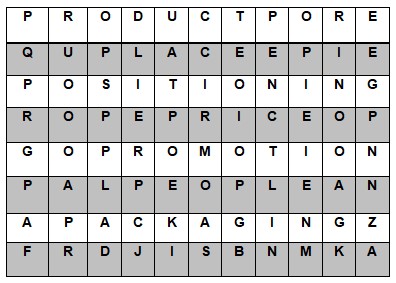
Find the P’s
Directions: Think of words or terms related to the topic that starts with letter “P” and find the words in the grid horizontally, vertically, or diagonally. Write the Words or Terms on the space provided and write something about the word using your own words.
1. __________________
2. __________________
3. ___________________
4.___________________
5. ___________________
6. ___________________
7. ___________________
 What
is It
What
is It
Marketing Mix is a set of controllable and connected variables that a company gather to satisfy a customer better than its competitor. It is also known as the “Ps” in marketing. Originally, there were only 4Ps but the model has been continually modified until it became 7P’s. The original 4 P’s stands for product, place, price and promotion. Eventually, three elements have been added, namely: people, packaging and positioning to comprise the 7 P’s.
Marketing strategy typically starts with the product. Marketers can’t plan a distribution system or set a price if they don’t know exactly what the product will be offered to the market.
Product refers to any goods or services that are produced to meet the consumers’ wants, tastes and preferences. An example of goods includes tires, MP3 players, clothing and etc. Goods can be categorized into business goods or consumer goods. A buyer of consumer goods may not have thorough knowledge of the goods he buys and uses. An example of services includes hair salons and accounting firms. Services can be divided into consumer services, such as hair styling or professional services, such as engineering and accounting.
Place represents the location where the buyer and seller exchange goods or services. It is also called as the distribution channel. It can include any physical store as well as virtual stores or online shops on the Internet.
STAGES OF DISTRIBUTION CHANNEL
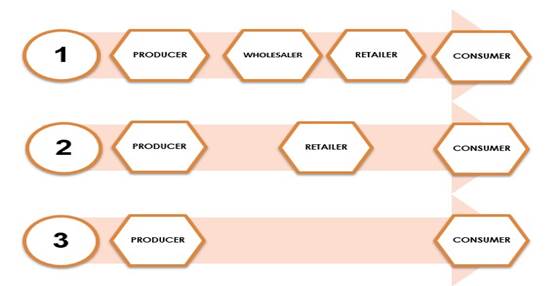
Channel 1 contains two stages between producer and consumer - a wholesaler and a retailer. A wholesaler typically buys and stores large quantities of several producers' goods and then breaks into bulk deliveries to supply retailers with smaller quantities. For small retailers with limited order quantities, the use of wholesalers makes economic sense.
Channel 2 contains one intermediary. In consumer markets, this is typically a retailer. A retailer is a company that buys products from a manufacturer or wholesaler and sells them to end users or customers. In a sense, a retailer is an intermediary or middleman that customers use to get products from the manufacturers.
Channel 3 is called a "direct-marketing" channel, since it has no intermediary levels.
In this case the manufacturer sells directly to customers.
The price is a serious component of the marketing mix. What do you think is the meaning of a Price?
In the narrowest sense, price is the value of money in exchange for a product or service. Generally speaking, the price is the amount or value that a customer gives up to enjoy the benefits of having or using a product or service. One example of a pricing strategy is the penetration pricing. It is when the price charged for products and services is set artificially low in order to gain market share. Once this is attained, the price can be higher than before. For example, if you are going to open a Beauty Salon, you need to set your prices lower than those of your competitors so that you can penetrate the market. If you already have a good number of market share then you can slowly increase your price.
Promotion refers to the complete set of activities, which communicate the product, brand or service to the user. The idea is to attract people to buy your product over others. Advertising, Personal Selling, Sales Promotion, Direct Marketing, and Social Media are examples of promotion.
Your team, a staff that makes it happen for you, your audience, and your advertisers are the people in marketing. This consists of each person who is involved in the product or service whether directly or indirectly.
People are the ultimate marketing strategy. They sell and push the product. People are one of the most important elements of the marketing mix today. This is because of the remarkable rise of the services industry. Products are being sold through retail channels today. If the retail channels are not handled with the right people, the product will not be sold. Services must be first class nowadays. The people rendering the service must be competent and skilled enough so that that the clients will patronize your service.
Therefore, the right people are essential in marketing mix in the current marketing scenario.
Packaging is a silent hero in the marketing world. Packaging refers to the outside appearance of a product and how it is presented to the customers. The best packaging should be attractive enough and cost efficient for the customers. Packaging is highly functional. It is for protection, containment, information, utility of use and promotion.
When a company presents a product or service in a way that is different from the competitors, they are said to be “positioning” it. Positioning refers to a process used by marketers to create an image in the minds of a target market.
Solid positioning will allow a single product to attract different customers for not the same reasons. For example, two people are interested in buying a phone; one wants a phone that is cheaper in price and fashionable while the other buyer is looking for a phone that is durable and has longer battery life and yet they buy the same exact phone.
|
Lesson 2 |
Develop a Brand Name |
Brand Name is a name, symbol, or other feature that distinguishes a seller's goods or services in the marketplace. Your brand is one of your greatest assets because your brand is your customers' over-all experience of your business. Brand strategy is a long-term design for the development of a popular brand in order to achieve the goals and objectives. A well-defined brand strategy shakes all parts of a business and is directly linked to customer needs, wants, emotions, and competitive surroundings
Experts believe that a good brand can result in better loyalty for its customers, a better corporate image and a more relevant identity.
As more customers continue to differentiate between emotional and experienced companies, a brand may be the first step forward in your competition instead of price points and product features. The question is, can you build a brand which truly talks to your audience?
Branding is a powerful and sustainable high-level marketing strategy used to create or influence a brand. Branding as a strategy to distinguish products and companies and to build economic value to both customers and to brand owners, are described by Pickton and Broderick in 2001.
"Every brand makes a promise. But in a market in which customer confidence is little and budgetary observance is great, it’s not just making a promise that separates one brand from another, but having a significant purpose," (Allen Adamson).
How can you define your business' purpose? According to Business Strategy Insider, purpose can be viewed in two ways:
a. Functional. This way focuses on the assessments of success in terms of fast and profitable reasons. For example, the purpose of the business is to make money.
b. Intentional. This way focuses on fulfillment as it relates to the capability to generate money and do well in the world.
The significant of consistency is to avoid things that don’t relate to or improve your brand. Consistency aids to brand recognition, which fuels customer loyalty.
There should be an emotional voice, whispering "Buy me". This means you allow the customers have chance to feel that they are part of your brand.
You should find ways to connect more deeply and emotionally with your customers. Make them feel part of the family and use emotion to build relationships and promote brand loyalty.
Marketers should remain flexible to in this rapidly changing world. Consistency targets at setting the standard for your brand, flexibility allows you to adjust and differentiate your approach from your competition.
According to Kevin Budelmann, "Effective identity programs require sufficient consistency to be identifiable, but sufficient variation to keep things fresh and human" so if your old tactics don't work anymore, don't be afraid to change. It doesn’t mean it worked in the past it may still work now.
It is equally important for your employees to be well versed in how they communicate with customers and represent the brand of your product
Loyalty is an important part of brand strategy. At the end of the day, the emphasis on a positive relationship between you and your existing customers sets the tone for what potential customers can expect from doing business with you.
Do not be frightened of competition. Take it as a challenge to improve your branding strategy and craft a better value in your brand.
Draw to Survive
Direction: Create a Concept Map for the 7 P’s of Marketing Mix in the box provided.

|
|
Rubrics for Scoring |
|
Score |
Description |
|
15 |
The illustration of the concept map is clear and complete. |
|
12 |
The illustration of the concept map is complete. |
|
9 |
The illustration of the concept map is lacking 1. |
|
6 |
The illustration of the concept map is lacking 2 |
|
3 |
The illustration of the concept map is lacking 3. |

Marketing mix constitutes of the 7P’s in case of products – product, price, place and promotion. In case of services it constitutes of 3 more P’s – people, packaging and positioning.
All P's should be compatible in marketing mix. The price is compatible with the product's placement. The product must be consistent with the promotion. In general, all P’s are connected intrinsically.
As a result, when you make a marketing mix, it becomes a chain of strong bonds. Then these connections will lead you to lengthen the chain. Whenever you plan to add or change existing features, you need to see the general image which helps create a fresh product in marketing mix.
Branding is absolutely critical to a business because of the overall impact it makes on your company. Branding can change how people percept your brand, it can drive new business and increase brand awareness.

Paste the P’s
Look for newspapers or magazines. Find and identify pictures related to the P’s in Marketing Mix. Cut out the pictures, sort and paste them on the box, then write a short description on the line next to the picture.
|
PICTURE 1
|
|
|
PICTURE 2
|
|
|
PICTURE 3
|
|
|
PICTURE 4
|
|
|
|
Rubrics for Scoring |
|
Score |
Description |
|
15 |
The table is complete with pictures and the descriptions are correct. |
|
12 |
The table is lacking one (1) picture and the descriptions are correct. |
|
9 |
The table is lacking two (2) pictures and the descriptions are correct. |
|
6 |
The table is lacking three (3) pictures and the descriptions are correct. |
|
3 |
The table is lacking one (4) pictures and the descriptions are correct. |
The Power of Color!
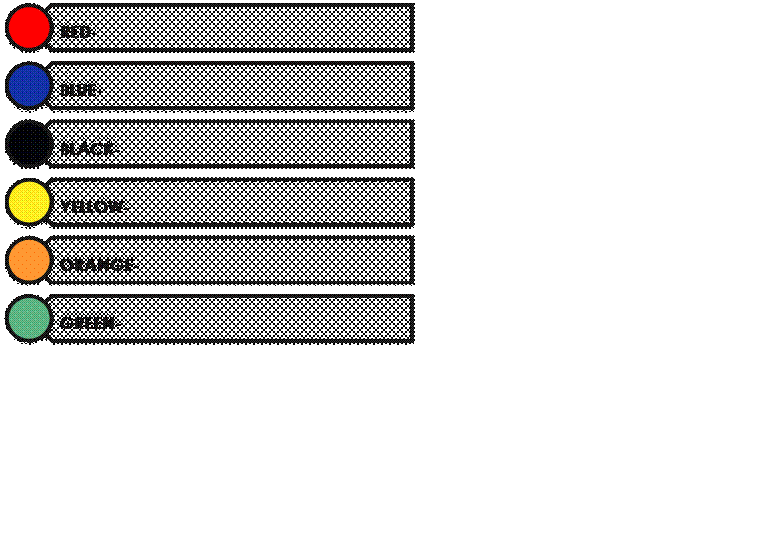
I am going to show you some colors. For each one, write down the FIRST company or product that comes in to your head when you see the color.
What’s the FIRST BRAND you think of when you see these colors?
|
|
Rubrics for Scoring |
|
Score |
Description |
|
15 |
The diagram is complete with the right brand written in its corresponding color. |
|
12 |
The diagram is lacking one (1) with the right brand written in its corresponding color. |
|
9 |
The diagram is lacking two (2) with the right brand written in its corresponding color. |
|
6 |
The diagram is lacking three (3) with the right brand written in its corresponding color. |
|
3 |
The diagram is lacking four (4) with the right brand written in its corresponding color. |
Identification
Direction: Write the word or phrase that is being described or completes the thought of each statement.
______________1. It is a set of controllable and interrelated variables composed of
product, place, price and promotions that a company assembles to satisfy a target group better than its competitor.
______________2. The amount of money that a customer pays for to enjoy it.
______________3. An item that is built or produced to satisfy the needs of a certain
group of people.
______________4. It determines your firm’s profit and survival.
______________5. It can be intangible or tangible as it can be in the form of services
or goods.
______________6. The way your product or service appears from the outside.
______________7. A marketing model that modifies the 4Ps model.
______________8. Responsible for every element of your sales, marketing
strategies, and activities.
______________9. It refers to how a business creates awareness in the market.
______________10. It claims a new space in the mind of the customer different from the spaces occupied by existing products.
______________11. The ultimate marketing strategy.
______________12. Where your product or service is actually sold.
______________13. The place occupied by products in the heart and minds of the consumers.
______________14. A name, symbol, or other feature that distinguishes a seller's goods or services in the marketplace.
______________15. A powerful and sustainable high-level marketing strategy used to create or influence a brand.
 Additional
Activities
Additional
Activities
Pictionary Style
Direction: Follow the task guide below.
TASK GUIDE:
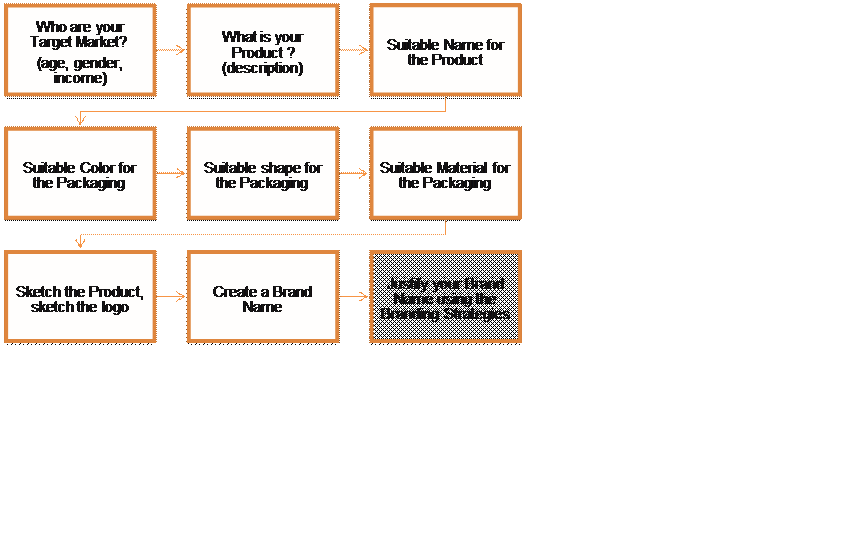
Task 1. Invent a new product and give it a name. Sketch it.
Task 2. Once you have chosen the name for your product write a short explanation. In your explanations you should describe your product and explain how and why you chose its name.

Here are some useful phrases that may help you with your tasks and explanations:
My Target Market is/are _______________________________________________.
I would like to introduce my new product ___________________________________
___________________________________________________________________.
I chose the name ___________________ because __________________________
___________________________________________________________________.
You can use it to _____________________________________________________
I chose the Brand Name _________________________ because ______________
___________________________________________________________________
___________________________________________________________________
___________________________________________________________________.
___________________________________________________________________
___________________________________________________________________.
|
|
Rubrics for Scoring |
|
Score |
Description |
|
15 |
The imaginary product is illustrated with a unique the brand name. There is an explanation describing the product and its name. |
|
12 |
The imaginary product is illustrated with a brand name. There is an explanations describing the product and its name |
|
9 |
The imaginary product is illustrated with a brand name. There is an explanation describing the product. |
|
6 |
The imaginary product is illustrated with a brand name. |
|
3 |
The imaginary product is illustrated. |
This
is the end of Module five (5). You did a great job! It is Indeed an
achievement. Congratulations!!! Hard work pays off and you really proved
it!!! Try to learn more about
Entrepreneurship in the next Modules. Thank you for being patient, honest, and committed.

Multiple Choice
Direction: Encircle the letter of the best answer.
O O O O 1. The entrepreneurs who create new ideas are called?
A. Innovative
B. Imitating
C. Fabian
D. Drone
O O O O 2. The entrepreneur who lives on the labor of others is called?
A. Drone
B. Fabian C. Imitating
D. Innovative
O O O O 3. These are entrepreneurs who are to follow the path shown by
innovative entrepreneur.
A. Innovative
B. Imitating
C. Social Entrepreneurs
D. Fabian
O O O O 4. Which of the following is NOT a function of an entrepreneur?
A. Skills management
B. Risk taking
C. Conduct research
D. Make no changes with his product O O O O 5. Entrepreneur means:
A. Risk taker
B. To undertake C. To research
D. To improve standard of living
O O O O 6. It is a personality factor which means “doing things even before
being told”
A. proactive
B. perseverance
C. persuasion
D. initiative
O O O O 7. It is a personality factor which means convincing customers to
buy the product
A. Proactive
B. Persuasion
C. Self-confidence
D. Risk-taker
O O O O 8. Which of the choices is NOT part of the environmental factors?
A. Political
B. Weather condition
C. climate
D. family background of the manager
O O O O 9. All except one does NOT belong to the group?
A. Unfair trade practices
B. Strikes
C. Political protest
D. Product
O O O O 10. The entrepreneur who are skeptical about the changes in the
company is called?
A. Fabian
B. Social entrepreneur
C. Drone
D. Imitating
O O O O 11. The following are the forces competing within the industry except
one:
A. Potential new entrants and Substitute Products
B. Buyers and Suppliers
C. Rivalry among existing firms
D. Needs and Wants
O O O O 12. They are the one that provides something that is needed or wanted.
A. Buyers C. Buyers
B. Competitors D. Sellers
O O O O 13. It refers to the physical environment, societal environment, and
industry environment where the business operates.
A. Entrepreneurial mind frame C. Entrepreneurial heart flame
B. External Environment D. Entrepreneurial heart frame O O O O 14. They are the one who enters something.
A. Buyers C. Suppliers
B. new entrants D. Sellers
For questions 15 to 16 refer to the following statements:
A. Substantial capital requirement.
B. Substitute products are not readily available in the market
C. Difficulty in accessing distribution channels.
D. The product or service is unique.
E. Characteristics of the products or services.
F. Increased capacity
O O O O 15. In Potential New Entrants the intensity of its threat will be affected by the presence of the following barriers.
A. A and C C. A only
B. A, B, C and D D. All of the above
O O O O 16. In rivalry among existing Firms the industry is attributable to the
following factors.
A. E and F C. A and B
B. A, B, C and D D. All of the above
O O O O 17. Which of the following includes the industry environment of the
business?
A. Competitors C. Creditors
B. Customers D. All of the above
O O O O 18. It is the process of considering, evaluating, and pursuing market- based activities that are believed to be advantageous for the firm.
A. Opportunity seeking C. Opportunity screening
B. Opportunity seizing D. Sources of opportunity
O O O O 19. This is essential to opportunity seeking which allows the entrepreneur to see things in a positive and optimistic light in the midst of crisis or difficult situations.
A. Entrepreneurial mind frame C. Entrepreneurial heart flame
B. Entrepreneurial gut game D. Entrepreneurial heart frame
O O O O 20. It is the ability of entrepreneur that can sense without using the five senses, also known as intuition.
A. Entrepreneurial mind frame C. Entrepreneurial heart flame
B. Entrepreneurial gut game D. Entrepreneurial heart frame
O O O O 21. What is the function of Value Proposition?
A. use to power up sales
B. customers buying habits
C. convince customer to purchase a particular product or services.
D. provide value to your customers
O O O O 22. Give example in promotion using Value Proposition and Unique Selling Proposition.
A. fruit shake stand
B. with the slogan “Langhap Sarap”
C. ordinary sari-sari store
D. multinational business
O O O O 23. Select type of customer requirement
A. service responsibility C. service requirement
B. service oriented D. service fulfillment
O O O O 24. Considered favorable indicators for doing business in that particular
location.
A. structure of the segment B. capability of the business
C. size and growth of the segment
D. segmentation marketing
O O O O 25. What is market size?
A. tangible things that can be seen.
B. The most important part to the success of the company C. Size of arena where the entrepreneur will play their business
D. another variation of segmentation marketing.
O O O O 26. This refers to how you sell your products or services to you
customer.
A. Value proposition C. Selling proposition
B. Marketing concept D. Unique selling proposition
O O O O 27. Service requirement _____________ thing or product not able to touch but customer can feel the fulfillment.
A. Intangible C. Service
B. Tangible D. Output
O O O O 28. Tips for the entrepreneur on how to create an effective unique selling proposition to the target customers, except.
A. Completeness of proportion
B. Identify and rank the uniqueness of the product or services characteristic.
C. Very specific
D. Keep it short and simple
O O O O 29. ________________ will determine entrepreneur possible customers in one locality.
A. Market design C. Market strategy
B. market size D. market research
O O O O 30. The following variable to consider in behavioral segmentation,
except.
A. perception C. reaction
B. brand concept D. benefits
O O O O 31. It is the most common way to gather primary research with the use of questionnaires or interview schedule.
A. Interview C. survey
B. focus group discussion D. data gathering
O O O O 32. It is the traditional method of data collection which is normally done on a face-to-face manner with the respondents.
A. personal interview C. survey
B. focus group discussion D. data gathering
O O O O 33. It refers to a type of focus group discussion where it obtains information on general attitudes, understand the circumstances under which customers might require your product, or service, understand their desired outcomes
A. trend explanation C. feature prioritization
B. exploratory D. comparative analysis
O O O O 34. It is a type of FGD where customers go to get similar information, services or products and what attracts them to those resources. A. trend explanation C. feature prioritization
B. exploratory D. comparative analysis
O O O O 35. A data gathering technique where it can be moderated to group interviews and brainstorming sessions that provide information on user’s needs and behaviors.
A. personal interview C. survey
B. focus group discussion D. data gathering
O O O O 36. It refers to information gathered directly from the respondents who
answered set of questions.
A. primary research C. survey
B. secondary research D. data gathering
O O O O 37. It is a type of discussions in FGD if trade-offs have to be made among various customer needs.
A. trend explanation C. feature prioritization B. exploratory D. comparative analysis O O O O 38. A data gathering technique where it can be done via direct mail, over the phone, internet or e-mail.
A. data gathering C. focus group discussion
B. survey D. personal interview
O O O O 39. It is the process of gathering, analyzing and interpreting the information about the product or the services to be offered for sale in the market, the market and about past, present and any potential consumers for the products.
A. data gathering C. secondary research
B. primary research D. market research
O O O O 40. It is an important aspect of any type of research study, it can impact the results of a study and ultimately lead to valid or invalid results.
A. data collection C. secondary research
B. primary research D. market research
O O O O 41. Which one is not a P in Marketing Mix?
A. Price B. People C. Participant D. Promotion
O O O O 42. Which statement supports Marketing Mix?
A. The marketing mix is also known as the “M’s” in marketing.
B. Marketing Mix is a set of controllable and connected variables that a company gathers to satisfy a target group better than its competitor.
C. There are only 4 P’s in Marketing Mix.
D. None of the above
O O O O 43. Select the best definition of Product.
A. A product is an item that is built or produced to satisfy the needs of a certain group of people, it can be intangible or tangible.
B. A product is an item that is built or produced primarily to gain profit; it can be intangible or tangible.
C. A product is an item that is built or produced to compete in the world of business; it can be intangible or tangible.
D. None of the above
O O O O 44. Choose the best statement that applies in Consumer Goods. A. A buyer of consumer goods must have complete knowledge of the goods he buys and uses.
B. After-sale service is of paramount importance in the case of all consumer goods.
C. The market for consumer goods is affected by technological changes.
D. A buyer of consumer goods may not have thorough knowledge of the goods he buys and uses.
O O O O 45. What factors would change in the distribution channel if there will be no Intermediary like producer and consumer?
A. Nothing will take place, since it has no intermediary levels. In this case the manufacturer cannot sell to customers.
B. Direct-marketing will take place, since it has no intermediary levels in this case the manufacturer sells directly to customers.
C. The company will utilize Technology to reach the customers.
D. All of the above
O O O O 46. What is the advantage of Penetration Pricing?
A. A firm has three options and these are to price lower, price the same or price higher than competitors
B. A firm can create the perception that the products must have a higher value than competing products because the prices are higher.
C. The company earns more through cross-selling products along with a basic core product.
D. The company will gain market share because the price charged
for products and services is set artificially low.
O O O O 47. Promotions refer to the partial set of activities, which communicate the product, brand or service to the user. The idea is to make people be aware, attract and induce to buy the product, in preference over others. Find the error.
A. partial set of activities
B. which communicate the product
C. idea is to make people aware, attract and induce to buy the product
D. No error
O O O O 48. How would you promote a product?
A. By offering Free Gifts, Free Samples, Free Trial, Customer
Contests, Special Pricing
B. By offering Brochure, Catalogues, Fliers, Newsletters C. By offering Post cards, Coupons, Email, Phone calls, Text messages
D. None of the above
O O O O 49. The following are interpretation of the word Brand except
A. a legal instrument C. a business
B. a logo D. a vision
O O O O 50. How can you define your business' purpose?
A. Purpose can be defined in two ways: Functional which focuses on the evaluations of success in terms of immediate and commercial reasons and Intentional which focuses on success as it relates to the ability to make money and do well in the world.
B. Purpose can be defined in two ways: National which focuses on the evaluations of success within the country for commercial reasons and International which focuses on success as it relates to other countries to make money and do well in the world. C. All of the above
D. None of the above
It’s a job well done! You have successfully completed the modules for the First Quarter. Get ready to carry on for the Second Quarter starting with Module 6.

What I know What’s New- Find the P’s
|
P |
R |
O |
D |
U |
C |
T |
P |
O |
R |
E |
|
Q |
U |
P |
L |
A |
C |
E |
E |
P |
I |
E |
|
P |
O |
S |
I |
T |
I |
O |
N |
I |
N |
G |
|
R |
O |
P |
E |
P |
R |
I |
C |
E |
O |
P |
|
G |
O |
P |
R |
O |
M |
O |
T |
I |
O |
N |
|
P |
A |
L |
P |
E |
O |
P |
L |
E |
A |
N |
|
A |
P |
A |
C |
K |
A |
G |
I |
N |
G |
Z |
|
F |
R |
D |
J |
I |
S |
B |
N |
M |
K |
A |
1 Marketing Mix
2 Price
3 Product
4 Goods
5 Product
6 Packaging
7 7 P’s Model
8 People
9 Promotion
10 Services
11 People
12 Place
13 Positioning
14 Brand Name
15 Branding
Quarter Challenge 1
Assessment
1.
 B. Marketing Mix
2. A. Price
3. C. Product 4. C. Goods
5. C. Product
6. D. Packaging
7. B. 7 P’s Model
8. D. People
9. D. Promotion
10. C. Services
11. C. People
12. A. Place
13. B. Positioning
14. A. Brand Name
15. C. Branding

Ronaldo S. Batisan, DIWA Senior High School Series: Entrepreneurship Module. Diwa Learning Systems Inc.
Angeles A. De Guzman. Entrepreneurship (For Senior High School, Applied subject, ABM Strand. Lorimar Publishing, Inc 2018, 25 – 26.
Edralin, Divina M. Entrepreneurship. Quezon City: Vibal Group, Inc. 2016, 80 – 83.
Leedy, P. and Ormrod, J. Practical Research: Planning and Design 7th Edition. (Merrill
Prentice Hall and SAGE Publications, 2001),
Nick L. Aduana, Entrepreneurship in Philippine Setting (for Senior High School), 2017
Dr. Eduardo A. Morato Jr., Entrepreneurship, 2016
Angeles A. De Guzman, Entrepreneurship for Senior High School Applied Subject
ABM Strand,Lorimar Publishing,p.1-5
Ronaldo S. Batisan, Entrepreneurship: Diwa Senior High School Series, Diwa
Learning Systems Inc., p. 16-20
Eduardo A. Morato Jr., Entrepreneurship, 1st ed., Manila, Philippines: REX Books Store,p.13
Nick L. Aduana, Etrepreneurship in Philippine Setting for Senior High School, 2017, C&E publishing, Inc.p.46-51
Angeles A. De Guzman, Entrepreneurship for Senior High School Applied Subject
ABM Strand,Lorimar Publishing,p.25-26
Raymund B. Habaradas and Tereso S. Tullao,Jr., Pathways to
Entrepreneurship,2016,Phoenics publishing house,p.17-28
Nick L. Aduana, Etrepreneurship in Philippine Setting for Senior High School, 2017, C&E publishing, Inc.p.46-51
Raymund B. Habaradas and Tereso S. Tullao,Jr., Pathways to
Entrepreneurship,2016,Phoenics publishing house,p.17-28
Aduana, Nick L. Entrepreneurship in the Philippine Setting for Senior High School. Quezon City.C & E Publishsing, Inc. 2016.
Morato, Eduardo A. Entrepreneurship. Manila. Rex Bookstore, Inc. 2016.
Batisan, Ronaldo S. Entrepreneurship Module, Diwa Senior Highschool Series, Diwa Learning System Inc. Legaspi Village, Makati City Philippines, copyright 2016.
ELECTRONIC RESOURCES
Santos, ELi. "Marketing Mix the 7 Ps of Marketing." LinkedIn SlideShare. February 06, 2012. Accessed January 04, 2019. https://www.slideshare.net/elisantos11/marketingmix-the-7-ps-of-marketing.
Tracy, Brian. "The 7 Ps of Marketing." Entrepreneur. May 17, 2004. Accessed January 04, 2019. https://www.entrepreneur.com/article/70824.
"Marketing Mix Definition - 4Ps & 7Ps of the Marketing Mix." The Marketing Mix. Accessed January 04, 2019. https://marketingmix.co.uk/.
"Branding Explained." Luminosity Branding Agency. Accessed January 04, 2019. https://www.luminosity.com.au/what-we-do/brand/branding-explained/.
"Marketing: Distribution Channels (GCSE) | Tutor2u Business." Tutor2u. Accessed January 04, 2019. https://www.tutor2u.net/business/reference/marketing-distributionchannels.
"What Is a Price? - Definition of Price." Marketing-Insider. July 13, 2015. Accessed January 04, 2019. https://marketing-insider.eu/what-is-a-price/.
"5 Basic Functions of Packaging in Marketing a Product." Your Article Library. January 03, 2014. Accessed January 15, 2019. http://www.yourarticlelibrary.com/marketing/5basic-functions-of-packaging-in-marketing-a-product/22204.
"Market Positioning - Creating an Effective Positioning Strategy." Corporate Finance Institute. Accessed January 15, 2019. https://corporatefinanceinstitute.com/resources/knowledge/strategy/marketpositioning/.
Jwayne2013 Follow. "Branding Ppt." LinkedIn SlideShare. January 16, 2013. Accessed January 18, 2019. https://www.slideshare.net/jwayne2013/branding-ppt16015717.
Stec, Carly. "Brand Strategy 101: 7 Essentials for Strong Company Branding." HubSpot Blog. Accessed January 21, 2019. https://blog.hubspot.com/blog/tabid/6307/bid/31739/7-components-that-comprise-acomprehensive-brand-strategy.aspx.
Amanda Jesnoewski, Four ways to identify more business opportunities. November 20,
2018 retrieve from: https://www.smartcompanyng.com.au/
startupsmart/advice/business-planning/four-ways-to-identify-more-businessopportunities
