Ayatullah Mutahhari in the Words of Imam Khomeini:
AN Analytical survey of the sahifeh-ye
imam*
Mansoor L. Limba**
Sahifeh-ye
Imam’s Account of Mutahhari: A Chronological Survey
Sahifeh-ye Imam’s Account of Mutahhari: An Analytical
Survey
As a
trustworthy representative
As a close
associate and confidant
As a beloved
son and student
As an
outstanding author and man of knowledge
As an
eloquent speaker and combatant ‘alim
As a
dedicated and pious servant of Islam and the nation
As an
epitome of martyrdom and self-sacrifice, and reviver of the movement
As a furqan
[criterion and acid test]
As a
multi-dimensional figure
List of Figures
Figure 1 Diagrammatical Representation of the Study
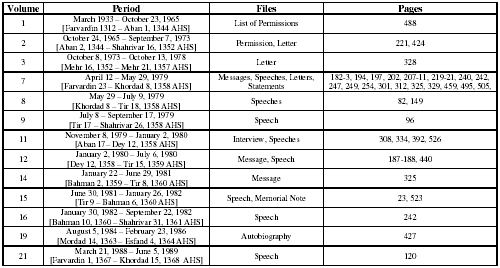
Figure 2 Sahifeh-ye
Imām’s Chronological Accounts
of Mutahhari
A cursory
examination of the 22-volume Sahifeh-ye Imam—the largest ever compiled
anthology of Imam Khomeini’s speeches, messages, interviews, religious decrees,
permissions, and letters—reveals that the martyred Ayatullah Professor Murtada
Mutahhari undoubtedly occupies a distinct station in the sight of the Great
Leader of the Islamic Revolution and the Idol-Breaker of the 20th
Century.
Imam
Khomeini’s communications with Ayatullah Mutahhari in the forms of religious
permissions and personal letters, as well as descriptions of him in letters,
speeches, messages, statements, interviews, autobiography, and memorial note
during and after his lifetime as indicated in the encyclopedic authentic
reference source suggest that the former considers the latter a trustworthy
representative, compassionate teacher, erudite scholar, competent jurist,
eloquent speaker, combatant ‘alim, and an epitome of martyrdom in the way of truth
and freedom of thought. These benevolent views on him are consistent from the
first volume of the anthology in which Professor Mutahhari is indicated having
been granted authority [ijazah] on Dhu’l-Hijjah 24, 1388 AHS (March 13, 1969)
by the Imam in the financial and religious law affairs up to the 21st
volume (volume 22 being the indexes of the whole voluminous treatise) wherein
he—in the Imam’s message dated Shahrivar 14, 1367 AHS (September 5, 1988)
addressed to the Muslim nation of Pakistan and the ‘ulama’ of Islam on the
occasion of the martyrdom of Sayyid ‘Arif Husayn Husayni—is mentioned as among
“the freedom-loving ‘ulama’ of the Islamic world subjected to conspiracy and
terrorism”.
For the
Imam, Shahid Mutahhari is more than a student, representative, associate,
confidant, friend, or son. Indeed, it can be said that for him, Mutahhari
cannot be confined to a single dimension as he is an embodiment of a totality.
Mutahhari is Mutahhari.
Professor Ayatullah
Murtada Mutahhari (1298-1358 AHS) was born on Bahman 13, 1298 AHS [February 3,
1920] in the village of Fariman near Mashhad, Khorasan, to a family of
clergymen. His father Hujjat al-Islam Muhammad Husayn Mutahhari was one of the
pious ‘ulama’ of his time. At the age of 12, after finishing his
preliminary education in Fariman, he proceeded to the theological center at Mashhad
to receive instruction under Mirza Mahdi Shahidi Radawi.
At the age of 18,
he set off for Qum for further pursuits of his studies under the supervision of
such great teachers as Ayatullah Burujerdi and Imam Khomeini and others. At
this time, he was considered one of the most brilliant students at the
theological center of Qum and a favorite student of Imam Khomeini. Beside the
philosophy lessons given by Imam Khomeini, the late Mutahhari also attended the
Imam’s classes on akhlaq (ethics). It
seems that these lessons had a profound influence in forging his personality.
He himself recalls Imam Khomeini’s lessons in these words:
The lessons in
ethics delivered by my beloved and favorite teacher (Imam Khomeini) on every
Thursday and Friday were actually exercises and training in treading the
spiritual path of gnosticism and were not a dry lesson in lifeless ethics. His
teachings overwhelmed me to such an extent that I found myself a great deal
under their influence that lasted until the next Monday or Tuesday. A great
part of my intellectual and spiritual personality was formed during those
classes which I underwent for 12 years from that divine teacher.[1]
Moreover, he
himself conducted lessons in subjects like Arabic literature, logic, kalam [scholasticism],
jurisprudence, and philosophy. In 1331 AHS [1952] Mutahhari was transferred
from Qum to Tehran and in 1334 AHS [1955] he was invited to teach Islamic
sciences at the Faculty of Islamic Sciences, Tehran University.
He was arrested at
the midnight of Khordad 15, 1342 AHS [1963] and spent 43 days in prison. After
Imam Khomeini’s migration to Paris in France, Mutahhari went to meet him and
His Eminence assigned him the responsibility of organizing the Revolutionary
Council. On the night of Ordibehesht 11, 1358 AHS [May 1, 1979] Mutahhari was
martyred by an agent of the Furqan terrorist group. He wrote more than 50 books
and tens of articles, and delivered scores of speeches.
Now, 25 years
after Shahid Mutahhari’s martyrdom barely three months after the victory of the
Islamic Revolution, it is appropriate to delve on, or review in the least, the
different aspects of the noble martyr’s personality. As his student at least, what is Imam Khomeini’s
opinion of Ayatullah Mutahhari? What are the references for these views? Do
these views of Mutahhari consistent from the beginning of their acquaintance up
to his martyrdom?
Against this backdrop, a critical examination of the
viewpoint of the Founder of the Islamic Republic on the late professor in the
light of Sahifeh-ye Imam is the
principal burden of this study.
This paper sought to know the
personality of Ayatullah Shaykh Murtada Mutahhari in the words of Imam Khomeini
as recorded in Sahifeh-ye Imam. In
particular, this article attempted to address the following queries, thus:
-
As the sole reference source of the study, what is Sahifeh-ye Imam? To what extent is it reliable as an academic source of inquiry?
-
Chronologically, what are the accounts of Sahifeh-ye Imam on Mutahhari?
-
Analytically, what aspects of Mutahhari’s personality can be deduced from these chronological accounts of Sahifeh-ye Imam on him?
Diagrammatically,
this research inquiry can be presented as follows:
Figure
1 Diagrammatical Representation of the Study
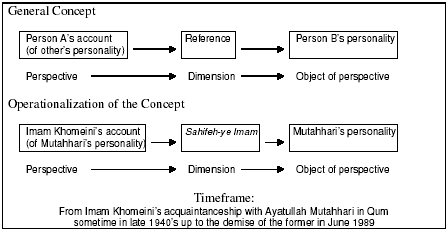
Initially, this paper gave a bird’s-eye-view of the
Sahifeh-ye Imam, the sole source of account of the present analytical survey
and examined its academic credibility.
Then, lengthy
chronological accounts of the Sahifeh-ye
Imam on Ayatullah Mutahhari are made. In these accounts only the actual
words and writings of Imam Khomeini to, or about, Mutahhari are quoted. Thus,
introductory headings in each of the documents, and the footnotes[2]
where the former is mentioned—which are not actually parts of the Imam’s words
and writings, unless otherwise stated—as well as some instances[3] in
the text where his name is only mentioned without the Imam having elaborating
on his personality are not covered. Equally excluded is Volume 22 of the Sahifeh being the comprehensive index of
the encyclopedic work.
Thereafter, an
analysis of the chronological accounts is conducted to arrive at an overall
picture of Ayatullah Mutahhari in the words of Imam Khomeini. In the conclusion,
the findings of the study, which are actually the restatement of the answers to
the points of clarification, are stated.
Published
by the Tehran-based Institute for the Compilation and Publication of Imam
Khomeini’s Works (ICPIKW) in the year 1378 AHS (1999) named as the “Year of Imam
Khomeini” being the centennial year of his birth, the Sahifeh-ye Imam has been so far the largest anthology of Imam
Khomeini’s literary works including his family-related letters, religious
permissions, socio-political letters and telegrams, decrees and orders, messages,
speeches and statements, interviews and dialogues, and others.
The
family-related letters open an impressive window on the private life of the Imam.
These letters show that not only was Imam
an ideal role model in the realms of scholarship and ijtihad, struggle
and jihad, and politics and leadership for his disciples, but also his
subtle soul and his self-disciplined and dutiful personality urged him not to
shirk his duties in the non-political spheres. He was an idyllic spouse in his
conjugal behavior and in terms of gentleness and fidelity toward his wife. As
both his quest and fate led him to Ayatullah Thaqafi’s home to select his
partner for all his sorrows and ecstasies, he remained committed to this first
and last selected one to the end of life and along all its ups and downs. A
departure for the obligatory hajj pilgrimage in his youth, a year of
exile to Turkey and a few trips of his wife to Iran for visiting the children
and relatives (during the joint sojourn in the holy city of Najaf, Iraq) were
the few cases, during the 60 years of married life when he and his wife
experienced separation. The archive of surviving letters displays a deep,
emotional and loyal relationship replete with affection and mutual respect. The
letters of Imam Khomeini to his children and relatives show us another aspect
of a great soul, and it is that being a Religious Reference Authority [(Source
of Imitation) marja‘ at-taqlid] and a religious patriarch and dealing
with the leadership of the Revolution
made him considerate of the religious and moral duties regarding his
relatives and children. The Imam’s training strategy toward the children and
his granting them the right to choose and free will along with compassionate
supervision can all be observed in these writings.[4]
Imam
Khomeini’s letters of authorization to a choice of people in the financial and
religious law [shar‘iyyah wa hasbiyyah] affairs, either chosen by
himself or in response to individual requests for authorization, form
another part of Sahifeh-ye Imam. According to the principles of Shi‘ah
jurisprudence [fiqh], any expenditure of the religious payments and
management of the Islamic financial affairs during the period of occultation of
the twelfth Imam is not authorized without the permission of a fully qualified
jurist; so it has been customary for the maraji‘
at-taqlid to issue letters of authorization for the qualified persons. The
faithful pay their religious dues through these representatives to their maraji‘. The issued authorizations
indicate the scope of authority of the recipient of the permission for expending
the payments in the lawful religious ways. These authorizations are granted to
persons who meet the criteria of authority of imitation [marja‘iyyah] in terms of general qualifications, devoutness and
commitment, or their qualification is certified by two just informed persons.
We can conclude from the collection of authorizations issued by Imam Khomeini
and particularly from the letters written by His Eminence to his official
representatives that he has been diligent and scrupulous in issuing the
permissions. Except the cases of authorizations that have been issued for the
prominent and pious scholars or for the persons who were closely in contact
with and known to him, generally Imam has not issued any authorizations without
a written endorsement of the just informed persons. An index of the religious
authorizations issued by Imam Khomeini during the period of his stay in the
holy city of Najaf is included at the end of this volume (volume one) of Sahifeh-ye
Imam. The original copy of this index is available in Imam’s handwriting
and it demonstrates the Imam’s fastidiousness and organization in such cases.
It should be mentioned that the religious authorizations are only valid as long
as the beneficiary remains virtuous, and possesses the other attributes required
for being the lawful representative in collecting and expending the religious
payments, otherwise they will be automatically dismissed. In the present
collection, only the authorizations are included of which a certified copy has
been available, while the number of the religious permissions granted by Imam
Khomeini exceed this.[5]
Another
component of Sahifeh-ye Imam is the telegrams and letters written by Imam
Khomeini to different persons, religious scholars, local and foreign diplomats
and political leaders, various political parties and societies, and ordinary
people, which embrace a variety of themes. The diverse addressees of
these letters and the vast span of time that they cover, beside the variety of
their themes and subjects, all add to the significance of these letters as a
part of the wealth of documents that relate fragments of the history of the Imam’s
movement and His Eminence’ positions and views on different issues. Among these
letters, we cross upon records that have instigated some developments in the
course of the uprising and during the Islamic Revolution. For example, the Imam’s
telegrams and letters to the Shah, Asadullah ‘Alam and Amir-‘Abbas Hoveyda, as
well as his letters to the maraji‘
at-taqlid, ‘ulama, seminaries, political and religious associations
in the country and abroad, and leaders of foreign states. Fortunately, through
the efforts made by the Imam’s Memento (Haj Sayyid Ahmad Khomeini) (r),[6]
the original manuscripts of many of Imam Khomeini’s letters and telegrams since
the climax of the Islamic Revolution in 1356 AHS 1978] till his demise has been
collected and are available in the Institute. Moreover, through the efforts of
the Institute and the assistance of his friends, a great deal of Imam Khomeini’s
correspondence in the years preceding the victory of the Islamic Revolution has
been recovered, all of which together with the other works and records of His
Eminence are thereby published, with no alterations, in Sahifeh-ye Imam.[7]
A large number of decrees and orders of His Eminence
Imam Khomeini, as the marja‘ of many
of the Shi‘ah people and as the Great Leader of the Revolution and the Islamic
Republic of Iran have survived, which are exactly printed in the collection.
The decrees published in Sahifeh-ye Imam include those issued for the
formation of the Revolutionary Council, the transitional government and
appointment of its members; confirmation of the Constitution; approval of the
presidential decrees; decrees on the foundation of different revolutionary institutions;
decrees for installing and deposing the judiciary, military, and law
enforcement officials, and the Leader’s representatives in various institutions
and organizations; the military orders issued by him as the Commander-in-Chief
of the Armed Forces, as well as His Eminence’s directives and orders issued
response to the requests of government officials on diverse issues. Studying
this part of the Imam’s works, especially observing the historical trend they have taken along
with His Eminence’s messages and speeches, offers an overall view of the kind of his religious and proficient, decisive
and potent leadership and yet, unassuming and people-based. Since some of Imam
Khomeini’s views and orders have been written at the bottom of request letters
of officials and inquirers, all or parts of the original requests are published
together with the Imam’s response for a better understanding of the issue.[8]
Imam Khomeini’s different religious and political
messages comprise some of the most important written works of Imam Khomeini
collected and chronologically published in Sahifeh-ye Imam. Issuing and
publishing these messages was in fact the most important direct channel through
which Imam Khomeini kept in touch with the people and his followers. It was via
these messages that, during the Provincial and District Councils Bill affair,
the rising surge against the monarchial regime began and the Khordad 15, 1342
AHS [June 5, 1963] uprising started. All along the struggles of the Iranian
nation, they were Imam’s statements and messages that determined the method of
uprising, the rational and political bases, and its main concerns, slogans and
approaches in each of the strenuous stages of the Revolution. When in 1356 and
1357 AHS [1977 and 1978] the Iranian nation’s struggle was heightening, each
statement issued by Imam Khomeini from Najaf (in Iraq) or Paris, which swiftly
circulated all around the country, stood for a general and national manifesto
that determined the course of the Revolution, and organized the revolutionary
forces and the people around certain objectives and maxims. In his messages, Imam
Khomeini did not just aim at invoking the heroic spirits and encouraging the
people to steadfastness and persistence on the course of the Revolution.
Rather, His Eminence, with his versatile and lucid writing style, tried to
increase the public religious and political awareness regarding the current
affairs, and to augment their insight concerning the proponents and opponents
of the Revolution inside the country and abroad, so that they might be
encouraged consciously to get involved in supporting the objectives of the
Revolution. The themes most conspicuous in Imam Khomeini’s statements include
wisely foreseeing the schemes designed by the Shah’s regime and its Western
supporters for suppressing the uprising at each stage and making the effort to
thwart them, warning against the misleading slogans and positions in the course
of the struggle, and highly stressing the public concurrence over their shared
religious slogans. What was common in all of Imam Khomeini’s messages, both
before and after the victory of the Revolution, was calling the people to
supporting the goals of the Revolution from the perspective of the religious
and divine duty, and with reliance on the people’s role as the primary founders
and owners of the Revolution, with an exceptional emphasis on the youth.[9]
A key
element in Imam Khomeini’s successful management and leadership was his
extensive relationship with the masses and various strata of society. The
complex link between realities and ideals, and the establishment of
relationship between theory and practice show the sagacious obvious image of
his leadership. Great theoreticians and idealists have seldom attained their
ideals. He did not merely depend on the scientific and practical treatises in
presenting and propagating his religious-political ideals, and this is what
made him a rare or even unique in the annals of religious authority [marja‘iyyah]. Just as he occupied a
lofty position as a great religious authority among his followers, he could be
able to explain in plain language deep religious concepts particularly the
political and social aspects of religion to his audience. Imam Khomeini’s
numerous messages at the gathering of various strata of the people provided the
possibility of direct connection of the people with his ideas and views, and
made them needless of the official and unofficial interpretations of
intermediaries, which are mostly associated with the exercise of their personal
views and political and factional motives. Contextual analysis of the Imam’s
speeches and his knowledge of the audience, and a comparison of the historical
events of the Islamic Revolution with the trend of his speeches and statements,
and the study of the aggregate of meetings and speeches, and the diversity of
the groups and strata will help the researchers in analyzing the realities of
the Islamic Revolution and in finding the reason behind Imam Khomeini’s
effective and people based-leadership. For this reason, in compiling the Imam’s
speeches and their publication in Sahifeh-ye
Imam no literary or textual edition, or change of any type, which is quite
usual in the process of rendering speeches into publishable written text has
been undertaken. Given that these speeches of Imam Khomeini were delivered in
relation to the historical events of the Islamic Revolution with the trend of
his speeches and statements, and the study of the aggregate of meetings and
speeches, and the diversity of the groups and strata will help the researchers
in analyzing the realities of the Islamic Revolution and in finding the reason
behind Imam Khomeini’s effective and people based-leadership.[10]
In
the age of communications, the mass media’s interviews with the intellectual
and political leaders with the aim of elucidating their viewpoints, and dispel
ambiguities and enigmas through answering the reporters’ questions, is one of
the effective means of establishing communication and direction in the public
opinion. Being aware of the importance of this phenomenon and in the absence of
restrictions, Imam Khomeini granted unconditional audience to journalists and
pressmen. The best part of his interviews took place during his sojourn in
Paris. As a result, the numerous interviews by the leading world news agencies,
radio-TV networks of various countries, and Iranian and foreign newspapers and
periodicals with Imam Khomeini, and his concise yet categorical and well
reasoned out answers to the questions have become part of the compendium of the
Imam’s valuable socio-political works, which in the present work have been
presented to the esteemed readers. The Imam’s talks with state leaders and
their envoys have so many instructive points. Examples are his reception of the
Elysee Palace’s envoys during his stay in Paris; holding talks with mediators
of the American government; his type of treatment and statements in his first
meeting with the ex-USSR’s ambassador; his meeting with Yasir ‘Arafat and
Palestinian leaders; and his meeting with Edward Shevardnadze as Gorbachev’s
special envoy who carried the latter’s reply to Imam Khomeini’s famous message;[11] dialogue with leaders of the Muslim countries
and other foreign political figures—which from the point of view of the
statement of the two sides and the extremely simple and unbelievable
reception—and the Imam’s self-confidence and proficiency in the arena of
discussion are among the different informative aspects for the Third World
statesmen and leaders particularly that of the Islamic Republic. Certainly,
such disposition and style of Imam Khomeini have multiplied a hundred times the
Iranian nation’s sense of identity and self-confidence in the arenas of
confronting the formidable enemies of the Revolution and in defending the
Islamic country.[12]
So
far, Imam Khomeini’s speeches and messages have been published in hundreds of
works under various titles and styles (summarized or complete, thematically or
chronologically) in manifold languages by his devotees and cultural
institutions both inside and outside Iran. Imam’s devotees and the cultural
institutes accomplished this both within and without Iran. Undoubtedly, these
works particularly his socio-political works are among the published works with
the highest circulation in Farsi language. Among the published books from Imam
Khomeini’s general works (before the establishment of this Institute), some
have been outstanding. Despite the demerits and defects which can be seen and
have been the point of some criticisms in Sahifeh-ye
Nur, it should be stated that this work from the time of publication of its
first volume up to now has so far been the most comprehensive reference for the
researchers and those interested in the works of Imam Khomeini. Worthy of
acknowledgment are the valuable efforts and endeavor of the compilers of Sahifeh-ye Nur from the Ministry of
Culture and Islamic Guidance, and the Organization of Islamic Revolution’s
Cultural Documents, and the dear ones who have rendered valuable assistance in
the different stages of compilation and publication of this work for all those
who have benefited from this pathway to the treasure of the Imam’s literary
works in their research, seminars, speeches, and references. Among the merits
of Sahifeh-ye Nur are its lengthy
introduction by Ayatullah, lucid titles, chronological arrangement, table of
contents, skillful editing, as well as relative comprehensiveness. In a bid to
present a complete series of all the literary works of Imam Khomeini and
keeping in view the main shortcomings and defects existing in the Sahifeh-ye Nur, the Institute has
published the present work entitled, Sahifeh-ye
Imam. During many years in the different department of this Institute, the
existing texts in the Sahifeh-ye Nur,
newspapers, periodicals, and books have been collated with the cassette
recorded tapes, handwritings and original manuscripts of Imam Khomeini’s works
which are at the disposal of the Institute, and the final text is meticulously
selected. All the date inconsistencies and other defects existing in the Sahifeh-ye Nur and other sources
concerning the identification of each of the Imam’s works have been
investigated, and the authentic and final facts have been presented at the
beginning of each piece of work along with its identification (headings). Apart
from the mentioned points, the most important merit of the Sahifeh-ye Imam over the Sahifeh-ye
Nur and other published books on the Imam’s works is the inclusion of over
2,000 cases of his works and documents from among the unpublished works of the
Imam, which become available for the public for the first time. The meticulous
selection of the indices (proper names, subjects and terms, Qur’anic verses and
hadiths, etc.) and their presentation
in one volume (volume 22), which provides easy access to selected topics and
subjects of the first 21 volumes.[13]
From the above scrutiny of the Sahifeh-ye Imam, it becomes clear that
it has so far been the most comprehensive and reliable collection of Imam
Khomeini’s literary works. So, it is only proper to take this anthology as the
sole reference in objectively examining the personality of Ayatullah Mutahhari
in the light of Imam Khomeini’s written communication with, and views on, him.
Sahifeh-ye Imam’s Account of Mutahhari: A
Chronological Survey
In the
first volume of the anthology, Ayatullah Mutahhari is included in the the Imam’s
personal list of individuals he, in capacity of being a marja‘ at-taqlid, has granted permission [ijazah] in the financial and religious law affairs:
334. To: Hujjat al-Islam Mr. Haj Shaykh Murtada Mutahhari
Khorasani, in Tehran
Recommender: Renowned
Scope of Authority: Financial; delivering a half
Date: Dhu’l-Hijjah 1388 AH[14]
In the second volume, we can find the permission itself
dated March
11, 1969 [Esfand 20, 1347 AHS/Dhu’l-Hijjah 24, 1388 AH] granted by the Imam during
his exile in Najaf, Iraq. The text of the permission is as follows:
In the Name of God, the Compassionate, the Merciful
Praise be to Allah,
Lord of the worlds; may peace and salutations be upon Muhammad and his pure
progeny; and may Allah’s curse be upon all their enemies.
His Eminence ‘Imad
al-‘Ulama’ wa Hujjat al-Islam Mr. Haj Shaykh Murtada Mutahhari, may his graces
last, has been granted my permission to be in charge of the financial and
religious law affairs whose supervision depends on the permission of a
fully-qualified jurist during the
occultation of Wali al-Amr, may Allah expedite his glorious advent, “so that he will be in charge
of the mentioned affairs while exercising caution.” He is also authorized to
collect the blessed Share of the Imam (‘a)
and spend one-half of it in such cases as are beneficial for the exaltation of
Islam, the promotion of the sacred precepts and the elevation of the foundation
of the sacred religion; and to remit the other half to this humble being to be
spent at the significant religious seminaries. He is also empowered to have
funds change hands, allow grace periods as deemed necessary and in collecting,
spending and remitting in the manner mentioned above.
“And I advise him,
may God, the Exalted, assist him, as we have been advised by the pious
predecessors to keep company of piety, to evade carnal desires and to be
meticulous in his worldly and afterworld affairs. I hope he will not forget me
in his benevolent prayers.” May God’s peace, mercy and blessings be upon him
and our pious brethren.
Ruhullah al-Musawi
al-Khomeini
Dhu’l-Hijjah al-Haram
24, 1388 AH[15]
In
the same volume, while still in exile in Najaf, Iraq, the Imam extends the
following letter of condolence dated March 5, 1972 [Esfand 10, 1350 AHS / Muharram
13, 1391 AH] to Shahid Mutahhari on the occasion of his father’s demise:
In His Most
Exalted Name
Muharram
al-Haram 13, 1392 AH
His Eminence ‘Imad al-A‘lam wa Hujjat al-Islam Mr. Mutahhari,
may his graces last:
As it was reported from the Holy City of Mecca the
late Hujjat al-Islam, your father, may God have mercy on him, returned to the
Mercy of the Lord. I pray to God, the Exalted, for a lofty station for him, and
patience and recompense for you and the rest of your family. I had a special
affection to him. “As what God, the Exalted wants, we will return to Him.” I
hope for benevolent prayers from you. May peace be upon you.
Ruhullah
al-Musawi al-Khomeini[16]
Around
January to March 1978 [the end of 1356 AHS/the beginning of 1398 AH], in his
place of banishment in Najaf the Imam sent a personal letter to Professor Mutahhari,
who was then in Tehran, concerning the deplorable state of the Islamic
seminaries at that time, as thus recorded in volume three of the Sahifeh:
In His
Most Exalted Name
After extending my greetings
and best wishes to you, I would like to say that I have received your esteemed
letter and that I pray for your honor’s health and prosperity. Most of the
topics that have been mentioned were and are under consideration. It is hoped
that the efforts to prevent mischief will meet with success. As you are far
away from the Qum Seminary and so are some of the other gentlemen—it being
better if their services are availed of in these chaotic conditions and
turmoil—these expected evils are the cause of my anxiety. The people you have
mentioned cannot solve this problem if not adding to it because of the
intervention of some, the likes of which have upset the youth. The case of the
council and a meeting of arbiters for solving and settling the problem will
also not solve any difficulty. In fact, such a meeting will not materialize. I
have experience; as a matter of fact, much experience. That which tops the
mischief list is the very same third case to which you have referred as
threatening the seminary from within. It should be reminded, and there is no
remedy except that the gentlemen who are acceptable and who, with respect to
knowledge, can be provided, stay in the seminaries and take hold of the
initiative. You are in a better position to select these people, and you can
find people who can stay in the seminaries on all days—even if it be in
turns—and gradually exert an influence on the morale of the youths.
In my recent, detailed
letter, written in answer to that of the Union of Islamic Associations in
Europe,2 I have explained the main problems and
shown the way, pointing out the evil of this perverted conviction that the
religious sciences, as also modern education, are worthless. Perhaps,
opportunity arising, I will comment on this matter in a message to the Qum
Seminary. But just pointing it out is not enough; these digressions must be
prevented in practice. This should be accomplished by the efforts of the
concerned notables including yourself.
It is hoped that the honorable gentlemen who have
taken notice of the matter by the grace of God, and have changed their attitude
somewhat, will be favored by the support of all the various groups, and that
the disputes and differences will be eliminated or, at least, narrowed.[17]
All
the above quotations constitute the Imam’s direct communications with the
martyred professor. The ensuing volumes reflect what the Great Leader of the
Islamic Revolution says about him. It starts with the message to the Iranian
nation released by the Imam on May 1, 1979 [Ordibehesht 11, 1358 AHS/Jamadi
ath-Thani 4, 1399 AH] on the occasion of the martyrdom of Murtada Mutahhari. Extolling
the personality and academic standing of the Martyr, the message runs as
follows:
In the Name of God, the
Compassionate, the Merciful
“Verily to Allah we belong and to Him we shall
return.”
I
express my condolences and congratulations to Islam, to its exalted prophets,
to the nation of Islam and in particular, to the combatant people of Iran for
the sorrowful loss of the honorable martyr, thinker, philosopher, and esteemed faqih [jurist] the late Haj Shaykh Murtada
Mutahhari—may his soul rest in peace. Condolence on the martyrdom of a
personage who spent his noble and precious life in the cause of the sacred
objectives of Islam and who struggled ferociously with deviations and
perversions; condolences on the martyrdom of a man who was peerless in
Islamology and various Islamic studies and the glorious Qur’an studies. I have
lost a very beloved son and mourn for him, for he was among the personalities
that were considered to be the achievement of my life. With the martyrdom of
this honorable son and immortal scholar, in a blow has been dealt beloved Islam
that nothing can substitute. And felicitations on the possession of these
self-sacrificing personalities who spread and are spreading light with their
appearance, both in this life and the hereafter. I congratulate the great
Islam, the trainer of human beings and the Islamic nation for rearing such
offspring, who with their luminous light give life to the dead and spread light
in darkness. Although I have lost a beloved child who was a part of my being, I
am honored that such self-sacrificing children had existed and exist in Islam. Mutahhari
who was peerless in purity of soul and strength of faith and the power of
oratory, has departed and joined the ranks of the exalted souls, but the
malevolent people should know that with his departure, his Islamic, scholarly,
and philosophical personality has not gone.
Terrorists
cannot assassinate the humane personality of the men of Islam. They should know
that by the will of the powerful God, with the departure of great individuals
our nation will become more determined in its resolve to fight against
immorality, tyranny, and oppression. Our nation has found its way and now will
not rest until the obliteration of the decayed roots of the former regime and
its evil supporters. The beloved Islam proliferated with the sacrifice and
martyrdom of its most beloved ones. From the age of revelation until now, Islam
has thrived on martyrdom interlaced with moral heroism. Fighting for the cause
of God and the cause of the downtrodden has been at the head of Islam’s plans. “Why
do you not fight in the way of Allah and for the sake of weak men and women and
children?”[18]
These
people, who have tasted their defeat and death and by means of this inhuman
behavior wish to take revenge or in their own wishful thinking, frighten the
holy warriors of Islam are wrong in their thinking. From every strand of hair
of a martyr from us; and from every drop of blood that pours to the ground,
determined and combatant human beings are created. Unless you assassinate the
whole courageous nation, the assassination of a single individual; however,
great he may be, will be of no benefit for returning to your plundering. A
nation that with trust in the great God and for the revival of Islam, has
risen, will not turn around by these desperate attempts. We are ready for
sacrifice and are prepared for martyrdom in the cause of God.
I
announce Thursday, May 3, 1979, as a day of public mourning for paying respects
to a self-sacrificing and holy warrior of the path of Islam and the nation; and
I shall be in mourning on Thursday and Friday at the Faydiyyah Madrasah. I
implore the Almighty God to grant blessings and forgiveness to that beloved son
of Islam, and honor and glory to Islam. Salutations to the martyrs of the path
of truth and freedom.
Ruhullah al-Musawi al-Khomeini[19]
On the third-day commemoration and mourning ceremony
of Mutahhari’s martyrdom [May 4, 1979/Ordibehesht 14, 1358 AHS/Jamadi ath-Thani
7, 1399 AH], in his speech delivered at the Faydiyyah Madrasah to the various
strata of the people, the Imam has this to say on the role of his martyrdom in
strengthening the Islamic Revolution:
Our movement was resurrected. All sections of the
people of Iran started life all over again. If it had developed lethargy or a
weakness, it was resurrected. Was it not because of the martyrdom of this great
man; and had this great man died in his bed; this would not have been
substantiated; this wave would not have arisen. Now a wave, all over the world;
the entire world; all the world that is interested in Islam has arisen. My
brothers in the rest of the countries be not afraid of this wave.[20]
The
subsequent part of the volume (volume 7) is full of the Imam’s acknowledgment
of gratitude in the form of letters, messages and statements for the messages
of condolence he received from various personalities both from inside and
outside Iran. We have, for example, the following lines:
In His Most
Exalted Name
Jamadi ath-Thani 9, 1399 AH
His Eminence Sayyid
al-A‘lam wa Thiqat al-Islam Mr. Sayyid Muhammad Khatami, may his blessings
last:
I
received your telegram of condolence for the sorrowful martyrdom of the late Hujjat
al-Islam wal-Muslimin Mr. Mutahhari—may his soul be sanctified—for which I
thank you. Other telegrams on this occasion were also received from the Islamic
Association of Students in Europe and the Iranians resident in Germany, Britain,
France, and other European countries. You kindly requested to convey my deep
gratitude and greetings to all of them. I pray to Almighty God for everyone’s
success. May God’s peace, mercy, and blessings be upon you.
Ruhullah al-Musawi al-Khomeini[21]
I would like to thank you for the communication of
condolences on behalf of the President, government and the people of your
country with regard to this great tragedy that has befallen us and our
country—rather to the nation of Islam. Nevertheless, we must give such martyrs,
for the cause of Islam. From day one when Islam was born, it has propagated
this righteous religion with martyrdom. Islam has had great martyrs and it is
honored to have given great martyrs in the way of God and in the path of its
objective. We too are honored to give martyrs in the cause of Islam and in the
path of our objective—and this man is not the last of our martyrs. We may again
have to give martyrs; and for us the life of this world is inconsequential. The
objective is important and we shall strive in the path of the objective. And
whatever happens in this regard we welcome it because it is for the attainment
of the objective.[22]
In the Name
of God, the Compassionate, the Merciful
His Excellency Colonel
Mu‘ammar Qadhdhafi, President of Libya:
I
received the telegram of condolence of Your Excellency, which was transmitted
on the sorrowful martyrdom of the late Hujjat al-Islam wal-Muslimin Professor Mutahhari.
I thank you for the expression of your sympathy. The martyrdom of one of the
greatest scholars of Islam was a loss for the world of Islam and all the
Muslims. And our enemies have once again proven their antagonism and hostility
towards Islam and the Muslims but they are ignorant of the fact that these
desperate attempts make our Muslim and the awakened nation more determined to
tread this path, and these satanic plots can never stop them in their path. I
pray to the Almighty God for the success and happiness of all Muslims.
Ruhullah al-Musawi al-Khomeini[23]
Then,
on a single day, the Imam had to reply to four separate messages of condolence
from various parts of Iran:
In His Most Exalted Name
Jamadi ath-Thani 12, 1399 AH
Jahrum
His Eminence Hujjat
al-Islam wal-Muslimin Haj Sayyid Ibrahim Haqqshenas, may his blessings last:
I
received the telegram of condolence on your behalf and that of the rest of the
sections of the respected residents of Jahrum on the sorrowful martyrdom of the
late Hujjat al-Islam wal-Muslimin Professor Murtada Mutahhari—may his soul rest
in peace.
I thank
the gentlemen for their expression of sympathy, and pray to God the Almighty
for the success of all of you. May peace, mercy, and blessings of Allah be upon
you.
Ruhullah al-Musawi
al-Khomeini[24]
In His Most Exalted Name
Jamadi
ath-Thani 12, 1399 AH
His Eminence Hujjat
al-Islam wal-Muslimin Haj Shaykh ‘Ali Ansari, may his blessings last:
The
telegram of the condolence on your behalf, the rest of the religious scholars
and the various strata of the people of Ahwaz on the sorrowful martyrdom of the
late Hujjat al-Islam wal-Muslimin Professor Murtada Mutahhari has been
received. Convey my sincere thanks and best wishes to all the gentlemen and
especially to your respected nephews. I pray to God for the success and
happiness of all of you. May God’s peace, mercy, and blessings be upon you.
Ruhullah al-Musawi
al-Khomeini[25]
In His Most Exalted Name
Jamadi ath-Thani 12,
1399 AH
Ordibehesht 19, 1358
AHS
His Eminence Hujjat
al-Islam wal-Muslimin Haj ‘Ata’ullah Ashrafi Isfahani, may his blessings last:
I
acknowledge the receipt of the telegram message on your behalf and that of the
rest of the religious scholars of Kermanshah—may their blessings last
long—regarding condolence on the martyrdom of the late Hujjat al-Islam
wal-Muslimin Professor Mutahhari Murtada—may his soul be sanctified I thank you
gentlemen for your expression of sympathy. I pray to the Almighty God for the
success and happiness of all of you in the path of service to Islam and the
Muslims. May peace, mercy, and blessings of Allah be upon you.
Ruhullah al-Musawi al-Khomeini[26]
In His Most Exalted Name
Jamadi
ath-Thani 12, 1399 AH
His Eminence Hujjat
al-Islam Mr. Afqahi Sabzevari, may his blessings last:
I
acknowledge the receipt of your telegram message regarding condolence for the
martyrdom of the late Hujjat al-Islam wal-Muslimin Professor Mutahhari—may his soul
be sanctified. I thank you for your expression of sympathy. I pray to the
Almighty God for the success and happiness of you. May God’s peace, mercy, and
blessings be upon you.
Ruhullah al-Musawi al-Khomeini[27]
In a
speech in Qum addressed to a group of students of the Medical University of
Tehran on the same day (May 9, 1979), the Imam explained the impact of Mutahhari’s
martyrdom, hence:
… we must not be in the least anxious that our people
are being killed. This Islam has been founded in this manner right from its
inception and it has marched forward while giving martyrs; it has constantly
given martyrs and moved forward. It was the same in the era of the Holy Prophet
too. In the Battle of Uhud,[28]
so many people were killed and in the other battles, so many Muslims were
killed but they were not worried at all. They would give martyrs and move one
step forward; again they would give martyrs and move one step forward; And,
praise be to God, now the situation is such that by giving a single martyr an
upsurge is created all over Iran and outside Iran. Outside Iran also, the
incident of the death of the late Mr. Mutahhari—which justifiably was a great
loss for us and for the whole of Iran—as you are aware was a loss too, they
broadcast on the radio stations that in Pakistan or in such and such
place—everywhere—it has created a wave. These people too are making a mistake
by killing Mr. Mutahhari. They must understand that the question is not that
with the killing of a single person the people will retreat, when one is killed
the whole lot comes forward and their cry becomes louder; the disgrace of the
enemy also becomes more. And I hope that this spirit stays with us and with our
nation.[29]
In
another speech on May 10, 1979 [Ordibehesht 20, 1358 AHS / Jamadi ath-Thani 13,
1399 AH]on the same occasion of the martyrdom of Mutahhari, the Imam emphasized
on martyrdom being an eternal honor to a group of the Air Force personnel of
Tehran, students of the Intermediate Teachers’ College of Isfahan; group of
teachers; Kalhor tribes of the border areas; trainees of the National Oil
Company of Abadan; students of the women’s Elementary Teachers’ College of Abadeh;
Women of Husayniyyah al-Irshad; and Employees of the Meat Organization:
Today, that you have gathered here to express your
condolences on the death of one of our beloved, and for the assassination of a
scholar, knowingly and determinedly you are resolved to continue the struggle
against the taghuti regime,
colonialism, and arrogance. My brothers! My sisters! My dear ones! Be resolute,
do not be afraid of assassination; do not be afraid of martyrdom, and for sure
you are not. Martyrdom is an eternal honor; it is immortality. Those people
should be afraid of martyrdom and be afraid of death who regard death to be the
end and human beings to be ephemeral. Whereas why should we, who regard human
beings to be immortal and the eternal life to be better than this worldly life,
be afraid? I thank all the various sections of the people, the tribes, the army
personnel, the ladies and the teachers, who have gathered together here, and
pray to the Blessed and Almighty God for the health and happiness of all.[30]
On
May 11-12, 1979, the Imam replied to two more condolence messages on the
martyrdom of Mutahhari:
In His Most Exalted Name
Jamadi ath-Thani 14, 1399 AH
His Eminence Hujjat
al-Islam Haj Sayyid Mahdi Yathribi—may his blessings last:
Your
telegram and that of the Association of Clergymen of Kashan on the occasion of
the sorrowful martyrdom of the late Hujjat al-Islam wal-Muslimin Professor Mutahhari—may
his soul be sanctified—has been received. Please send my sincere thanks and
greetings to all the respected gentlemen.
I
pray to the Blessed and Almighty God for the success of all in the cause of
service to Islam and the Muslims. May God’s peace, mercy, and blessings be upon
you.
Ruhullah al-Musawi al-Khomeini[31]
In His Most Exalted Name
Your Majesty Shaykh Zayid
bin Sultan Al-i Nahyan—Head of the United Arab Emirates:
The
telegram of condolence of Your Highness on the sorrowful martyrdom of the late
Professor Mutahhari, the esteemed Islamic philosopher—may his soul be
sanctified—has been received. I thank Your Highness for the expression of deep
sympathy. I pray to the Almighty God for the glory of Islam and Muslims, and
the severance of the hands of the outsiders and enemies of religion.
Ruhullah
al-Musawi al-Khomeini
Jamadi ath-Thani 15, 1399 AH[32]
While
exposing the treason and contradictory stances of the claimants of human
rights, in a speech delivered to members of the Iranian Chamber of Commerce on
May 15, 1979 [Ordibehesht 25, 1358 AHS/Jamadi ath-Thani 18, 1399 AH], the Imam
mentioned the case of Mutahhari in this fashion:
Those
like Mr. Mutahhari who would not hurt a fly—I knew this man for approximately
twenty years—a man of such morality, a man of such grace, of such humanity was
condemned to assassination.
Why?
What had Mutahhari done? Whom had he killed? What was his crime? Was he not a
human being? This man of philosophy, knowledge, religious scholar, and
scientist—was he not a human being? They kill this human being in this fashion
without having committed a single crime. What was the crime of Mr. Mutahhari?
What had he done? What was the crime of Waliyyullah Qarani?[33]
But what were they guilty of that they deserved to die?
Now
too they have prepared a list of those who are to be assassinated. Are they
under the mistaken impression that with the killing of Mr. Mutahhari or the
killing of those like Mr. Mutahhari, this movement will die out and once again,
the rights of our nation will be trampled upon? Once again, these human rights
activists did not write a word about Mr. Mutahhari or say a word. At least we
have not heard them utter a word. Was he not a human being? They did not
protest, they said nothing; they did not condemn the person who killed him.
Now they claim not to know him. Well, why did not
they condemn the group who committed this act? Now, if we are to find Mutahhari’s
killer and punish him for his crime, in retribution, then they will raise their
voice that it is an act of violence. Is it not violence to kill an innocent man
for no reason? Sometimes, a person may have done something, whereas this man
had no vocation other than to teach and to study. He was a person whom I had
known for about twenty years, and I was informed of his condition and status,
and I know that he has not hurt any person; a man who had toiled for this
nation; a man who was an author of books; a man who was a philosopher and an
intellectual deserved to be killed that they assassinated him? Where are the
human rights groups that they are not uttering a single word? Now, if we find
the person who has killed him and sentence him to death, then all of a sudden
the pens of the human rights activists will begin to write and publicize it as
an act of violence. That Iran is a violent country that does not respect human
rights. What sort of a group are these people? I do not know what kind of an
upbringing they have had; what sort of animals are they?[34]
Another
telegram of condolence was replied by the Imam on May 16, 1979 [Ordibehesht 26,
1358 AHS/Jamadi ath-Thani 19, 1399 AH]:
In His Most Exalted Name
His Eminence Hujjat
al-Islam wal-Muslimin Mr. Khadimi, may his blessings last:
Your
telegram of condolence about the martyrdom of the late Hujjat al-Islam
wal-Muslimin Professor Mutahhari has been duly received. Yet, another telegram
on this occasion has been received from the respected business guilds and the
rest of the strata of the people of Isfahan. Convey my profound thanks and
greetings to all the respected gentlemen. I pray to the Blessed God for the
success and happiness of all of you. May God’s peace, mercy, and blessings be
upon you.
Ruhullah al-Musawi al-Khomeini[35]
On
the same day (May 16, 1979 [Ordibehesht 26, 1358 AHS/Jamadi ath-Thani 19, 1399
AH]) the Imam delivered a speech to a group of residents and tribes of the city
of Khorramabad, the capital of Lorestan province. Elsewhere in the speech, the
Imam states:
Now that they have witnessed their defeat in the
referendum—their convincing defeat—and felt the attraction of the nation to
Islam; and tasted their own defeat, they have resorted to desperate actions; to
desperate moves. They have assassinated our important personalities, and they
perceive that with their assassinations, things will go their way. This
assassination of martyr Murtada Mutahhari has proven that the more blood the
people of Iran see and the more hardship they suffer, the stronger they become.
The steely determination of our nation is not in a manner that you can defeat
it with these desperate moves. Our nation has found its course, and now will
not rest until it has implemented the beloved Islam, until it has chopped off
the hands of all traitors, and until it has put a stop to the plunder of the
parasites.[36]
In
another speech on May 21, 1979 [Ordibehesht 31, 1358 AHS/Jamadi ath-Thani 24,
1399 AH] addressed to a number of students of the Faculty of Law, Tehran
University, the Imam mentioned Mutahhari in this way:
We are
obligated to do our best to safeguard this movement until its final
establishment, in order to see empowerment of an Islamic government. We must
establish a religious government that could be a model in the world, to show
the foreigners what democracy is, what does freedom mean. They complain about
lack of freedom and human rights violations in Iran because we detain and
punish the assassins and thieves, but when the enemies kill influential people
like Mr. Mutahhari, they remain silent.
We want to form a form of Islamic government to show
them what human rights means, what freedom is, what the rights of women are,
the rights of men, and the rights of farmers. We want to form such a thing if
the satanic powers, the mercenaries of the Great Satan, do allow us to do so.
Then, they will see how Islam respects the laborers, the farmers, religious
minorities, and all strata of the people. However, they do not give us a chance
to work on it. I wish all the best for you and for all strata of the people. I
feel tired now, and at another opportunity, I will talk about it more.[37]
And
before another group of students, on May 23, 1979 [Khordad 2, 1358 AHS/Jamadi
ath-Thani 26, 1399 AH], the Imam talked of Mutahhari, thus:
You should make sure you find out what anybody under
any name, any delegation under any title, any association under any name, and
anybody who is making a lot of noise about being an expert in law says or puts
down in his or their writings. Look at what they do when they get together, pay
attention to the way they oppose Islam[38].
Make sure to find out what types of people make up these groups. They first try
to insinuate themselves into our circles, but then they have nothing to say
about Islam. Find out what types of groups are trying to leave the clergy out,
as they killed the very clerics who had led the movement to victory at the
beginning of the Constitutional Revolution. This is the very same conspiracy.
In those days they assassinated Sayyid ‘Abdullah Behbahani and the late Nuri,[39]
and then they changed the course of the people’s movement. It is that very same
plot for which they killed Mutahhari today, and they may kill me tomorrow and
kill somebody else the day after that.[40]
On
the occasion of the assassination attempt on Mr. ‘Ali-Akbar Hashimi Rafsanjani,
part of the Imam’s message dated May 26, 1979 [Khordad 5, 1358 AHS/Jamadi
ath-Thani 29, 1399 AH] reads:
The Americans and other superpowers should learn that
our nation is alive. The mass rallies staged in the past few days go a long way
to prove that the Revolution is alive. These people can never kill our
Revolution through their stupid approaches. They can never eliminate humane and
Islamic personalities of Mutahhari and Hashimi through their terrorist acts.
There is no denying the fact that these assassination attempts are
premeditatedly calculated and well organized, while the telltale tracks of
international and criminal superpowers in such crimes are easily discernable.[41]
On the same day of the issuance of the above message
(May 26, 1979), the Imam emphasized to a group of women and families of students
of the Qum seminary the fact that assassination of individuals such as Mutahhari
is not synonymous with the assassination of the movement:
You are responsible; we are all responsible. God, the
Blessed and Exalted, has entrusted everybody with this responsibility and has
commanded in this noble verse: “Allah
is sufficient for you and (for) such of the believers that follow you.”
God has made those who obeyed you—the Holy Prophet—of the pious believers, of
the pious believers who are the followers of Islam, who are the followers of
the Messenger of Islam; these individuals suffice the Prophet, the Messenger of
God. There is one big responsibility on the shoulders of everyone; on all the
followers; on the whole nation who is the follower of the Prophet, which is
that the manifestation of this verse, “Allah is sufficient for you and (for) such of the believers that follow
you”
must be visible on their foreheads; they must safeguard the religion of
God; they must protect Islam and the glorious Qur’an. That they should not
submit to these feeble revolts that these inhuman individuals are creating in
Iran; they should not be afraid that these weaker sections have joined these
revolts, and by their wishful thinking assassinate personalities in order to
terrorize the nation. The assassination of individuals is not the assassination
of the movement. Our movement is perpetual, even in the absence of
personalities such as the late Mutahhari and Mr. Hashimi[42]
and others. God, the Blessed and Exalted, and the pious followers of the
honorable Prophet are sufficient. The nation is sufficient. And our nation has
discovered its path. There is no fear. We shall never be afraid of these
assassinations; and we shall never retreat; and we shall never allow the East
or the West to interfere in the affairs of our country.[43]
In
an address to members of the Central Council of the Iran Statistics Center on
June 10, 1979 [Khordad 20, 1358 AHS/Rajab 15, 1399 AH], the Imam cited the case
of Mutahhari in exposing the collapse of moral standards and human principles in the West:
The
West is totally unaware of this. The West is after manufacturing aircraft; it
is not concerned with human beings. Man must make the world; the West has
nothing to do with man. It is concerned with aircraft and such things. It is
leading mankind toward destruction. It is bringing up people as savages and
murderers. Those who kill the most and eat the most are savages. The West is
bringing up human beings as savages; the type that kills and devours people! It
is turning out savages.
Islam, on the other hand, brings up people that are
friendly and considerate. Even when Islam went to war and destroyed corrupt
elements, it was out of its loving concern for society. As those people were
corrupt, they (Islam’s leaders) would destroy them in order to eradicate the
cancerous tumor and to allow society to develop on the right lines. It is all a
matter of loving concern. We are calling for the execution of these few corrupt
people because they are like cancerous tumor, they are wicked. It is because
they corrupt society, and have corrupted a society! Now that these corrupt ones
are being executed, a clamor has arisen in the West over the executions. They
(West) say that these people are their friends. Well, we are executing them for
this very reason. They say, “These people are of us; they have helped us!” and
so they are raising a hue and cry over our killing their lackeys. We are
punishing them for this very reason, on these very grounds, of being your
servants, of acting against our nation and Islam and of killing the people. Not
a word was uttered, not a single word, when they assassinated the late (Ayatullah)
Mutahhari! But they raised a hue and cry when Hoveyda[44]
was executed.[45]
And
on June 13, 1979 [Khordad 23, 1358 AHS / Rajab 18, 1399 AH], the Imam raised to
a group of students from Tehran University the issue of the need to confront the conspirators in the
university, as what Mutahhari did before:
Sir, are you sitting by to see some communists come
and take over the university? Are you inferior to them in any way? You are
greater in number; you have better credentials. You can expose their treachery
by stating these facts in that place; in the university. You can reveal their
treason so that they go away. Stand your ground and speak out. Tell them, Sir.
Each one of you should ask them who they are to come into the university and
create disturbances. Ask them what they are up to; do they want to teach you?
Tell them to first consider as to what they are in this country. Ask them
whether they belong to this country or are foreign agents out to trouble you.
Stand firm, Sir, and speak out. The orators (preachers), of course, should also
come to the university; I suggest that Mr. Sayyid ‘Ali Khamene’i[46]
come. If possible, please go and tell him on my behalf to come in the place of
Mr. Mutahhari. He is very good; he is intelligent; he can talk; he can express
himself.[47]
In
volume 9 of the anthology, in his speech to professors of the University of Isfahan
and Islamic Association of employees of the Ministry of Interior on July 15,
1979 [Tir 24, 1358 AHS/Sha‘ban 1399 AH] the Imam highlighted the terrorist
action of the splinter groups as repugnant to Islam and the interest of the
nation:
We must ask a question from these people that some of
these groups that create this chaos and regard themselves as Islamic or
supporters of the people and the masses and so forth, that well, if you are
Islamic and are Muslims, then how is it that your actions are contrary to
Islam? The killing of a person who spent his life for the propagation of Islam;
for attestation of the religion of Islam such as Martyr Mutahhari or making an
attempt on the life of theologian whose life was spent in the service of Islam
and no one had heard a thing from him that was contrary to the interest of
Islam such as Mr. Razi Shirazi who is now hospitalized, how do these acts
conform to Islam? You claim that you are Muslims and wish to serve Islam
whereas you attempt to assassinate the theologians of Islam and the progeny of
the Messenger of Islam! If they belong to the group that says we are supporters
of the masses and the people and so forth; I would like to say that in these
five months that the Islamic Republic has been established have you seen
anything except service to the people, have you seen the agents of the present
government break into some persons’ home and take away an innocent person?
Except that they put on trial degenerate individuals, or those who slaughtered
the people en masse or ordered killings. Do you not burn the cultivated lands
of the people; do you not prevent them from cultivating the farmlands; and when
they do cultivate, you prevent them from harvesting the produce; and when they
have harvested, you burn the harvests; is this service to the nation? Is this
service to the masses? This referendum in which 98 – 98.5% of the people voted
in favor, if you want the good of the masses; if you have the interest of the
people in mind, well then these people have wanted this regime so why are you
indulging in acts of terrorism? What happened that some of you boycotted it?
You burnt some of the ballot boxes and prevented some from voting at the point
of a gun, are these in the interest of the masses? Now that they are serving
the people; now that they are busy putting the house in order; now that they are
busy clearing the house; now that the people are busy serving; you are creating
disturbances in this fashion; are these in the interests of the people?[48]
And elsewhere in an interview
granted to British Muslim journalists,
and some African and Asian journalists on December 16, 1979 [Azar 25,
1358 AHS/Muharram 26, 1400 AH], the Imam repeated the splinter group’s
terrorist and sabotage acts’ repugnance to Islam and the interests of the
Iranian nation:
Which
one of us is the dictator? Which one of us acts democratically: you, who become
brain-washed by others, or us who prepare two cased for people’s voting?
Everywhere in the world election is done once, we have done it twice. Is this
dictatorship? You have seen that some group of people, captured the television
network.[49]
This group is called “The devoted guerrillas,” whom everyone of you recognize,
who martyred Mr. Mutahhari—may God bless him—who killed major general Qarani,
who shot M. Hashemi[50] to assassinate him and
who killed Mr. Qazi.[51] And you should see what
sort of agitators have come together to further their cases of agitation.[52]
The
Imam also mentioned of Mutahhari in explaining the impact of the assassination of the religious dignitaries
and its aftermath in a speech to the champions of the freestyle wresting
in the Asian tournaments as well as the champions of the ancient style
wrestling on December 19, 1979 [Azar 28, 1358 AHS/Muharram 29, 1400 AH]:
I am surprised at the degree of the stupidity of
these agitators. The assassination of personalities such as Mr. Mutahhari or
Mr. Mufatteh is just an excuse in the hands of these troublemakers to weaken
our Islamic movement. And their stupidity is even felt more when they see that
people unite when a scholar like Mr. Mutahhari is assassinated. If after each
assassination half of the people had withdrawn from their supporting Islam and
the Islamic government, then they would have tried to assassinate another
personality, such as Mr. Qadi[53]
or Mr. Mufattih, to let the other half of the population disperse. However,
much of their astonishment, they have realized that after each assassination
trial, the movement takes up more momentum, and is welcomed more by people. The
reason for their miscalculation lies in the fact that they are made blind and
deaf of God. Allah has deprived them of their rightful thinking. They
themselves are to blame for this deprivation. They have acted in such a way
that they are deprived of the faculties of visualization and conceptualization.
Now they are engaged in doing things contrary to their own interests.[54]
On December
23, 1979 [Dey 2, 1358 AHS / Safar 3, 1400 AH], the Imam stressed to the
household of Martyr Mufatteh the invincibility
of the Islamic Revolution notwithstanding the elimination of its key figures
such as Mutahhari and Mufattih himself:
I hope no one else would get assassinated. They kill
our dignitaries one by one in the hope to strike a blow over us. But after each
assassination we will see the Revolution becomes warmer and takes on a
momentum. When the late Mutahhari was taken from us, people did not sit idle.
The same thing is happening not that Mr. Mufatteh is martyred. People now are
different in that they would not quit even if they are confronted with many
disasters. The enemy’s efforts are in vain since our nation is invincible now.
It is nonsense to threaten us with the military intervention. Suppose this
happened, our country would not fear the military forces. A nation who took to
the streets, resisting such a devilish government and brought it down would not
get frightened even if the enemies brought about bloodshed.[55]
And in a speech on January 1, 1980
[Dey 11, 1358 AHS / Safar 12, 1400 AH] to a group of Women of Azerbaijan
Province, the Imam said: “At that time, the Furqan group, for example, a group
which is a terrorist, would assassinate such persons as Mr. Mutahhari, and
announce it.”[56]
In volume 12, the Imam issued a
message to the Iranian nation on March 17, 1980 [Esfand 27, 1358 AHS/Rabi‘ ath-Thani 29, 1400 AH], recommending the
youth to read the books of Prof. Martyr Mutahhari. The full text of the message
reads:
In the Name of God, the
Compassionate, the Merciful
Although the Islamic Revolution of Iran has attained
victory in spite of the ill-wishers and adventure-seeking elements, it was the
will and pleasure of God. Organizations, Islamic and revolutionary, have come
into being one after another. All this within a year, and in calm and with
success. At the same time, great many losses—irreparable or irretrievable —hailed
on our nation and on our academic and Islamic institutions at the hands of
hypocrites and anti-revolutionaries. Similarly the assassination of the scholar
and specialist in Islam, His Eminence Hujjat al-Islam Hajj Shaykh Murtada Mutahhari,
may God have mercy on him.
I cannot express my feelings and sentiments at this
moment of sensation with regards to this dear one. The thing that I can tell
about him is that he rendered much valuable services to Islam and learning. It
a matter of sorrow that the traitors’ hand has uprooted this fruit yielding
tree from the institutes of leaning and Islam. They deprived all from the
valuable fruits of the late professor. Mutahhari was a dear son to me and a
strong backing to the religious and academic institutions. He was a useful
servant to the nation and the country. May God bestow upon him mercy and host
him along with the great servants of Islam.
Now it is being heard that the anti-Islamic and
anti-revolutionary groups are canvassing propaganda (anti-Islamic) to keep our
youth from reading the books of this professor. I recommend the students and
the class of open-minded ones to not let the books of this scholar to be
neglected. I wish success to all from God. Peace be upon the virtuous servants
of God.
Ruhullah al-Musawi al-Khomeini
Esfand 27, 1358 AHS
Rabi‘ ath-Thani 29, 1400 AH[57]
On
the question of the song versified on the occasion of the martyrdom of Mutahhari,
the Imam has this to say before a group of IRIB personnel on June 16, 1980
[Khordad 25, 1359 AHS/Sha‘ban 2, 1400 AH: “The songs which are useful and exciting
can be broadcast. There is no objection to it. The song of Mr. Mutahhari has no
objection.”[58]
Volume
14 contains a message dated April 29, 1981 [Ordibehesht 9, 1360 AHS/Jamadi
ath-Thani 24, 1401 AH] that Imam Khomeini issued on the occasion of the coming
of Murtada Mutahhari’s martyrdom anniversary. The full text of the message is
as follows:
In the Name
of God, the Compassionate, the Merciful
It is the martyrdom anniversary of Mutahhari who, in
his short lifespan, has left immortal works which are a reflection of an
awakened conscience and soul filled with love of the creed. With his versatile
pen and a gifted mind in analyzing Islamic issues and explaining philosophical
truth, and with the language (level of understanding) of the people and
tranquil and tranquility-giving words, he engaged in teaching and educating the
society. Without exception, his writings and speeches are all educational and
life-giving. His preaching and admonition which emanated from a heart full of
faith and conviction are beneficial and pleasant for both the gnostic [‘arif] and the commoner [‘ami]. It is hoped that from this
fruitful tree, more than what have been left fruits of knowledge and faith
would be picked up and valuable scholars be offered to the society. Unfortunately,
the hand of the traitors did not give respite (as it assassinated him) and
deprived our dear youth of the wholesome fruit of this fruitful tree. Thanks to
God that what have been left by this martyred professor having rich substance are
educational and instructive. The late martyred Professor Murtada Mutahhari
joined eternity. By His mercy, may his Lord include him in the company of his
masters.
Ruhullah
al-Musawi al-Khomeini[59]
In Volume
15, in a speech to families of the martyrs of the Tir 7 tragedy and members of
the Central Office of the Islamic Republican Party on July 2, 1981 [Tir 11,
1360 AHS / Sha‘ban 29, 1401 AH], the Imam exposed the aim of the enemy in
eliminating devoted elements of the Revolution by citing the case of Mutahhari:
What
is important for us is that we perform our duty; that which God, the Blessed
and Exalted, has ordained, we will undertake. For those who have connection
with God, the martyrdom of the dear ones does not matter; what matters is the
service rendered by the dear ones. They have rendered their services and for
this nation they were assets that were lost. However, the path that they trod
we have to follow with consciousness. From the initial stage of the movement
and from the early part of the Revolution, there was an existing trend opposing
the Revolution. It was not just accidental that they martyred one after another
influential individuals, individuals who were assets of this nation… It was not
that … a person would just assassinate the late Mutahhari, the late Mufattih,
Mr. Hashimi, Mr. Khamene’i, the late Beheshti, or these ministers each of whom
was precious for Islam, or those representatives who were devoted and
important.[60]
Interestingly enough, in the same
volume, there is a record of the memorial note of Mutahhari being offered by
the Imam to his daughter-in-law, Fatimah Tabataba’i, on January 26, 1982 [Bahman
6, 1360 AHS/Rabi‘ al-Awwal 30, 1402 AH]. The memorial note reads:
In the Name
of God, the Compassionate, the Merciful
I do
hereby give the memorial note of martyred thinker Mutahhari as my remembrance
and memorial note to my dear daughter Fati—may God Almighty give her success.
It is hoped that she would benefit as much as she can from the valuable books
of our martyr and remember him in her benevolent prayers.[61]
Ruhullah
al-Musawi al-Khomeini
Bahman
6, 1360 AHS
Rabi‘
al-Awwal 30, 1402 AH[62]
In a speech (May 1, 1982
[Ordibehesht 11, 1361 AHS / Rajab 7, 1402 AH]) to Ahmad Tawakkuli (the then Minister
of Labor and Social Affairs) as well as workers of the industrial and
production units of the country on the occasion of International Labor Day,
which also falls on the death anniversary of the late Mutahhari, the Imam
describes Mutahhari in these words:
Since
the day corresponds to the death anniversary of the late Mutahhari—may Allah
have mercy on him—I have to give a statement to you concerning him. The late
Mr. Mutahhari was a person who embodied different aspects. The service that has
been rendered by the late Mutahhari to the youth and others has been done by
only a few. All the literary works he has are all excellent without exception.
I know nobody about whom I could say that all his works without exception are
excellent. Without any exception, all his works are excellent, gearing toward
the molding of man. He has rendered service to the country. Amidst the state of
suppression, this prominent man has done great services. By the truth of the
Noble Messenger, may God include him in the company of the Noble Messenger…[63]
There is also a mention of Mutahhari
in a very brief autobiography written by the Imam sometime in 1986 [1364 AHS /
1406 AH], i.e. two years before his spiritual ascension: “After his arrival
(i.e. the arrival of Ayatullah Burujerdi in Qum), I had to teach jurisprudence
in the highest level [dars al-kharij]
upon the request of such gentlemen as the late Mr. Mutahhari…”[64]
Finally, in the last volume (volume
21), barely 10 months before his demise the Imam is reported to have made
mention of the late Professor in a message dated September 5, 1988 [Shahrivar
14, 1367 AHS / Muharram 23, 1409 AH] to the Muslim nation of Pakistan; the ‘ulama’ of Islam on the martyrdom of Sayyid ‘Arif-Husayn Husayni:
And the Muslim nations
definitely have realized the reason behind this incident, why in Iran
“Mutahharis”, “Beheshtis”, martyrs of the altar, and other dear clerics, and in
Iraq “Sadrs” and “Hakims”, and in Lebanon ‘Raghibharbs” and “Kurims”, and in
Pakistan “‘Arif-Husaynis”, and in all countries the clerics who well-acquainted
with the pure Muhammadan Islam are the subject of conspiracy and terrorism.[65]
In sum, the following table shows
the chronological instances of the Imam’s direct communication with the late
Ayatullah Mutahhari and mentioning of his name or description of his
personality.