Web Integrated Time Attendance System
MAZURA MAT DIN
MAHEYZAH MD SIRAT@SIRAJ
AHMAD SYUKRI AHMAD MOKHTAR
Faculty of
Computer Science and Information System,
Universiti Teknologi Malaysia,
81310 Skudai, Johor, MALAYSIA
E-mail: mazura,[email protected],
[email protected]
SANORAZMAN
MOHD. ISA
Stradex Systems Sdn. Bhd.
Technovation Park,
Universiti Teknologi
Malaysia,
81310 Skudai, Johor, MALAYSIA
[email protected]
INTRODUCTION
Time and attendance solutions have a long history. The most familiar and widely deployed is the mechanical punch clock, which records on a heavy paper card the time an employee punches in and punches out. Development of microprocessor and software technology introduced a wide range of newer software-based time and attendance solutions. The purpose of these solutions is to cut down the time and costs to the organizations by reducing the amount of manual effort needed to transcribe information from paper cards to reporting systems. Many organizations have also discovered that capturing more data on what is being done during the work day helps them in improving operational efficiencies [1, 2, 3] .
Among current challenges in many municipalities is the processes of tracking hourly employee’s times, updating them with overtime, and various time-off designations has not changed too much through the years for the vast majority of municipalities. A new financial or payroll system may have been implemented, but that does not impact the effort required to get labor information into the system, and definitely does not often help with improving management’s pro-active decision making ability. As is seen in other industries, especially those that are highly unionized (i.e. Auto, Airline), when incoming revenue does not keep up with labor costs, it has very detrimental effects.
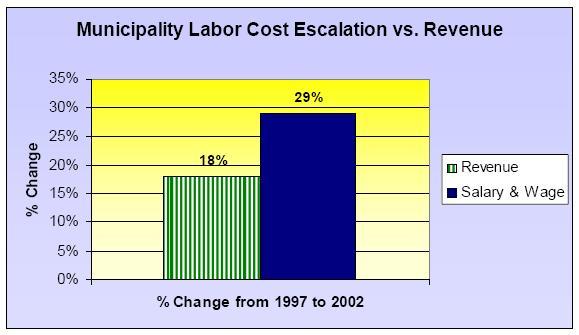
Figure 1: Finances of Municipal and Township Government 2002 (Data from US Census Bureau)
As shown in the Figure 1, data from the prior two U.S. census’ for municipalities nationally shows that labor costs (salary and wages) have increased 29%, while the revenues have increased only 18%.
Time and attendance systems have been viewed as a relatively low priority by many small organizations. However, many are now coming to realize there can be a substantial bottom-line value to the implementation of effective time and attendance management. A modern time attendance systems can benefit your organization in many ways. One of the major advantage is the reduce costs associated with clerical errors. Studies by the American Payroll Association indicate a higher than expected rate of human error in data manipulation. Eliminating these problems typically yields a positive return on investment in less than five months [4]. Furthermore, it can eliminate “buddy punching” and increase security. One of the mechanism used is by using biometric fingerprint devices which enable to verify employee identity prior to recording a time punch, thus eliminating costly “buddy punching,” potentially saving your organization up to 20% of your payroll costs. With some time attendance systems this positive identification can also be tied to access control devices that limit entry to sensitive areas. This kind of systems has been widely deployed since last 10 years in many municipalities in United States of America [3]. The implementation issues addressed in this system includes:
-
Time approval and reporting. This is viewed through the web based reporting that can be accessed by the users and the managements.
-
Interfaces to other solutions: The proposed time attendance system offer a built-in interface with existing payroll, accounting and/or human resources solutions, eliminating duplicate data entry, reduce clerical errors and processing time.
-
Expandability: Business expansion is the eventual goal of many SMEs. While a low cost, limited-capacity time attendance package might be adequate for organization needs today, they may want to take into account the plans for growth in the future. Migrating from one time attendance system to another can be expensive and time-consuming. An expandable or upgradeable system that can easily grow with their business may prove to be more cost effective in the long run.
-
Flexible input options: Today’s time attendance systems offer a variety of input options, including: punching in and out at stand-alone or networked PCs; swiping proximity, bar code or infrared badges at stand-alone or PC-connected terminals; or using biometric profiles such as fingerprints or hand measurements to verify employee identity and record punches. Some systems depend on a single input method, while others can support a number of options. The input method(s) suitable for organization will depend on the number of employees, the work environment, budget, and employees’ comfort level with technology such as biometric verification. A flexible time attendance system can accommodate a variety of input options, allowing us to choose those method(s) that make sense in our specific situation.
-
Positive employee identification: Many organizations are turning to biometric verification systems to combat costly “buddy punching” and increase the accuracy of their time and attendance data. Even if we don’t have a need for biometric verification now, we may want a system that can accommodate the technology in order to maximize our options in the future.
In this time attendance system development, we have accommodates the benefits and implementation issues discuss above in implementing the state-of-the-art computer system. Some organizations that involved in our early deployment are Majlis Perbandaran Kulai (MPKU), Badan Pencegah Rasuah Johor, Perbadanan Islam Johor, Yayasan Pembangunan Keluarga Darul Takzim, Dewan Perniagaan Melayu Negeri Johor etc.
OUR APPROACH
The idea is to develop and produce a flexible Time Attendance System that will be able to integrate with any existing Human Resource Applications or Database. It means the said system should have its own development kit to assist in building an interface to communicate with other systems.
Another interesting concept is, to have a license free system that will allow users to access from any possible way using easy-to-use tools and generate any possible reports regarding employees’ attendance. These features must be developed by taking into consideration the cost effectiveness and its practicality due to common policies in human resource.
Components of the System
The development of the system has been divided into 4 major components. The components are:
-
Administration Control Panel (ACP)
The Control Panel is where the user registration and access level configuration take place. To minimize the effort and speed up the process during registration, our national ID MyKad reader will be used to extract necessary info especially the IC No. and picture from the card to the system. This approach will totally eliminate the typo errors which always happen during any registration activities. Also by using this panel, system administrator will be able to set the automated Duty Roster for the employees, working hours, holidays, overtimes etc.
-
Terminal Software Interface (TSI)
The Terminal in the system is where the user does the transactions. The terminal could be the Barcode Reader, Smart Card Reader, Fingerprint Sensor etc. In order to identify and to help the system recognize the medium of transactions, a light SDK called Terminal Software Interface is developed. By using TSI, administrators will be able to connect and configure multiple terminal regardless what type of devices the terminal represent.
-
Integration Development Kit (IDK)
Integration process has always been the causes of delay during the implementation of a Time Attendance System. Most of users normally refuse to let the system change the way they work. It goes the same to the type of computer application they always use for the job. This is why the IDK is important. IDK will play its role in assisting the system by ‘translating’ the database into the language understood by the system. Once the communication between the two systems has been accomplished, the system will run smoothly under the existing application platform without giving any hesitation for the user to use it. Normally, the integration process only take place when the customers need the Time Attendance System to automatically transfer the data their Payroll System, Leave Application, Claims System etc.
-
Web Reporting System (WRS)
Most users would prefer to access any computer systems just from the web rather than from a specific work place. This will provide them a more convenient way to do their job regardless wherever they are. That is why the system utilizing PHP 5.1 open source scripting to develop the reporting system. SQL that has a lot to offer as the open source database is the key database for the system [5].
System Features and Functionalities
Web Integrated Time Attendance System comprises the following features:
-
Terminal Devices connected to the servers through Local Area Network (LAN).
-
Terminal Devices outside LAN will be connected to the servers through the Internet connection using Modem.
-
The system supports Multi Terminal with unlimited quantity.
-
User friendly and easy to use Administration Control Panel.
-
Integration Development Kit (IDK) for advanced users to integrate with their existing human resource application.
-
Terminal Software Interface (TSI) as a tool to integrate any terminal devices to the system.
-
Using MyKad for user registrations and user photo extraction
-
Photo display during every transaction and record display.
-
Centralized web based database.
-
Color indicators to represent bad attendance records.
-
Animated colorful graph and charts for the statistics.
-
All reports can be accessed through web.
-
Interactive user customizable interface.
Implementation Setup
Figure 2 below, shows the architecture design of the system. The terminal which can be in terms of any identification devices that have its own or separate controller will be connected directly to the servers using LA N connection.
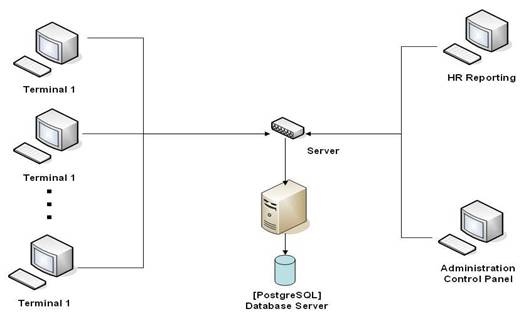
Figure 2: System Architecture
The server will be installed web server components so that it can host a web based applications. Besides web server, the same server also can be the database server to store the transaction records. For institutions that have more than 100 employees, it is advisable to install the database server separately to provide the space for web server to handle the heavy transactions in a maximum performance. Administration Control Panel (ACP) is a software client that can be installed in any PC. Any registrations, configurations or setup done in the control panel will be updated directly to the web servers. Unlike ACP, there is no installation needed to access the reporting system. The report can only be accessed through the web using specific accounts provided by the administrator.
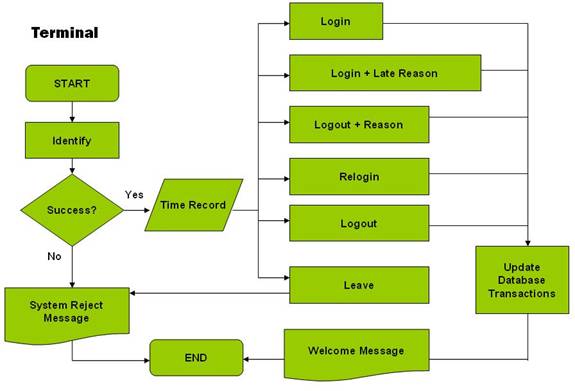
Figure 3: System Flow Chart
Figure 3 shows the process flow of the transactions in a Time Attendance System. It is a typical flow that any similar system should have. The difference here is this particular system is developed in open parameters and made it easier to customize or change any possible process into other than stated above. Some of the changes can also be done by the administrators themselves, giving them greater control of the system.
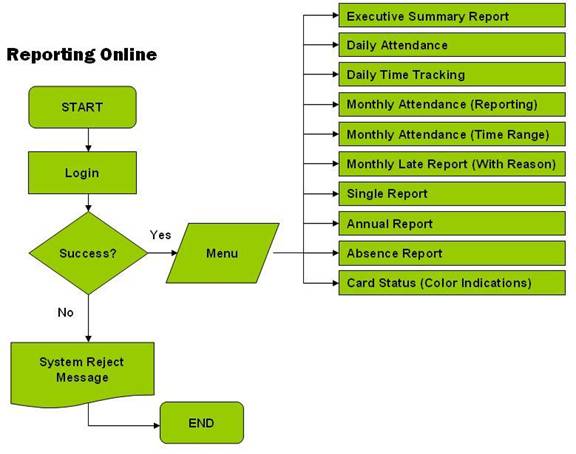
Figure 4: System Report Flow Chart
Figure 4 shows the flow of the process in accessing the Web Reporting System. Animated statistics will be generated when displaying the Single Report and Annual Report. However this is just based on the studies conducted with few Human Resource Officers. The statistics can always be added anytime subject to user requirements.
The animated statistics is a result of the scripts integration by PHP and FLASH components that can be obtained easily from the Internet.

Figure 5: Administration Control Panel Flow Chart
The above Figure 5 shows the process flow in the Administration Control Panel. This control panel must be installed in a system client PC before the administrator can use it. The control panel plays the key role in registering the employees, update their personal record and set their working hours due to the assigned job scopes.
Besides assigning working hours to the group of employees, the system also has the capabilities to let the administrator set up and configure the Duty Roster for certain group of users who work in shift.
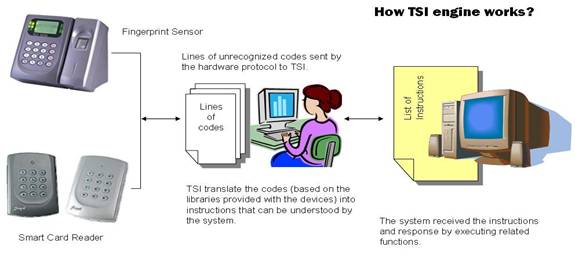
Figure 6: TSI System Flow Chart
During the development of the Terminal Software Interface (TSI), few selected readers from different brands (i.e. smart card reader (AR721HV3, AR727HV3, AR829e), fingerprint reader (AR821EF), MyKad reader (SCR30U), and fingerprint sensor (Digital Pesona URU4000)), has been programmed and tested [6, 7, 8]. As a result, we have finally identified and developed an engine that works as shown in Figure 6.
Terminal devices through the protocol provided will send a data in terms of ‘electrical processor codes’ during transactions. TSI will read the codes by referring them from the predefined library and translate them in computer terms. These terms will then be converted automatically into instructions before the system understood and execute related functions as a response.
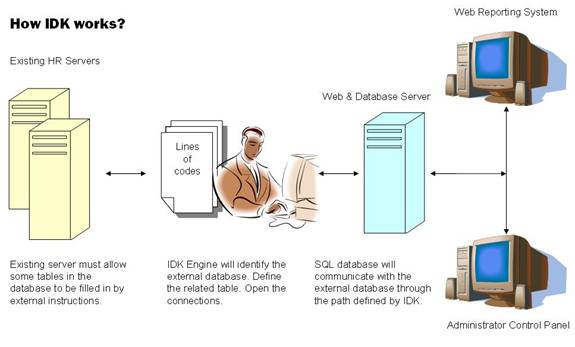
Figure 7: IDK System Flow Chart
Integration Development KIT (IDK) is a set of parameters and sub modules that has been compiled to reduce the scripting process in bridging together two separate platform or language of databases. The purpose is to let the system use the existing database so that the user doesn’t need to use multiple applications in order to process and generate related things. For example, when the user needs to calculate the overtime claims in their own payroll system, they just need to the existing payroll system and calculate the claims based on the record sent by the Time Attendance System. This can be viewed in Figure 7 above.
Even though the background process is complex and involves many subcomponents, it usually took less than a second to complete task. However it also depends on the server performance and LAN connection reliability.
screen shots (to list a few)
Figure 8–13 shows a few screen shot of our Time Attendance System.
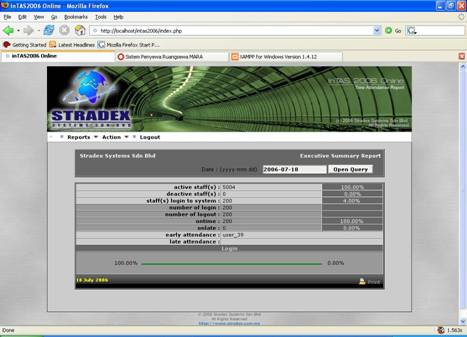
Figure 8: Executive Summary
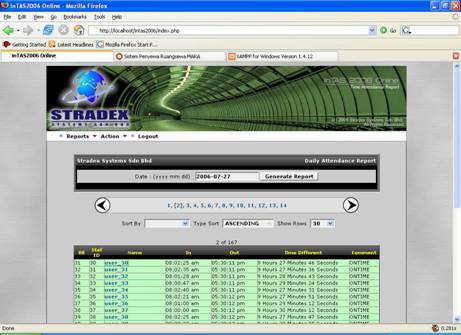
Figure 9: Interactive Interface
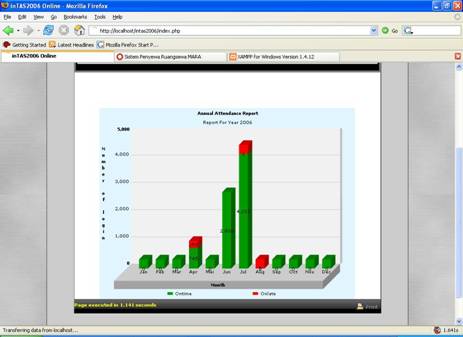
Figure 10: Animated Statistics
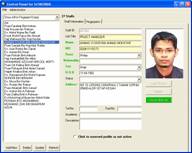
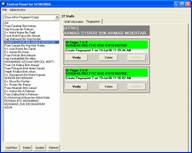
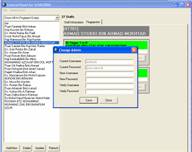
Figure11:Administration
Figure12:Control Figure13:Panel
SOLUTION
COMPARISONS AND DISCUSSION
As mentioned in Section 1.0, the differences between our approached compared to other solution is summarized in Table 1 below.
TABLE 1: Solutions Comparisons
|
Web Integrated Time Attendance System |
Typical Time Attendance System |
|
Reports can be accessed just through the web. Employee tracking has never been easier. |
Reports can only be accessed by the operator or administrator through an installed client PC. |
|
Customizations done by the administrator themselves. No extra cost or effort from the developer. Training on that matter will be provided. |
Customizations done by extra cost and effort from the supplier. Normally more time needed based on requirement complexity. |
|
Work with any type of terminal devices. |
Will only work with specific devices based on the product brands. |
|
Using MyKad to speed up the registration process and photo captures. Reduce typo errors. |
Registration process has to be entered manually to the system. Photo should be taken by Digital Camera. Typo errors in names are common. |
|
Can integrate with any existing HR database as long as being allowed to. |
Stand alone database and may send files in Text or MS Excel for external use. |
|
Affordable solutions. Has been implemented in a Government Primary School and a Book Store in Johor. |
Expensive solutions. There are always hidden costs for small add-ons. |
|
Locally developed by former students of Universiti Teknologi Malaysia |
Most of the solutions came from overseas mostly China, Taiwan and Singapore. |
CONCLUSION
Since the needs for each organization is vary, the challenge in this research is to design and develop an integrated system which can be customizable and interact with different terminal is conducted. An additional advantage of this system in hope will benefited organizations and local authorities in effectively managing their employees, and at the same time will further enhanced their productivity and efficiency. The future works for this system includes, integration with a notification system via short messages system (SMS) and e-mail that will alert the user (employees and management) regarding their absentees and attendance report, and the integration with a leave application through web and etc.