USE OF SCRAP TIRE AS REPLACEMENT IN BACKFILL MATERIALS
ANAS IBRAHIM
MOHD FARID AHMAD
DAMANHURI JAMALLUDIN
Faculty of Civil
Engineering
Universiti Teknologi Mara Pulau Pinang (UiTMKPP)
ABD.
NASER ABD. GHANI
School
of Housing, Building and Planning
Universiti Sains Malaysia (USM)
INTRODUCTION
The total generation of tyres throughout the world is estimated at 1000 million tonnes every year and in European alone generates 180 million per year. The huge amount of tyres generation is actually representing a severe disposal and environmental problems. The European Union (EU) has recognised scrap tyres as a ‘priority waste stream’ requiring special treatment and disposal. Landfill Directive in 1999 has proposes to prohibit the landfilling of whole tyres by 2003 and shredded tyres by 2006. In the United State, landfill areas consist of 45 % of scrap tyres.
The mandatory of recycling legislatives and continuous campaign efforts contribute toward interest in the reuse or recovery of industrial waste as fills for engineering purposes. Reusing industrial waste instead of excavating and hauling natural soils and rocks is obviously beneficial to the aspect of cost and environment if necessary precautions are taken prior to its use. The properties of the waste material should be initially analysed, both originally and in state of mixture with soil for possibilities of better landfill material and soil or groundwater contamination. Examples of industrial by products that are currently being used for geotechnical purpose are foundry sands, paper mill sludge, plastics, fly ash and shredded tire.
The utilization of shredded tyres as lightweight backfill material is not yet popular and not well accepted in Malaysia. However it is indeed effectively used in other countries such as United State and Canada. In Minnesota, the shredded tyres are used to build logging roads in order to overcome the problem of poor soils. When used as road base, shredded tires significantly improve the drainage below the pavement and therefore extend the life of the roadway. Being elastic, shredded tires can also ease the constructions of the road and are beneficial for the roadway loads over unstable soils. Research done by Chein-Jen (1998) show that the soil mixes with less than 30% of shredded tire material would meet the requirement for roadway embankment. Therefore, it will be suitable for the construction of roadway embankment. For example, in 1992, the Virginia Department of Transportation (VDOT) utilized more than 2 millions shredded tire in overpass embankment. The overpass project on State Route 199, near Interstate 64, used a mixture of shredded tires and soil to build 6 m highway embankments (Hughes, 1993).
LABORATORY TEST
All related tests were performed according to British Standard 1377, 1990 to obtain the desire physical and engineering properties of samples. Tests were conducted on the untreated and treated samples to investigate the improvement in term of geotechnical properties.
Physical and Engineering Properties of Residual Soil.
Residual soil is defined as material containing more than 10% particles passing through B.S sieve with dimension of 63μm and frictional angle, Φ of ³ 20º (DTp, 1987). In addition, cohesive frictional soil is also known as material having ³ 52mm dimension, liquid limit of £ 45% and plasticity index of £ 20%. Moisture content of the soil in between 6 and 10% is acceptable, since it facilitates the construction works and structural stability. In United Kingdom, suitable fill materials should have the effective angle of internal friction of cohesionless soil, f/ ³ 25o (Jones 1996).
The parameters that are related with basic physical and engineering characteristic of cohesive soils which is specific gravity, consistency limit, maximum dry density, optimum moisture content, particles size distribution, permeability and shear strength were obtained from the laboratory test. Results of untreated residual soil (plate 1) are summarized as in Table 1 below:
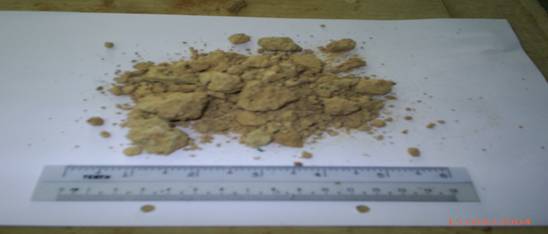
Plate 1: Cohesive frictional soils
TABLE 1: Properties of Cohesive Frictional Soils.
|
Engineering properties |
Cohesive frictional soil |
|
Maximum dry unit weight (kN/m3) |
15.4 |
|
Optimum moisture content (%) |
26.57 |
|
Internal frictional angle (o) |
30 |
|
Liquid limit (%) |
26.05 |
|
Plastic index (%) |
< 4 |
|
Coefficient of permeability (K) (m3/s) |
0.242 x 10⁻⁵ |
|
Specific gravity |
2.64 |
|
Percentage of passing sieve (B.S 63 mm) (%) |
61.00 |
Properties of Shredded waste tires
In this study, shredded tires without wire mesh or steel were used. Tires were shredded to sizes using tire shredder machine. Plate 1 below shows the shredded tires (7 mesh) and figure 3 shows the particle size distribution of tires compared to the Public Work Department (PWD) grading limits of material for replacement of unsuitable material. From the graph of figure 3, the (7 mesh) shredded tires were called uniformly graded materials with the coefficient of uniformity value was 1.90 < 4.0.
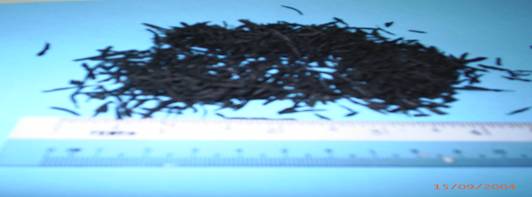
Plate 2: Tyre shred (7 Mesh)

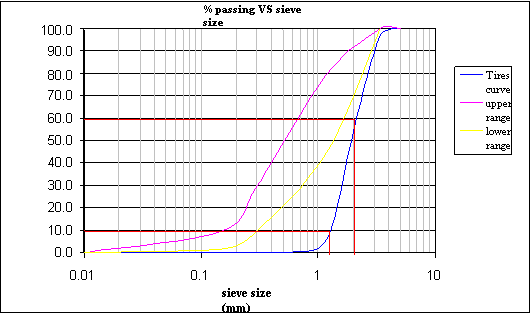
Figure 3: Particle size distribution curve for 100% tire compared with PWD (JKR, 1988) grading limits of material for replacement of unsuitable materials.
Chemical analysis was conducted on the shredded waste tire to investigate the concentration of heavy metals in shredded tyres and the leachates. Leachates are liquids produced by degradation process (anaerobic) and usually contained a very high pollution matters (Vesilind P. A. & Susan M.M, 2004). Tests were done purposely to investigate whether the concentration of heavy metals from shredded tyres exceed the tolerance limit as per Minnesota Pollution Control Agency (MPCA). Samples were analysed using Atomic Absorption Spectrophotometer (AAS). Table 2 below shows the result of chemical analysis on shredded tires. Based on the results from AAS test, plumbum exceed 40% from the tolerance limit, chromium exceeds 37.5%, and zinc exceeds 11772% and the rest of heavy metals substances were below the tolerance limit.
TABLE 2: Heavy metals concentration in shredded waste tires (μg/g).
|
Element |
Shredded tires |
Leachate |
MPCA |
|
Cadmium |
0.0006 ± 0.0001 |
0.0005 ± 0.0002 |
0.13 |
|
Chromium |
0.33 ± 0.12 |
ND |
0.24 |
|
Ferum / Iron |
105 ± 5.75 |
79 ± 10.94 |
500 |
|
Plumbum / Lead |
0.0712 ± 0.0035 |
ND |
0.05 |
|
Zinc |
2790 ± 658 |
0.08 ± 0.01 |
23.5 |
Properties of Soil-Tyre Mixtures
The preliminary tests were conducted to investigate the coefficient of uniformity (Cu) of untreated and treated soil. Coefficient of uniformity indicates the suitability of selected materials to be used as backfill materials. Cu above than three will be considered having well graded materials where less than three is called poorly graded materials (Whitlow, 2004). Results in table 3 show that the soil-tyre mixture (10-90) and total tyre shred having the Cu value less than three.
TABLE 3: Grading characteristics for cohesive frictional soil, Shredded tyre and mixtures
|
Soil sample |
Effective size,
|
Effective size,
|
Uniformity coefficient,
|
|
100% soil |
0.116 |
0.722 |
6.22 |
|
90% soil + 10% tyre |
0.118 |
0.907 |
7.68 |
|
70% soil + 30% tyre |
0.145 |
1.329 |
9.16 |
|
50% soil + 50% tyre |
0.201 |
1.586 |
7.89 |
|
30% soil + 70% tyre |
0.339 |
1.848 |
5.45 |
|
10% soil + 90% tyre |
1.021 |
2.190 |
2.14 |
|
100% tyre |
1.343 |
2.552 |
1.90 |


Engineering properties are very important to enable engineers selecting the best materials according to the specified standard. Laboratory test to investigate maximum dry density and optimum moisture content needed to achieve it is called; proctor test. This test was performed to find the maximum density that can be achieved under compaction effort. Water content plays important rule as lubricant to ease the particle movement during compaction effort. The optimum water content therefore will ensure the compaction success.
Table 4 shows the proctor results obtained from the laboratory. Water contents slightly various with the different percentage of soil-tyre mixtures and the average water content is 15.4 %. Maximum dry density value decreased with the increment of tyre amount. The reduction of dry density values mean the materials become lighter compared to the original materials. In engineering practice, lightweight materials having several benefits especially when the construction is planned on the soft soil area.
TABLE 4: Maximum dry density and optimum moisture content for cohesive frictional soil and shredded tire
|
Soil sample |
Maximum dry density (Mg/m3) |
Optimum moisture content (%) |
|
100% soil |
1.30 |
16.52 |
|
90% soil + 10% tyre |
1.20 |
14.60 |
|
70% soil + 30% tyre |
1.20 |
15.00 |
|
50% soil + 50% tyre |
0.86 |
15.50 |
|
30% soil + 70% tyre |
0.70 |
15.40 |
|
10% soil + 90% tyre |
0.60 |
15.50 |
|
100% tyre |
0.53 |
15.50 |
DISCUSSION
Results from physical and engineering properties show the great potential of shredded scrap tires as replacement materials for backfills. Mixture of 70 % soil + 30 % shredded tires performed better compared to the untreated cohesive frictional soils. Replacement of 30% soils with shredded tires increased the shear strength value of untreated soil from 31o to 38o and the same time reduced the maximum dry density from 1.3 Mg/m3 to 1.2 Mg/m3. Results from sieve analysis also indicate that the mixture was well-graded materials with the Cu value greater than 3. The best mixtures to be considered was 50% soils + 50% shredded tires, where the value of maximum dry density was 0.86 Mg/m3, Cu was 7.9 and value of internal friction angle was 34o. This mixture allows the optimum utilization of shredded waste tires to produce lightweight backfills material without compromising the shear strength value.
Shredded scrap tires have many beneficial engineering properties such as lightweight, strong and durable. Shredded tires normally utilized as fill material for highway construction over soft ground. It’s also improved the drainage below the pavement and therefore should extend the life of the roadway. The shredded tires also elastic and helps the constructions of the road. The lighter materials help in minimizing the foundation requirements, reduce land cutting for mountainous area, reduce settlements and prolong the life of landfill area (A.N.A Ghani et. al, 2002). In the analysis of a retaining wall, mixture of 70% sand and 30% shredded tires contribute in reducing pressure on bearing capacity and total vertical pressure of approximately 29% and 21% respectively Anas et. al (2005). Figure 5 shows the 3 different types of embankment configuration that has been used in road construction.
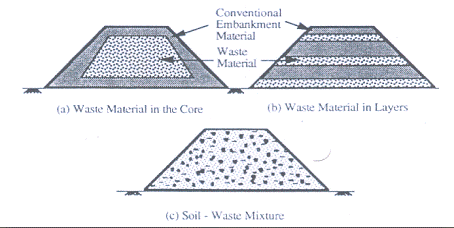
Figure 5: Different Embankment Configurations
CONCLUSION
In conclusion, the utilization of shredded scrap tires as replacement materials aids in decreasing lateral pressure, improving stability and thereby reducing settlement of retaining wall structure, while in the mean time contribute towards better solid waste management.
ACKNOWLEDGEMENT
The authors would like to acknowledge the support provided for the project by the Institute of Research Development and Consultancy (IRDC), University Teknologi MARA, UiTM.