THE STATE OF LOCAL GOVERNMENT FINANCE IN MALAYSIA
KUPPUSAMY
SINGARAVELLOO
Department of Administrative Studies & Politics,
Faculty of Economics & Administration, University of Malaya
[email protected]
MANGALESWARI
SUBRAMANIAM
[email protected]
INTRODUCTION
A local government is often viewed as an institution that provides urban services to its local communities (Kelly, 1999). Apart from the traditional responsibilities, local government exercises great influence over the social and economic well being of local communities as it also plays the role of a local planning agency. Over time, the demands of the local communities for more efficient and equitable services as well as economic and social growth in their areas are on the rise (Mangaleswari, 2006). As someone quotes it “there are limits to the resources of the local authorities[1] but there is no limit to the demands from the public”.[2] In the case of Malaysia, the local government forms the third tier of the government and as such, there are constraints to the capacity of the local government and often local authorities also assume the mediatory role between the different levels of governments and the people.
Many federal and state programmes are implemented by the local government especially through projects funded by the higher levels of the governments. According to Phang (2001), “As a city evolves into the nucleus of the state and nation, local government assumes a pivotal role that cannot be denied by the other spheres of the government”. To a certain extent, local authorities are said to be overburdened with tasks that extend beyond their capacity (Kuppusamy, 2000). Consequently, local authorities in Malaysia have no other options than to strategise plans to improve efficiency and develop action plans that will garner public support and engage community resources (Azmi & Elayne, 2003). As a result, the municipalities find it is almost impossible to pursue an effective approach to manage their urban centres due to weak financial positions and almost inelastic revenue and their sources
Financial strength plays a pivotal role in determining the extent of provision and utilisation of the local infrastructure and public services. Bahl and Linn (1992) say;
"...it would appear that changes in locally raised resources determine the ability of an urban government to expand its services. Where locally raised revenues fare badly, urban government expenditure suffers; where they do well, urban expenditure thrives."
This implies the significant role finance plays in the setting ultimately expenditure patterns of a local authority. A fundamentally strong financial backing allows the authorities to plan ahead more efficiently and effectively than an organisation that is left with little room to spend. Weak finance subsequently affects the extent of deliverables to its communities.
Therefore, it is pertinent to examine the revenue and expenditure structure of the local authorities towards developing and expanding its financial resources. Consequently, this will allow the local authorities to strategise its policies and approaches as well as introduce instruments that will create opportunities for the authorities to improve their revenue generating capacity.
This paper evaluates the financial status of local authorities in Malaysia by looking at the level of financial autonomy; explore revenue and expenditure patterns, the extent of surplus or deficits in current and fiscal accounts as well as examination of arrears in assessment taxes that goes uncollected and amount of fixed savings. This paper takes the premise that local authority finance can be improved in a number of ways. At the same time, the paper does not cover other areas such as cash flows are beyond the scope of this paper. Instead, analysis is focused on a general perspective, and where it permits, analysis by type of local authority or by region is also performed. In a number of occasions, the term local government is utilised loosely by “local authority” or “local council” to mean the same.
FINANCIAL BACKGROUND OF LOCAL AUTHORITIES
Financial Autonomy
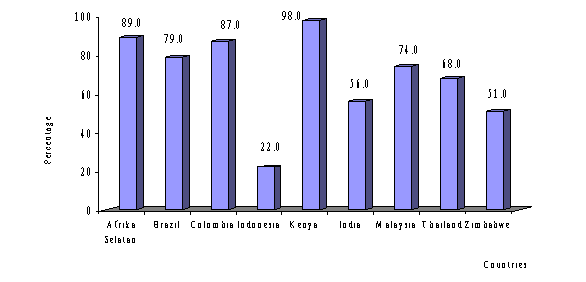
Financial autonomy reflects the capability of government to finance its expenditures from its own revenues (Klugman J., 1994). This criterion enables one to determine the financial strength of local authorities especially to measure their ability to finance its activities using own resources. In other words, the level of financial autonomy of a local authority can be interpreted as the proportion of its total revenue that is contributed by own resources, i.e. is the sum of contributions from taxes and non-tax revenue. Figure 1 depicts the degree of financial autonomy of selected developing countries. The table shows that local authorities in Kenya were the most independent (98%) followed by South Africa (89%) and Cambodia (87%) in term of financial autonomous. Indonesia recorded the least where only 22.0% of its local revenue is considered own revenue. As for Malaysia, it is noted that 73.6% of its local revenue were derived from its own local revenue. This proportion has risen to 76.2% by 2002. Malaysia’s score is almost at par with that of Thailand and Brazil. Even though local authorities in Malaysia can be considered to have a good financial strength, there is still room for improvement to reduce its dependency on external grants from state and federal governments.
Source: Complied from Klugman, J. (1994)
Figure 1: Level of Local Financial Autonomy in Selected Developing Countries (%)
Sources of Revenue
The local government revenue structure invariably reflects the historical background and political factors that influences the local government institution (Norris, 1980). The Ministry of Housing and Local Government (MHLG) has classified the sources of income of local authorities into six groups namely (i) assessment tax; (ii) licenses (iii) rentals (iv) car parking charges, planning fees, compounds, fines, and interest; (v) government grants (inclusive of road grants) and (vi) loans (from higher levels of government or financial institutions).[1]
However, local government revenue in general can be classified into three broad categories. The first is tax revenue (TR), which mainly refers to assessment taxes. The second is with regards to non-tax revenue (NTR) that includes licensing, rentals, car parking, planning and application fees, fines and compounds, and interests. The third category covers grants and contributions from federal and state governments.
The sum of total local government revenue depends heavily on their total population as well the economic activities in the respective council. This is interrelated to the level of development under the council in terms of infrastructure, advancement in commerce and industry as well as real estate. The levels of development in these resources appear to vary from one local authority to another and revenue from taxes is also highly associated to the level of development (such as being a city or municipal council as against district councils) of the local authority area. Likewise, the rates imposed are also higher in larger local authorities than smaller ones. Referring to Philippe Burger (2000) “poor, underdeveloped communities can usually raise little property taxes due to low value of property and the mere absence of business that develop property”. As such, this poses serious implications to smaller local authorities, especially district councils, to derive significant size of revenue from assessment taxes.
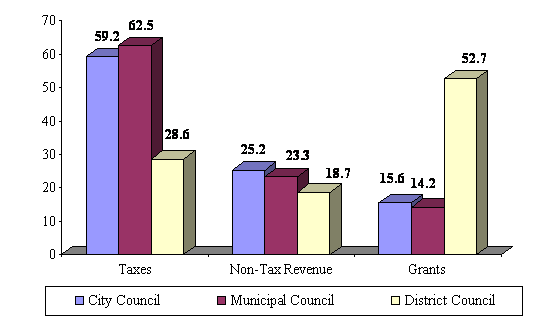
Figure 2 shows local government revenue in Malaysia by type of local authority and category of revenue for the year 2002 based on a study conducted on 53 local authorities across the country. The chart indicates that City Councils and Municipal Councils derived their main revenue from the taxes which constitutes 59.2% and 62.5% of total revenues, respectively. For District Councils, their revenue derived from taxes represents only 52.7% in the year 2002.
Source: Compiled from MHLG (2006).
Figure 2: Local Authority Revenue by Category and Type of Local Authority, 2002 (%)
The contribution of grants for both City and Municipal Councils are about the same at around 15% and for District Councils, this escalates to almost 53%. This is because the amount of the tax revenue depends on the number of taxable holdings. City and Municipal Councils, which has more taxable holdings including residential houses, commercial and industrial buildings, allows the council to collect more revenue from this source compared to District Councils, which has fewer rateable properties. On the other hand, it is noted that smaller local authorities like District Councils are highly dependent on fiscal transfers from federal and state governments to cover overhead and development expenditures. Although the equalisation grants work out to be small, a large proportion of grants take the form of development grants. There is evidence that District Councils receive more development grants than City and Municipal Councils. However, if this situation continues, it is likely to foster a dependency syndrome among District Councils. In the long run, this will discourage local authorities from greater efforts to increase own revenues which would affect the delivery of the services. It must also be noted here that the equalisation grants provided by the federal government still employs 1991 census population figures as compared to a much expanded population in most local authority areas to date. It is likely that a revised rate may be provided by the federal government within a short time. This will help raise the financial strength of local authorities but will result in lowering of the average financial autonomy figure already established so far, as this may enlarge further the third category of revenue.
Expenditure pattern
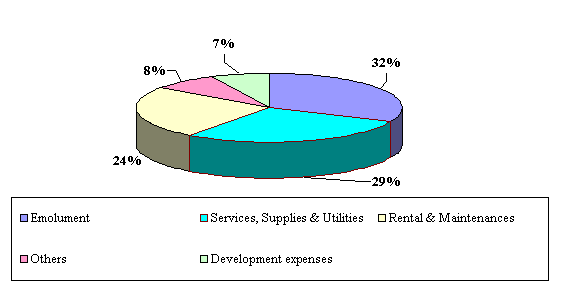
Basically, local government expenditure can be generally classified into two main categories. The first category relates to operating expenditure, which covers emoluments, supplies, rentals, payment in-lieu of services provided, equipment and others. The other category is in regards to development expenditure, which involves heavy capital spending. This includes expenditure on assets such as public facilities and infrastructures and maintenance. Figure 3 depicts the expenditure pattern of the local authorities in Peninsular Malaysia for the year 2002.
Source: Compiled from MHLG (2003).
Figure 3: Expenditure Pattern of Local Authorities in Peninsular Malaysia, 2002
In 2002, about 93% of total expenditure was spent on operating expenses. As such, only 7% from total expenditure is spent on development expenditure. Of the operating expenditure, 32.0% was spent on emolument. In most Municipal and District Councils, emoluments take up a large share of the operating expenditure. The second largest component of operating expenditure goes to services, supplies and utilities which take up 29.0%. This is followed by rental and maintenances, which takes up 24.0%.
On the other hand, Table 1 depicts the breakdown of operating expenditure and development expenditure in 2002 by type of local authority. City Councils allocate less than one quarter of its total expenditure for development. Municipal Councils and District Councils allocate 92.7% and 70.8% of their total expenditure for operating expenses, respectively. Municipal Councils face the problem of low amounts for development because greater attention is given to District Councils while City Councils also serve as capital of the state and are thus able to obtain significant amount of grants for development.
City and Municipal Councils have a huge allocation for operating expenditure to equip the council with sufficient facilities to enhance their performance in relation to the ever increasing demands from their inhabitants.
TABLE 1: Operating & Development Expenditure By Type of Local Authority, 2002 (%)
|
Type of LA |
Expenditure Pattern |
% |
|
City Councils |
Operating |
75.8 |
|
Development |
24.2 |
|
|
Municipal Councils |
Operating |
92.7 |
|
Development |
7.3 |
|
|
District Councils |
Operating |
70.8 |
|
Development |
29.2 |
Source: Compiled from MHLG (2006).
Table 1 also reveals that in the year 2002, District Councils spent 29.2% from their expenditure for development compared with Municipal Councils which allocated only about 7% of their total expenditure for development. One of the reasons which lead this situation is because, District Councils are still undergoing development, and therefore preferences are given for physical development projects to enhance their living environment. Moreover, funds allocated by District Councils for development are mainly derived from fiscal transfers, mostly from the federal government except for local authorities in Sarawak which also receives significant grants from the state government.
Income and Expenditure Management
Hepworth (1984) stated that there are two main features of finance i.e. source of funds and their utilisation, which means income and expenditure. The financial strength can be established by examining its surpluses and deficits in current and fiscal accounts.
Table 2 shows surplus and deficit of current and fiscal accounts for local authorities in Peninsular, Sabah, Sarawak and Malaysia, for the year 2001 and 2002. The table reveals that 79% of the local authorities in Peninsular Malaysia maintained a surplus in their current account respectively in 2002. The figure for Sabah is 83%, while all local authorities in Sarawak recorded a surplus in their current account. Similar observations are seen for the 2001. Over 80% of local authorities in Malaysia maintained a surplus in their current accounts in both 2001 and 2002.
However, if development expenditure taken in account, it is clear that most local authorities faced deficits. In the year 2001, 38% of local authorities in Malaysia faced fiscal deficits and this increased to 45.3% in the year 2002. As for local authorities in Peninsular Malaysia, 42.9% of the councils had fiscal deficits for both years. As for Sarawak, only 23% of its local authorities encountered fiscal deficits in 2001 but this improved for the better in 2002 with only 8% of its council’s recorded fiscal deficits. Meanwhile for Sabah, 42% of its local authorities experienced fiscal deficits in the year 2001 and this worsened to two-thirds in 2002.
TABLE 2: Surplus/Deficit of Current Account and Fiscal Account For the Year 2001 and 2002 (%)
|
State |
|
|
2001 |
2002 |
|
Peninsular |
Current Account
|
Surplus |
75.0 |
78.6 |
|
Deficit |
25.0 |
21.4 |
||
|
Fiscal Account
|
Surplus |
57.1 |
57.1 |
|
|
Deficit |
42.9 |
42.9 |
||
|
Sabah |
Current Account
|
Surplus |
75.0 |
83.3 |
|
Deficit |
25.0 |
16.7 |
||
|
Fiscal Account
|
Surplus |
58.3 |
33.3 |
|
|
Deficit |
41.7 |
66.7 |
||
|
Sarawak |
Current Account
|
Surplus |
100.0 |
100.0 |
|
Deficit |
0.0 |
0.0 |
||
|
Fiscal Account
|
Surplus |
76.9 |
92.3 |
|
|
Deficit |
23.1 |
7.7 |
||
|
Malaysia |
Current Account
|
Surplus |
81.1 |
84.9 |
|
Deficit |
18.9 |
15.1 |
||
|
Fiscal Account
|
Surplus |
62.3 |
54.7 |
|
|
Deficit |
37.7 |
45.3 |
Source: Compiled from MHLG (2006)
On the other hand, Table 3 depicts the total revenue and expenditure pattern for local government in Malaysia for the year 1995-2001. Table 3 shows the gap between total revenue and expenditure from the year 1996 to the year 2001. From the year 1995 to the year 1997, there were generally surpluses in the local authority fiscal accounts. From the year 1995 to 1997, there were significant increases in its surplus from RM 7 million to RM 388 million. However, after the financial crisis in the year 1998, there was a slump in the trend where local government financial position changed. From the year 1998 till 2001, the local authorities generally faced fiscal deficit of almost RM 300 million every year.
TABLE 3: Total Revenue and Expenditure for Local Government in Malaysia for the Year 1995-2001 (RM Million)
|
|
1995 |
1996 |
1997 |
1998 |
1999 |
2000 |
2001 |
|
|
Revenue |
||||||||
|
|
Own Revenue (%) |
79.9 |
76.1 |
77.4 |
77.4 |
78.3 |
82.6 |
82.5 |
|
|
State & Federal Grants (%) |
19.0 |
23.2 |
22.2 |
21.3 |
20.4 |
15.5 |
15.8 |
|
|
Federal Reimbursements (%) |
1.0 |
0.7 |
1.4 |
1.3 |
1.3 |
1.9 |
1.7 |
|
|
Total Revenue (RM mil) |
2,872 |
3,108 |
3,242 |
3,343 |
3,533 |
3,410 |
3,844 |
|
Expenditure |
||||||||
|
|
Operating Expenditure |
73.5 |
73.2 |
73.1 |
61.2 |
67.1 |
66.4 |
68.1 |
|
|
Development Expenditure |
26.5 |
26.8 |
28.9 |
38.8 |
38.8 |
33.6 |
31.9 |
|
Total Expenditure (RM mil) |
2,865 |
2,922 |
2,854 |
3,684 |
3,835 |
3,640 |
4,141 |
|
|
Surplus/Deficit (RM mil) |
7 |
186 |
388 |
-341 |
-300 |
-230 |
-297 |
|
Source: Complied from Malaysian Institute of Economic Research (2003), report on Local Government Finance and Bond Financing in Malaysia by Azmi Setapa and Elayne Yee Siew Lin and Mangaleswari S (2006)
Arrears in Assessment Tax
Figure 4 portrays the level of arrears in assessment taxes that were not collected by Municipal and District Councils in Peninsular Malaysia. In 1998, 19% of the taxes to be collected were defined as arrears but only 41% of these were able to be collected. Similarly, in 2000, 23% were deemed arrears and of these, only 40% were collected. This means that between 1996 and 2000, about 15% - 25% of tax revenue for Municipal Councils and District Councils remained uncollected.
Even though Municipal Councils managed to collect 50 to 60% of its arrears while District Councils were able to collect between 30 and 40% of their arrear, these certainly indicate that there is some form of significant leakage in the financial system. There is as such a need for local authorities to have concerted effort towards reinforcing their capability to achieve ‘zero arrears’ in future. Although it is quite impossible to achieve zero arrears, it fits as a yardstick for local authorities to achieve in future. There is also no clear indication from the state or federal governments as to how much of arrears should be allowable and many local authorities have therefore been complacent on this matter. Many chide that their limited human resources hinders their efforts to achieve zero arrears. There is also evidence where some local authorities understate their expected assessment revenue for the year and therefore what is collected tend to appear high at the end of the year. Meanwhile, there are also local authorities that have achieve almost 100% collection and some achieved more than 100% especially when some new phases of development are surrendered by developers in the year, which increased collection as against what was estimated to be collected in their budget statements.
Fixed Savings
It is a common practice among local authorities to have some fixed savings. For smaller local authorities, fixed savings become an alternative source when there is a setback in the finance. For example, when the Federal Government announces certain amount of bonus for its employees, local authorities follow suit in order to ensure its employees do not feel let down. But in smaller local authorities, it is quite common to note expenditures exceeding revenue and some resort to seek special assistance from higher levels of government, especially the Federal Government. For large local authorities, fixed savings becomes a source of earning from interests that is fed back into the non-tax revenue. There is evidence that a number of “affluent” local authorities have significant amount in fixed savings. There is currently no guideline as to the extent of allowable fixed savings by local authorities. The extent of fixed savings can be seen from Table 4 which indicates the amount that is felt reasonable by local authorities to have.
TABLE 4: Total Acceptable Fixed Savings for Local Government
|
|
City Hall/ City Councils |
Municipal Councils |
District Councils |
|
< RM1 mil. |
- |
- |
22.6 |
|
< RM 5 mil. |
- |
28.6 |
32.3 |
|
< RM 10 mil. |
60.0 |
35.7 |
6.5 |
|
< RM20 mil |
20.0 |
- |
6.5 |
|
< RM 30 mil |
- |
7.1 |
- |
|
No limits |
20.0 |
28.6 |
32.3 |
|
Total |
100.0 |
100.0 |
100.0 |
Source: Compiled from MHLG (2006).
It can be noted that most of the district councils felt RM 5 million or below are the best amount to have. Only one thirds of the district councils felt there should not be any ceiling for fixed savings. About 55% of the municipal councils felt they should have RM10 million or below and about 30% felt that there should not any limits. As many as 80% of the city councils state RM 20 million or below as the ceiling and another 20% felt there should not be any limits to it.
These figures imply a resemblance of actual fixed savings by the local authorities concerned. It also reflects that more affluent local authorities feel higher limits are justifiable as compared to poorer ones which state lower limits.
However, though there may be some justification for the fixed savings, local authorities being government agencies are expected to operate on a balanced budget thereby there should not be excessive surpluses for them to save. Savings are to be transferred back to the communities in the form of services and facilities. However, fixed savings is common even in developed countries although some cities have a determined ceiling. So, one may question as to how much of fixed savings is sufficient. This can be resolved by examining total fixed saving in terms of the number of months of operating expenditure. Most local authorities registered fixed savings equivalent to about 10 months of operating expenditure.
CONCLUSION
The foregoing discussion highlights the state of the local government in the country and there are larger variations between regions and the type of local authorities, although some of these have not been detailed out in this paper. In a nutshell, this paper identifies that financial autonomy of local authorities has increased over time but continual dependency on federal and state grants would potentially lower this figure in the future. The financial autonomy can only be increased if the tax and the non-tax revenues are increased tremendously. However, increasing the taxes has been an uphill task and many local authorities have given up their attempts to increase them after futile efforts to get the state governments to approve them.
Nonetheless, there is room for enlargement of the sources of non-tax revenues. Besides that, this paper also highlights the size of arrears that has potentials to be written-off if they are kept uncollected after a few years. To many local authorities, the leakages are enormous. At the same time, there are significant amount transferred into fixed savings.
RECOMMENDATIONS
It is identified that the poor administrative or enforcement system had resulted in poor monitoring and delay in revenue collection. In the administration of revenue collection, it is time that the local authorities aim for more efficient and effective collection and utilisation of the local resources and to have standard performance goals to ensure the targeted goals are achieved.
Avenue to Improve Revenue in Local Authorities
It is very important that new avenues of generating local revenue be introduced where local authorities shift from old to new paradigms in addressing financial constraints, at least in the Malaysian context. Ideas to improve the fiscal position of local authorities should consider all possible situations i.e. poor as well as rich councils. Furthermore, Dr. Mahathir Mohamad (1995), the former Prime Minister of Malaysia said that:
"Given these rapid changes in the world economy, the public service must be prepared to confront new sets of challenges in the 21st century... Continuous efforts must therefore be made to review… as to be in line with the current needs and times. We need to look into new ways and means to improve and enhance the capability of our public service"
This implies that, there is room for improvement for local authorities to take the right steps to design approaches to generate new revenue sources as well as to introduce instruments that will create opportunities to improve their revenue generating capacity. Hence, it is imperative that new revenue generation approaches are identified to assist local authorities to reduce their financial burden as well as to cater for the rapid urbanisation and to meet the demands of the populace.
Training
Local authorities can espouse to cope and manage their urban centres with limited financial resources by implementing strategies to administer its revenue (Hammad, 1991). One of the approaches that a local authority can embark in order to have a good accounting system is by providing fiscal management training to their personnel. The training courses should be designed to equip the personnel with planning and decision making skills, tools to handle problem, cost recovery, cost benefit analysis, costing, financial management and book-keeping.
Appropriate Financial Management
Appropriate management techniques to financial administration contributes significant in local authorities, as it will help increase the capability of the council as well as to improve the effort taken to reinforce their finances. Conversely, poor fiscal administration may be caused by low standards of reporting, poor monitoring and revenue collection. Therefore, a good training section may guide local authorities to have an effective financial administration and record keeping. An appropriate reporting system can help the local authority to monitor and compare the actual cost against the total revenue through out the year (Phang, 1997).
Consequently, by having a sound financial administration system, the local authorities can identify problems or difficulties encountered and help reduce wastage as well as prioritize their spending. This can indirectly help the local authority in planning as to ensure that the local revenue is spent wisely. These help to guide local authorities to be more prudent in its expenditures.
Assessment tax is one of the most essential sources of revenue to a local authority, where the authorities utilise it to provide a range of services. Hence, assessment rate should be revaluated according to the market value of the property over a certain period. This is important to ensure the tax burden is fairly distributed among all property owners as it reflects the values of the property (Hazman Shah Abdullah, 1992). Furthermore, there is also provision in the Local Government Act 171, which allows local authorities to revaluate their assessment rates at least once in five years. The Local Government Act 171, Section 137 states that:
“A new Valuation List which shall contain the same particulars … shall be prepared and completed once every five years or within such extended period as the State Authority may determine”.
However, many local authorities fail to get the approval from the state governments to impose the proposed new rates after some costly revaluation exercise were carried out. For many of the local authorities, this activity proved futile and at the same time, it depleted existing financial resources. There is as such a need for a review of the Act 171 to adopt automatically a revaluation exercise of the assessments after the second attempt. Instead of resting the decision-making power with the state government, the decision-making power can be rested with the councillors of the local authority. However, this may take some time to amend the Act once the federal government accepts this proposal.
Expand Non-Tax Revenue
Local authorities also must expand the contribution of non-tax revenue source e.g. all local authorities should the have power to review charges for service or facility provided. Moreover, the councils should identify areas to develop the small businesses by providing appropriate buildings, planning, licensing and permits as well as organising other agencies like MARA to provide soft loans. Consequently, all these can assist the local authorities in increasing their fees as well as charges from rentals. Furthermore, economic activities during festival seasons should also be encouraged. It would also be highly effective if local authorities draw strategies to derive a larger share from non-tax revenue by identifying and implementing specific activities that will increase the revenue from the NTR category.
Address Financial Leakages and Limit Fixed Savings
There is a dire need for the Ministry of Housing and Local Government and relevant ministries in Sabah and Sarawak to determine the reasonable percentage of arrears for each local authority, and this should be reduced further in the long run. Similarly, it is highly necessary that the higher authorities determine the size of fixed savings in terms of the number of months of operating expenditure. City councils may be allowed more months of such savings as compared with smaller councils.
Good Governance
Transparency and accountability forms the most significant principles that becomes the basis of good governance. Transparency enables the local community to access reliable information on decision and performance. For example, the extent of dissemination of information on the councils budgetary planning and financial administration to the local community enables stakeholders to measure the performance of their local authorities. Therefore, it helps the council and other relevant parties to understand how revenue is generated and how it is spent.
Accountability on the other hand, helps the local council to design a reporting mechanism on the decision-making process of the council as well as disseminate information about usage of public resources and be answerable if they failed to meet the targeted objectives. Therefore, both principles are fundamental for a local authority to achieve effective, efficient and equitable management.
Transparency and accountability are important especially in handling budget and procurement process, as these two activities are the channels where resources are used, planned and controlled. This move is very important in order to avoid misuse of resources. Therefore, this will ensure that the resources are used efficiently and optimally. One proposal is to ensure that local authorities present their annual budgets and proposed activities including development projects to their community for feedback. The participants can also provide information as to what they prefer to have in their neighbourhood rather than local authority planning something it thinks would benefit the people. By this way, the number of projects that are deemed ‘not welcomed’ by the people can be reduced and expenditures prioritized. This can ensure that accountability and transparencies to the community is enhanced and practised. This mechanism is also inline with the concept of Local Agenda 21 that encourages public participation and fosters a bottom-up approach in decision making.
The Use of Information Communication Technology (ICT)
Advancement in Information Communication Technology (ICT) enables the local government to improve the record keeping system. ICT provides a diverse and infinite set of techniques and mechanisms to create, store, process and present complicated data that are essential in management. Effective computer-based workflow also helps the local authorities to speed up the execution of their work with limited or fewer workforces. This is because through ICT, information can be retrieved easily where it helps to process data quickly as well as reduce desk-to-desk paper movement (Cariah, 2004). This means cost-saving by reducing the number of employees needed to carry out the same task.
ICT further enhances the local authorities’ efforts to develop new techniques to collect assessment by using good databases on actual and potential taxpayers, develop effective accounting system and design program to track details about uncollected old assessment tax (Kardar, 2003). Consequently, this method can act as a tool for local authorities to reduce their high uncollected assessment rate. An interesting application of ICT in similar field can be seen in the Licensing Department of the City Hall of Kuala Lumpur where the processing and file movement is traced on the computer and at any given time, the head of department (HOD) is able to identify employees who have caused delays along the way. The ICT system allows certain time period agreed upon as per the client charter for every employee who will be warned by the system if he/she exceeds the given time. As such, the employees have shown to be on their toes to ensure their performance is up to mark. The HOD can also check the performance of each employee on a daily, weekly, monthly or annual basis. In fact, the department is able to monitor performance at any time it deems fit. Similar approaches can be emulated for financial administration in all local authorities.
Political Will
Political will is certainly necessary to gradually instil determination for the local authorities to introduce new solutions to achieve fiscal balance and to address other financial issues. Political will is very important for the council to grip and explore new fiscal opportunities. The Federal Constitution states that no new taxes can be introduced except by or under the authority of the federal law. This disallows for introduction of new taxes for local authorities but there is avenue to introduce new or revision of charges that fall under the non-tax revenue categories.
Any adjustments in the assessment rate or increment in service charge requires strong political will and support from local councillors and state government to ensure effective implementation of policies. Therefore, strong political will is important to generate effective policies, strengthen and reinforce the ‘will’ to implement those policies (Mangleswari.S, 2006).