|
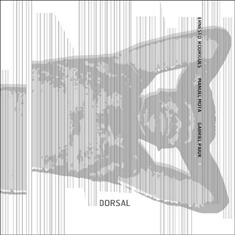
«Dorsal»
marca o regresso a este catálogo do pianista argentino Gabriel
Paiuk e do guitarrista Manuel Mota, desta vez em contexto intimista
e que expõe muito mais as suas respectivas qualidades, com um
Rodrigues mais comedido do que nunca, verificando-se mesmo a sua intenção
de apenas “sustentar” o trabalho dos seus parceiros. E que
trabalho: Paiuk é, nestas faixas, um exímio colorador,
desta feita muito preocupado com a dimensão tímbrica das
suas realizações, e poucas vezes Mota se terá entrosado
tão bem num colectivo, ele que é um músico tão
cheio de idiosincrasias, justificativas, aliás, do percurso a
solo que tem desenvolvido ou das situações em que a presença
de outr(o) instrumentista(s) (regra geral a contrabaixista Margarida
Garcia) é apenas de acompanhamento. E quanto a Ernesto Rodrigues,
observe-se como a sua viola respira lá no fundo, quase como se
fosse um instrumento de sopro, envolvendo no seu bafo todos os demais
sons, mas isto em pequeno, obrigando-nos a apurar o ouvido...
Rui Eduardo Paes (JL)
Nemmeno una probabile
fiacca, dovuta al caldo soffocante di questi giorni, è riuscita
a frenare il Portogallo e la propria scena indipendente, tra le più
attive musicalmente al momento in Europa. Discorso non solo concerne
al jet set dei musicisti, ma anche allargato agli ambiti produttivi,
con etichette sempre più emergenti nel panorama internazionale.
La Creative Sources, poi, nel corso di un modesto lasso di tempo ha
subito una notevole crescita (produttiva e qualitativa), acquisendo
un sicuro posto di riguardo da parte degli aficionados delle musiche
di ricerca.
“Dorsal” presenta un trio intarsiato da manierismi piuttosto
classici. Il termine non è un eufemismo se si osserva la totale
attinenza, mostrata da entrambi i componenti, al mantenimento di un
suono acustico da parte degli strumenti. Manuel Mota, Ernesto Rodrigues
e Gabriel Paiuk si lasciano corteggiare da un'infinità di pulviscoli
sospesi nell'universo musicale e se volessimo tentare d'inquadrare il
tutto sotto un'ottica più precisa, potremmo delineare due linee
parallele tracciate da (impalpabili) sapori jazz(y) e scampoli di musica
contemporanea. Sei attimi dove una viola, contorta e tirata, le miniature
introverse di una chitarra e certe bizzarrie di un piano (preparato)
indagano i diversi stati fisici / psichici del corpo umano, rendendone,
così, una visione personale.
[...] Tre lavori che nascondono il sapore del ‘già detto’:
questo il pensiero che balena alla mente, dopo essersi voltati ad osservare
tonnellate di lavori simili accatastati sullo scaffale, ma importanti
per l'etichetta, curata con passione da Ernesto Rodrigues. La possibilità
di aprirsi, come in questo caso, a produzioni estranee al circuito iberico
è di rilievo per un paese che, a differenza di molti, non vivendo
di particolare benessere nutre una certa indifferenza nei confronti
della propria comunità artistica.
Sergio Eletto (Sands-Zine)
Over the last several
years, the young Portuguese label Creative Sources has become one of
the most intriguing out there, occupying a spot on the improvisational
music spectrum similar to that of Rossbin and Potlatch. Initially focused
on the Iberian scene in particular, head honcho Ernesto Rodrigues –
who is a marvelous improvising violist and is featured on many Creative
Sources releases – has shifted away from geographic specificity
and is now attuned simply to subtle but tough improvisations which test
instrumental conventions and lean gently into the bathing pool of electroacoustic
music.
On this fine disc, Rodrigues meets up with the enigmatic guitarist Manuel
Mota and pianist Gabriel Paiuk for a very arch set of chamber improvisations.
Paiuk is the new name to me and his playing is seriously restrained
– as is that of his partners – poised somewhere between
the unpredictable harmonic commentary of Agusti Fernandez and the sparseness
of John Tilbury: Paiuk’s punctuation of Rodrigues’ languorous,
laminal statements. Mota, who favors a cryptic, almost hermetic style
of guitar playing – clean tone, clipped lines, with occasional
bursts of static from a brutalized input jack or pickup toggle –
is the disruptive element here, harshly derailing the whisper-soft bowing
or ringing piano chord here and there.
Though the trio language is fine and compelling, it’s Rodrigues
who inevitably catches my attention. He is so good here, using extended
techniques as creatively as violist Charlotte Hug and, though his phrasing
is completely different, Mat Maneri. He effortlessly combines dirty,
grainy sounds with sweeping drone-like washes.
At times, their interlocked playing recalls the excellent new music
group the Abel/Steinberg/Winant Trio (when the tones become drones,
I can’t help but think of that group’s marvelous reading
of Alvin Curran’s “Schtyx”). They excel at huge, resounding
blocks of sound whose tonality fluctuates ever so slightly, creating
a hypnotic, almost psychedelic effect. Elsewhere, Mota sounds like a
chorus of ringing bells – not too far off from some of Taku Sugimoto’s
playing, once upon a time – with Rodrigues and Paiuk at their
most percussive in contrast. And if the more staccato or pizzicato passages
occasionally seem a bit tentative, that’s not much of a knock
on this empathetic trio. Another fine release from one of the improv
labels to watch.
Jason Bivins (Dusted
Magazine)
[...] “Dorsal”, with its trio of viola, electric guitar
and piano, is a more open affair, more relaxed with a greater amount
of “air” between instruments, and has greater immediate
charm. Quiet playing with scurrying undertones is the order of the day,
again with more than a nod to past exemplars of the discipline like
Iskra 1903. As with the Schwimmer disc, each track works fairly well
if leaving little lasting impression (perhaps that’s an aspect
of the group’s conception, who knows?) other than having heard
three attentive musicians communicating (perhaps that’s enough!).
An exception is the piece titled “Natural”, where a wispy
continuum is maintained, a tenuous thread of gurgles and brushstrokes
with the occasional plink and plonk that’s mysteriously absorbing,
with a depth that the remaining pieces don’t quite achieve. Would
that this pathway was more intently explored. Mota has a generally lovely
attack, picking up the baton dropped by Sugimoto a couple of years back
and both Rodrigues and Paiuk are pleasingly self-effacing. They appear
to be scratching toward some rewarding areas and if they fall a wee
bit short on this particular journey, I’m certainly interested
to hear what develops. This trio has the decidedly greater upside.
Brian (Bagatellen)
Three honorable representers
of the current free music scene are here subtly linked to a rippling
yet unexploding energy that seems to organize the sound movement all
by itself, with just a minimum intervention by the artists.
"Dorsal" is a pathway walked by three men looking one another
with the eyes of staunch friends, persons needing just a nod to immerse
themselves in thrilling combinations of vibrant acoustic catharsis,
where the resonant
slipstream of a silent thought materializes itself in a percussive chord
or a fluorescent wood crackle. Beauty is also obtained by abnormal use
of less explored parts of the instruments - picking behind the bridge,
hitting near the keys; an illusion of structure is always there, as
to call the notes to their "regular" task. Luckily for us,
those notes have other ideas: their close relationship with silence
is cemented in an unbreakable pact.
Massimo Ricci (Touching
Extremes)
In the second half of the 1990s, the new "reduced" aesthetics
pursued by Radu Malfatti and others threw down a fundamental challenge
to the world of improvised music. Within a few years, a number of the
original explorers of "reductionism" had begun to move beyond
the principles and practices that had initially defined this austere
musical movement. In issue 89 of Musicworks magazine (Summer 2004) the
Berlin-based trombonist Robin Hayward observed that "by 2000 I
was feeling in a cul-de-sac with the much reduced, static music I was
producing" and explained how he subsequently sought to break his
self-imposed rules by, amongst other things, including an element of
narrative structure. More generally, the question of how a viable and
relevant musical improvisation for the start of the 21st century should
be approached in the light of the aesthetics, techniques and insights
of reductionism (and their limits) has arisen not just amongst those
identified (usually by others) as 'reductionists' but also a number
of thoughtful musicians across the improvised music spectrum. To a degree,
each of the three latest releases on Lisbon's industrious Creative Sources
label can be seen as a response to this musical problem.
In the second half of the 1990s, the new "reduced" aesthetics
pursued by Radu Malfatti and others threw down a fundamental challenge
to the world of improvised music. Within a few years, a number of the
original explorers of "reductionism" had begun to move beyond
the principles and practices that had initially defined this austere
musical movement. In issue 89 of Musicworks magazine (Summer 2004) the
Berlin-based trombonist Robin Hayward observed that "by 2000 I
was feeling in a cul-de-sac with the much reduced, static music I was
producing" and explained how he subsequently sought to break his
self-imposed rules by, amongst other things, including an element of
narrative structure. More generally, the question of how a viable and
relevant musical improvisation for the start of the 21st century should
be approached in the light of the aesthetics, techniques and insights
of reductionism (and their limits) has arisen not just amongst those
identified (usually by others) as 'reductionists' but also a number
of thoughtful musicians across the improvised music spectrum. To a degree,
each of the three latest releases on Lisbon's industrious Creative Sources
label can be seen as a response to this musical problem.
For me, the most successful of the new discs is Dorsal. The music is
not as radical as some that has appeared on the label: Ernesto Rodrigues
brings his usual startlingly extended techniques to bear on the violin,
but Gabriel Paiuk's playing inside and outside the piano owes much to
contemporary classical music and Manuel Mota's guitar seems relatively
conventional in comparison with the work of Keith Rowe, Annette Krebs
and other cutting-edge reinventors of the instrument. If music is to
explore beyond the miniscule fraction of the universe of possibilities
regarded as legitimate by the arbitrary presuppositions of conventional
western music, it would seem necessary to adopt much more radical approaches
to sound generation than Mota and Paiuk bring to their respective products
of the bourgeois era. Notwithstanding this, as a collective the trio
succeeds in creating some captivatingly capacious improvisations that
are characterized by responsive and creative collaboration amongst the
musicians. It's not all entirely successful, and Paiuk's occasional
introduction of jazzy touches into his playing drags the music back
towards musical ideologies the group is straining to surpass; but the
best of the trio's work points to some of the improvisational virtues
and spacio-temporal approaches that a radical post-reductionism would
arguably do well to adopt and makes the disc well worth acquiring.
Wayne Spencer (Paris
Transatlantic)
Enquadrando-se na linha estética e conceptual dos seus dois últimos
trabalhos, também estes editados pela Creative Sources, este
novo opus de Ernesto Rodrigues não constitui propriamente uma
surpresa. Com efeito, Rodrigues mantém intactos os predicados
a que já nos havia habituado: uma música desafiante, imprevisível
e complexa. A aversão pela linearidade ou a opção
por soluções menos óbvias continua a ser um dos
vectores dominantes da música de Rodrigues, embora em “Dorsal”
por vezes se definam os contornos de algo mais concreto, como um drone
ou uma pequena figuração de fácil memorização
auditiva.
Dos três músicos desta formação, merece especial
referência o pianista argentino Gabriel Paiuk. E isto pelo trabalho
críptico e preciosista que desenvolve, um pouco ao estilo de
um Steven Lantner, mas mais importante ainda, por desempenhar um papel
de catalisador de situações e de direcções
veiculadas pela entidade colectiva.
Policromas cintilações, edificação de estruturas
efémeras, agregações e desagregações
da matéria sonora – a música destes três artífices
do som é, definitivamente, apenas para aqueles que mantêm
intacta a capacidade de se deixar surpreender...
João Aleluia
(All Jazz)
Since Rodrigues started his Creative Sources label somewhere in the mid-90s he put a very clear stamp on improvised music. Each new record illustrates his specific approach of improvised music and is a further enrichment of his musical world. His improvisations are very much about exploration of sound and texture, always in the context of groupimprovisation. Because of this, unconventional playing techniques in order to create new sounds are a common factor by all musicians involved. Of course they not working on a catalogue of sounds that can be draw from the violin, etc. First of all we have to deal here with delicate improvised music.
The soundworlds created by him and his mates are always more close to the abstractness of electro-acoustic music or John Cage then to improvised jazz music. This is also the case for the CD I want to introduce now.
'Dorsal' is a very fine and successfull recording . Every note fell on the right place here. Rodrigues (viola), Mota (electric guitar) and Paiuk (piano) communicate very much on the same level. All three of them just need one word instead of a whole sentence in order to understand each other. The music is relaxed but also intense and concentrated. It appears sober and subtle but it is also evident that the musicians have a very rich vocabular. Their improvisations have many little surprises. Mota has an unique fingerpicking style of playing the electric guitar. The violin in the hands of Rodrigues sounds very warm and his playing has great depth.
Music must be experienced live in order to be enjoyed at the max, which is with no doubt the case for improvised music. On the other hand, it must be said, that the improvisations on 'Dorsal' surprisingly survived their way onto CD. Very well recorded and a joy to listen to.
Dolf Mulder (Vital Weekly) |
