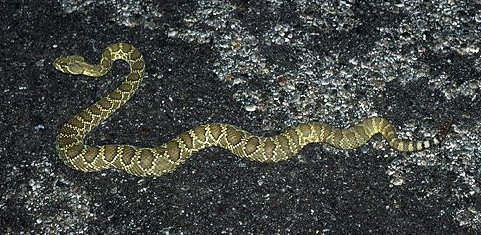
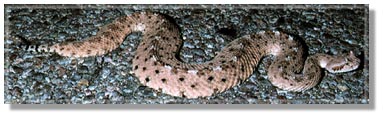
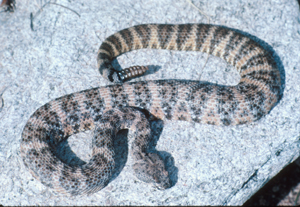
| Identifying rattlesnakes: Tails are not pointed, flat broad, triangular shaped heads. The pupils (black portion) of a rattlesnake's eyes are cat-like or elliptical. Several species of rattlesnakes can be found in Southern Nevada. MOJAVE GREEN: (Crotalus s. Scutulatus) This aggrssive species is 2 - 4 feet in average length. Its venom, which is uses to immobilized its pre and defend itself, contains both nuerotoxins and hemotoxins. Nuerotoxins affect the nervous system and hemotoxins affect the bloodstream. It has a greenish to olive green overal color and has a pattern of distinct diamond-shaped patches along its back. Diamonds normally clearly outlined in white. It is very similar in appearance to the Diamondback, but is greenish-colored, instead of brownish, with narrow tail bands, instead of wide bands. It is most commonly found in rolling-open desert terrain, but also ranges into the mountains. Found around Lake Mead and Red Rock. MOJAVE DESERT SIDEWINDER: (Crutalus.c.Cerastes) Smallest of the rattlesnake species, averaging about 1-2 feet in length, tan in overal color with a series of darker patches along its back. The bottom on their rattle is brown. Also referred to as "horned rattlesnake" because of a horn-like scale found above each eye. Its common habitat is sandy, creosote brush areas. Found around Lake Mead. Early in the spring the Sidewinder may be active during the day, but soon as the weather warms up, it becomes nocturnal. SOUTHWESTERN SPECKLED: (C.m.pyrrhus) This snake is 2-4 feet in average length. The pattern can be vague and varies from hexagonal to hour glass or diamond. Its tail is blunt with dark rings before the rattle. It has a salt-and-pepper overall appearance and may vary in color from tan, to gray, to pink or reddish. It is most commonly found in the foothills and mountains, but may also be found in open desert especially in rocky washes. Found around Vegas, Red Rock. |
 |
 |
 |
| There are a few things to think about when you go out hiking in Southern Nevada. |
 |
 |
|
|
|
|
| Southern Nevada hiking can be an enjoyable adventure that requires a little forethought before you venture out. |
| Hidden dangers: Rattlesnakes When out walking in heavy brush or rocky areas, watch where you step or put your hands! With its camouflage marking a rattlesnake is a hard creature to spot. Be careful when turning over logs, rocks or other large objects. Don't put your hands in places you cannot see, such as cracks, crevices and ledges above your head. Most snakes will give a warning before they bite, although they may strike quickly if they are startled. Some rattlesnakes don't rattle. March to late May and September to October are the most active times of the months for snakes. In the spring and fall when the temperature is warm, you will more likely find snakes out warming in the sun. As the temperature starts to rise in the summer months, they are more likely to be cooling in the shade of a bush or rock outcropping. When the heat gets too hot, they will retreat to the nearest subterranean lair. Snakes are most active in early morning and at dusk. A young rattlesnake is twelve times more toxic than the adult. |
| Snake bite treatment: Approximately 20 percent of all adult rattlesnake bites are "dry" (no venom) The remaining 80 percent range from minimal to lethal injections. Tingling and swelling develop within 5 to 10 minutes with a "wet" bite. A mild injection swell, turn black and blue and may blister. A moderate injection results in swelling that moves up the arm or leg towards the heart with numbness and swelling of the lymph nodes. Severe injection results in large jumps in pulse and breather rates, with profound swelling, blurred vision, headache, lighheadedness, sweating, chills and possibly death. 1.) Remain calm. It is important to keep the pulse rate down. A bite does not mean certain death. 2.) Identify the snake without furthering a chance strike by the snake 3.) The bitten area should be immobilized and placed lower than the heart. 4.) Remove rings, watches and anything else that might reduce circulation if swelling occurs. 5.) Wash the wound and monitor swelling. 6.) Mechanical suction for 30 minutes with a reverse syringe within 5 minutes after bite occurs. 7.) Transport the victim to a doctor, by carrying them, or if victim is stable, by walking very slowly Do Not give painkiller, aspirin, tylenol, or advil Do Not apply ice, or cold water to wound Do Not apply a tourniquet Do Not give alcohol to the victim to drink |
| Click on the flag to return to the menu or use the "Back" button to return |
 |