A Little Information About Euclid
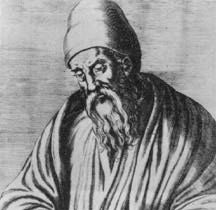
Euclid - (Third Century B.C.)
Euclid was one of the most famous Greek mathematicians and was probably the most successful scientific author who ever lived. His book, the Elements, was a treatise on geometry and the theory of numbers. For well over two thousand years, every student who learned geometry learned it from Euclid's book. And in all that time the Elements served as a model of logical reasoning for everybody.
Nobody knows, today, how much of the geometry in the Elements was original with Euclid. Some of it may have been based on earlier books, and some of the most important ideas in it are supposed to be due to Eudoxus, who lived at the same time. In any case, of the books which have come down to us, the Elements is the first one which presents geometry in an organized, logical fashion, starting with a few simple assumptions and building on them by logical reasoning.
This has been the basic method in mathematics ever since. The remarkable thing is that it was discovered so early and used so well. Logic plays the same part in mathematics that experiments do in physics. In mathematics and physics, one may get an idea one thinks is right. But in physics, one had better go to the laboratory and try it, and in mathematics, one had better think a little further and try to get a proof.
While Euclid's general method is here to stay, his postulates and the theory based on them are no longer widely used. Since the development of algebra, the use of numbers to measure things has become fundamental. This method does not appear in the Elements, because in Euclid's time algebra was almost unknown.
Excerpt courtesy Geometry, by Edwin E. Moise.