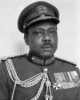
The Former Supreme Commander, Head Of
The Federal Military Government and Nigerian Armed Forces
How Ironsi was killed, …by
his ADC
By PETRUS OBI, Abakaliki Monday, June
28, 2004
• Senator Andrew
Nwankwo
Photo.Sun News
Publishing
Senator Andrew Nwankwo from
the Izzi clan in Abakaliki, EbonyiState, was a captain in the
Nigeria Air Force before the January 1966 coup that made way for Major
General J. T. U Aguiyi Ironsi to emerge as Head of State.
He became Ironsi’s Aide-De-Camp through the recommendation of Brigadier
George Krubo who was then in-charge of the Air Force and subsequently
supervised the late Head of State’s security.
Capt. Andrew Nwankwo (rtd) said he was to die with his boss, but for
fate. He was present when both Ironsi and Fajuyi were shot dead.
Tracking the 61-year-old former ADC down in his one story building
residence in Abakaliki was not as difficult as getting him to recall
the events that led to the death of his master 38 years ago.
He would start by taking you down memory lane when he served as a
courier to late Emperor Haile Selassie of Ethiopia,
"I was manning the octopus-a helicopter that carries 105 artillery gun
and six other machine guns.
"So when Ethiopia
was at war with Somalia
in 1964/65 we formed the defence group of the emperor, we also formed
an attack force. When the emperor is going to the frontline to see what
is happening, we ring him round to clear the way for him".
It was part of these that Ironsi saw and handed over his security to
the young captain. "It was cool working with Ironsi, he understood
everything about what I should do because he had commanded the UN
forces in Congo,
and that exposed him to the type of people he needed". The coup
Recalling the events of that
night, July 29, 1966,
Nwankwo noted that they were in Ibadan,
"we had a small detachment of 106 Artillery, Commanded by one Walbe
from Plateau"
The Head of State had the previous day hosted traditional rulers from
all parts of the country in the Ibadan Government House. "He wasn’t
feeling quite well, he had a knee problem and had to go to bed early.
"Lieutenant Sanni Bello was the army ADC, and we were very close. So,
we left that night to go and look out and came back late. Lt. Adamu who
was the ADC to Fajuyi, Sanni Bello, Walbe and myself, we all slept
together in one room that night".
"At about 4a.m the telephone rang, I picked it up and that was Adeola,
the then commissioner of police, Ibadan he said he wanted to speak with
Ironsi, I said I was the ADC, he said he wanted to speak with him
because there was a coup and he gave me some names Orok and two others
that had been killed in
Abeokuta.
"Immediately, I made a mental
picture of it, and I knew that it was the northerners that were
responsible. So, I handed the phone to Ironsi and they talked. I then
alerted Adamu and Sanni Bello and said look, there is a coup and the
trend is this way.
"Bello assured me that if
it is his own people he will protect me, because, there was tension in
the land such that we knew a coup was imminent. So, we agreed to
protect each other depending on where it will be coming from. I later
discovered that Walbe who was sleeping with us was part of the coup; he
later became ADC to Gowon.
"Around 5:30 we heard
gunfire, then Ironsi had called Col. Njoku to tell him about the coup.
As Njoku was going out, he was short at, but he escaped with bullet
wounds. It was Njoku, who was the commander of Lagos Garrison that
alerted others outside the Government House, Ibadan.
"Fajuyi later sent me outside the government House to find out what was
happening. I met Danjuma, who was then a major and he was my friend. He
pretended he didn’t know what was happening, he was asking me, and I
said I didn’t know. While I was trying to go back, one sergeant from Benue
almost shot me, but Danjuma stopped him and spoke to him in Hausa.
Danjuma later told me that he would like to see Ironsi, so that he
could tell them what to do.
"It was then that Fajuyi came out to find out what was holding me, and
there inside the Government House Danjuma ordered for his arrest and
mine too. That was when I saw Walbe. Then Fajuyi asked me to take him
to Ironsi so that they will obey him, that there should be only one
person in charge. So, I took them to Ironsi, and major Newman,
immediately he saw Ironsi, he seized his crocodile swagger stick, and
then they started asking him about the January coup, he said he didn’t
know about it that he only agreed to be Head of State so that he can
restore confidence and normalcy. It was immediately they arrested
Ironsi that they turned violent". The road to the valley of
death
They marched us down, Ironsi and
myself, to where Fajuyi was. They used telephone cable to tie my hands
behind and my legs, with a little space to walk. Same they did to
Ironsi, but they removed his shirt, he wore only trousers, they also
tied Fajuyi. Ironsi was in a Land Rover, Fajuyi in a mini bus and
myself in another bus. They drove us towards Iwo Road, 10 km from
Ibadan, there was a small forest were they stopped, marched us to the
right hand side of the bush, Fajuyi was leading and as he tried to
cross a small stream, he fell down, the soldiers were unruly, it
appeared some of them had for the first time taken Indian hemp, so when
he fell down some of them started beating him. My escape
As Fajuyi fell down and they were
beating him, Sanni Bello came to me and tapped me and said, we could do
something now. It was providence, may be I was not destined to die. I
took a few steps from them and jumped into a nearby ditch, all in a
split of a second, Bello
came and stood by the ditch and was shouting that I had escaped
pointing at another direction. So the soldiers ran around that
direction shooting into the bush, and when they felt they must have
killed me, they shot Fajuyi and then Ironsi there, by the side of the
stream. So Bello made sure
that he was the last to leave the place.
The ADC, who was later elected senator in 1983 stated that the former
Head of State could have escaped if not that he wanted to make sure
that there was no bloodshed. He said if he sacrificed his life and
prevented bloodshed in Nigeria,
it’s better for him. Even his chaplain urged him to escape but he said
No. Also many of his officers who were contacted instead of taking
action ran away.
The ADC denied the prevailing story that Ironsi was tied to a Land
Rover and dragged along the road. He maintained that he saw Ironsi and
Fajuyi shot dead. "They shot him on the chest and it was a burst, so he
would have died after the first shot". The crocodile staff
It was a swagger stick, which he
made after his name Aguiyi (crocodile). It was in the Congo, when he
was commanding the United Nations Forces, the Indian troops were to
land at the Lumumbashi Airport but the Cameroon gendarmes went and
blocked the place with trucks, so that the Indian soldiers will not
land, so, he used a Land Rover and with the stagger stick waved as they
were shouting, he was eventually able to convince them to remove the
trucks. Many attributed that feat to extraordinary powers in his
swagger stick. But there was nothing in it, it was just a stick. Ironsi
was not fetish; he was a devoted Catholic and attended mass every
morning, even the day he was killed.
Below
is the federal Government of Nigeria acoount of events
In July 1966, then Lt Col. Yakubu Gowon assumed the position of
"Supreme Commander" in the very tense circumstances of a violent
counter-coup in which Ironsi was killed. Gowon remained "Supreme
Commander" until he gave up the title after the Aburi meetings of
January 1967. However, he re-assumed the powers of "Supreme Commander"
when he declared a state of emergency in May 1967 and revoked Decree
#8. His successor as Chief of Staff (Army), Lt. Col. JRI Akahan later
died in a helicopter crash as the civil war broke out in July 1967
EVENTS THAT LED TO HIS RISE TO POWER
In the Nigerian Army's official history of the Civil War, Major General
IBM Haruna (rtd), said: "The dominance of the NPC and the perceived
dominance of the North in the centre were like a threat to the presumed
more enlightened and better educated Southerners who believed they were
the backbone of the movement for Nigerian independence but did not
succeed the colonial power to run the affairs of the state. So with
that background one can now lay the foundation of the perception of the
military struggle in Nigerian politics."
Reflective, therefore, of certain repeatedly articulated viewpoints in
sections of the Press, the opinion matured among a small budding caucus
of already politically inclined officers after independence, that every
military deployment for internal security in aid of the civil authority
whose political orientation they did not share, even if constitutional,
was just another provocation.
These include:
1. 'Operation Banker', a joint Army-Police operation in the Western
region, led by then CO, 4th battalion, Lt. Col. Maimalari, allegedly at
the behest of the pro-NPC regional Premier (Akintola) culminating in
the declaration of a state of emergency in May 1962 after a fracas in
the House of Assembly and the appointment of an administrator.
Interestingly, the General Staff Officer
(2) at the Army HQ in charge of Intelligence was none other than
Captain PPatrick Chukwuma Nzeogwu who, as a Major, was later to play a
key role in the coup of January 1966 in which Maimalari lost his
life.2. The arrest on September 22, 1962 and subsequent imprisonment of
the opposition leader, Chief Awolowo, on suspicion of planning a
civilian overthrow of the government. It was alleged that 300
volunteers were sent to Ghana for 3 weeks militia training. Certain
accounts hypothesize two separate plots, one by Dr. Maja and the other
by Awo himself.
But there is a body of evidence that indicates that Dr. Maja was
actually collaborating with the government. The real plotters planned
to exploit the absence from the country of three out of the five Army
battalions to seize key points in Lagos and arrest leading figures of
the government. The absent battalions were in or on their way to and
from the Congo. One available military detachment at Abeokuta was out
on military training exercises, while the newly formed federal guard in
Lagos was essentially ceremonial.
Thus, there was an internal security vacuum which the plotters intended
to exploit. Court records also indicate that an attempt was made to
recruit Brigadier Adesoji Ademulegun for the scheme but he refused to
cooperate with the plotters, choosing instead to remain loyal to the
traditional military hierarchy and government, which had just promoted
him from Lt. Col. to Brigadier. Whether this later played a role in his
subsequent assassination in January 1966 is unknown.
3. Army Stand-by during the acrimonious reactions to the National
Census of 1962/63 aand 1963/64.
4. Army Stand-by during the Midwest referendum of 1963.
5. Mobilization of the Army to provide essential services during the
General Strike of 1964. Even this apparently innocuous deployment in
support of the civil authority attracted criticism from some of the
would-be plotters of the January 1966 coup.
Captain Nwobosi (rtd), for example, has said that as a young officer
deployed to the railways as an escort, he was troubled by the fact that
the Prime Minister left Lagos for his home town in Bauchi during the
strike, leaving crucial matters of state to assistants in Lagos as well
as the Army which was fully mobilized. I have not been able to
independently verify the validity of this accusation against Balewa,
but it does provide insights into the expectations of soldiers of their
civilian masters when they are drafted by civil authorities to
stabilize the polity.
A perception of lack of a "hands on" approach, even if false, can
undermine authority and the culture of respect.
6. Tiv Crises: As far back as April 1960 and July 1961 the Army had
been placed on standby in Tiv land. This became necessary again in
February 1964. However, on November 18, 1964 the 3rd battalion under
Lt. Col James Pam which was just returning from Tanzania was deployed
in full for internal security operations there. The choice of Pam's
unit was a deft move because he was of middle belt origin and the
battalion had been out of the country training another Army, and thus
insulated from acrimony. The Nigerian Army actually emerged from this
operation with high mmarks because the local people saw Pam's unit as
more neutral than the Mobile Police. Interestingly, Major Anuforo of
the Recce unit at Kaduna was deployed in support of Pam for this
operation. This is the officer who later shot him during the January
1966 coup. Other would-be plotters who served in Tiv land were
Ademoyega and Onwatuegwu.
7. Constitutional crisis of January 1965:
Following the controversial Federal Election of December 1964,
ceremonial President Azikiwe of the NCNC, urged by radical
intelligentsia, refused to invite Prime Minister Balewa of the NPC to
form a government and issued orders mobilizing the Army to enforce his
authority to suspend the government, annul the elections and appoint a
temporary interim administrator to conduct elections. However, the oath
of allegiance of the officer corps was not only to the Commander in
Chief but also to the government of Nigeria.
The Army Act (#26 of 1960) and the Navy Act (#9 of 1960) were also
clear on lines of authority and control.While the Army and Navy were
"under the general authority" of the Defence Minister in matters of
"command, discipline and administration", the authority for operational
use and control was vested in the Council of Ministers and the Prime
Minister. President Azikiwe and the service chiefs were so advised by
the Chief Justice and Attorney General of the Federation.
Thus the Navy Commander, Commodore Wey politely told the President that
the Navy (under him), the Army (under Major General Welby-Everard) and
the Police (under Louis Edet) had decided to refuse his orders. After a
week of cliff hanging tension, in which the military stood aside, a
political compromise was eventually reached and a government of
"national unity" formed under Prime Minister Balewa.
In the US Diplomatic Archives: Nigeria 1964-1968, the situation was
characterized in this manner: "Very complicated African politics, in
which tribes, religions and economics all play a part, are involved in
the situation. The Northern Premier is at odds with the Eastern Premier
in whose region large oil deposits have been discovered. In the heat of
the election campaign, there have been threats of secession by the
east; threats of violence "that would make Congo look like child's
play" from the north.." At the same time, strong rumors of an impending
Army coup purportedly planned for the annual Army Shooting competition
were also heard in political circles. But the status quo held, albeit
temporarily.
8. Army Stand by during the ethnic leadership crisis between Yorubas
and Igbos at the University of Lagos in March 1965.
9. Army Stand-by during the Western regional Election of October 1965
which led to a break down of law and order. Political pressures and
recrimination resulting from this exposure finally cracked the
façade of political neutrality among some officers exposing deep
personal, ethnic, regional and political schisms in the process. To
quote Captain Nwobosi again, "When I was in Abeokuta, my soldiers were
being detailed to go somewhere towards Lagos from Abeokuta to guard
ballot boxes that were not opened. They were not opened but somebody
had already been declared the winner. Everyday, they would go and come
back and in the process, I lost one of my corporals. You know soldiers
are soldiers and sometimes like children, you have your favourite ones
and this was personal."
10. A subsequent alleged plan to bring the situation in the West under
control by the NPC controlled federal government in support of its
regional ally, using the Army as had been done in 1962, allegedly
brought forward the date of the January 15 coup. The coup was organized
by predominantly Eastern officers sympathetic to the UPGA alliance of
political parties that had lost the 1964 federal elections and the
October 1965 regional elections in the West. The majority of casualties
were Northern politicians and senior military officers from the same
alma mater all of whom were deemed to represent the NPC or its
interests. Others were politicians and officers from the western region
viewed as being in alliance with the NPC leadership.
The coup failed to bring the "young turks" who led it to power but it
did result, through a complex and controversial series of events, in
the emergence of a military regime led by General Ironsi.There is a
tragic post-script to the widely held (but false) presumption that the
January 15 coup pre-empted an inevitable military operation to crack
down in the West. This presumption is based on a reported meeting
between key NPC and NNDP political leaders as well as certain senior
military officers said to have occurred in Kaduna on January 14.
===============================================================================
However, the last interview granted to the magazine 'West Africa', by
the late Prime Minister Balewa on January 14, a few hours to his death,
went like this:
Question: Do you see the solution as taking the form of a coalition
government in the West?
Balewa: Yes, it would have to be that ...The Action group has accepted
my mediation, but the NNDP has asked for more time. If I use real force
in the West - and make no mistake about it, I haven't yet - then I
could bring the people to their knees. But I don't want to use force
like that. Force can' t bring peace to people's hearts.
Question: Would you consider the release of Chief Awolowo as part of a
political solution of the West's troubles?
Balewa: I think that might be part of it; yes, obviously we would have
to see."
This interview was not published until January 29, 1966.
=========================================================================
CIVIL-MILITARY INSTITUTIONAL RELATIONSHIPS BEFORE 1966
Until the coup of 1966, civil-military relations after independence
basically followed the classic model. Soldiers were rarely seen in
public in their uniforms unless there was an official event. Barracks
were mostly separated and remote from concentrations of civilian
housing. Political speech making, writing articles in the lay press
without approval, or political campaigns in barracks by or at the
behest of soldiers were not allowed. Furthermore, in part because there
was no significant external threat, but also because of the
predominance of British officers at the top until 1965, the army
command played very little role in security policy making. The major
foreign policy decisions of that era were made by the political class.
Even in its internal security role the Army did not make policy. It
carried them out.
However, the socialization process that made this relationship possible
seemed to be confined to the uppermost echelons of the military where
officers who had spent the longest amount of time working directly with
British officers before independence were to be found. Coincidentally,
certain key officers at these levels shared certain social origins with
key political leaders. Officers at lower and middle rungs of the
ladder, however, did not share many of those attributes because the
transition from decolonization to democratization was rushed, driven by
notions of patriotism.
From October 1st 1960 until May 1st 1965 when he died naturally of an
illness Alhaji Muhammadu Ribadu, the second Vice President of the
Northern Peoples Congress, served as Minister for Defence. From May
1965 until January 1966 his place was taken by Alhaji Inua Wada, also a
member of the NPC. They were both civilians with no prior military
service. Ribadu (also known as "Power of Powers") was a very
influential and highly regarded politician with extensive connections
across the political divide. His sudden death in April 1965 is said by
some to have seriously undermined the reconciliation of the frayed
political relationship between the NPC and the NCNC after the January
1965 crisis which may have prevented the January 1966 coup. Indeed,
active plotting for coup actually began after his death that year.
Ribadu presided over a rapid expansion of the Army and Navy as well as
the creation of the Nigerian Air Force. The establishment of the
Defence Industries Corporation, the Nigerian Defence Academy, a second
Recce Squadron (located at Abeokuta) and two new Artillery batteries
occurred on his watch. He got practically all his budgetary requests
through parliament including approval to spend 19.5 million pounds on
defence from 1962-66 as compared with 5.5 million pounds during the
preceding seven year period. Defence costs as a percentage of Federal
recurrent spending from 1958-1966 ranged from 7.7 to 9.9%. Defence
costs as a percentage of Federal capital spending during the same
period ranged from 1.5 to 12.1%.
Pressure to expand the military did not originate from within the
military. It came from the political class. Resistance to additional
defence spending did not come from the legislature or the public. It
originated in 1962 and 1964 from other Ministers as well as economists
in the Ministry of Finance concerned about failure to meet national
economic targets. Ribadu lost the Chairmanship of the Economic
Committee of the federal cabinet in 1964, a position he had used
skillfully to protect and oversee his defence appropriations. Thus
civilian oversight of military budgeting in the first republic was
total and exclusive. In my opinion, the late Alhaji Muhammadu Ribadu is
probably Nigeria's best Defence Minister since Independence - a point
that belies the tendency these days to think that civilians with no
military experience cannot run the Ministry of Defence.
In addition to Ribadu there were Ministers of State for the Army and
Navy. From February 1960 until August 1961 Dr. Majekodunmi, a
physician, was the Minister of State for the Army. Then Jacob Obande
held the position from August 1961 until December 1962. From January
1963 until January 1966 the position was held by Ibrahim Tako Galadima
- a personality (unlike Ribadu) whose grrasp of military affairs and
protocol was not respected within the military. Mr. M. T. Mbu was
Minister of State for the Navy from 1960 to 1966. Mr. AA Atta was the
permanent secretary from 1960-64 while Alhaji Sule Kolo held the
position from 1964-66. Like the substantive ministers of that era, both
were northerners.
One area in which there was direct political interference from the
political class as a group in military professional policy was in the
question of quotas for Army recruitment, which nevertheless reflected
legislative pressures in a multiethnic society. Such political
pressures to apply the federal character principle have found their way
into subsequent Nigerian constitutions. Other than one or two alleged
cases, politicians generally stayed out of purely military professional
matters. Even when the departing GOC General Welby-Everard, (for a
variety of reasons dating back to events in 1951 and 1961), recommended
either Brigadier Ademulegun or Ogundipe as his successor, the Prime
Minister and the Defence Minister chose to stick with the principle of
seniority and chose Ironsi instead - perhaps mindful of NCNC
sensitivities coming as it did, after the constitutional crisis in
January and around the time of the acrimonious fight over the Vice
Chancellorship of the University of Lagos.
The literature reports that Brigadier Ademulegun lobbied for the
position of GOC through his friend the Sardauna, but it would seem that
the political leadership of the Ministry resisted all such pressures.
Until just before the collapse, therefore, the link between the Army
leadership and the political class was mostly formal and appropriate.
Although informal liaisons existed on the basis of alma mater and other
shared values, these did not rise to the level of the client networks
(such as "IBB Boys" or "Abacha Boys") that came to characterize future
military regimes in the country. Nevertheless, in a country where
ethnic identities were and are often stronger than professional
identities, any perceived coincidences of liaisons with the ethnic,
political and security map of the country were bound to provoke
suspicion among officers who considered themselves outside those
networks.
The final intervention of predominantly eastern junior and middle
ranking military officers resulted from the gradual decline in the
cohesion and legitimacy of civilian institutions, signs of which were
already evident from the time of the December 1959 federal elections
before independence.
Certain long standing colonial military policies, amplified by the
fractious nature of Nigeria's political framework set against Nigeria's
unique history provided a backdrop to contentious civil military
relations after independence. As the role of the independent army
evolved from external missions and its participation in internal
security deepened, political antagonisms toward elements of the
political class were amplified as it found itself making judgments and
allocating values.
Latent societal cleavages began to undermine esprit d'Corps. It was
from among those who enlisted between 1957 (when the FDC took over from
the British Army council and introduced quotas into the rank and file)
and 1961 (when quotas were introduced into the officer corps) that the
deepest schisms appeared, enabled by other political undercurrents in
larger society. As the Roman military writer, Vegetius (De Re
Militari), wrote in 378 B.C.: 'An army raised without proper regard to
the choice of its recruits was never made good by length of time.'
In the final analysis, driven by bitter fights for political control,
lack of unity in the civil class between the coalition partners, NCNC
and NPC, along with disenfranchisement of some stake-holders in the
Action Group (who continued to be loyal to the jailed Chief Awolowo)
played a crucial role in undermining whatever organized resistance
(with or without British help) the political class might have put up to
save democracy when some soldiers came calling in January 1966. Indeed,
military intervention may have been sought by aggrieved elements of the
political class.
As the Police Special Branch report put it: "..sometime during August
1965, a small group of army officers, dissatisfied with political
developments within the federation, began to plot in collaboration with
some civilians, the overthrow of what was then the Government of the
Federation of Nigeria."
Fearful of certain anticipated political decisions which might have
involved the use of the Army to forcefully restore order in the
Akintola-led Western region and cram the results of the controversial
October 1965 election down the throats of voters, the coup was finally
launched on January 15, 1966. But as I have noted previously, the
paradox about this alleged NPC plan to "wallop" the West is that the
late Prime Minister, Tafawa Balewa, in his last interview just before
the coup was actually contemplating a political solution to the impasse
in the Western region, one that might even have involved a coalition
government and the release of Chief Obafemi Awolowo from jail.
At the final meeting just before H-hour in Major Ifeajuna's house in
Lagos, the Police report says "Major Ifeajuna addressed the meeting on
the subject of the deteriorating situation in Western Nigeria to which,
he contended, the politicians had failed to find a solution. He added
that as a result the entire country was heading toward chaos and
disaster". One of the key participants in the coup, Captain Emmanuel
Nwobosi has also recently expressed the opinion that there was
"information" that the NPC dominated Federal Government would declare a
state of emergency in the NCNC dominated Eastern region in coordination
with an agitation for the creation of Rivers state.
In the Army's Official history of the Civil War, Nwobosi said: "Adaka
Boro was stationed in the Rivers area to start off some insurrection
and the East would have been declared an area under a state of
emergency like was done in the West under Dr. Majekodunmi." Nwobosi
also said that this information "is not something you will hear and go
to sleep". Such perceptions - some of which were plainly false-among
officers with sympathies for (or views coincident with) the United
Progressive Grand Alliance, set against the NPC-NCNC-Army
constitutional crisis of January 1965 and the background tensions
inherited at independence, provided fuel for the events of January
1966.
Captain Emmanuel Nwobosi (rtd) who led operations in the West during
the coup, holds the opinion that President Nnamdi Azikiwe was briefed
about the coup plot by Major Emmanuel Ifeajuna in Lagos - but points
out that his own sub-group was not in on Ifeajuna's duplicity. He has
also said that one of the intentions of the plotters was to release
Chief Awolowo from jail - a somewhat strangely coincident plan to what
Prime Minister Balewa was contemplating before he was killed.
In the state of confusion that reigned after the Prime Minister's
abduction on January 15, refusal of the President of the Senate (Nwafor
Orizu, an easterner from the NCNC - who was also acting President) to
accept the appointment by the NPC dominated cabinet of an interim Prime
Minister (Dipcharima, a northerner) closed whatever option remained to
formally invite British Troops in (with or without a pact). With no
constitutional provision for such a move, Orizu and the rump cabinet
chose to "hand over" to the Army Chief, Major Gen Ironsi, (himself an
easterner) allegedly to give him needed authority to put down the coup
attempt which had already collapsed in the south.
It appears from testimony provided by former President Shagari that the
British would likely have responded to an invitation from Acting Prime
Minister Dipcharima in the same way as they did in East Africa two
years earlier. Indeed, other sources claim that a British Battalion was
already on standby. Interestingly, recently declassified American State
department archives also show that American intervention was also
contemplated in Nigerian government circles before the rump cabinet was
advised to "hand over" to General Ironsi to "avoid disaster".
Along with the brutal and regionally asymmetric murders that
accompanied the coup, this fateful decision, which Orizu later defended
as "patriotic", ushered in a very bloody chapter in Nigerian history.
However, surviving officers of the January 15 plot (like Nwobosi and
Ademoyega) seem united in their belief that it was General Ironsi's
'misrule', rather than their unfortunate actions that night, that led
Nigeria to chaos in the months ahead
The coup report was released to very few individuals in Nigeria and
certain foreign governments in early August 1966 - and then leaked. The
remainder of the report which allegedly implicated certain other
persons has apparently never been released widely to this day. It
exists, we are on its trail - and shall publish it on sight.
1. Due to unforeseen circumstance it has not been possible, so far, to
inform the nation fully of events which took place in the Federation on
15th January 66 at Lagos, Ibadan, and Kaduna, events which were
directly responsible for further military action on the 29th July 66.
2. It will be appreciated that events of this nature require prolonged,
painstaking investigation. It is realized that the absence of
legitimate information on this subject has produced a flood of
undesirable rumours and speculation. It is, however, pointed out that
without thorough investigation, the wisdom of any premature releases,
unsupported by fact, was questionable.
3. Investigations have not yet been completed but it is now possible to
put the nation, and the world, in possession of the facts so far
collected. The civilian involvement and influence in the whole affair
is not as far as possible, included in this report.
4. It has been established that sometime during August 1965, a small
group of army officers, dissatisfied with political developments within
the federation, began to plot in collaboration with some civilians, the
overthrow of what was then the Government of the Federation of Nigeria.
The plan which eventually emerged from their deliberations was that on
a date not yet decided at the time, the following action would be taken
by troops from selected units, led by the ringleaders of the plot:
a). The arrest of leading politicians at Lagos, Ibadan, Kaduna, Enugu
and Benin. The plan stipulated that wherever resistance was
encountered, the individuals concerned were to be killed.
b). The occupation of key points such as radio and TV stations,
telephone exchange and other public utilities, police headquarters and
signal installations, by carefully selected troops who were not,
however, to be informed in advance of the true nature of their
operations.
c). The movement of troops and armoured fighting vehicles to Jebba and
Makurdi to hold the Benue and Niger Bridges with a view to preventing
the movement of any troops, opposed to the plotters' aims, to and from
the North.
d). The assassination of all senior army officers known to be in a
position to foil, successfully, the conspirators' efforts to topple the
governments of the federation.
e). The eventual take-over of the machinery of government by the
rebels.
5. Although the original plan stipulated that the action intended by
the plotters should take place, simultaneously, in all the Regional
capitals, no arrangements were made to implement these intentions in
Benin and Enugu.
6. The date on which the plot was to be put into execution was decided
by several factors. These include the return of the Premier of Northern
Nigeria from Mecca and the Commonwealth Prime Ministers' conference
held at Lagos between the 11th and 13th January 66. An additional
factor was the possibility that details of the plotters intentions
might have leaked out, necessitating early implementation of the plot.
In this manner, the night of 14th to 15th January was finally selected.
7. The action which was well planned and conducted like a military
operation was, in its first stages efficiently carried out.
8. Immediately before "H" hour, which has been set for 2am on the 15th
January, a number of junior officers were taken into the confidence of
the ringleaders of the plot. It is known that a number of these were
reluctant to comply with the wishes of the plotters. Confirmed
information indicates that it was made clear to these junior officers
that those who were not with the conspirators would be regarded as
being opposed to them and might suffer death as a consequence.
9. Non commissioned ranks involved in the night's activities at Lagos,
Kaduna and Ibadan, were given no previous information of the true
nature of the action in which they were about to be engaged.
10. The activities of the rebels, commencing at 2am on 15th January 66,
resulted in the deaths of the following personalities:
AT LAGOS
a. Alhaji Sir Abubakar Tafawa Balewa, Prime Minister of the Federation
of Nigeria.
b. Chief F. S. Okotie-Eboh, Finance Minister of the Federation.
c. Brigadier Z. Mai-Malari, Commander of the 2nd Brigade NA
d. Colonel K. Mohammed, Chief of Staff Nigerian Army
e. Lieut-Colonel A. C. Unegbe, Quartermaster General.
f. Lieut-Colonel J.T. Pam, Adjutant General, Nigerian Army
g. Lieut-Colonel A. Largema, Commanding Officer 4th Battalion Ibadan
AT IBADAN
h. S. L. Akintola, Premier of Western Nigeria
AT KADUNA
i. Alhaji Sir Ahmadu Bello, the Sarduana of Sokoto and Premier of
Northern Nigeria
j. Brigadier S. Ademulegun, Commander of the 1st Brigade NA
k. Colonel R. A. Shodeinde, Deputy Commandant, Nigerian Defence Academy
l. Ahmed Dan Musa, Senior Assistant Secretary (Security) to the North
Regional Government
m. Sergeant Duromola Oyegoke of the Nigerian Army
n. The senior wife of Sir Ahmadu Bello
o. The wife of Brigadier Ademulegun
11. In addition to the foregoing, four members of the Nigeria Police,
one junior NCO of the Nigerian Army, and an estimated number of six
civilians lost their lives during the night's events. One major of the
Nigerian Army was accidentally shot and killed at Ibadan on the 17th
January 66, bringing the total loss of life to twenty-seven.
12. Apart from the aforementioned killings, a number of political
leaders and civil servants were arrested by the plotters and detained
in military establishments at Lagos and Kaduna. These included:
a. Sir Kashim Ibrahim - at the time Governor of Northern Nigeria
b. Alhaji Hassan Lemu - Principal Private Secretary to the Premier of
Northern Nigeria.
c. Aba Kadangare Gobara - Assistant Principal Private Secretary to the
Premier of Northern Nigeria.
d. B. A. Fani-Kayode - at the time Deputy Premier of Western Nigeria.
_________________________________
DETAILS OF THE EVENTS ARE AS FOLLOWS:
13. In August 1965, three officers, Major Okafor, Major Ifeajuna and
Captain Oji who were already dissatisfied with political developments
in the Federation and the impact of these developments on the Army,
held series of discussions between them about the matter and set about
the task of searching for other officers who held views similar to
their own and who could, eventually, be trusted to join them in the
enterprise of staging a military coup d'Etat.
14. In September 1965, Major I. H. Chukwuka of Nigerian Army
Headquarters Lagos was persuaded to join the group of conspirators,
followed in October 1965 by Major C. I. Anuforo, also of the Army
headquarters. Major C. K. Nzeogwu was brought in around that time
through the efforts of Major Anuforo, an old friend of both Majors
Nzeogwu and Okafor. Major Nzeogwu in turn secured the support for the
plan of Major A. Ademoyega who had worked with him in the Nigerian Army
Training College Kaduna.
15. By early November the recruiting activities of the group were
completed and an inner circle of conspirators emerged, consisting of
the following officers:
Major CK Nzeogwu
Major A. Ademoyega
Major EA Ifeajuna
Major CI Anuforo
Major IH Chukwuka
Major D. Okafor
Captain O. Oji
Planning for the execution of the plot started in earnest in early
November 1965 at a meeting of the inner circle which took place in
Major Ifeajuna's house in Lagos.
16. The plan which eventually emerged from their deliberations was
broadly as follows:
a. The arrest of VIPs at Kaduna, Ibadan, Lagos, Enugu and Benin. The
plan stipulated wherever resistance to arrest was encountered, the
individuals concerned were to be killed
b. The occupation of vulnerable points such as Radio and TV stations,
telephone exchange, police signals installations, airfields and
civilian administrative establishments, by carefully selected troops
who were not, however, to be informed in advance of the purpose of
their operations.
c. The movement of troops to Jebba and Makurdi to hold the Niger and
Benue bridges against any movement of troops opposed to the plotters'
aims, to and from the North.
d. The killing of all senior army officers who were in a position to
foil successfully the conspirators efforts to topple the
Governments of the Federation and who resided in the areas of
operations.
e. The eventual take-over of the machinery of Government by the Army.
17. Amongst the civilian VIPs scheduled for arrest, the following have
been named:
a. The Prime Minister of the Federation
b. The Federal Finance Minister
c. The Premiers of Northern, Western, Midwestern and Eastern Nigeria.
18. Additional personalities scheduled to be arrested in Lagos were the
following:
a. K. O. Mbadiwe
b. Jaja Wachuku
c. Inua Wada
d. Shehu Shagari
e. T. O. Elias
f. Ayo Rosiji
g. M. A. Majekodunmi
h. Mathew Mbu
i. Richard Akinjide
j. Waziri Ibrahim
19. Other ranking politicians were to be placed in house arrest pending
a decision as to their disposal and eventual fate.
20. Events have shown that other political figures including the Deputy
Premier of Western Nigeria, the Finance Minister and the Governor of
Northern Nigeria were scheduled to be arrested.
21. The conspirators further decided that the following senior army
officers represented a threat to their plans and must be killed during
the first hours of the rebellion:
Brigadier Z. Mai-Malari - Lagos
Brigadier S. Ademulegun - Kaduna
Colonel K. Mohammed - Lagos
Colonel R. A. Shodeinde - Kaduna
Lt. Col. A. Largema - Ibadan
Lt. Col. A. C. Unegbe - Lagos
Lt. Col. J.T. Pam - Lagos
NOTE: Lt. Col. Largema was the CO of 4th Battalion NA stationed at
Ibadan. On 15th January 66, however, this officer was on temporary duty
at Lagos, staying at the Ikoyi Hotel
22. For the actual execution of the plan, three commanders were
nominated, namely:
a. Northern Nigeria Major C.K. Nzeogwu
b. Lagos Area Major E. A. Ifeajuna
c. Western Nigeria Captain E. N. Nwobosi
23. The latter officer was not a member of the inner circle and was not
approached until either the 13th or 14th January 66. He was, however,
well known to the conspirators who were certain that when the time came
he could be relied on to cooperate.
24. The execution of the plan was to take place in three areas only,
i.e. Kaduna, Ibadan and the Lagos area, although many of the
participants believed the insurrection to be nation wide. It is a
matter of established fact that no violent action took place in either
Benin City or Enugu. It has been suggested that these areas were spared
because the plotters found it impossible to recruit reliable
co-conspirators in these regions. None of the officers has indicated
under interrogation that any efforts to recruit collaborators in either
Benin or Enugu were made. Indeed subsequent action of some of the
leading officers indicated collaboration with the then Premier of
Eastern region.
25. For the purposes of this report, the execution of the plan is dealt
with in three main sections, namely Lagos Area, Ibadan and Kaduna. Each
section is divided into incidents, showing the identities of officers
and men involved.
LAGOS AREA:
26. The execution of the plan commenced by the calling of a meeting
late on 14 January 66 of the Lagos members of the inner circle and, for
the first time, of junior officers previously selected to take an
active part. A number of those present had attended a cocktail party
that very evening in the house of Brigadier Mai-Malari in Ikoyi. The
following attended this meeting which was held in the Apapa House of
Major Ifeajuna:
a. Major EA Ifeajuna
b. Major CI Anuforo
c. Major D Okafor
d. Major A. Ademoyega
e. Major IH Chukwuka
f. Captain O Oji
g. Captain GS Adeleke
h. Lt. G. Ezedigbo
i. Lt. BO Oyewole
j. 2/Lt. ES Nweke
k. 2/Lt. BO Ikejiofor
l. 2/Lt. NS Wokocha
m. 2/Lt. Igweze
27. Major Ifeajuna addressed the meeting on the subject of the
deteriorating situation in Western Nigeria to which, he contended, the
politicians had failed to find a solution. He added that as a result
the entire country was heading toward chaos and disaster. He next
acquainted the junior officers with the inner circle's plans and asked
them if they were prepared to assist to put an end to this state of
affairs. Major Ifeajuna claims that all present pledged their support
for his plans with the exception of Captain Adeleke who was, however,
later persuaded to join. It was made clear to these junior officers
that those who were not with the conspirators would be regarded as
being opposed to them and might suffer death as a consequence.
28. When, at the end of the meeting, it was clear that all present were
in support of the rebellion, tasks and targets were issued as follows:
a. Abduction of the Prime Minister and the Federal Finance Minister:
Major Ifeajuna, 2/Lt. B. Oyewole, 2/Lt. Ezedigbo
b. Killing of Colonel Mohammed and Lt. Col. Unegbe: Major CI Anuforo,
2/Lt C. Ngwuluka
c. Killing of Brigadier Mai-Malari: Major D. Okafor, Capt. O. Oji,
2/Lt. C. Igweze
d. Killing of Lt. Col. Pam: Major IH Chukuka, 2/Lt. G. Onyefuru
e. Occupation of the Control Room at FT Police HQ Lion Building: 2/Lt
NS Wokocha
f. Occupation of P & T Telephone Exchange: , Lt. PM Okocha, 2/Lt.
CC Anyafulu
g. Occupation of N.E.T. Building: 2/Lt DS Nweke
But there were apparent last minute change of the plans as will be
shown later in this paper.
29. Troops selected for these various tasks were to be drawn from the
following units (all stationed or accommodated at Apapa and Dodan
barracks, Ikoyi):
a. No. 1 Signal Squadron
b. Camp - HQ 2 Brigade NA
c. Lagos Garrison Organization
d. The Federal Guard Unit
30. The Federal Guard Officers Mess at Ikoyi was named as the rallying
point for all teams on completion of their tasks.
31. All other officers and other ranks to be involved, either
consciously or unconsciously in the operations were called out for
alleged Internal Security operations between midnight and 0100 hours to
allow time for the issue of arms and ammunition and the provision of
the necessary transport. With the exception of other ranks of the
Federal Guard, they were all ordered to report to Headquarters of No. 2
Brigade NA in battle order, with their arms. Ammunition was issued to
them by Lt. Okaka, assisted by Major Ifeajuna, RSM Ogbu of Camp 2 Bde
and others.
32. Officers and men moved off to their various assignments at around
0200 hours as planned.
ABDUCTION AND ASSASSINATION OF SIR ABUBAKAR TAFAWA BALEWA
33. The party charged with the abduction of the Prime Minister (PM)
left HQ 2 Bde at approximately 0200 hours. The following have been
identified as members of that group:
OFFICERS
a. Major EA Ifeajuna (in command)
b. 2/Lt. G. Ezedigbo (Federal Guard Unit)
c. 2/Lt. Oyewole (2 Brigade Transport Company)
NO. 1 SIGNAL SQUADRON
NA 84254 Cpl C. Madumelu
NA 18149591 L/Cpl . O. Achi
NA 18159447 S/Sgt. A. Ogbogara
NA 18150401 Sgt. L. Onyia
NA 500147 Sgt. BS Odunze
NA 18150392 Sgt. F Impete
NA 18150400 Sgt. I Ndukaife
NA 1856 Sgmn. S. Onwuli
NA 18149817 Cpl. P. Okoh
NA 18149084 Cpl. U Eduok
NA 18150345 Cpl. Z. Chukwu
NA 18150206 L/Cpl FI Okonkwo
NA 3775 Sgmn FN Chukwu
NA 18150443 L/Cpl RC Amadi
NA 18159121 WO II J Onyeacha
CAMP - HQ 2 BRIGADE NA
NA 3339 Pte NA Evulobi
NA 18150137 L/Cpl S. Kanu
NA 502724 WO II L. Okoye
NA 124643 WO I (RSM) J. Ogbu
ARMY HEADQUARTERS (LGO)
NA 504299 Sgt. J. Nwakpura
NA503865 Sgt. B. Iberesi
NA 149820 Sgt. E. Okonkwo
NOTE: The above named were not all, of necessity, directly involved in
the abduction of the PM. A number of them operated on the premises of
the Federal Finance Minister, adjacent to the residence of the Prime
Minister
34. The small convoy reached the Onikan roundabout at approximately
0230 hours and halted near the PM's residence. Major Ifeajuna ordered
all troops to leave their vehicles and divided them into three groups
with targets as shown:
PRIME MINISTER
Major EA Ifeajuna - in command
Sgt. B. Iberesi
Sgt. J. Nwakpura
Sgt. BS Odunze
Cpl. P. Okoh
Cpl C. Madumelu
Sgmn FN Chukwu
Sgmn. S. Onwuli
2/Lt. Oyewole
FEDERAL FINANCE MINISTER
2/Lt. G. Ezedigbo - in command
WO I (RSM) J. Ogbu
L/Cpl FI Okonkwo
Cpl. Z. Chukwu
Cpl. U Eduok
Sgt. F Impete
S/Sgt. A. Ogbogara
Sgt. I Ndukaife
WO II L. Okoye
ON GUARD OVER VEHICLES AND APPROACH ROADS
WO II J Onyeacha - in command
L/Cpl RC Amadi
Pte NA Evulobi
L/Cpl S. Kanu
Sgt. E. Okonkwo
35. The latter group was given the task of stopping and turning back
all vehicles approaching Onikan road. There is no record concerning
their instructions as to what action they were to take in the event of
any of the drivers refusing to obey the order to turn back.
36. The Major knocked on the gate and was answered by a policeman who
was on guard inside. The Major identified himself as an Army Officer
whereupon the PC (Police Constable) granted them access. The Major
asked the PC how many men were on guard with him and was told that
there were six. The Major then ordered the PC to show where they could
be found.
The PC agreed whereupon the Major seized his rifle and passed it to one
of his men. The PC then led the group to round up the remaining members
of the Police guard. At the back of the house, ie. at the creek side,
they found a PC armed with a rifle and accompanied by a Police dog. The
Major ordered the PC to surrender his rifle, which he refused to do. He
was then hit in the face by Sgt. Odunze whereupon he capitulated and
surrendered his firearm.
Major Ifeajuna ordered Sgt Odunze and Cpl. Okoh to stand guard over the
PC and his dog with orders to shoot both if they made an attempt to
abscond or raise the alarm. All the other members were disarmed and
taken to the main gate where they remained guarded by Sgt Iberesi and 2
others. They were all informed that they would be shot if they
attempted to escape or raise the alarm.
37. Major Ifeajuna and few of his men then approached the back entrance
to the Prime Minister's residence having secured the police orderly,
and the stewards under arrest, and broke into the lounge and thence to
the Prime Minister's bedroom. A voice from the inside asked who was
there. The Major replied by kicking the door open, entering the room
and pointing his gun at the Prime Minister and thereafter led out the
PM wearing a white robe with white trousers and slippers. The PM was
then led away by Major Ifeajuna along Awolowo Road where Ifeajuna had
parked his car adjacent to the Onikan swimming pool.
ABDUCTION AND ASSASSINATION OF FS OKOTIE EBOH
38. On arrival at the Onikan roundabout, at approximately 0230 hrs on
15 Jan 66, Major Ifeajuna divided his force into three groups as shown
in para 34 of this report. Major Ifeajuna and his group proceeded
towards the PM's residence and 2/Lt Ezedigbo took his men to the
compound of the Finance Minister. When they arrived at the front gate,
they found this locked and were compelled to gain access by jumping
over the wall. Inside they found a number of civilian guards, about 5,
who were armed with bows and arrows. These offered no resistance and
were disarmed and placed under guard. At least one policeman was
encountered in the compound. He too was disarmed and escorted to the
3-Ton truck by RSM J. Ogbu.
39. 2/Lt Ezedigbo then attempted to open the front door but found this
also to be locked. He broke one of the panes of glass in the door with
his SMG but even failed to open the door which he finally broke down by
kicking it with his boot. He then entered accompanied by the following
other ranks:
WO II L Okoye
Sgt. I Ndukaife
Sgt. E. Okonkwo
Cpl. U. Eduok
Sgt. F. Impete
Before entering 2/Lt Ezedigbo ordered his men to walk quietly and to
make no noise, a rather superfluous caution considering the noise which
must have been made when the door was broken open. They mounted the
stairs to the first floor. Having arrived there, the 2/Lt posted one
man on the balcony and 3 on the landing.
40. The officer then shouted twice "Okotie-Eboh", come out". When this
met with no response he entered a bedroom where he found the Minister
dressed only in a loin cloth. He ordered the Minister to precede him
down the stairs, and the Minister was escorted to the 3-Ton lorry.
Rumors that the Minister was beaten and otherwise ill-treated on the
way to the vehicle have been stoutly denied by all who took part in the
operation.
41. Whilst the Finance Minister was being loaded into the 3-Tonner, the
PM was escorted from his house and placed into Major Ifeajuna's car.
2/Lt Ezedigbo joined Ifeajuna whilst the ORs (other ranks) re-entered
their respective vehicles. The convoy then moved off to the Federal
Guard Officers' Mess, stopping en route at a point in Ikoyi where Major
Ifeajuna and 2/Lt. Ezedigbo killed Brig. Mai-Malari. (editors comment:
Maimalari had escaped from the team that had been sent to kill him at
home)
ARREST AND ASSASSINATION OF COLONEL K. MOHAMMED AND LT. COL. A. UNEGBE
42. Meanwhile Major CI Anuforo, assisted by 2/Lt. C. Ngwuluka and the
following other ranks:
NA 173629 WO II B. Okugbe - No. 1 Signal Sqn
NA 18149383 Sgt. J Oparah - No. 1 Signal Sqn
NA 1641 Cpl. C. Egwim - No. 1 Signal Sqn
NA 18149792 Cpl. E. Nwoke - No. 1 Signal Sqn
NA 18150530 L/Cpl. J Nwankpa - No. 1 Signal Sqn
NA 18151259 Pte C. Unegbu - Military Hospital, Yaba
proceeded in the two private cars of Anuforo and Ngwuluka to No. 1,
Park Lane Apapa, the residence of Colonel K. Mohammed. This was then
being guarded by unarmed nursing orderlies of a Field Ambulance
stationed in Apapa.
43. On arrival Major Anuforo ordered all his party to leave the cars,
which had stopped some distance from the house. They then advanced
towards the house led by Major Anuforo. They were challenged by Pte L.
Onyegbule, then on sentry-go. Major Anuforo told the sentry to "shut
up" and to put up his hands. The Major then gave orders that the sentry
and the other 3 members of the guard be banded together in one place in
the custody of Pte. C. Unegbu, who although a member of a medical unit,
was then bearing arms.
44. Major Anuforo then went to the front door of the house and knocked.
It would appear that he received an answer, because he was heard
shouting "You first come out and see who is knocking". With the Major
at this stage was WO II B. Okugbe. When he received no further answer
to his knocking, Anuforo ordered his men to cock their weapons. He then
kicked open the door and entered accompanied by Cpl. E. Nwoke, WO II
Okugbe and Cpl Egwim.
45. The house was searched until the Colonel was found, in night
attire, in his bedroom. The Colonel was forced out of the house by
Major Anuforo and the other ranks who had accompanied him, and put into
Anuforo's car. It is believed that before being put into the car, the
Colonel's wrists were tied with a rifle sling which was still in place
when later, his dead body was discovered along the Abeokuta road.
46. Before leaving, Major Anuforo instructed the Colonel's guard to
return to their unit and not to discuss what they had seen with anyone.
Sgt. J Oparah and Cpl. E. Nwoke could not get into the car of Major
Anuforo because of the presence of the Colonel and were odered to
follow on foot to the house of Lt. Col. Unegbe, situated on Point road,
Apapa, not very far away.
47. On arrival at Lt. Col. Unegbe's house, Major Anuforo entered the
house alone. They heard SMG fire inside the compound and were later
ordered to bring out the dead body of the Lt. Col.
48. Whilst the men were inside collecting Lt. Col. Unegbe's body, Col.
Mohammed was compelled to leave the car by Major Anuforo. The latter
told the Colonel to say his prayers as he was going to be shot. The
Colonel did not plead for mercy or remonstrate in any other manner, but
quietly prayed until he was shot in the back by Major Anuforo, using
his SMG.
49. Colonel Mohammed's corpse was stowed into the boot of Major
Anuforo's car while the body of Lt. Col. Unegbe was placed on the floor
in the back of the car. Anuforo and his men then entered the vehicle
which was driven straight to the Federal Guard Officers' Mess. At the
Mess the two bodies were unloaded on the ground.
This is the Police Report on the official investigation into the coup
of 15 January 1966. It was prepared by Police Special Branch
Interrogators based on interviews with soldiers, other ranks and some
officers who had been arrested after the mutiny.
None of the soldiers and officers involved had come to formal trial in
a court-martial as of the time of the July 29 1966 "counter-coup".
Indeed the fact they were not court-martialed was one of the grievances
listed by those officers who carried out the unfortunate operations of
July 28-August 1, 1966.
The coup report was released to very few individuals in Nigeria and
certain foreign governments in early August 1966 - and then leaked. The
remainder of the report which allegedly implicated certain other
persons has apparently never been released widely to this day. It
exists, we are on its trail - and shall publish it on sight.
ASSASSINATION OF LT. COL PAM
50. Major Chukuka assisted by 2/Lt G Onyefuru and the other ranks
NA 160152 Sgt. NN Ugongene - No. 1 Signal Squadron
NA 18150196 Sgt. H. Okibe - No. 1 Signal Squadron
NA 154544 Sgt. B. Anyanwu - Camp - HQ 2 Bde NA
NA 403298 Sgt. L. Egbukichi - Army HQ (LGO)
NA 18150416 Sgt. P. Iwueke - HQ 2 Bde NA
had by then accomplished the arrest of Lt. Col. JY Pam and was being
guarded inside a landrover in the Mess premises. Majors Chukuka and
Anuforo held a brief discussion after which both Majors entered the
Landrover. The driver was ordered to proceed to Ikoyi.
51. At a point inside Ikoyi the landrover was stopped and both Majors
descended. Major Anuforo ordered Lt. Col. Pam to leave the vehicle,
which he did. Major Anuforo then spoke to him and told him that he was
going to be killed and would do well to say his prayers first. Lt. Col.
Pam pleaded but Major Anuforo remained adamant, stating that he was
carrying out orders. Then without warning Major Anuforo fired a burst
from his SMG into Lt. Col. Pam's body killing him on the spot.
52. Major Anuforo then ordered the NCOs in the landrover to come down
and load the dead body into the vehicle. The men, who were shocked and
frightened by the killing were reluctant to comply with this order and
refused to leave the vehicle until Major Anuforo pointed his SMG at
them and threatened to kill them unless they did as they were told.
They then obeyed and loaded the corpse. The party then drove back to
the Federal Guard Officers Mess where the body was off-loaded and
placed alongside the bodies of Col. Mohammed and Lt. Col. Unegbe.
ASSASSINATION OF BRIG. MAIMALARI
53. The assassination of Brigadier Z. Mai-Malari as originally
conceived in the conspirators Master plan failed.
54. Major DO Okafor and Captain Oji were present at HQ 2 Bde when
troops were being mustered and issued with arms and ammunition. When
these arrangements had been completed these two officers entered Major
Okafor's personal car accompanied by the following ORs from No. 1.
Signal Squadron:
NA 500611 L/Cpl B Okotto
NA 18150074 L/Cpl P Esekwe
55. They drove direct to the Federal Guard Unit in Dodan Barracks,
Ikoyi, where, in the meantime, Lt. Ezedigbo and 2/Lt. Igweze had roused
additional troops and arranged for the issue of arms and ammunition. By
the time the troops were ready for the alleged IS operations, Major
Okafor and Captain Oji had arrived at the barracks and were at the Unit
guardroom. Major Okafor ordered that troops mount into 2 Federal Guard
Landrovers detailed for the operation by Ezedigbo
56. Federal Guard personnel detailed for this operation were the
following:
NA 3785 Sgt. SA Umch
NA 18150997 Sgt. N. Ibundu
NA 18149870 L/Cpl N. Noji
NA 3995 L/Cpl HH Okeke
NA 18149870 L/Cpl P. Nnah
NA 1706 Pte. J. Ogu
NA 18149723 Pte. S. Eke
NA 18141571 Pte. I. Onoja
NA 18148787 Pte. JF Enunehe
NA 18149970 Pte. J Abaye
NA 3695 Pte. CS Dede
NA 18151261 Pte. S. Adekunle
57. The following vehicles were used:
Landrover NA 773 - driven by Pte. I Onoja
Landrover NA 957 - driven by L/Cpl N. Noji
58. The party drove direct to the house of Brigadier Z. Mai-Malari at
11 Thompson Avenue, Ikoyi. This is a corner house and situated at the
point where Brown road runs into Thompson Avenue. On arrival at their
destination, the troops were dismounted and divided into three sections
commanded as shown:
No. 1 Section - Captain Oji
No. 2 Section - 2/Lt C Igweze
No. 3 Section - Sgt. SA Umch (in reserve)
59. The reserve section under Sgt. Umch was ordered to take post in a
dark place opposite the house. The three officers, followed by their
men then entered the compound which was guarded by NCOs and men of the
2 Battalion NA. Major Okafor ordered the Sentry to call the Guard
Commander whom he informed that the situation was bad and that he,
Okafor, had come to take over the guard. He instructed the Guard
Commander to assemble his men and to take them back to his unit. The
Guard Commander, according to some of the ORs interrogated, replied
that he could not obey this order as he had received no instructions to
that effect. Major Okafor and Captain Oji overruled the Guard
Commander's objections and entered the compound
60. Whilst Major Okafor was pre-occupied with the guard the telephone
in the downstairs lounge of the Brigadier's house started to ring. Some
of the men present, including 2/Lt. Igweze, have stated that the
Brigadier came downstairs to answer the telephone. No sooner had he
picked up the receiver than a burst of SMG fire was heard in the
compound. This was Captain Oji firing at a member of the Brigadier's
Guard, a L/Cpl of 2 battalion. The L/Cpl was killed and his body later
placed into Major Okafor's Landrover. At the same time, L/Cpl Paul
Nwekwe of 2 Brigade Signal Troop who was on gaurd in the front of the
main gate to the compound, was hit in the neck by a bullet, thought to
be a richochet.
61. Brigadier Mai-Malari, alerted to the presence of Major Okafor's
force in his compound by Captain Oji's burst of fire dropped the
telephone and, followed by his wife, was observed running into the
boy's quarters. From there he escaped into the road, and it is thought,
tried to make his way to the Federal Guard Barracks.
62. According to the ORs interrogated, Major Okafor flew into a rage
when he discovered that the Brigadier had escaped and bitterly blamed
the men of the Federal Guard for not shooting the Brigadier when they
saw him running towards the boy's quarters. He then ordered all present
that the Brigadier must be shot on sight.
63. Major Okafor then jumped into the landrover driven by L/Cpl Noji.
He informed 2/Lt Igweze that he was going to get "that man" and to
arrange for more troops to come to the Brigadier's House. He drove
around the area for some time but failed to find the Brigadier. By the
time he returned to 11 Thompson Avenue, Major Ademoyega and Captain
Adeleke had arrived there in a landrover driven by L/Cpl D. Omeru.
Major Ademoyega had already informed Captain Oji that the Brigadier had
been killed and that he had seen his body at the Federal Guard. Captain
Oji was overheard telling Okafor that "the Jack had been killed". It is
presumed that by "the Jack" Oji meant the Brigadier. Major Okafor then
informed the troops with him that Brigadier Mai-Malari had been killed
by men from another unit.
64. The time, by then, was nearly 0400 hrs. captain Oji was ordered by
Major Okafor to proceed to 2nd Battalion in Ikeja to check the
situation there. The Captain left in landrover NA 773 accompanied by
Sgt. H. Irundu, L/Cpl H Okeke, Pte. S. Adekunle and Pte. I Onoja.
65. As stated elsewhere in this report, Major Ifeajuna and his convoy,
after the abduction of the PM and the Finance Minister, drove towards
the Federal Guards Officers mess where he made a brief stop and then
proceeded toward Ikoyi Hotel, still with the PM in the car. At a point
in the Golf course, adjacent to a petrol station Brigadier Mai-Malari
was walking towards Dodan Barracks when he saw Major Ifeajuna's car.
The Brigadier recognized his Brigade Major Ifeajuna and shouted and
beckoned him to stop. Then Ifeajuna stopped the car and accompanied by
2/Lt Ezedigbo went towards Brig. Mai-Malari and killed him.
66. After the Brigadier had been killed, his body was loaded into the
3-Tonner and driven to the Federal Guard Officers' Mess.
ASSASSINATION OF LT. COL. LARGEMA
67. Although not initially alloted to Major Ifeajuna as a target for
assassination, Major Ifeajuna proceeded to Ikoyi Hotel to kill Lt. Col.
Largema. On arrival at the hotel Major Ifeajuna told the receptionist
on duty that he had an urgent message for Lt. Col. Largema of Room 115.
The time was between 0330 and 0400. He then asked the hotel
receptionist to supply him with the master key which can open all doors
in the hotel but was told that this was not available. He then ordered
the receptionist to lead him to the room in which Lt. Col. Largema was
staying, warning the receptionist on the way that he would be shot if
he refused to comply with whatever he might be ordered to do.
68. On their arrival on the first floor Major Ifeajuna, accompanied by
2/Lt Ezedigbo instructed the hotel receptionist to knock on the door of
Lt. Col. Largema and to inform him that he was wanted on the telephone.
It should be pointed out here that rooms in this hotel have no
telephones. There are situated in small alcoves in the corridors. In
the case of Room 115, the telephone alcove is only a few paces away.
69. Lt. Col Largema responded and came out dressed in pyjamas and
slightly dazed by sleep. In the meantime the two armed soldiers had
stepped back into the corner near the lifts from where they could not
be observed by Lt. Col. Largema when he came out of his door. The Lt.
Col. then picked up the receiver, which was off the hook. At this
moment both the soldiers near the lift opened fire with their SMG. Lt.
Col. Largema fell down and died.
70. The killers went downstairs and called the third man to come up.
Between the three of them they then carried the dead body down the
stairs and deposited it on the floor. They then called yet another
soldier from the Mercedes car who helped the other three to carry the
body to the car. The whole party then drove off.
71. When Major Ifeajuna and party returned to the Federal Guards
Officers' Mess he learnt that the GOC was in town and was organizing
2nd Battalion NA at Ikeja to attack the rebels. He was then joined by
Major Okafor and they drove off together in Major Ifeajuna's car.
At the Yaba Military Hospital they dropped 2/Lt Ezedigbo who had been
wounded in the encounter with Brigadier Mai-Malari. The time was about
0400 hrs. Major Ifeajuna drove away on to the Abeokuta road. On the way
they stopped and Ifeajuna asked the PM out of the car whence he shot
and killed him. When he and Okafor became certain that the PM was dead
they left the body in the bush at a point beyond Otta on the Lagos to
Abeokuta road. They then opened the boot of the car and dropped the
body of Lt. Col. Largema near that of the PM.
They then drove on to Abeokuta. On the way after Abeokuta two other
soldiers in the car were dropped and told to find their way back to
Lagos whilst Ifeajuna and Okafor proceeded to Enugu. They arrived Enugu
at about 1415 hours and proceeded to the Premier's Lodge where they
held discussion with Dr. MI Okpara, then Premier of Eastern region,
after which they separated and went into hiding. Ifeajuna eventually
escaped to Ghana where he was received by the former President Kwame
Nkrumah who sent him to Winneba to stay with SG Ikoku.
72. At the Federal Guard Officers' Mess the corpses of Brigadier
Mai-Malari, Col. Mohammed, Lt. Col. Pam and Lt. Col. Unegbe were loaded
into a 3-tonner lorry in which was sitting Chief Okotie-Eboh still
alive. The time was then about 0330 hours.
73. By this time Major A. Ademoyega and Major CI Anuforo were present
on the Mess premises. Major Ifeajuna having departed, these two
officers took command of his men and vehicles. They mounted into Major
Anuforo's Peugeot car accompanied by 2/Lt Igweze. Major Ademoyega
entered the landrover.
74. On the instructions of Major Anuforo, the little convoy moved off
with Anuforo leading. They traversed Lagos and went along Abeokuta
road. At a given point, unidentifiable by the men interrogated, Major
Anuforo stopped the convoy and he, 2/Lt Igweze and Major Ademoyega left
their vehicles. They came to the tailboard of the 3-Ton truck and
detailed a number of men to take position in front and to the rear of
the convoy with instructions to stop and turn back all approaching
traffic.
75. Major Anuforo then ordered the four corpses to be unloaded onto the
road. The bodies were then carried into the bush on the left hand side
of the road. Major Anuforo then observed FS Okotie-Eboh still seated in
the truck and asked the question: "Who is that man"?, which leads to
the belief that, until then, Anuforo was unaware of the presence of
Okotie-Eboh in the truck. The Finance Minister replied "I am
Okotie-Eboh".
Major Anuforo then ordered the Minister to step down. The latter
complied, whereupon Major Anuforo informed him that he was going to be
shot. The Minister commenced to plead for his life. This met with
little or no response from Anuforo who is reported as having confined
himself to stating that he was acting under orders. The Minister was
then forced to go into the bush, pushed along by Major Anuforo and
Major Ademoyega and followed by 2/Lt Igweze and Sgt. Ndukaife to the
spot where the bodies of the 4 senior officers had been deposited.
Arriving there, without hesitation, Major Anuforo killed Okotie-Eboh
with a short burst from his SMG.
77. Major Anuforo then returned to the road followed by the others but
leaving 2/Lt Igweze, Cpl. Egwim, L/Cpl Nwankpa and Cpl. Nweke on guard
over the five bodies.
78. The convoy drove off and returned later, accompanied by 3 Ferret
scout cars which had been obtained from 2 reconnaisance Squadron at
Abeokuta. Four spades were brought out from the landrover and used to
dig graves for the burial of the corpses. The graves were dug by Cpl.
C. Egwim, Cpl Z Chukwu, L/Cpl J Nwankpa and private N.A. Evulobi. When
this task had been completed, they all boarded their respective
vehicles and drove off to Lagos.
OCCUPATION OF P & T TELEPHONE EXCHANGE,
N.E.T., AND LION BUILDING
79. These three cases have been treated jointly as they are of lesser
importance and because the officers and men involved left Apapa
together in the same vehicle
80. Although it is probable that the officers concerned in the
occupation of these vulnerable points were fully aware of the purpose
of their activities of that night, they have all denied this. It is
certain that none of the ORs involved received any advance information
on this subject.
P & T AUTOMATIC TELEPHONE EXCHANGE
81. After the distribution of arms and ammunition at HQ 2 Brigade, 2/Lt
PN Okocha and 2/Lt OC Anyafulu were allotted a Landrover and 3 Ors and
instructed to proceed to the P & T Exchange by Major A. Ademoyega
and to wait there until he, Ademoyega, joined them
82. They drove there and, after waiting for a very short time, Major
Ademoyega arrived in another Landrover accompanied by other officers
and men. The Major went straight to the main door and knocked. The door
was opened by one of the employees and Major Ademoyega, 2/Lt Okocha and
2/Lt Anyafulu entered, accompanied by the Ors. The Major sent the
2/Lieutenants upstairs with orders to bring down all the workers from
the Exchange, whilst the 3 soldiers were ordered to guard the three
entrance doors of the building.
83. When all the workers were assembled, Major Ademoyega addressed them
and ordered them not to pass any calls. He reassured them that there
was no danger and advised them not to panic. He told them that he was
leaving the two 2/Lts and the soldiers at the Exchange to ensure that
his orders were obeyed. After speaking to the officer in charge of the
exchange, Major Ademoyega instructed the 2/Lts not to molest any of the
workers leaving instructions that they must not leave there until he,
Ademoyega, returned to collect them.
84. Neither of these officers have admitted that they took any steps to
ensure that the automatic exchange would cease to function. An
automatic exchange does not depend upon any human agency to continue
functioning and it must, therefore, be accepted that one of these
officers interfered with the installation.
85. At 0500 hours 2/Lt Okocha complained that he was unwell and left in
the landrover that had brought them there. 2/Lt Anyafulu and the 3 ORs
remained in the exchange until about 0645 hours. Seeing no sign of
Major Ademoyega, Anyafulu became worried. The workers of the day shift
began to arrive but were prevented from entering by the soldiers. He
then decided to return to his unit. He gave the soldiers some money to
enable them to travel back to Apapa by bus. He too returned to Apapa in
a commercial bus and remained in his office until arrested.
NIGERIAN EXTERNAL TELECOMMUNICATIONS (N.E.T)
86. After the distribution of arms and ammunition at HQ 2 Brigade,
Major A. Ademoyega ordered the following officers and ORs to enter with
him into a landrover driven by L/Cpl Umoru:
Captain GS Adeleke
2/Lt NS Wokocha
2/Lt ES Nweke
NA 18149089 Sgt. E. Ogbu - Army HQ (LGO)
NA 18150419 Cpl. H Nwegu - 1 Signal Squadron
NA 504344 Cpl. B Nwuogu - Army HQ (LGO)
NA 18150320 L/Cpl R Ejimkonye - 1 Signal Squadron
NA 504221 Sgt. F Agonsi - 1 Signal Squadron
NA 18151015 Sgt. F. Eke - 1 Signal Squadron
NA 18150647 Cpl. JC Iroegbulam - 1 Signal Squadron
NA 1810641 Cpl. Esonu - 1 Signal Squadron
NA 18150599 Cpl. D. Oharuzike- 1 Signal Squadron
87. From Apapa the party drove straight to Lion Building where 2/Lt ES
Nweke, Sgt. E Ogbu, Cpl. H Nwegu, Cpl B Nwuogu and L/Cpl B Ejimkonye
left the vehicle and entered the building. Major Ademoyega spoke to the
officer in charge and ordered him to cease receiving or transmitting
all messages. He introduced 2/Lt Nweke as the officer who would see to
it that his orders were obeyed. Major Ademoyega and Capt. Adeleke then
drove away.
88. 2/Lt. Nweke posted his men in strategic positions to prevent anyone
entering or leaving the building and remained inside the building with
L/Cpl Ejimkonye to ensure that no messages were received or
transmitted. The party remained there until 0820 hours when, in the
absence of any further instructions, 2/Lt Nweke and his men traveled to
the Federal Guard Barracks in Ikoyi by taxi. On arrival there they were
arrested.
89. There is no doubt that 2/Lt Nweke was fully aware of the fact that
his occupation of the NET was connected with the rebellion of which he
was informed at the meeting of officers late on 14 Jan 66 in Major
Ifeajuna's house in Apapa.
FEDERAL TERRITORY POLICE HEADQUARTERS,
LION BUILDING, LAGOS
90. As shown in paragraph 85 of this report, Major Ademoyega,
accompanied by 2/Lts Wokocha and Nweke left HQ 2 Brigade at
Approximately 0200 Hours in a landrover driven by LCpl Umoru, which
also contained 9 ORs
91. They arrived at Lion Building around 0220 hours where Major
Ademoyega, 2/Lt Wokocha, Sgt. F Agonsi, Sgt. F. Eke, Cpl Iroegbulam,
Cpl S. Esonu and Cpl. D. Ohazurike left the vehicles and entered the
building. Cpls Ohazurike and Esonu were posted downstairs at the
security desk. Major Ademoyega spoke to the policemen on duty there and
told them that they were engaged on military operations. He ordered
them not to answer the telephone nor transmit any telephone messages.
The two corporals were instructed to ensure that the police obeyed the
Major's orders.
92. Major Ademoyega, 2/Lt Wokocha and the others then proceeded
upstairs to the Police Control Room. Here they found 4 PCs and one WPC
on duty. A SPO, rank not identified was also on duty there. Major
Ademoyega spoke to the police and ordered them not to receive or
transmit any telephone or radio messages. He informed the SPO that they
were engaged in military operations and that the soldiers were there to
protect the Police.
93. At approximately 0320 hours. The GOC, Major General Aguiyi-Ironsi
arrived at Lion Building in a Jaguar car. He entered the lobby holding
a pistol in his hand and asked the two soldiers on duty what they were
doing there. They replied that they did not know why they were there
and that they had been brought by Major Ademoyega. They also told the
GOC that 2/Lt. Wokocha and some others were upstairs. The GOC then
ordered Cpl. Esonu to go up and to bring down the 2/Lt. Esonu complied
but could not find the control room. He came down again and informed
the GOC of his failure.
94. The GOC, after having asked the men to which unit they belonged,
then ordered them to return to their barracks immediately. He added
that he did not know what was happening but that he was turning out 2
Battalion to attack the men then engaged on unlawful operations in
Lagos. After this, the GOC left.
95. Cpl. Ohazurike then ordered Esonu to go upstairs again, accompanied
by a PC, to find 2/Lt Wokocha and to tell him of the visit of the GOC.
Esonu complied and passed the message to 2/Lt Wokocha. The latter then
decided that it would be wisest to comply with the GOC's orders. He
collected all his men and went to the Ministry of Defence where he
succeeded in obtaining transport to take the entire back to Apapa where
they arrived around 0430 hours.
IBADAN - WESTERN NIGERIA
ABDUCTION OF R.A. FANI-KAYODE AND
ASSASSINATION OF S.L. AKINTOLA
96. As has already been demonstrated, Captain E. Nwobosi, OC 2 Field
Battery NNA, was taken into the confidence of the conspirators either
on 13 or 14 Jan 66, whilst he was attending a Brigade Training
Conference at Apapa. During the afternoon of 14 Jan 66, he was given a
set of written instructions by Major Ifeajuna.
It is probable that these instructions included the arrest of the
Premier and Deputy Premier of the West and an order to bring these VIPs
to the Federal Guard Officer's Mess. The instruction also probably
included an order to make arrangements for a 105 mm Howitzer to be
brought to Lagos after the operation. This written instruction has not
been recovered and was probably destroyed by Capt. Nwobosi after his
arrest.
97. Capt. Nwobosi was further instructed by Major Ifeajuna to stand by
his telephone in Abeokuta to await a message giving the all clear and
"H" hour.
98. Capt. Nwobosi returned to Abeokuta, where he arrived around 1800
hrs. Since the battery which he commanded was in the process of being
formed and had not, as yet, been supplied with vehicles, Capt. Nwobosi
went to 2 Recce Squadron, also stationed at Abeokuta, where he spoke to
Capt. Remawa and 2/Lt. Orok.
He gave them a message purporting to have come from Major OBIENU, CO 2
Recce Sqn, instructing these two officers to supply him, Nwobosi, with
one 3-Ton truck and a landrover. Capt. Remawa agreed and arrangements
were made for the vehicles to report to Nwobosi at midnight, with
drivers. Later that evening, Capt. Nwobosi received a telephone call
from Major Ifeajuna giving him the all clear and giving "H" hour as
0200 hours.
100. Around midnight, Capt. Nwobosi, woke up 2/Lt. A. A. O. Egbikor of
his unit and Sgt. T. Ibolegbu, the acting Battery Sergeant Major (BSM).
He ordered the latter to turn out 25 men for IS operations and to tell
the Battery Quartermaster Sergeant (BQMS), Ambrose Chukwu, to prepare
all the Unit's stock of small arms and ammunition for immediate issue
to the men. Although Capt. Nwobosi claims that he gave no intimation to
anyone about the night's operations, the interrogation of the ORs
involved has made it clear that around 1930 hours he instructed certain
key NCOs to stand-by for IS operations.
101. After the men had been roused, they were issued with arms and
ammunition by the BQMS. A total of 15 SLRs and 12 Sterling SMGs were
issued. The two officers drew SLRs. When issued, each SLR magazine
contained 20 rounds of ammunition, whilst each SMG magazine contained
28 rounds.
102. After the issue of arms, the men now marched to the parade ground
where they were addressed by Capt. Nwobosi who informed them that they
were proceeding to Ibadan for I.S operations. The men were then ordered
to enbus. When this was completed the vehicles contained the following
personnel:
(1) Landrover
Capt: E.Nwobosi
NA 504197 BQMS A. Chukwu
NA 2630 Gnr. D. Odiachi
NA 3330 Gnr. I. Ajao
NA Gnr. S. Adefi
NA 5117 Lbdr E. Uloh
NA 5479 Gnr. R. Nwabuisi
NA 5145 Gnr. B. Akau
Driver: NA 2215 Tpr. A. Itodo (2 Recce Sqn)
(2) 3-Ton Truck
2/Lt. A.A.O. Egbikor
NA 502193 Sgt. T. Ebelegbu {acting BSM)
NA 18147640 Sgt. M.E. Ogaga
NA 4175 Gnr. G. Njeku
NA 4266 Gnr. B. Ifezue
NA 18144875 Lbdr. A. Aghar
NA 5792 Gnr. (lllegible)
NA 3208 Gnr. J. Echenim
NA 4195 Gnr. O.Onyekwe
NA 4337 Gnr. S. Ukelenye
NA 18151782 Gnr. B. Mba
NA 5498 Gnr. R. Gbongbo
NA 3094 Gnr. D. Ugbemoiko
NA 5789 Gnr. 0. Dasheet
NA 5675 Gnr. J. Gwaske
NA 4338 Gnr. s. Anukam
103. When all were seated, the convoy moved off to Ibadan. Whilst still
in Abeokuta, Capt. Nwobosi stopped to pick up a pregnant woman in
labour and take her to the nearest hospital. After this incident, the
convoy continued on its way uninterrupted, reaching Ibadan around 0200
hours as planned.
104. They drove straight to the P & T automatic telephone exchange
in Agodi, where Capt. Nwobosi and 2/Lt. Egbikor ordered all the
employees to leave the building, believing that this would stop all
telephone communication in and out of Ibadan. In the event, this was
not the case, as the automatic exchange continued to function and
telephone communication continued unimpaired throughout the night.
105. From the P&T the force drove to the Eleyele ECN Power Station.
Here the employees were ordered to stop the generators and to leave the
building. A number of the employees prevailed on Capt. Nwobosi to give
them a lift into the town. He obliged and dropped them near Dugbe
Market, on his way to the house of R.A. Fani-Kayode.
106. Arrived at the Deputy Premier's residence, the 3- Tonner remained
outside and the landrover drove into the compound. Of two policemen on
guard at the gate, one escaped and the other was overpowered and put
into the landrover. A number of persons believed to have been thugs
were seen in the compound, but these absconded when they caught sight
of the armed soldiers.
107. All the men were ordered to take up defensive positions around the
house. Capt. Nwobosi then shouted "Fani-Kayode: Come down you are for
lawful arrest by the army". A voice from upstairs replied affirmatively
to the Captain's summons, but nothing stirred. Nwobosi repeated his
call once or twice and eventually fired a round from his SLR into the
ground. When this failed to produce any reaction from Fani-Kayode, the
Captain ordered the following to accompany him into the house:
(1) 2/Lt. A.A.O. Egbikor
(2) BQMS A. Chukwu
(3) Gnr. I. Ajao
(4) Gnr. S. Adefi
(5) Sgt. T. Ibelegbu
108. To gain entrance, Capt. Nwobosi was compelled to break a glass
panel in the door with his SLR. He reached in, turned the key and
opened the door. The small party then entered and mounted the stairs
where they found Fani-Kayode in a bedroom. He raised his hands above
his head and said "I surrender". Capt. Nwobosi replied "you have wasted
a lot of time - we could have shot you. This is a lawful arrest by the
army". Fani-Kayode was then escorted downstairs and put into the
landrover after his hands had been tied together, with a rifle sling.
From upstairs a-woman's voice was heard shouting "Don't kill him".
109. All the men were then assembled and mounted into their respective
vehicles. They drove straight to Premier's Lodge, directed by
Fani-Kayode. When they arrived, they had to overpower the police guard
consisting of 1 Corporal and 5 PCs. These were put into the 3- Tonner
under guard. The landrover then drove in and was parked facing the main
entrance porch. At this time the security lights were burning and the
lodge emergency generator was running.
110. The men were disposed around the building in strategic positions
whilst Capt. Nwobosi went to the generator room to switch off the
lights. Whilst he was there according to the landrover driver, Tpr. A.
Itodo, a shot was fired. It was believed that this was the shot fired
by Capt. Nwobosi, which killed the generator attendant. His body was
later found with a bullet wound in the back of the head.
111. It is known that by the time S.L. Akintola had been informed by
the wife of R.A. Fani-Kayode of what had happened by telephone.
Akintola had returned from Kaduna only a short time before the arrival
of Nwobosi and his men. He had been to the North to greet the Sardauna
when the latter arrived from Mecca. Akintola must have been further
alerted by the commotion caused by the overpowering of the police guard
and the killing of the generator attendant.
112. All dispositions having been taken, Capt. Nwobosi stood in the
middle of the courtyard and shouted "Akintola come down - you are for
lawful arrest by the army on orders from HQ 2 Brigade. A voice from
upstairs, presumably that of Akintola, replied "Yes, I am coming"
Nothing further happened. Capt. Nwobosi repeated his summons a number
of times without reaction from Akintola. He then fired from his SLR one
round at the building. When this produced no result, the Captain
ordered the following to accompany him into the lodge:
(1) 2/Lt. A.A.O. Egbikor
(2) BQMS A. Chukwu
(3} Gnr. S. Adefi
(4} Gnr. I. Ajao
{5) Gnr. B. Akau
(6) Gnr. J. Gwaske
(7) LIBdr E. Uloh
113. To gain entrance, Captain Nwobosi was compelled to force the main
door to the lodge. They all entered and mounted the stairs. On the
first floor they searched a number of rooms without encountering
anyone, until they came to S.L. Akintola's bedroom which was locked.
When Nwobosi was about to force this door, Akintola opened fire from
inside the room with an SMG, shooting through the closed door. This
first burst of fire immediately wounded Gnr. S. Adefi in the hand,
2/Lt. Egbikor in the head and Capt. Nwobosi on the left cheek. None of
the injuries were sufficiently serious to impede them. Nwobosi and his
men immediately returned the fire whilst retreating down the stairs.
They then left the house in a hurry and sought cover amongst the
flowerbeds facing the back building.
114. Two of the men, L/Bdr. Uloh and, Gnr. Ajao remained upstairs and
sought refuge in one of the other rooms. Akintola came to the room
covering the entrance porch and continued to fire at his assailants
with his SMG without, however, hitting anyone. Capt. Nwobosi ordered
his men to return the fire which they did, massively. Akintola
continued firing until he ran out of ammunition.
115. Around this time R.A. Fani-Kayode was heard shouting from the
landrover to Akintola urging him to surrender. Akintola, now
defenceless, decided to surrender and was next seen coming out of the
front room, by Gnr. Ajao. When Akintola saw Ajao and Uloh he raised his
hand in surrender and went downstairs. Capt. Nwobosi in the meantime,
was heard shouting repeatedly "bring him out, bring him out".
116. Capt. Nwobosi then ordered 2/Lt. Egbikor and BQMS A. Chukwu to
shoot the Premier. These two opened fire on Akintola with their SLRs,
joined, shortly afterwards, by Nwobosi himself. S.L. Akintola fell down
dead or dying with several bullets in his body.
117. After the killing of Akintola, Capt. Nwobosi assembled his men,
released the captured policemen and drove off. This time he was joined
in the landrover by 2/Lt. Egbikor. They stopped at a roundabout near
the Central Police Station, where Capt. Nwobosi ordered Sgt. T.
Ibelegbu to proceed independently to Abeokuta with orders to collect a
105 mm Howitzer from the battery gun park together with a team of 12
gunners, and to drive to 2 Battalion, Ikeja. There, Ibelegbu and his
party were to await the arrival of Capt. Nwobosi.
118. On the way out of Ibadan, R.A. Fani-Kayode begged Capt. Nwobosi to
be released. The Captain refused this request and informed Fani-Kayode
that he had orders to bring him to the Federal Guard Officers' Mess in
Lagos.
119. The party drove direct to Dodan Barracks where they arrived around
0700 hours, having left Ibadan at approximately 0400 hours. On their
arrival they were all arrested.
120. The party travelling in the 3-Tonner with the 105 mm Howitzer was
arrested on arrival in 2 Battalion lines, Ikeja.
KADUNA, NORTHERN REGION
121. Major C.K. Nzeogwu of the Nigerian Military Training College
(NMTC) at Kaduna was appointed by the "inner circle" as the commander
of the rebellion in the North. The manner in which this was to be
organised appears to have been left entirely to him.
122. The record does not show that any officers, other than Major
Nzeogwu, in the North were taken into the confidence of the inner
circle. It is, however, probable that some time before the rebellion
Major Nzeogwu obtained the co-operation of Major T. Onwatuegwu and
Captain G. Ude, both of the NMTC.
123. Whereas in the West and in the Lagos area military movements by
night were not unusual as a result of the disturbed conditions then
prevailing, this was not the case at Kaduna. It was, therefore,
necessary that a cover be provided for the proposed rebellious
activities, at the same time creating a reason for bringing troops out
of barracks by night without alerting the senior officers of 1 Brigade
to Nzeogwu's intentions.
124. It has been established that Military night exercises in the
Kaduna area, organized by the NMTC, then under the command of Major
Nzeogwu commenced in early December 65, leading up to Exercise Damissa
on 13 and 14 Jan. 66. By then the population of Kaduna and the Police
were accustomed to troop movements after dark.
125. The master plan of the inner circle made provision for the arrest
of a number of leading political personalities who were not to be
killed unless they offered resistance. This may well have been true as
far as the West, Mid-West and the East were concerned. In view of Major
Nzeogwu's activities at the Premier's Lodge in Kaduna, however, it is
thought that this officer had no intention of abiding by these
decisions but was determined, from the start, to kill the Premier of
the North at any cost.
PART 111- EXECUTION:
126. The details of exercise DAMISSA are not relevant to this report.
Suffice it to say that the night exercise of 13 Jan 66 took place in
the area of the Ministers' quarters in Kaduna, whereas that of 14 Jan
66 was held in the bush some 5 or 6 miles outside Kaduna along the
Zaria road.
Units involved
l27. On 14 Jan 66 troops from the following units took part in Exercise
DAMISSA:
(1) 3rd Battalion NA -"C" Company
(2) N.M.T.C.
(3) No. 1 Field Squadron NAE
(4) No.2 Field Squadron NAE
(5) 1 Brigade Transport Company NASC
(6) lst Field Battery NAA
Arms and Ammunition
128. Troops proceeding on military training exercises by night or by
day were normally issued with their arms, either without ammunition or
with blanks.
129. As far as can be established, this practice was first deviated
from on Jan 13 66 when, at approximately 0900 hours Major Nzeogwu
handed the Acting RQMS of the NMTC, Ssgt. J. Daramola, a list of live
ammunition required for Exercise DAMISSA. This NCO handed the list to
Cpl. E. Aiyikere, the arms storeman, with instructions to draw this
ammunition from the NMTC Magazine at Kawo. This was done and the
ammunition was issued in bulk at approximately 1730 hours on 14 Jan 66
by Ssgt. Daramola and CMS Oko (also of NMTC).
130. This list of ammunition issued is not available but it has,
however, been established that at least 6 x 84 mm projectiles for the
Carl Gustav Anti-Tank gun were issued to Sgt. Yakubu Adebiyi, an
instructor in the Tactical Wing of the NMTC. These were loaded into a
landrover whilst the bulk of the small Arms Ammunition drawn was loaded
into a 3-Tonner driven by NA/ 18266054 Pte. Clement Agbe of 1 Bde.
Transport Coy. This driver subsequently transported the ammunition to
the DAMISSA exercise area.
Briefing
131. Exercise DAMISSA terminated at approximately 0130 hours on 15 Jan
66. Around that time all officers engaged in the exercise with the
exception of the officers of 1st Field Battery NAA, were called by
Major Nzeogwu to attend an "O" Group in the bush at which, they
believed, the success or otherwise of the exercise was to be discussed.
Identified as present at this discussion are the following:
(1) Major C.K. Nzeogwu )NMTC
(2) Major T. Onwatuegwu )NMTC
(3) Captain G. Ude ) NMTC
(4) 2/Lt. S. R. Omeruah )3rd Bn NA - "C" Coy
(5) 2/Lt. D.K. Waribor )
(6) Capt. B. Gbulie )at the time in command of lst and 2nd Field
Squadron NAE
(7) 2/Lt. Ileabachi )
(8) 2/Lt. Kpera ) lst Field Sqn NAE
(9) 2/Lt. P. Ogoegbunam Ibik )
(10) Lieut. E. Okafor )
(11) 2/Lt. Ezedima ) 2nd Field Sqn NAE
(12) 2/Lt. H.O.D. EGHAGHA )
132. The officers of 1st Field Battery NAA were not called to the "O"
Group for reasons which are not altogether clear. No direct use in
connection with the rebellion was made of this Battery that night.
133. When all the officers were assembled, Major Nzeogwu addressed then
on the subject of the rapidly deteriorating political and security
situation in the Federation. He claimed that a stage had been reached
at which the politicians should be told to quit. To accomplish this, he
announced, the army had decided to take over power by force of arms.
He compared the incomes of the politicians with those of Nigerian
workers and urged the officers to support the rebellion. He further
announced that the revolt was taking place simultaneously in all
regional capitals and at Lagos and that, therefore, they need fear no
repercussions as a result of the activities in which they were about to
participate that night. It would appear that none of these present
raised a dissenting voice. In fact, their subsequent actions showed, in
most cases, enthusiastic support for the plan.
134. Major Nzeogwu then proceeded to issue set tasks to each officer
present. Events have shown that, subsequently, last minute changes in
these plans were made. The tasks allotted have been established as
follows:
Occupation of Vulnerable Points
135. The officer in over-all charge of this part of the operation was
Capt. B. Gbulie. He claimed to have distributed tasks as shown below on
the spur of the moment:
(1) Ammunition Service Depot (ASD) -2/Lt. Ileabachi
(2) P & T Telephone Exchange -2/Lt. P. Ogoegbunam Ibik
(3) N.B.C. House -2/Lt. Kpera
(4) BCNN Radio & TV Station -2/Lt. Ezedima
(5) State House -2/Lt. Okafor
(6) Road Blocks on Kachia Road near PMF Barracks -2/Lt. Eghagha
136. In addition, Capt. Gbulie was instructed to rouse the following
officers to inform them of what was taking place and to ask for
support:
(1) Capt. P. Anakwe - 1 Bde Staff Capt. "A"
(2) Major A.A. Keshi - Brigade Major
(3) Capt. L. Dillibe - 1 Bde Staff Capt. "Q"
(4) Lieut. J.C. Ojukwu - 1 Recce Squadron NA
(5) Lieut. Ikeachor
(6} Lieut. Mohammed Eandiya
Capt. Gbulie has stated under interrogation that he complied with this
order and caused these officers to foregather at HQ 1 Bde where he
informed them of the situation.
137. As far as has been established, the following officers were then
detailed for tasks as shown:
(1) Assassination of Alh Sir Ahmadu Bello
Major C.K. Nzeogwu
2/Lt. K.D. Waribor
2/Lt. S.E. Omeruah
Capt. G. Ude
(2) Assassination of Brigadier S. Ademulegun
Major T. Onwatuegwu
(3) Assassination of Colonel R.A. Shodeinde
2/Lt. K.D. Waribor
(4) Abduction of Sir Kashim Ibrahim
Major T. Onwatuegwu
(5) Abduction of Makaman Bida - Regional Finance Minister
Major C.K. Nzeogwu
138. After the officers had been briefed they were sent to join their
men and to proceed immediately with the execution of the tasks allotted
to them. It is not clear whether or not Major Nzeogwu instructed the
officers to inform their men of what was afoot. It is certain that the
men of 3rd Battalion who were to be used for the attack of the
Premier's Lodge were not briefed. It is equally certain that Capt.
Gbulie addressed all the men of the Engineers under his command and
spoke to them along the lines in which Major Nzeogwu had briefed the
officers.
139. Immediately after the "O" Group, senior NCOs of all units
represented were sent to the 3~Tonner containing the ammunition and
order to draw ammunition for their men. In the case of the "C" company
this raised a problem. The men believed the exercise to be finished and
a number of them queried the reason why they should be issued with live
ammunition. This was explained to them by 2/Lt. Waribor who told them
that they were proceeding on Internal Security Operations.
140. After the issue of ammunition had been completed, the entire force
left the exercise area and proceeded to its allotted targets.
141. The following officers and ORs have been identified as having been
involved in the attack on the Premier's Lodge:
Officers
(1) Major C .K. Nzeogwu - NMTC
(2) 2/Lt. K.D. Waribor - "C" Coy, 3rd BN NA
(3) 2/Lt. S.E. Omeruah - "
(4) Capt. G. Ude
Other ranks
(1) NA 18147406 Sgt. Husa Kanga - NMTC
(2) NA l8149900 Sgt Yakubu Adebiyi - NMTC
(3) Sgt Duromola Oyegoke . NMTC
(4) NA 5888 Pte. Ogbole Agwu - 3rd Bn NA
(5) NA 2405 Pte Bello Mbulla - 3rd Bn NA
(6) NA 18151763 L/Cpl . Samuel Amajo - 3rd Bn NA
(7) NA 18151319 L/Cpl Danyo Mbulla - 3rd Bn NA
(8) NA 5684 Pte. Abu Odiedier - 3rd Bn NA
(9) NA 18148998 Pte Lekoja Gidan-Jibrin - 3rd Bn NA
(10) NA 163287 Cp1. Bako Lamundo - 3rd Bn NA
(11) NA 5860 Pte. Joseph Wadu Goji -3rd Bn NA
(12) NA 1982 Pte. Alexander Agbe - 3rd Bn NA
(13) NA 18151864 Pte Lagwin Goshit - 3rd Bn NA
(14) NA 18266006 Pte Augustine Oguche Agbo - 3rd Bn NA
(15) NA 634212 Pte Effiong Atkinson - 3rd Bn NA
(16) NA 18147284 Cpl. Tunana Bangir - 3rd Bn NA
(17) NA 18l49368 Cpl. Abibo Elf - 3rd Bn NA
(18) NA 18151873 Pte. Uguman Monogi - 3rd Bn NA
(19) NA 1562 Pte Felako Kwa - 3rd Bn NA
(20) NA 18149363 Cpl. Reuben Nwagwugwu - 3rd Bn NA
(20) NA 502542 Cpl. Yakubu Kaje - 3rd Bn NA
(21) NA 505092 L/Cpl. Mamis Hundu - 3rd Bn NA
(22) NA 18151861 L/Cpl Thaddens Thamyil Tsenyi1 - 3rd Bn NA
(23) NA l8148269 L/Cpl Issna1m Tayapa - 3rd Bn NA
(24) NA 18148272 L/Cpl Ali Shendam - 3rd Bn NA
(25) NA 18151771 Pte. Usuman Gabure - 3rd Bn NA
(26) NA 18149613 Pte Emmanue1 Ekwueme - 3rd Bn NA
(27) NA 4887 Pte Erastus Nakito - 3rd Bn NA
(29) NA 3659 Pte Jonathan Anahiri - 3rd Bn NA
142. When this force left the DAMISSA exercise area, it was led by
Major Nzeogwu who was travelling in a landrover accompanied by a driver
and two OR's. He was followed by another landrover containing Sgts.
Adebiyi, Manga and Oyegoke who were armed with two 84mm Carl Gustav
Anti-Tank Guns and 6 projectiles.
143. Following this were a number of other vehicles, landrovers and
3-Tonner containing 2/Lts. Waribor and Omeruah and troops from "C" Coy
3rd BN NA.
144. On arrival at the main gate to the compound, Major Nzeogwu found 4
PCs on guard in front of the gate. They were the following:
(1) No.8301 L/Cpl. Musa Nimzo
(2) No. 10674 PC. Akpan Anduka
(3) No. 18913 PC Hagai Lai
(4) No. 18920 PC Peter Attah
145. Major Nzeogwu, who was armed with a sterling SMG, ordered the
constables to face the wall. Attah complied with this order but the
three others refused. Without further ado, Major Nzeogwu immediately
opened fire on them with his SMG killing all three on the spot.
146. Immediately after the killing of the policemen, Major Nzeogwu
ordered the two men with the guns and the 3 NMTC Sergeants to follow
him into the compound, bringing with them the Carl Gustav guns and the
projectiles for these weapons.
147. Immediately inside the compound, Major Nzeogwu stationed the Carl
Gustavs some 10 yards apart facing the lodge. The gunners were Sgts.
Oyegeke and Manga, whilst Sgt. Adebiyi acted as ammunition number. As
soon as both guns had been loaded, Major Nzeogwu ordered the NCOs to
open fire at the Lodge. Both fired their projectiles bursting inside
the ground floor rooms of the building. Sgt. Adebiyi stated that he
then ran towards Sgt. Manga to help this NCO reload.
Whilst he was with Manga he heard Major Nzeogwu shouting repeatedly
"Fire you bastard, fire". Immediately after this both Manga and Adebiyi
heard a burst of SMG fire. They turned round and observed Sgt. Oyegoke
slumped on the ground bleeding from multiple wounds. It was clear to
both that their colleague had been killed by Major Nzeogwu either for
refusing to obey or because he attempted to run away.
143. After the killing of Oyegeke, Major Nzeogwu ordered Sgt. Adebiyi
to take over Oyegeke's gun and to continue firing at the house. Both
Adebiyi and Manga, frightened by Oyegoke's killing, continued to fire
as ordered. They used a total of 5 projectiles. As a result the
building caught fire.
149. Whilst all this was happening, 2/Lst. Waribor and Omeruah had
arrived with the men from 3rd BN who were rapidly deployed around the
outer perimeter wall of the lodge. Although these men heard the
bursting of the Carl Gustav projectiles, the SMG and SLR fire and the
screaming of women and children inside the compound, they were in no
position to observe what was happening.
150. 2/Lt. Waribor, whilst deploying his men, instructed them to shoot
anyone they observed attempting to leave the compound. A number of
civilians, including women, however, were seen running and crying and
Major Nzeogwu firing at them with his SMG.
151. NA 502342 Cpl. Yakubu Kaje of 3rd BN NA reports that, at a given
moment, he observed a civilian coming out of the Lodge armed with a
sword. The corporal and the men with him stopped the civilian and
ordered him to drop the sword. At this moment, according to the
corporal, Major Nzeogwu arrived on the scene and asked the civilian, in
Hausa, for the whereabouts of the "master of the house". The man
replied that he did not know, whereupon Major Nzeogwu threatened to
kill him unless he led him to his master. The man then agreed and led
Major Nzeogwu to the back of the building. A shortwhile afterwards, the
corporal states, he heard a number of shots fired. Assuming that Kaje
is telling the truth, it is probable that the Sardauna of Sokoto died
at that moment.
152. Cpl. Kaje has further reported that when the firing ceased, Major
Nzeogwu came from the compound and was met at the gate by 2/Lt.
Waribor, who asked the Major: "Did you get the man?", to which Nzeogwu
answered, "Yes". When Major Nzeogwu left the compound he stated for all
to hear, exultantly, "I have been successful, he is dead".
153. It has not been possible to establish the circumstances in which
the senior wife of the deceased Premier was killed. The same applies to
the death of one Zaruni, the Premier's personal body-guard. It is
presumed that they died at the same time as the Premier.
154. With regards to the killing of Ahmed Ben Musa, Senior Assistant
Secretary (Security) in front of the Lodge, none of the men
interrogated has admitted to having witnessed this. Ahmed Ben Musa was
shot dead in his car by a number of unidentified soldiers, having
arrived at the Premier's Lodge after being alerted by the police.
Presumably the soldiers had ordered Musa to drive away but he could not
do so for some unexplained reason. They then killed him.
ASSASSINATION OF BRIGADIER S. ADEMULEGUN
155. The following have been identified as having been involved in the
killing of this senior officer and his wife at No.1, Kashim Ibrahim
Road, Kaduna at approximately 0200 hours on 15 January 1966:-
156. After the briefing at the DAMISSA "O" Group by Major Nzeogwu at
0130 hours l5 Jan 66, Major Onwatuegwu entered a landrover driven by
No. NA 18149929 Pte. G. Eberandu of Bde. Tpt. Coy. With the exception
of L/Cpl. Lawrence Akuma all the men mentioned were made to enter this
vehicle and another landrover.
157. Before leaving the exercise area these men drew ammunition from
the 3-Tonner already referred to in this report. They had already been
briefed as what was expected from them that night by Capt. Gbulie, the
OC. The two vehicles then moved off to the junction of the Lagos Zaria
roads where they stopped. Here the men from one of the landrovers were
transferred to a 3-Tonner whilst the empty landrover containing only
the driver and L/Cpl. Muli was despatched to the Air Force Base by
Major Onwatuegwu.
158. When L/Cpl. Muli returned, the convoy, now consisting of 2
landrovers and one 3-Tonner, proceeded to the residence of Brigadier
Ademulegun. At some distance from the house, variously estimated at
between 100 and 400 yards, all three vehicles stopped. Major Onwatuegwu
ordered a section of men under L/Cpl. Muli to accompany him towards the
house.
159. The Brigadier's house was guarded by L/Cpl. Lawrence Akuma and
three sappers of 2 Field Squadron NAE. When the Major and his party
arrived, L/Cpl. Akuma and the two sappers were on the verandah of the
house whilst one sapper was patrolling the grounds. The latter
challenged Major Onwatuegwu when he approached. He was disarmed and
escorted to the house where he was made to join the guard commander and
the other two members of the guard. They were all placed in the custody
of a number of soldiers.
160. Major Onwatuegwu, accompanied by a number of soldiers entered the
house. A short while after this, the guard heard several shots fired
upstairs after which the Major and his men returned. The guard were
placed into the 3-Tonner truck and driven to HQ 1 Brigade where they
remained until released in the morning.
ASSASSINATION OF COLONEL R.A. SHODEINDE
161. The only persons positively identified as having been involved in
the murder of this senior officer are the following:-
(l) Major C.K. Nzeogwu - NMTC
(2) Major T. Onwatuegwu - NMTC
(3) Lieut. G.E. Nwokedi - NMTC
162. It will be recalled that at the briefing by Major Nzeogwu, it was
2/Lt. Waribor who was allotted the task of killing the Colonel, after
the attack on the Premier's Lodge 2/Lt. Waribor has stated that after
the completion of his task at the Premier's Lodge, he was ordered by
Major Nzeogwu to effect the arrest of Makaman Bida before proceeding to
Col. Shodeinde's residence. He was unable to do so, because he did not
know the address of the Colonel, and therefore, returned to Brigade
Headquarters.
163. Mrs. Shodeinde has stated that at approximately 0300 hours on Jan
15. 66 she heard the sound of three vehicles stopping in front of her
house. Immediately afterwards she heard a voice which she identified as
that of Major Nzeogwu, calling her husband's name. The Colonel was fast
asleep. She left her bed and switched on the lights. As she did so, the
men outside started to shoot at the doors and windows of the house and
she was immediately wounded in the left hand. The door then flew open
and about ten soldiers rushed into the room. Amongst these she
identified Major Nzeogwu, Major Onwatuegwu and Lieut. Nwokedi.
164. By this time the Colonel was awake and sitting up in bed. Mrs.
Shodeinde started to cry and beg for her life. Nzeogwu assured her that
they had not come to kill her but her husband the Colonel. When she
continued shouting, the other soldiers shot at her legs, wounding her
several times.
165. Major Nzeogwu and the others then commenced firing at the Colonel
whilst still in bed, who fell down dead or dying by the side of the
bed. Mrs. Shodeinde then fled from the room and ran for shelter to the
servant's quarters where she remained until the attackers left.
ABDUCTION OF SIR KASHIM IBRAHIM -
GOVERNOR OF NORTHERN NIGERIA
166. This abduction was accomplished by the persons involved in the
assassination of Brigadier S. Ademulegun. Their names are, therefore,
not repeated here.
167. After killing the Brigadier, Major Onwatuegwu ordered his men to
re-enter their vehicles and drove straight to the Governor's residence.
On arrival a number of men were deployed around the house whilst the
Major entered accompanied by a number of unidentified soldiers.
168. The house was then being guarded by the following police
constables:-
(1) No.11258 PC Benson Sihindatiya
(2) No.185 " Yohana Garkawa
(3) No.1391 " Johnson Lamurde
(4) No.18909 " Warzar
169. At approximately 0245 hours Major Onwatuegwu and his party reached
the residence, according to PC Lamurde. The Major was then in the
landrover. The first landrover containing some 7 men stopped. The man
jumped out and overpowered the PC on duty. The Major then entered the
building.
170. Whilst the Major and his party were inside, the military personnel
who remained outside the building heard a burst of SMG fire. It is
certain that this burst of SMG fire killed PC Yohana Garkawa. PC
Sihindatiya was disarmed by 4 soldiers and dragged to the police guard
room where he saw the dead body of PC Garkawa. The soldiers pointed at
the body and said "Do you see your brother?". They then instructed him
to lead them to the bedroom of the Governor. When he stated that he did
not know where the Governor was sleeping they threatened to kill him.
By that time, however, the Governor had been found by other soldiers
reaching the residence. He was brought out and made to enter the
3-Tonner and was driven to HQ 1 Brigade
171. Simultaneously with the Governor, his two ADC's Messrs. Noman
Dikwa and Garba Lango, were abducted and driven to 1 Bde HQ in the
landrover containing Major Onwatuegwu.
ABDUCTION OF MAKAMAN BIDA -
NORTH REGIONAL FINANCE MINISTER
172. This attempted abduction (or assassination) failed because the
Minister was not in his house that night, having traveled to Bida, his
home town, the previous day. The incident is, however, worth reporting,
because during the search of the Minister's residence one man, Ahmadu
Pategi, a Government driver, was killed by Lieut. Waribor who mistook
him for the Minister.
173. Among those taking an active part in this incident the following
have been identified:-
(1) 2/Lt. Waribor - NMTC (other names are illegible)
174. After the completion of the operation at the Premier's Lodge,
2/Lt. Waribor met Major Nzeogwu near the main entrance to the Lodqe.
The Major had been wounded during the attack and had bloodstains on the
right side of his face and his shirt. The Major ordered Waribor to take
his platoon to the house of Makaman Bida, to arrest the Minister and to
take him to Brigade Headquarters.
175. Waribor complied with the order, and drove straight to the
Minister's house. On arrival he deployed his men around the house and
called in a loud voice upon the Minister to surrender. This brought no
reaction so he forced open the door with the intention of searching the
house. At this moment Major Nzeogwu arrived. The Major ordered Waribor
to search the ground floor whilst he, accompanied by a number of men
from 3rd Brigade NA went upstairs.
176. Waribor's search downstairs proved fruitless. He collected about 3
house servants and questioned them as to the whereabouts of their
master. They claimed that the Minister had traveled to Bida and was
returning in the morning. Whilst he was questioning the servants
outside the house, Waribor observed a man running from the house with
his face covered.
Believing this to be the Minister, Waribor fired at the man and killed
him. He then went to the body, and after removing the cloth from the
man's face, found that he was mistaken. It was later established that
the body was that of Ahmadu Pategi, a Government driver attached to the
Minister.
177. Major Nzeogwu, having failed to find the Minister upstairs then
came down and enquired from Waribor why he had fired his SMG. Waribor
explained after which Nzeogwu ordered him to accompany him to the house
of Colonel Shodeinde, who according to the plan was to be killed that
night. The Major then drove off before Waribor had a chance to assemble
his men and to mount into the vehicles. Since Waribor did not know Col.
Shodeinde's address and the Major had departed without him, he had no
choice but to return to Brigade Headquarters.
OCCUPATION OF OTHER VULNERABLE POINTS
178. This was carried out by the officers named in paragraph 135 of
this report without producing any incident of interest to this enquiry.
2/Lt. H.O.D. Eghagha whose task it was to set up a road block on the
Kachia Road near the Police Mobile Force Barracks was instructed to
prevent the PMF from travelling into Kaduna. This, it is thought,
implied that he and his men were to attack the PMF should they move out
in strength. It has been established, however, that 2/Lt.
Eghagha instructed his men not to molest the PMF as these were too few
in number to affect materially the rebellious operations of that night.
It is a fact that the majority of the Northern PMF were, at that time,
serving in Western Nigeria.
THE NIGERIAN AIR FORCE
179. Although not directly involved in any of the incidents reported on
in this document, there is no doubt that the Nigerian Air Force played
a comparatively important role in the rebellion under the command of
2/Lt. Godfrey Ikechukwu Amuchienwa of the Military Training and
Security Squadron NAF at Kaduna.
HOW HE WAS KILLED
On July 29, 1966, mutinous soldiers, taking a cue from their colleagues
elsewhere surrounded the premises, arrested the General and his host
and eventually kidnapped them both, taking them to mile 8 on Iwo road
where they were shot and buried.
July 1966 coup, many Northern officers, including Lt. Col. Murtala
Muhammed argued for the secession of the North from Nigeria. [Note that
it was the irascible Murtala Muhammed who along with Major T. Y.
Danjuma and Martins Adamu planned the July 29 coup, and Muhammed used
his role as Inspector of Signal to expedite and facilitate the
unfolding dynamics and ruthlessness of the blood-letting that followed
the coup]. However, many prominet civilians argued strongly against the
breakup of the country, and the Northern officers acquiesced to keeping
their units in Lagos only on the condition that Lt. Col. Yakubu Gowon,
the Army Chief of Staff and the most senior Northern officer, assume
control of the government. On August 1, 1966.
[Excerpt in Quotes]
==============================================
"Once it became obvious to northern soldiers in Lagos that killings had
started in Abeokuta, Murtala Mohammed, Martin Adamu and others got
themselves organized and launched operations in Lagos to "adjust" to
the situation. Meanwhile, wearing a borrowed uniform, Major TY Danjuma,
who was accompanying General Ironsi on a nationwide tour, cordoned
Government House Ibadan with troops from the 4th battalion and arrested
the General, along with Colonel Fajuyi. Shortly thereafter, certain
junior officers and NCOs pushed Danjuma aside, took control of the
situation and abducted both men. They were later shot. It was
subsequently alleged that Muhammed used his key position as Inspector
of Signals to communicate messages to northern conspirators in other
parts of the country urging action. It was also alleged that he was the
leader of the initially separatist faction among northern troops in
Lagos and at one point commandeered a passenger jet to transport
northerners out of Lagos back to the North in an apparent move to
secede. This murky charge has never been satisfactorily explained and
it is hard to get consistent accounts about it. As things settled down
after the initial orgy of killings in Abeokuta, Lagos, Ibadan and
Kaduna, the tentative Lt. Col. Yakubu Gowon (who was then Chief of
Staff, Army, professionally senior to Muhammed, and by no means privy
to or part of the coup) emerged as the choice of the northern rank and
file, barely edging out the charismatic Lt. Col. Murtala Mohammed from
the position of C-in-C. The bad feelings generated by this power
rivalry was to dog their relationship from then on." [Nowa Omoigui,
cited from: www.gamji.com/nowa2.htm]
THE GATHERING STORM
Below is a transcript/complete account of how the July 29, 1966 coup
was reported by Arthur Nwankwo & Samuel Ifejika in their book
titled: "Biafra: The Making of a Nation" published by Praeger
Publishers, (c) 1969, pp. 156-159. In presenting this account, I have
relied exclusively on excerpts and corroborative accounts of Nwankwo
& Ifejika (1969), and a recent book "Politics in Nigeria" (2002)
published by Oladimeji Aborisade (a Yoruba) and Robert J. Mundt( an
American), both of them internationally recognized scholars in the
academia. There is a 30 year gap between both texts, but despite the
time lapse, the original account remain the same and both of them
corroborate each other. Unlike Nowa Omoigui, I refuse to inject my
personal opinions, speculations, biased and one-sided interpretations,
or make any attempt to conflate facts from fiction. Please read this
with great objectivity and save it for history. I have asked the
webmaster of gamji.com (Dr. Iro) to publish this account on gamji.com,
at least to counteract Nowa
Omoigui's incessant lies and bigoted anti-Igbo misrepresentations of
events in Nigeria's tumultuous history. If the webmaster can be fair as
well as professional, he would publish this account of the event of the
July 29, 1966 Northern coup and the accompanying pogroms directed at
the Igbos. For a complete list of the more than 300 Igbo military
officers killed during the July 1966 coup, please consult Chuks
Iloegbunam's "Ironside," or Robin Luckham,s "The Nigerian Military"
(1971), Cambridge University Press. [Please compare to Nowa Omoigui’s
adulterated and superficial account above and you can see why Nowa
Omoigui remains an unreliable and dubious individual and has no
credibility at all in relating the actual events].
THE JULY 29, 1966 COUP: IRONSI MUST DIE
****************************************
The aim of the July 29, 1966 coup (massacre) was two-fold: (1) To split
the country and effect the secession of the North from the rest of
Nigeria; and (2) in the alternative, to re-establish the hegemony and
domination of the North in the federation. In accordance with these
aims, the Federal Military Government, as led by General Aguiyi Ironsi
had to be overthrown and the General himself must be eliminated. Lt.
Col Yakubu Gowon was selected as the man who would replace Ironsi. He
had been General Ironsi's Army Chief of Staff (Defense Headquarters)
and a member of the Supreme Military Council. He had returned to
Nigeria from Britain less than forty-eight hours before the Revolution
of January 15, 1966, and subsequently a member of the Supreme Military
Council. This shows the amount of confidence General Ironsi reposed in
him - a confidence he betrayed. His position gave him the opportunity
to study the inner workings of the National Military Government,
preparatory to his revolt.
On July 28, 1966, General Ironsi addressed the country's natural rulers
at Ibadan. In the evening he retired to the Government house, Ibadan,
with his host, Lt. Col. Adekunle Fajuyi, the West Military Governor.
With him were Lt. Col. Hilary Njoku, Officer Commanding the 2nd
Brigade, Lt. Nwankwo, the Supreme Commander's Air Force aide-de-camp,
and Lt. Bello, his Military aide-de-camp. Late that evening, the
"Araba" was launched into operation in many parts of the Federation,
Southern Nigerians in General Ironsi's body guard were removed, and a
group of twenty-four Northern soldiers was sent to reinforce the
remaining Northerners. Before midnight the Ibadan Government House was
already surrounded.
Meanwhile operations had started at Abeokuta in Western Nigeria. A
group of Northern soldiers broke into the officer's mess and shot Major
Obienu, Lt. Orok (both Easterners, and Lt. Okonweze (Mid-West Igbo). An
alarm was sounded, and Southeners who responded to it were arrested and
locked up in the guardroom and the armoury, which had by now been
emptied of its contents and converted into a guardroom. The Northern
troops, now fully equipped with arms and ammunition taken from the
armoury, went hunting, both in the barracks and in the adjoining
civilian houses, for Southern troops who had failed to answer the
alarm. Some of those caught were locked up, others were shot at sight,
depending on the whims of their Northern captors. Later the Westerners
were sifted out from the other Southerners and released. At sunrise,
the non-commisioned officers (NCOs) amongst the detainees were brought
out and shot, their bodies being bundled into a vehicle which was made
available for the purpose.
Back in Ibadan, news of the disorders had reached the Government House.
The Supreme Commander's Military ADC, Lt. Bello (a Northerner) had
disappeared. So had Lt. Col Fajuiyi's ADC. Following a brief conference
between the Supreme commander, his host and Lt. Col Njoku, it was
decided that Njoku should hurry down to Lagos in plain clothes, take
over control and quell the uprising. On his way, a group of Northern
soldiers fired at him, wounding him in the thigh. He returned fire and
made straight for the University Teaching Hospital, Ibadan. He had
scarcely been admitted there for treatment when his assailants tracked
him to the hospital. Fortunately, with the help of some hospital staff,
he managed to escape to the Eastern Region.
UPSTAIRS AT GOVERNMENT HOUSE, IBADAN:
THE ABDUCTION
The sound of the exchange of fire warned Ironsi and his host that they
were in trouble. So they sent Lt. Nwankwo downstairs to find out what
was happening. When he got downstairs, the Lt. was arrested and
detained by the guards. When he did not return for some time, Lt. Col.
Fajuiyi himself went downstairs and was himself arrested and detained.
At about 9 am on July 29, Major T. Y. Danjuma, who was in command of
the guards, took some men upstairs, and after quizzing the Supreme
Commander, saluted him and ordered his arrest.
The three captives were stripped naked, tied up and, amidst floggings
and beatings, bundle into separate police vans. Led by Lt. Walbe, Lt.
Paiko, Warrant Officer I. Baka and Company Sergeant-Major Useri Fegge,
the special team selected for this purpose took the captives to a smal
stream about 10 miles along the Ibadan-Iwo road, where the torture
continued. At this stage Lt. Nwankwo escaped. Enraged by this, Lt.
Walbe and his men sprayed Major-General Ironsi and Lt-Col. Fajuiyi with
machine gun bullets.
[NOTE: This very chronology of events is equally corroborated by
Oladimeji Aborisade & Robert J. Mundt, in their recently published
book: "Politics in Nigeria" (2nd Ed.), New York: Longmans Publishers,
2002. Dr. Aborisade is a Lecturer in Political Science at Obafemi
Awolowo University, Ile Ife; and Robert J. Mundt was a late Professor
of Political Science at the University of North Carolina, Chapel Hill].
According to Aborisade & Mundt (2002, pp. 16), "At about 5.am the
Government House (Ibadan) was surrounded and their guards disarmed.
Ironsi himself was not confronted until 9.am when Major Danjuma of the
4th Battallion went upstairs in the Government House with an escort,
saluted him, questioned him, and ordered his arrest."
[But in the account written by Nowa Omoigui on the Hausa-Fulani website
called Gamji.com, He unreservedly and falsely exonerated Major T. Y.
Danjuma of “being there,” of having any role and complicity in the
abduction of General Ironsi and murder of the General. Nowa Omoigui
wrote “that Danjuma was pushed aside at the Government house by junior
officers,” who then, arguably, took charge of the situation and thus
proceeded to arrest and eliminate Ironsi. This assertion is a complete
misrepresentation of truth and total lack of human conscience on the
part of Nowa Omoigui. I will let you be the judge on Nowa Omoigui's
ignoble role at disinformation and revisionism of the most disingeneous
kind].
At the Letmank Barracks, Ibadan, the process was the same as at
Abeokuta. The armoury and magazines were siezed by Northern troops, the
alarm was blown, the Southern soldiers arrested, and the
non-commisioned officers of Eastern origin among them were shot and
bundled away in a waiting van. Then there followed a room-to-room hunt
for Eastern soldiers, but this time the killings and arrests were
accompanied by the raping of wives and looting of property of
Easterners.
There were, however, a few differences. At 10 am (July 29), Lt. Col. J.
Akahan, Commanding Officer of the 4th Battalion at Ibadan, called an
officer's meeting. He did not attend. The officers of Eastern origin
who attended were arrested and locked up in the guardroom. At night
they were transferred to the tailors' shop, into which were thrown
hand-grenades. The few surviving officers were shot as they tried to
escape. Their corpses were bundled into a van and conveyed to a mass
grave already prepared at the outskirts of the town. The next day,
Lt-Col. Akahan disarmed the Northern soldiers and caused it to be
announced that the fleeing officers should return, as their safety was
now assured. Some Eastern officers who were in hiding in the city
returned, but, at night, Northern soldiers attacked them with guns and
knives, killing all they caught. Those who escaped fled to the East.
The same pattern was followed in the remaining Southern military
stations - Apapa, Ikeja, Lagos island and Yaba. [Major Okafor, the
erstwhile Commander of the vaunted Brigade of Guards was buried
alive].In the absence of General Ironsi, Lt-Col. Gowon was in overall
command, and thus had a free hand to direct the operations. He later
moved to Ikeja, where he established his headquarters. It is pertinent
to note that, for over twenty-nine days after July 29, the Northern
Nigeria secessionist flag of red, yellow, indigo, green, and khaki
stripes was flown in the Ikeja Barracks. (So Eastern Nigeria was not
the first to embark on a secessionist bid).
In the North, the pattern was not much different except that operations
did not start until the night of July 29. Here, however, ghastly
bestialities were committed in broad daylight, and here too the
atrocities were committed by both civilian and military authorities
alike. In Kaduna, The Eastern officers were rounded up, sentenced to
death and taken in batches to a waiting firing squad in the outskirts
of town. In Kano, an alarm summoned the soldiers for parade at the
basketball pitch. Then, as in other places, the Easterners who were
present were arrested and locked up. Some were removed to unknown
destinations. Others were tortured and eventually murdered. Some
managed to escape and, after sleeping in the bush for days, finally
found their way to the East. There were many who did not make it,
however. The unfortunate ones ran into search parties of
Northern soldiers, who invariably shot them at sight. [Elsewhere,
Lt-Col. Okoro was tricked to a side ‘garage’ by one of the Northern
soldiers under his command who proceeded to shoot him point blank]
One thing that is perculiar to the July operations is the revolting
bestiality that marks every aspect of it. Some victims were not even
given the 'mercy' of a quick death from a bullet, but were slaughtered
with knives. Others were made to swim in ponds of faeces for several
hours before being finally shot. It is difficult to understand the
depth of hatred that must have driven Northern soldiers to these
sadistic acts, the more so when it is realised, that, a few hours
before the holocaust, the Eastern soldiers shared the same sleeping
accommodations and dined at same table with their executioners. It
cannot be argued that these killings were a sudden outburst of pent-up
grievances. All available evidence points to a detailed and exhaustive
programme - a premeditated and cold-blooded extermination of Easterners
in the army. This is borne out by the uniformity of the procedure for
carrying out the massacres in the different military stations, with
slight modifications depending only on the degree of bestiality of the
commanding officer and the whims of the executioners. The scrupulous
separation of Western Nigerians from the
Easterners before the latter were executed goes a long way to support
pre-meditation. The genocide of the later months of 1966 is still more
conclusive as evidence.
Another point which must be mentioned here is that the killing of the
Eastern soldiers was indiscriminate. No attempt was made to ascertain
whether any Eastern soldier was Igbo, Ibibio, Efik, Ijaw or Ogoja. As
soon as the Yorubas were sifted from the detained
Southerners, the rest, including Mid-Westerners were marched off to the
firing squad, which is usually preceded by some torturing. Of the total
43 officers killed, 33 were Easterners, 7 from the Mid-West, and 3 from
the West. The number of other ranks killed is estimated at 200, but,
due to the fact that records of newly trained soldiers are not
available, only 170 can be accounted for. Of these 153 were easterners,
21 Mid-Westerners, and 3 Westerners.
In the East, the operation Araba was a a complete failure in spite of
the fact that, of the 950 soldiers in the 1st Battalion at Enugu, 700
were Northerners. By a stroke of sheer luck, Captain Ogbonna had
escaped the killings at Abeokuta. Not realising the extent of
the plans, he phoned the Quarter-Master General of a number of military
stations to report what he believed to be an isolated mutiny.
Fortunately the Quarter-Master General at Enugu (a Northerner) did not
receive the call having gone out to get the Northern soldiers ready in
full war dress. As soon as the report reached Lt-Col. Ogunewe, the
officer commanding the 1st Battalion, he contacted Lt-Col. Odumegwu
Ojukwu, the Eastern Military Governor, who took immediate precautionary
actions. He ordered the immediate disarming of all soldiers, sealed off
the armoury, called in the mobile police Force, and moved into the
Police Headquarter from where he contacted Brigadier Ogundipe, Chief of
Staff, Supreme Headquarters, and the next senior officer in the absence
of General Ironsi, whom he urged to assume command and leadership. In
the course of his discussions with Ogundipe, he learned that the rebels
were in firm control of Lagos and would only agree to a ceasefire on
two conditions:
(1) the the republic of Nigeria be split into its component parts,
(2)that all Southerners resident in the North be repatriated to the
South, and all Northerners resident in the South be repatriated to the
North.
As Aborisade & Mundt (2002, pp. 17-18) report that "in the
confusion following the July 1966 coup, many Northern officers,
including Lt. Col. Murtala Muhammed argued for the secession of the
North from Nigeria. [Note that it was the irascible Murtala Muhammed
who along with Major T. Y. Danjuma and Martins Adamu planned the July
29 coup, and Muhammed used his role as Inspector of Signal to expedite
and facilitate the unfolding dynamics and ruthlessness of the
blood-letting that followed the coup]. However, many prominet civilians
argued strongly against the breakup of the country, and the Northern
officers acquiesced to keeping their units in Lagos only on the
condition that Lt. Col. Yakubu Gowon, the Army Chief of Staff and the
most senior Northern officer, assume control of the government. On
August 1, 1966, Gowon announced by radio that he had taken the title of
Supreme Commander and Head of the Military Government. One major figure
was not a party to this agreement and immediately denounced it: the
Military Governor of the Eastern Region, Col Ojukwu.
PLANNING TO OVERTHROW GENERAL IRONSI
There is no doubt that fairly soon after January 15, the motive for a
northern counter-coup also known as "return match" was established.
What remained were the means and the opportunity. In Kaduna, the
Platoon Commanders Course at the NMTC provided an opportunity for young
northern subalterns to come together to share ideas and vent
frustration. These officers included Lts. Shelleng, Hannaniya,
Muhammadu Jega, Sani Abacha, Sali, Dambo and others. They held secret
meetings and even wrote a letter of protest to the Chief of Staff
(Army) - Lt. Col. Gowon - openly stating that if senior northern
officers did not take action within a certain time frame, they would,
and that senior northern officers would have themselves to blame for
the catastrophe. Indeed, the Ironsi government was sufficiently alarmed
that on at least two occasions the course was suspended. For a brief
period, thereafter, things were relatively quiet, but not for long.
Matters began to stir in Lagos.
Although it is said that practically all northern officers serving in
Lagos, Abeokuta, Ikeja and Ibadan eventually became involved, three
officers formed the innermost circle of the plot to overthrow Major
General Aguiyi Ironsi. They were T/Lt. Col. Murtala Muhammed (Inspector
of Signals), T/Major TY Danjuma (General Staff Officer II, SHQ) and
Captain Martin Adamu (2nd Battalion, Ikeja). The coup leader was T/Lt.
Col. Murtala Muhammed.
According to late Major General Garba (rtd), others involved in
planning in the South include Captain JN Garba, Lt. William Walbe and
Lt. Paul Tarfa (Federal Guards), Lts. Muhammadu Buhari and John
Longboem (2nd battalion), Lts. Pam Nwatkon (Abeokuta garrison, Recce),
Lts Jerry Useni, Ibrahim Bako and Garba Dada (4th battalion, Ibadan),
and Lt. Shehu Musa Yar'Adua (Adjutant, 1st battalion, Enugu). Air force
conspirators included Majors Musa Usman and Shittu Alao. However, other
officers were clearly involved because Muhammed compartmentalized the
planning and also encouraged officers to recruit additional local
conspirators and storm troopers. Examples include Lts. Nuhu Nathan and
Malami Nassarawa at Ikeja, IS Umar in Abeokuta, Abdullai Shelleng,
Haladu, Magoro, Obeya and Onoja in Ibadan and Captains Jalo and
Muhammadu Jega in Enugu, among others.
Active planning for the coup began after the promulgation of the
Unification decree. In fact there was a brief scare in Kaduna when
false rumors of Lt. Col. Hassan Katsina's arrest in Lagos by Ironsi
after the May riots rent the air. Katsina had gone to Lagos for a
meeting at which fruitless efforts were made to get the decree
repealed. When he eventually returned to Kaduna he found the airport
surrounded by irate northern soldiers.
Captain Garba was recruited in Lagos by being told that northerners
were planning a coup to "pre-empt" an expected one by Igbo officers.
This so called expected Igbo coup was also known as "Plan 15" - part 2
of the so called final solution to the northern problem perhaps (as the
propaganda went) made all the more urgent by the killings of Igbos in
the North during the May riots. Lagos conspirators, who were being
closely watched, met in various locations, including their private
cars, Muhammed's house, Garba's house, and during games at Abalti
barracks.
At Ibadan, Lt. Col. Muhammed would often drive into town from Lagos,
pick up Ibrahim Bako and Abdullai Shelleng at a pre-arranged location
and drive around without stopping while they discussed.
The Kaduna group was not as formally organized as the
Lagos-Ikeja-Abeokuta-Ibadan axis at this stage although it later
consolidated and was in the habit of having meetings at Lugard Hall
with northern civilians. However, Capt. Ahmadu Yakubu was the liaison
who would drive from Lagos to Kaduna with messages from Lt. Col.
Muhammed for Lts ADS Wya, Ibrahim Babangida, Garba Duba, BS Dimka,
Dambo, Sani Abacha, Hannaniya, Salihi and others. Messages were also
passed to the 5th battalion in Kano under Lt. Col Shuwa primarily for
reasons of coordination. But Lagos was to be the fulcrum.
In order to keep tabs on what was going on inside the government, Lt.
Col Murtala Muhammed maintained contact with northern civil servants in
Lagos (like Muktar Tahir), while Captain Baba Usman of military
intelligence provided insights into what the Army knew and did not
know. Nevertheless, the Ironsi government had other mechanisms of
information gathering outside official channels. For example, at least
one officer, Lt. Jasper, then the intelligence officer at the 4th
battalion in Ibadan, was suspected of passing information directly to
Supreme HQ and perhaps even to Ironsi himself, bypassing the Army. All
sorts of self appointed civilian informants were also known to mill in
and out of Army formations passing rumors to Igbo commanders who would
then find ways to get it to Ironsi. Major Danjuma, at that time a staff
officer, was attached to General Ironsi as a military scribe, dutifully
taking notes at his public hearings.
At the outset of planning for the coup, late General Garba says in his
book '"Revolution in Nigeria", Another View', that "We intended
explicitly to kill no one. The aims were, firstly, to get Decree No. 34
abrogated; secondly, to bring the coup makers of January 15 to trial;
thirdly, to accord due honour to the military and political leaders -
especially the Prime Minister - who had been killed."
However, as we now know, the rebellion was anything but bloodless as
other agendas took center stage when all hell broke loose. Garba
insists that there was no specific plan to annihilate all Igbo officers
and soldiers - although it appeared so to neutral observers from the
way many northern NCOs (aided by some officers and civilians) were
carrying on with reckless abandon and total disregard for life and
property. Garba himself admits that they went "berserk". The late
General says, though, that had there been such a formal plan, specific
Igbo officers would have been targeted and "no one would have escaped".
In my view, it is hard to know what to make of this comment, seeing as
it means little considering the scale of killings. Nevertheless,
thankfully to God, although many died, most Eastern officers, the vast
majority being completely innocent of any connection either to the
January 15 coup or to the Ironsi government, survived the July 29
rebellion. Unfortunately, thousands of innocent civilians were murdered
in orgies of deliberate and mindless bloodshed that began in May and
continued until September. There can be no justification for what
transpired, although the circumstances have been explained and the
sensitivity of the issues involved better understood with the passage
of time. Interestingly, the vast majority of those soldiers detained
for the January coup escaped primarily because they had been kept in
jails located in the eastern region.
As planning developed, loose as it was, it was influenced (as are all
coups) by issues of timing and opportunity. It is said that at least
four plans were discussed. The first was to seize State House and place
the Head of State under arrest. However, this would have entailed much
bloodshed because of the security set up inside the State House
grounds, bristling with weapons. In any case the General was also fond
of leaving without warning to sleep on a Boat along the Marina which,
on occasion, would set for sea. A decision was, therefore, made to
stage the coup when he was outside Lagos to minimize bloodshed. The
second was when initial plans were being considered for the transfer of
the 1st battalion at Enugu to Ibadan in exchange with the 4th
battalion. Lt. Shehu Yar'Adua was to be the coordinator of that plan.
He would create some kind of confusion as a signal for the coup. This
too was put off, likely because the decision to exchange both
battalions also kept being put off and was not formally announced until
late July. In any case, rumors (again, without foundation) soon had it
that the regime may have been aware of a "battalion switch plot" and
that the 4th battalion would be derailed by Igbo sappers.
On July 14, however, the government announced plans for General Ironsi
to undertake a Nationwide tour. The tour would take him first through
Abeokuta, Ibadan, Kano, Kaduna, Zaria, Jos, and Benin. He would return
to Ibadan from Benin for a meeting of traditional rulers on July 28,
spend the night, return to Lagos on July 29 and then resume his tour in
early August to the East. The third plan, therefore, was to abduct
General Ironsi during a visit to the North on July 19th. It too was put
off, some say in deference to northern traditional leaders, while
others say it was for reasons of military coordination. For one, Ironsi
hardly slept outside Lagos thus reducing the window of opportunity to
get him, and secondly, then Captain Garba, who was practically in
command of the Federal Guards company in Lagos was scheduled to be in
Fernando Po for a basketball game and would not be on the ground to
help seize the capital.
The fourth plan, therefore, was to take place on July 28/29 during
Ironsi's visit to Ibadan for the National conference of traditional
rulers when he would be arrested by troops from the 4th battalion. His
decision to spend the night there, guarded by the 4th battalion,
provided a perfect opportunity. The code word for the coup was "Aure",
a Hausa word for "marriage". Conspirators in southern Nigeria made
coded reference to it by talking about "Paiko's wedding", Paiko being
the nickname for (and hometown in Niger Province of) one of the
northern subalterns at the 4th battalion who was to be the spearhead.
But even this plan was put off by Lt. Col. Muhammed when it became
apparent to him and Captain Martin Adamu that it had leaked, likely
through Lt. Jasper. This is why Major Danjuma did not go to Ibadan with
his combat dress.
A rough plan for early August when Ironsi would be in the East was thus
discussed but not finalized. Nevertheless, Captain Baba Usman (GSO II,
Int) had left for Enugu to coordinate with Lt. Yar-Adua when news of
what happened in Abeokuta on July 28 came through, taking him by
surprise. He is not the only one who was taken by surprise. Difficulty
in getting the message of cancellation across to all parts of the
country and all conspirators without using regular Army signals (then
dominated by southerners) led to some complications elsewhere,
including Kaduna, where Lt. BS Dimka was arrested on July 27/28 by
Major Ogbemudia for attempting to break into the armoury, albeit drunk.
As will be apparent later, a combination of panic, unplanned
coincidences and accidents eventually triggered off the July 29
rebellion when northern NCOs at Abeokuta took matters into their hands.
ABEOKUTA GARRISON, THURSDAY, JULY 28, 1966
Shortly before 2300 hours on July 28, 1966, Lt. Col. Gabriel Okonweze,
Commander of the Abeokuta Garrison was tipped off by Lt. Col. Patrick
Anwunah, General Staff Officer (1) for Intelligence at Army HQ in
Lagos, that the long anticipated Northern counter-coup was scheduled to
begin that night. What Anwunah did not know for sure was that the coup
had in fact, once again, been put off by its chief planners on account
of a leak.
Earlier that evening Anwunah had confronted Lt. Col. Murtala Muhammed
in Yaba, Lagos with information that he was behind a planned
counter-coup, leading to a mean-spirited (some say violent) exchange
between them. Anwunah initially thought this confrontation would in
fact deter the plot from going forward, and planned to do nothing. But
having been prompted by Lt. Col. Alexander Madiebo to take some
precautionary steps, and perhaps being in receipt of additional
information, he took it upon himself to alert some unit commanders, one
of whom was Okonweze. (An alternative account says Okonweze was also
alerted by Njoku)
Lt. Col. Okonweze, therefore, called a meeting in the mess of all
available officers (Igbo and non-Igbo) at the Abeokuta Garrison where
he made the following announcement:
Gentlemen, I have just been informed that there is going to be a coup
tonight. Anyone of you who knows anything about the coup should please
tell us. You may know the beginning but you never know the end. I am
not ambitious. My only ambition is to become a full Colonel. If you
know anything, please let me know; I am not going to report anyone.
What we are going to do is to avoid what happened in January where
officers were taken unawares. We are going to wake up all soldiers, ask
them to go to the armoury to get issued with arms and ammunition.
Officers present included Okonweze himself, Major John Obienu (Recce
Commander), Lt. Gabriel Idoko, Lt. DS Abubakar ("Datti Abubakar",
Recce), Lt. IS Umar, and Lt. AB Mamman (Arty). Lt. E.B. Orok (Recce)
later came in his Volkswagen. Captains M. Remawa (Recce 2ic) and Domkat
Bali (Artillery Battery Commander) were at the Abeokuta club. Captain
Ogbonna (Infantry company commander) was also in town.
Thereafter, an Igbo NCO went around the barracks, waking soldiers
excitedly and saying "Come out, come out, there is trouble; go to the
armoury and collect your armour."
This alert woke up Sergeant Sabo Kole, an NCO from the Bachama area of
Adamawa State. In the charged atmosphere of prevailing rumors at that
time, Kole wrongly interpreted the Igbo NCO's actions as an attempt by
Okonweze to selectively wake up Igbo soldiers who would thus have an
advantage in what was alleged to be an effort to finish what they did
not finish in January. He, therefore, woke up another neighbor,
Corporal Maisamari Maje, also Bachama, who happened to be the armourer
of the unit. He told Maje to go to the armory and ensure that only
northerners would be issued weapons. Meanwhile, assisted by Corporal
Inua Sara, he mobilized a small guard of northern soldiers to protect
the armory against any attempt to dislodge them while he made
arrangements to disarm the quarter-guard. Having secured the armory,
Sgt. Kole issued weapons and ammo to a section of assault troops.
Assisted by Maje, and including Corporal J. Shagaya, the group advanced
to the Officers Mess under the direction of the duty officer, Lt. Pam
Mwadkon, younger brother of the late Lt. Col James Pam who was shot in
Ikoyi by Major Christian Anuforo in January.
Once in the mess they ordered all officers present to raise their
hands. When Okonweze challenged them, he was summarily executed right
there and then. Major John Obienu, Commander of the Recce Squadron,
sitting next to Okonweze, was also shot dead. Lt. E Orok, driving in to
join them, saw what was happening, shouted at the soldiers, and was
himself shot dead right under the tree where he parked his car. In the
chaos, some northerners were shot too, notably Lt. Gabriel Idoko,
mistaken for Igbo because he was wearing an "English dress". He was
lucky to survive. Some Igbo soldiers (other ranks) in the garrison were
subsequently rounded up and shot.
INITIAL CONTACTS WITH IBADAN, LAGOS, ENUGU, AND KADUNA
Not all Igbo officers in the Abeokuta garrison were killed. Ogbonna
escaped and was the one who initially made urgent informal phone calls
to Lagos (2nd Battalion), Ibadan (4th battalion) and much later to
Enugu (to Lt. Cols Ogunewe - 1st Bn - and Ojukwu at the State House).
Almost simultaneously, Lt. Pam phoned Lt. Garba Dada (Paiko), the
Adjutant of the 4th Battalion in Ibadan at Mokola Barracks saying
"Look, we have done our own oh! If you people just siddon there, we
have finished our own.......We have finished the Igbo officers here. We
liberated our unit." He was wrong, though, because Ogbonna was alive.
Lt. John Okoli also survived.
When Captains Remawa and Bali returned to the Barracks from town, they
met the dead bodies of Okonweze, Obienu and Orok in or around the mess.
They changed quickly into combat dress and got themselves armed.
Captain Remawa then contacted Army HQ in Lagos to notify Lt. Col. Gowon
of events. Gowon ordered Remawa to collect the corpses, secure the
garrison, and await further instructions. This order from Gowon to
Remawa sent shivers down the spines of the junior northern officers at
Abeokuta like Lt. DS Abubakar who feared that they would all be
arrested for the killings in the Mess. Therefore, they decided that
come what may, they would fight to finish to ensure the end of the
Ironsi regime. The impulse was primarily self preservatory.
Gowon then contacted Brigadier Ogundipe, then Chief of Staff, SHQ and
got orders to mobilize Army units in Lagos. Both Ogundipe and Gowon
initially tried to reach Ironsi directly in Ibadan and failed. (It was
when Gowon was trying to get Col. Njoku at the guest house that he
spoke to Major Danjuma). Ogundipe then notified the Police hierarchy,
including the Commissioner in Ibadan, whose first attempt to
investigate events at the 4th battalion was strongly rebuffed by the
Battalion adjutant who told him to steer clear. "Flying Policeman" Mr.
Joseph Adeola eventually got through to Government House Ibadan,
sometime around 1 am (some say 0030), to notify General Ironsi of
events. (Adeola replaced Timothy Omo-Bare as the Commissioner of Police
in the Midwest and was one of those kidnapped by Biafran forces to
Enugu in August 1967.)
By this time Major Danjuma, Lt. James Onoja and elements of the 4th
battalion were in process of arriving to cordon off the building.
Before he was finally arrested shortly before 8am, Ironsi had made
requests for a Police helicopter from Lagos and made other efforts, as
are described elsewhere in this essay, to mobilize loyal units. By the
time a helicopter arrived, though, he and Colonel Fajuyi had been taken
away. General Ironsi's last formal military contact was with Kaduna to
mobilize the 1st Brigade. The commander, Lt. Col. Wellington "Papa"
Bassey was not around so he spoke to Major Samuel Ogbemudia, then the
Brigade Major, telling him "All is not well." Unfortunately, the
Brigade was too far away to be of immediate tactical value, even if it
wanted to be.
Ogbonna's call to Lt. Col. Igboba at the 2nd battalion in Ikeja
preceded Remawa's call to Army HQ. Unfortunately, it was intercepted by
Lts. Nuhu Nathan and Malami Nassarawa. Nathan was the duty officer and
had been contacted earlier by Murtala Muhammed about the postponement
of the coup. When Ogbonna gave him the message to deliver to Igboba
about events at Abeokuta, he immediately contacted Murtala Muhammed
instead, who, having just gotten off the phone with the boys at Ibadan,
finally realized that events were moving faster than he thought
initially. Muhammed gave the go ahead to Nathan and Nassarawa to
mobilize northern troops at Ikeja and launch operations to pre-empt
predictable efforts by the establishment to regain control. They
secured the armoury, distributed weapons selectively, and got busy
rounding up Igbo soldiers. Northern NCOs and ordinary soldiers later
went wild. If their officers did not explicitly give an order for an
Igbo soldier to be shot they would shoot him anyway and shout
"accidental discharge, sah!"
Meanwhile, Muhammed began making rounds of Army units all over Lagos to
see things for himself and wake up other coupists in the Lagos area
asking them to "adjust to the new situation". Two of those he woke up
himself were Captain JN Garba and Lt. Paul Tarfa at the Federal Guard.
As they were dressing up, the call from Gowon came in. By the time
Muhammed got to Ikeja, Captain Martin Adamu, Lts. Nathan, Nassarawa,
Muhammadu Buhari, Alfred Gom, Longboem and a bunch of NCOs were already
in control of the battalion, having executed several Igbo soldiers and
officers (including Major B Nnamani, one of the company commanders) and
arrested many others by cordoning off the quartermaster section of the
barracks or grabbing soldiers as they came out for morning PT. The
battalion commander, Lt. Col. Henry Igboba, narrowly escaped a dragnet
deployed around his house by Lt. Longboem and got away.
Muhammed reportedly gave orders to stop the killing, and focus instead
on securing the perimeter as well as approach roads and taking measures
to ensure the eventual success of their activities. Captain Martin
Adamu went to Army HQ and placed himself in the intelligence center to
monitor information and disseminate disinformation. Muhammed then
contacted Abeokuta garrison directly and asked Lts. DS Abubakar and Pam
Nwadkon to fuel up, arm a troop each of armoured vehicles (ferrets) and
head out for Lagos and Ibadan respectively, accompanied by a section of
assault troops to provide support in case of any shoot out with loyal
troops being mobilized by Lt. Col. Gowon, Lt. Col. Anwunah, Major
Mobolaji Johnson and Brigadier Ogundipe from SHQ. Sergeant Paul
Dickson, a fearsome Idoma NCO who was later to acquire a reputation as
a bloodthirsty savage, was despatched to take Ikeja Airport. A typical
example of a coded order (in Hausa) for the murder of an Igbo captive
was: "Take him to the house of chiefs."
Later that morning, after Abubakar and Pam had left for Lagos and
Ibadan, northern NCOs from the Abeokuta garrison set up check points in
town and decided to pay a visit to the Abeokuta Prison where Major DO
Okafor, former Federal Guards Commander, January 15 co-conspirator and
alleged co-executioner of the late Prime Minister was held. He was
tortured and killed in the courtyard, some say buried alive. The
soldiers did not stop there. At one of the checkpoints, 2/Lt A.O.
Olaniyan, oblivious of events, was stopped. As he tried to identify
himself, he was summarily shot dead. The situation was clearly out of
control.
LAGOS, JULY 29, 1966
After being alerted, first by Lt. Col. Muhammed, then Lt. Col. Gowon,
Captain Garba and Lt. Tarfa secured the Federal (then known as
'National') Guards Barracks at Obalende, better known as 'Dodan
Barracks'. It is named after a town called Dodan in the Arakan
peninsula in Burma where Nigerians fought back in World War 2. They
rounded up all Igbo soldiers and locked them up in safety. Not a single
Igbo soldier in that unit lost his life. Garba and Tarfa overcame a
challenge by a northern soldier called Adamu Lamurde who emotionally
threatened to kill them both if he was not allowed to avenge the death
of Brigadier Maimalari by liquidating the Igbo soldiers in the unit.
Indeed, this achievement was one of the very few successes of northern
officers against northern NCOs seeking revenge. Garba later got a
letter of commendation and appreciation from Col Hilary Njoku, his
erstwhile Brigade Commander, when all the Igbo soldiers including
Sergeant Vidal, Private Oligbo, Private Calistus Chukwu and others in
the unit eventually arrived back safely in the east.
After Lt. Col. Gowon completed the first round of calls to Army
commanders in Lagos early that morning, a decision was made to
establish an operations room at the Police HQ on Moloney Street in
Lagos. Brigadier B. Ogundipe, then Chief of Staff, SHQ, was joined by
acting Police IG Kam Salem, Commodore Wey of the Navy, Lt. Col. Gowon
(Army COS), Lt. Col. Anwunah (PSO I), and Major Mobolaji Johnson.
Although he had previously served as DAQMG at the 2nd Brigade in Apapa
under late Brigadier Maimalari, on this day Johnson was a fish out of
water because he was supposed to be the second-in-command to Lt. Col
Akahan at the 4th battalion 100 miles away in Ibadan where junior
officers had run amock. However, he had long since settled down as
Lagos military administrator. The commander of the 2nd battalion at
Ikeja could not be reached.
Meanwhile, Lt. DS Abubakar had arrived from Abeokuta with his troops of
ferrets, only to run into an ambush mounted by troops from the 2nd
battalion under Lt.
Longboem at Ikeja from which he was very lucky to escape. Longboem had
recognized him at the last minute when he stuck his head out of the
hatch. Apparently Lt. Nassarawa had forgotten to alert the boys that
Abubakar was coming with ferrets on Muhammed's orders. Anyway, once
this misunderstanding was resolved, Muhammed deployed DS Abubakar to
Abalti Barrracks for "mopping operations". This essentially meant that
Muhammed was now in control of Ikeja, Dodan and Abalti Barracks as well
as the airport. Indeed, Sergeant Dickson's boys took control of two
BOAC VC10 aircraft at the airport and ordered the Captains to fly
northern families of soldiers back to Kano before returning to Lagos to
pick commercial passengers. The soldiers involved had been completely
taken in by frivolous rumors of a "second Igbo coup" and, like northern
civil servants, wanted to get their families away.
After a quick appreciation, a decision was made by Brigadier Ogundipe
to scrap together a fighting force from Army HQ elements commanded by
an Igbo Captain. They were to go to Ikeja and try regaining control of
the airport, by then under the control of Sergeant Paul Dickson of the
2nd battalion. This group advanced right into an ambush of machine gun
nests along Ikeja road, losing about 30 soldiers in the process. In the
confusion, two expatriates (including the General Manager of Bata Shoes
in Lagos) were killed in cross-fire.
Lt. Col. Gowon volunteered to go to Ikeja Barracks to negotiate with
the rebellious troops. By this time he and Brigadier Ogundipe were
already aware from reports coming from Ibadan that General Ironsi and
Colonel Fajuyi had been snatched from Major Danjuma and were probably
dead. When he arrived at Ikeja some reports say he was initially
detained, but there is no corroborative evidence that this really
occurred. Aghast at what he saw, he was, however, said to have issued
orders in support of Muhammed's earlier orders that there should be no
more shooting. This order was quickly sidelined by northern soldiers
who proceeded to use other methods, not firearms, to slaughter their
victims. Daggers and other more primitive contraptions for ritual
murder became weapons of choice. In one illustrative case, northern
soldiers at Ikeja airport took Captain Okoye, then based at Abalti
Barracks but enroute to the US on a course, tied him to an Iron cross,
whipped him unconscious and then left him to die in the guardroom.
Okoye was suspected of being an informant for the Igbo underground
network in Lagos.
About this time, first Major Johnson and then Brigadier Ogundipe
himself gave an order to a northern NCO deployed to the Federal Guards
Company. The soldier blatantly said he would not take orders from the
Brigadier unless approved by Captain JN Garba. So, Captain Garba was
sent for and came to the Police HQ. He was initially interrogated by
Lt. Col. Anwunah, searching for information about what was happening in
the country. Garba then aggressively confronted Anwunah with the
grievances of northern soldiers and why they had struck. When Anwunah
reported Garba's intransigence to Ogundipe, Ogundipe told Garba: "I
wish you boys had waited. I have just received the report about the
January coup this morning and it's on my table right now. Try to talk
to your friends in Ikeja, and I am sure we can settle this matter, even
at this stage."
Capt. Garba, now placed in a difficult position, went back to his
office to make a call to Murtala Muhammed in Ikeja and brief him about
what had just transpired. Muhammed endorsed Garba's actions and
instructed him to maintain contact. Garba says he later discovered that
Ogundipe had been bluffing about the report. Indeed, at the Military
Leaders Meeting at Aburi, a full six months later, Commodore Wey said:
"A decision has been taken on the boys of 15th January....They were to
be dealt with in August but later on it was shifted to October."
Meanwhile, Brigadier Ogundipe made a public broadcast on Radio Nigeria
at 2:30pm which was repeated in 30 minute cycles until about 8:30pm:
As a result of some trouble by dissidents in the army, mainly in
Ibadan, Abeokuta and Ikeja, the National Military Government has
declared a state of emergency in the affected areas. Consequently, the
following areas have been declared military areas under the Suppression
of Disorder Decree of 1966: Ibadan, Ikeja and Abeokuta. Military
Tribunals have been considered and accordingly set up. Curfew has been
declared in the affected areas from 6:30 pm. The National Military
Government wishes to state that the situation is under control and
hopes to restore peace and tranquility very soon. The government
appeals to the public for cooperation in its effort to restore law and
order in the affected areas.
At about 3pm, though, Ogundipe sent for Garba again and instructed him
to contribute a platoon to a second assault force which he was sending
to dislodge the boys at Ikeja. Garba notified Muhammed at Ikeja and
then contributed a platoon to Ogundipe under one 2/Lt. Osuma (then
known as "Usman") with separate orders that should he be ordered to
shoot at fellow soldiers he was to refuse and return to base. 2/Lt.
"Usman" did exactly as he was told before subsequently escaping from
Lagos on August 1st himself. When he got back to the east, he used his
real name (Osuma) to request that his property be sent back to him
there. Needless to say that Ogundipe's second attempt to establish
military supremacy had failed.
Meanwhile phone calls and signals were coming in from other parts of
the country, including Enugu (from Lt. Col. C. Ojukwu, the governor).
At one point Ojukwu was able to speak to Lt. Col. Gowon at Ikeja. It is
said that Gowon told him that he was no longer a "free agent". Ojukwu
encouraged Ogundipe to keep fighting even though he himself at one
point escaped from Enugu to Onitsha from where he was calling Ogundipe.
The rebels later made Brigadier Ogundipe aware that they would only
accept Captain JN Garba as his intermediary for negotiations.
Meanwhile, angry about the phone calls from Ojukwu, Lt. Col. Muhammed
began making plans to march on Enugu - from which he was eventually
restrained.
LAGOS, SATURDAY JULY 30, 1966
At about 0600 hrs, Capt. JN Garba was ordered back to Police HQ. Over
the course of that day he made three trips back and forth to Ikeja on
behalf of Brigadier Ogundipe, including one trip in which his vehicle
was even shot at by northern troops. Emotional demands were made back
and forth, including initial declarations that they no longer wanted to
share barracks with Igbo soldiers, and demands that either the North be
allowed to secede or that the Unification decree be repealed with a
return to the position before January 15 under a civilian government.
As John de St. Jorre put it, "It was the northern soldiers, roaming
around outside the conference room in their dark, satanic mood, who
were the ultimate arbiters of power".
It was during this back and forth ado that Gowon is said to have been
pressurized by the soldiers at Ikeja to participate in the discussions
and lead them as the senior northern officer. This may have been
assisted by calls from Kaduna and Kano by Lt. Cols Hassan Katsina and
Mohammed Shuwa. Having been alerted overnight of goings on, Ojukwu had
now joined the chorus of phone calls and signals coming in from other
parts of the country seeking clarification. He was even able to speak
to Lt. Col. Gowon at Ikeja. It is said that Gowon told him that he was
no longer a "free agent". Ojukwu encouraged Ogundipe to keep fighting
even though he himself at one point escaped from Enugu to Onitsha from
where he was calling Ogundipe. Angry about the phone calls from Ojukwu,
Lt. Col. Muhammed began making plans to march on Enugu - from which he
was eventually restrained.
Another authority (Kirk-Greene) claims that Gowon's change of status
from government messenger to rebel representative occurred when
Ogundipe declared that he could not accept the proposals being put
forward by northern soldiers and wanted to remove himself from the
negotiation seeing as he could not exert his authority over them.
Indeed Captain Alfred Gom had bluntly told him that they no longer
wanted to deal with him or the SHQ at all. More recently, Gowon has
revealed that main grouse the mutinous soldiers at Ikeja had against
dealing with and accepting orders from Ogundipe was that he had sent
two separate assault teams to attack them. General Olusegun Obasanjo,
however, thinks an additional reason was that Ogundipe "did not
belong". According to Biafran propaganda, a northern flag was even
flown at this point over the Ikeja Barracks, but no other independent
source, local or foreign has ever confirmed this allegation.
Meanwhile Lt. DS Abubakar of the 2 Recce Squadron Abeokuta and his
troops of Ferrets were ordered from Lagos to Ikeja Barracks. But he was
first ordered to secure Carter Bridge which was when he told the
notorious Sergeant Lapdam to man the checkpoint while he left for
Ikeja. Lapdam later shot Major Ibanga Ekanem, Provost Marshall, who was
on his way to SHQ, allegedly with a list of northern officers who were
behind the revolt. [As a Captain, Ekanem survived injuries sustained in
combat as an officer in the 4QNR in Katanga during Congo Operations in
1961]. Quite a few other soldiers (and possibly civilians) were also
killed on Carter Bridge and at least two southern airforce officers
later rescued from him. When Lt. DS Abubakar got to Ikeja, as reported
in the Army's official history, Col. DS Abubakar (rtd) recalls that one
of those who was most strident about separation was Lt. Nuhu Nathan who
reportedly told Gowon:
"Let us all leave now - we all go back if we cannot form a
confederation". Gowon replied: What is that word you mentioned"? Nathan
said "Confederation", to which Gowon retorted: "What does that mean"?
As Nathan proceeded to explain, Lt. Malami Nassarawa said "I have an
encyclopedia". DS Abubakar explains that "They brought an encyclopedia
and Gowon saw the meaning of confederation in it. He was about to buy
the idea - thank GOD the British High Commissioner and some of the
permanent secretaries advised against it." DS Abubakar says 'the
British High Commissioner said: "If you dare do this kind of thing -
confederation - that is the end of you". So that is why we came back to
federalism.'
Others who were present include Lt. Col. Murtala Muhammed, Major Shittu
Alao and Captain Baba Usman.
While Captain Garba was away on his second visit to Ikeja, Federal
Permanent Secretaries met with Brigadier Ogundipe at the Police HQ. He
told them that the soldiers at Ikeja were not willing nor ready to
assume responsibility for running the country at that point. On his
part he was not ready to do so either unless he had both legal and
military backing.
Although he had suspicions that Ironsi was already dead he was not
absolutely certain. To compound Ogundipe's position, the Attorney
General , GC Onyiuke advised him that there was no provision for an
acting Supreme Commander in the Constitution, as amended by Decree No.
1 of 1966.
Having rendered this advice, Onyiuke left Ogundipe at the Police HQ and
then proceeded to depart Lagos for safety. Others did too, abandoning
him and Wey there with no clear answers.
During Garba's third visit to the Ikeja Barracks he was accompanied by
the delegation of senior civil servants including Musa Daggash, Abdul
Aziz Attach, HA Ejueyitchie, Yusuf Gobir, BN Okagbue, Ibrahim Damcida,
Allison Ayida, Phillip Asiodu, along with Justice Adetokunbo Ademola,
acting Police IG Kam Salem, Sule Katagum, Muktar Tahir, Justice
Mohammed Bello, and Ali Akilu. When Garba arrived at Ikeja with them,
he confirms that Muhammed was the "leading personality" in the room,
doing most of the talking until he suddenly turned to Gowon and said:
"You are the senior, go ahead." This acquiescence may have been
influenced by other senior northern officers as noted previously,
citing seniority. DS Abubakar recalls that there was certainly an
argument about who should take over and Major Abba Kyari was even
briefly mentioned. However, after Gowon took over the discussions,
Muhammed kept interrupting until Gowon had to turn to Muhammed and say:
"Look, it's either you have deferred to me and will allow me carry on
this discussion, or you have not, and you can continue." Garba
pointedly recalls that Allison Ayida, permanent Secretary for Economic
development, forcefully insisted that Nigeria not be broken up and kept
repeating this view "despite the fact that Murtala was from far from
receptive to such a view; instead he was constantly telling Ayida, his
eyes red with rage, in effect to shut up."
After complex informal negotiations brokered by Lt. Col. David Ejoor,
Military Governor of the Midwest, involving Commodore Wey and Lt. Col
Hassan Katsina, Gowon was finally quietly sworn in late that day,
Saturday July 30, 1966, at Ikeja but he did not make an announcement to
the nation until Monday August 1st.
He spent the time notifying senior Police officers like Kam Salem and
Hamman Maiduguri, getting information and consolidating his 'control'
over other parts of the country - except, as later became apparent, the
eastern region. In an interview with Elaigwu, Gowon described his
emotions when he was anointed as C-in-C as follows:
Honestly, I felt as if I was under a battle. I had a feeling of death -
virtually choking me. I felt my throat go dry immediately. I was cold
and yet sweating. If I could then I would have run away. But two things
kept me on - one, a strong belief in God who had seen me through the
Congo and two, a number of questions I kept asking myself - 'Are you
not a man? Are you not a soldier? 'What would people and history say of
you?' ..My first objective was to restore discipline in the army and to
prevent killings. I called the soldiers, and as I stood on the rostrum,
tears were in my eyes. I was angry and at the same time moved. I told
myself that if I cried, the soldiers would have had me. I took courage
and addressed them. I told them that if I heard of any more killing,
they should also remember that I was a soldier, and that I could and
would, kill.
In his speech to the nation on August 1st, Gowon said, among other
things:
This is Lt. Col. Y. Gowon, Army Chief of Staff, speaking to you..I have
been brought to the position today of having to shoulder the great
responsibilities of this country and the armed forces with the consent
of the majority of the members of the Supreme Military Council as a
result of the unfortunate incident that occcurred on the early morning
of 29th July, 1966...
...As a result of the recent events and the other previous similar
ones, I have come to strongly believe that we cannot honestly and
sincerely continue in this wise, as the basis of trust and confidence
in our unitary system has not been able to stand the test of time. I
have already remarked on the issues in question. Suffice to say that,
putting all considerations to test - political, economic, as well as
social - the base for unity is not there or is so badly rocked, not
only once but several times. I, therefore, feel that we should review
the issue of our national standing and see if we can help stop the
country from drifting away into utter destruction.
All members of the armed forces are requested to keep within their
barracks except on essential duties and when ordered from SHQ. Troops
must not terrorize the public, as such action will discredit the new
National Military Government.." "
I promise you that I shall do all I can to return to civil rule as soon
as it can be arranged. I also intend to pursue most vigorously the
question of the release of political prisoners. Fellow countrymen, give
me your support and I shall endeavour to live up to expectations. Thank
you."
Shortly thereafter, on the same day, Lt. Col. Ojukwu, Military Governor
of the East, made a counter-broadcast from Enugu. The next morning
Gowon signed an instrument of pardon for Chief Obafemi Awolowo, Chief
Anthony Enahoro, and others who had been convicted and jailed in
September 1963 for treasonable felony, conspiracy to commit a felony
and conspiracy to effect an unlawful purpose in 1962 with the object of
forcefully removing Alhaji Tafawa Balewa from office as Prime Minister.
On August 3rd, Lt. Col. David Ejoor made a public speech as the
Military Governor of the Midwest, in support of the new regime.
Likewise, on August 4, Colonel Adeyinka Adebayo, Military Governor of
the West, broadcast his support for the new government as Gowon was
addressing a press conference at the Lagos City Hall, having earlier
that day released Isaac Boro and others. Gowon was later to announce
his plans for return to civilian rule four days later, followed the
next day by a meeting of delegates representing the Regional Military
Governors.
However, Gowon or no Gowon, northern NCOs were still running amock
killing people arbitrarily, even threatening northern officers who
stood in their way. Lt. DS Abubakar was very nearly shot at Ikeja
airport in this manner by one Edward William allegedly for "hiding some
Igbo people". Lagos Garrison Commander, Lt. Col. Eze, barely escaped a
mob of northern soldiers on August 2nd but his staff officer, Captain
Iloputaife, was not so lucky. Indeed, a few days after the mutiny, a
northern corporal at Ikeja summarized his own motives for the mutiny by
telling Norman Miners: "The Ibos killed our leaders in January; they
were taking all the top jobs; we had to get rid of them. Now we have
only got Northerners in this barracks; all the Southerners have run
away." In fact northern NCOs and soldiers were in the habit of taking
uniforms of dead Igbo officers and NCOs and wearing their ranks. On
August 8, all Igbo soldiers at the Army workshop in Yaba were expelled.
But as the nation was to find out, the worst was yet to come. Colonel
DS Abubakar (rtd) recalls: At that time, if an other rank does not like
the face of another person he will just kill him like an animal and
nobody will do anything."
But it would be simplistic to presume that some northern officers did
not take part in the killings in Lagos. Lt. Nuhu Nathan, for example,
was later personally credited in eastern publications with the
execution of some Igbo soldiers at Ikeja. There were undoubtedly others.
---------------------------------------------------------------------------------
Very Special thanks to the Dr Nowa Omoigui.........Overthrow General
Ironsi
----------------------------------------------------------------------------------