Freemasonry and The Magick Circle
In his book Born in Blood - The Lost Secrets of Freemasonry, John J. Robinson writes:
The circle that is at the center of the Masonic lodge is in four parts: first, the circle itself; then the point in the center of the circle; and then two parallel lines, one on each side of the circle. In Masonic lore the circle is the boundless universe, the point in the center is the individual Mason, and the lines on two sides of the circle are the staffs of St. John the Baptist and St. John the Evangelist.
Now let's have a medieval Mason prepare the meeting place. He will brush back the leaves and fallen twigs to make clear the area. He will cut two sticks, say four feet long. He will then hold or tie them at one end, spreading them at the other end to make a crude compass. Holding the end of one stick firmly to the ground, he will rotate the other to scratch a circle in the dirt. The end that was held in place will necessarily leave a point in the center of the circle. Placing the two sticks on either side of the circle, he will have created the total symbol. Active minds and the passage of time will imbue the point with important symbolic meaning of its own, as they will also do for the two sticks. At one point in the ritual the Masons in attendance will walk around the circle, a reverential act now know as the "circumambulation of the lodge."
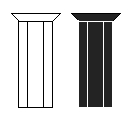
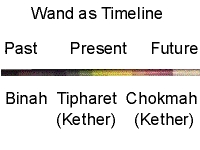
It should be clear to those of you that have read my earlier essays that the circle represents - Zero, No-Thing, the unconscious, Nuit, Space, Infinity, infinite expansion, etc.; while the point in the center of the circle corresponds to the individual, the magician, consciousness, the Self, the Point of View, a Star, the Sun, Hadit, infinite contraction, etc. The staff illustrates the Will extended from Kether to Chokmah, by reflection, the magick wand (1), the time line (representing Past/Present/Future) broken in half symbolizing the two opposites, corresponding to the two pillars Jachin and Boaz (2). The two sticks are then used to fashion a compass utilized to trace the magic circle (0); and there it is again, the equation 0 = 2.
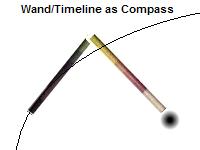
Notice that the staff representing the time line is split at the center corresponding to the Present or the Observer, the Self or magician, Kether (the place where the two sticks are tied represents the One manifesting as Two by reflection. The compass forms a triangle, one stick corresponding to Chokmah (the top of this stick is Kether, where the sticks join to become one, while the bottom is Chokmah, while the bottom of the other stick is ascribed to Binah (taken separately the sticks correspond to Chokmah and Binah). The stick ascribed to Chokmah creates the point, and the other stick representing Binah traces the circle (Binah is the feminine principle, corresponding to Nuit, zero, the unconscious, and the past). The two sticks representing the time line then form the circle, which is a line whose beginning and ending points meet, symbolizing the Alpha/Omega; where there is the end there is also the beginning. The circle, Zero, infinity, therefore contains within itself all time - past, present and future, demonstrating the inseparability of time (the line; 1 [the line considered as a single unit], 2) [the line as two points, start & finish] /space (the circle; 0) or the observer and the observed. Also, the end of the wand corresponding to Binah may be taken as Malkuth, Mother Earth, the Idea or Seed, Hadit being that of the Individual, Point of View in space, Nuit. Similarly the Point of View corresponds to both Kether and Tipharet (Tipharet being a reflection of Kether), this is also true of Chokmah as it initially arises as a reflection of Kether. In short the Tree of Life is a graphical method for depicting the process of reflection.
Bibliography
Robinson, John. Born in Blood - The Lost Secrets of Freemasonry. New York, New York: M. Evans and Company, 1989.
Roberts, Allen E. The Craft and Its Symbols. Richmond, Virginia: Macoy Publishing, 1974.
Macoy, Robert. A Dictionary of Freemasonry. New York, NY: Gramercy Books, 2000.
�2004 Ian Axir. All Rights Reseved.