|
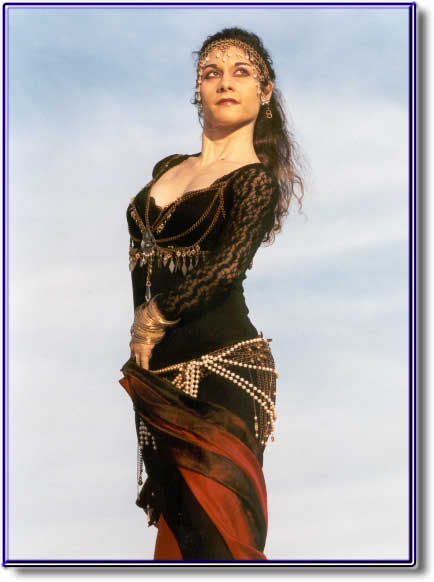
Journey
through the Middle East: A Caravan of Dance
The
Middle East includes the countries of Egypt, Israel/Palestine, Syria,
Lebanon, Jordan, Iran, Iraq, Turkey, Qatar, United Arab Emirates, Kuwait,
Bahrain, Oman, Yemen/Democratic Republic of Yemen. Except for Egypt,
these countries are currently considered as part of the continent of Asia
now called Southwest Asia. Geographically and culturally, the people
of the Middle East can be divided into four regions: Asia Minor, Egypt/the
Sinai Peninsula, the Fertile Crescent, and the Arabian Peninsula. Dances
from each of these regions will be performed. There is much confusion
surrounding the identity of the Middle East (due to its rather complicated
history) therefore, dances of this area are more easily understood in
modern, familiar terms.
Like ballet, there
is a classical, contemporary dance style called raks sharki or
danse orientale, which is what we think of when we hear of Middle
Eastern dance, a style including the movements of all countries of the
Middle East, North Africa, the Near East, Europe and North America, and
a folklore tradition, raks sha’abi, dance of the village which
is specific to a certain people who do not necessarily live all in one
place i.e. they are or were nomadic. There are also folklore dances
of settled people i.e. agricultural communities. Both types of
dance will be performed. Middle Eastern dance developed from the Rom
or Romany people, otherwise know as ‘gypsies’, raveling from
Northwest India, across and into central Asia and Turkey, across and south
into Egypt, further south and across into the Arabian Peninsula. The
Bedouin tribes of the Arabian Desert are the distant ancestors
of these Romany people who settled there. Each Rom and Bedouin
clan has a specific name and a specific style of dance which we will learn
about today. As they passed through each country and in some cases settled
there, they brought with them the dances of their home country and added
movements of the in the place in which they now lived. Four dances from
each of the people mentioned above will be performed: Tsengie
or Cengie skirt dance from Turkey, a Nawar, ghawazee sagat
dance from Egypt, and from the Southern Bedouin ( Wahabis and Rashida)
and Gulf states, the khaleegy dance and finally from the northern
Bedouins, the ceremonial sword dance.
Eastern
or Oriental dance differs from Western or Occidental dance
in many ways. Eastern dance is created to communicate and interrelate
with an audience during a performance in which it is expected that audience
members will take part either by singing, playing music, or dancing, and
is therefore performed in an intimate, closer space in which audience
members can easily participate. The dances generally have a specific
meaning or purpose for performance. Dances are performed in celebration
of everyday life: for fun and entertainment (or to tell stories), for
physical fitness, to help with work or are a part of the work, learning
how to act in a community, as ceremonies, and for combat. Four of these
Middle Eastern folklore dances will be performed, a dance about fun, a
dance about work, a social dance about courtship, a ceremonial dance,
and a contemporary dance and one contemporary dance and then the audience
will be asked to participate in learning a folklore dance.
The first dance is
a Turkish Romany dance from the Black Sea region, a Tsengie or
Cengie skirt dance usually performed for fun. The shoulder movements
are special to these people and to this dance because (move shoulders)
the women who dance them wear coins given to them as part of their dowry
or as payment for entertainment which they then move rapidly back and
forth to show them off.
From Turkey, the Romany
went south into Egypt and became known as the Nawar. Of the
Nawar, the dancers of these people became known as ghawazee
meaning “invaders of the heart.” They are professional entertainers and
make a living dancing, singing, and playing music for money in everyday
life, in a market place or at private celebrations or religious occasions.
Their movement emphasizes the hips and sagat or finger cymbals.
They also wear coins because they travel all the time, they cannot put
their money in a bank, so they sew it on their clothes. In addition, the
coins help to make the movements stand out and to make noise to draw attention
to their dancing. Volunteers to help make noise are needed at this time.
The next two dances
come from the Bedouin people: the first from the Southern Bedouin, mainly
in Bahrain, Oman, the UAR, Kuwait,--the gulf states and the second from
the Northern Bedouins of the Fertile Crescent. The first dance is a social
dance a courtship dance called a khaleegy, done only by women,
married or unmarried and performed with this dress called a tobe.
Swirling turns to emphasize the rich dress and catch the wind, the open
arms, graceful hand movements, the tossing of the hair and subtle shoulders
are representative of this courtship style of dance. The second dance
is a sword dance performed at a wedding as a part of the actual marriage
ceremony called a zeffa. The dancer dances before the bride and
groom to their new home (with the whole village following in behind them
singing, clapping and playing music) in much the same way as a flower
girl precedes the bride to the altar in a Christian wedding. In the music
a zaghareet, or the battle/grief/joyous cry is heard. Learn the
zaghareet and help me by doing it while I dance. Isolation, balance,
focus, alignment and dexterity are the representative of Northern Bedouin
movements.
The last type of dance
is what we think of when we think of folklore dance. This dance is performed
throughout the Fertile Crescent but this particular style comes from Israel
and called the Hora. The dance is performed by farming communities to
celebrate the prosperity of the community, to help with the work of farming,
packing of the soil perhaps, and just for fun. Danced in a circle and
with many people, only the feet move in complicated patterns. Sometimes
this dance is performed with dancers holding onto each other’s shoulders
but it is also done holding hands or holding scarves. The first person
on the left is the leader of the circle who at one point is able to do
his own steps and show off while the rest of the group marks time with
a basic step until he is finished. When the leader is finished, he goes
to the back of the line and the next person becomes the leader and so
on until everyone has had a chance to become the leader.
Vocabulary:
Nomadic vs. Settled
Asia
Minor/Near East: countries of Turkey,
Iran and Iraq
Sinai
Peninsula: land body between Egypt and Israel
Fertile
Crescent: countries of Israel/Palestine, Syria, Lebanon, Jordan,
sometimes part of southern Iraq. Rich agricultural area fought over for
centuries for its abundant land and strategic position.
Arabian
Peninsula: Includes countries of the Fertile
Crescent, plus Bahrain, Oman, Kuwait, Qatar, United Arab Emirates, Yemen/Democratic
Republic of Yemen, and Saudi Arabia. These last few countries are also
knows as the Gulf States.
Classical
dance: a highly stylized
dance form with a specific message system of movement
Folklore/
folk dance: dance with movements
specific to a certain people that have certain meanings when performed---both
movements and dances; a communal dance
Danse Orientale/Raks
Sharki: “dance of the east’, contemporary or classical Middle Eastern
dance
Occidental Dance:
western European and North American dance forms, e.g. ballet and modern
dance
Oriental
Dance: dance forms from the Far, Near, the Middle
East and Egypt e.g. classical East Indian dance/drama, Balinese temple
dance, raks sha’abi or raks sharki.
Raks
Sha’abi: ‘dance of the village’,
folklore dance of the Middle East
Romany/Rom:
name of the people always called ‘gypsy’
Tsengie/Cengie:
Turkish Rom; dowry:
Nawar, ghawazee:
Egyptian Rom, the dance lineage meaning ‘invaders of the heart’
Sagat: finger cymbals
Bedouin:
nomadic people living in the Arabian Desert and Fertile Crescent,
probable distant ancestors of the Rom that settled. Families include
Rashida, Hassi, Wahiba, Junuba, Harasis, Bait Kathair and so on.
zaghareet: ceremonial cry that is an expression
of joy, grief, praise, triumph, or rage.
Books:
Alo
taibi, Muhammed. Bedouin: The Nomads of the Desert. Rourke Publishing,
Inc. 1989.
Atil, Esin. Kalila
wa Dimna: Fables from a Fourteenth-Century Manuscript. Smithsonian
Institution Press. 1981. (Arabic Aesop’s fables; to be read to children)
Cultures of the World.
Marshall Cavendish Corporation.
Series of books about
countries from around the world including: Israel, Jordan, Lebanon, Syria,
Saudi Arabia, Egypt, Libya, Tunisia, Algeria, Morocco and so on. E.g.
Cultures of the World: Egypt.
Enchantment of the World.
Children’s Press.
Series of books about
countries from around the world including: Jordan, Lebanon, Syria, Bahrain,
Qatar, Saudi Arabia, Yemen, Egypt, and so on. E.g. Enchantment of the
World: Egypt.
Music:
The
Music of Islam, Volumes 1-15 (see below) and The Music of Islam Compilations
I and II. Celestial Harmonies. 1998. Excellent, excellent
music and historical text.
Volume I: Al-Qahirah;
Classical Music of Cairo, Egypt.
Volume 2: Music of
the South Sinai Bedouins.
Volume 3: Music of
the Nubians; Aswan, Egypt.
Volume4: Music of
the Arabian Peninsula; Doha, Qatar.
Volume 5: Aissaoua
Sufi Ceremony; Marrakesh Morocco.
Volume 6: Al-Maghrib.
Gnawa Music, Marrakesh. Morocco.
Volume 7: Al-Andalus.
Andalusian music, Tetouan, Morocco.
Volume 8: Folkloric
Music of Tunisia.
Volume 11: Music
of Yemen. Sana a, Yemen.
Musicians of the Nile.
RealWorld. 1989. Folk music of Egypt. From Luxor to Isna.
Hart, Mickey. Egypt.
Rykodisc. Nubian, Uppper Egyptian folk music. 1984, 1988.
|