
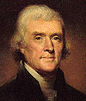
This page of biographical information tells us about Thomas Jefferson's two terms as the commander in chief, our president. It mentions some monumental events that took place during his administration that changed our history. It then concludes with the death of our third president
To go back to the Greatest Presidents homepage |
|
| Jefferson's victory over John Adams in the presidential election of 1800 can be partially explained by the dissension among the Federalists, but the policies of the government were unpopular, and as a party the Federalists were now much less representative of the country than were the Republicans. Jefferson's own title to the presidency was not established for some weeks, because he was accidentally tied with his running mate, Aaron Burr, under the workings of the original electoral system. The election was thrown into the House Of Representatives, where the Federalists voted for Burr through many indecisive ballots. Finally, enough of them abstained to permit the obvious will of the majority to be carried out. Jefferson later said that the ousting of the Federalists and the accession of his own party constituted a "revolution," but that statement was hyperbole. He was speaking of the principles of the government rather than of its form, and his major concern was to restore the spirit of 1776. He regarded himself as more loyal to the U. S. Constitution than his loose-constructionist foes were, though in fact he was less a strict constructionist in practice than in theory. Although he had objected to features of Hamilton's financial system, he had no intention of upsetting it now that it was firmly established. Instead, the purpose he had in mind, and was to be highly successful in carrying out, was to obviate some of the grave dangers he saw in the system by reducing the national debt. Jefferson's accession to the presidency is notable in American history because it marked the first transfer of national authority from one political group to another, and it is especially significant that, despite Federalist obstructionism for a time, the transition was effected by peaceful and strictly constitutional means. Jefferson himself emphasized this in his conciliatory inaugural address. These events set a precedent of acquiescence in the will of the majority. The new president described this as a "sacred principle" that must prevail, but he added that, to be rightful, it must be reasonable and that the rights of minorities must be protected. His accession removed the threat of counterrevolution from his country. The government he conducted, in its spirit of tolerance and humanity, was without parallel in his world.
His first term, most of it in a period of relative international calm, was distinctly successful. He was the undisputed leader of a party that had acquired cohesion during its years in opposition. In James Madison as secretary of state and Albert Gallatin as secretary of the treasury, he had lieutenants of high competence whom he treated as peers but whose loyalty to him bordered on reverence. By virtually ruling himself out of the party, Vice President Aaron Burr relieved Jefferson of a potential rival. Working through the Republican leaders in Congress, whom he treated with the utmost respect, Jefferson exercised influence on that body that was unexampled in previous presidential history and was to be rarely matched in later administrations. Because of his own commitment, and that of most of his countrymen, to the doctrine of division of powers between the executive and legislative branches, his leadership, except in foreign affairs, was indirect and generally unadmitted. He also shared with most of his fellows a rather negative concept of the functions of the federal government in the domestic sphere. The policy of economy and tax reduction that the favorable world situation permitted him to follow served to reduce rather than increase the burdens of his countrymen, and it contributed no little to his popularity.
CLICK HERE |
|
| These partial political failures were more than compensated by the purchase of Louisiana in 1803, the most notable achievement of Jefferson's presidency. His concern for the free navigation of the Mississippi River had caused him, while secretary of state, to assume a more belligerent tone toward Spain, which controlled the mouth of the river, than toward any other nation. The retrocession of the province of Louisiana from Spain to France, now powerful and aggressive under Napoleon, aroused his fears and, for the first time in his career, caused his diplomatic friendship to veer toward the British.
The acquisition of an imperial province, rather than the mouth of the river, was a fortunate accident that added the West to the American Union. The treaty that Robert R. Livingston and James Monroe sent home aroused constitutional scruples in Jefferson's mind, which he expressed privately. Because this vast acquisition of territory would inevitably change the character of the Union, it seemed to him that it should be authorized by a constitutional amendment. But the process of amendment was painfully slow, and the treaty had to be ratified by a specified date. Napoleon, who was thought by some to have already repented this transaction, could not have been expected to tolerate any departure from its terms. Recognizing that this was no time for constitutional purism, the president yielded to his friends, while strict constructionist arguments were taken up ineffectually by the New England Federalists. Nearly everybody else enthusiastically approved of the acquisition. In May 1801 the Pasha of the pirate harboring state of Tripoli, dissatisfied with his tribute, declared war on the United States. Jefferson ordered a naval squadron to the Mediterranean Sea to blockade Tripoli. The bizarre conflict that ensued served as a training school for the American Navy, and the relatively favorable treaty of 1805 justified Jefferson's resort to force.
CLICK HERE |
|
| On both the domestic and foreign fronts Jefferson encountered greater difficulties in his second term than in his first. But he was relatively successful at home during most of it. Factionalism increased among Republicans. But the revolt of John Randolph, an uncompromising strict constructionist and formerly the Republican leader in the House of Representatives, was contained. Until the last session of Congress in his presidency, Jefferson maintained his influence over that body and his undisputed leadership of his party.
Jefferson's second term as president was his last political adventure. After this term he retired and finishe off his life. Jefferson died on July 4th 1826, hours before his friend, John Adams, on the 50th anniversary of The Declaration of Independence.
CLICK HERE |
