
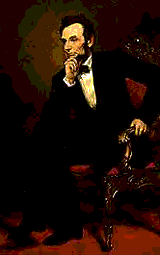
This page of biographical information describes the life of our sixteenth president before he was elected to office. It tells of Lincoln growing up and developing into the legendary leader we all know him to be.
To go back to the Greatest Presidents homepage |
|
| The future president was born in log cabin near Hodgenville, Kentucky on Feb. 12, 1809. His entire childhood and young manhood were spent on the brink of poverty as his pioneering family made repeated fresh starts in the West. Opportunities for education, cultural activities, and even socializing were meager.
Like most frontier children, Abraham performed chores at an early age, but occasionally he and his sister Sarah attended classes in a log schoolhouse some two miles away. Faulty land titles were a problem to Kentucky settlers. Because of a flaw in title, he lost part of a farm he had bought before his marriage and resolved to move to Indiana, where land could be bought directly from the government. December 1816, the Lincolns struck out northwestward. They eventually settled near Pigeon Creek, in present day Spencer County, Indiana. Unforutnately, just a few years after settling, Nancy Lincoln came down with "milk-sick" (milk sickness), a disease dreaded by Indiana settlers, and soon afterward, on Oct. 5, 1818 she died of the disease. Without a woman to keep the household functioning, the Lincolns lived almost in squalor. Thomas Lincoln returned to Elizabethtown, where, on Dec. 2, 1819, he married Sarah Bush Johnston, a widow with three children. A kindly, hard-working woman, she brought order to the Lincolns' Indiana homestead. She also saw to it that at intervals over the next two years Abraham received some schooling. Abe's meager education had aroused his desire to learn, and he traveled over the countryside to borrow books. Among those he read were Robinson Crusoe, Pilgrim's Progress, Aesop's Fables, William Grimshaw's History of the United States, and Mason Weems' Life of Washington. The Bible was probably the only book his family owned, and his abundant use of scriptural quotations in his later writings shows how earnestly he must have studied it. Young Lincoln worked for a while as a ferryman on the Ohio River, and at 19 helped take a flatboat cargo to New Orleans. There he encountered a manner of living wholly unknown to him. Soon after he returned, his father decided to move to Illinois, where a relative, John Hanks, had preceded him. On March 1, 1830, the family set out with all their possessions loaded on three wagons. Their new home was located on the north bank of the Sangamon River, west of Decatur. When a cabin had been built and a crop had been planted and fenced, young Lincoln was hired out to split fence rails for neighbors. In the autumn all the Lincoln family came down with a bad fever. That winter the pioneers experienced the deepest snow they had ever known, accompanied by subzero temperatures. In the spring the family backtracked eastward to Coles county, Illinois. But this time Abraham did not accompany them, for during the winter he, his stepbrother John D. Johnston, and his cousin John Hanks had agreed to take another cargo to New Orleans for a trader, Denton Offutt. A new life was opening for young Lincoln. Henceforth he could make his own way. As Lincoln made his way through life he came across a woman by the name of Mary Todd. Todd was brought up in Lexington, Kentucky and had an excellent education. They were married on November 4, 1842. They enjoyed a happy marriage. |
