The Gospel according to Matthew: Messiah and His Kingdom
by
Chi-Keung Ng
Abstract
We propose a structure for the Matthew Gospel which is an amalgamation of the theories of B. W. Bacon and J. D. Kingsbury. In doing so, we also show that there are two major themes for the Gospel: the Messiah (or the Son of God) and the Kingdom of God. More precisely, we show that the book is a combination of the "Messianic Narratives" and the five "Kingdom Disclosures".
Many people have suggested different structures for the gospel of Matthew. Some said that the book was arranged in geographical order. Goulder gave an interesting suggestion that "Matthew is a Midrash on Mark, composed in accordance with annual weekly lectionary cycle". Other think that the book is in the "Chiastic structure". J. D. Kingsbury proposed a three parts structure using the theme of the Messiah whereas B. W. Bacon proposed a five parts structure which he considered as "corresponding to the oration codes of the Pentateuch, each introduced, like Mosaic code, by a narrative section, each closing with a transition formula as the reader passes from the disclosure to the narrative".
These theories have their strong and weak points. In the following, we will present a suggested structure of this gospel using the ideas from both Bacon and Kingsbury. In a sense, this can be regarded as a development of Bacon's five blocks theory.
Bacon made an interesting and important observation that there are five places in this gospel where the phrase "When Jesus has finished (end) ..." are used (namely, 7:28, 11:1, 13:53, 19:1 & 26:1). He then went on to argue that these are markers for the end of sections and so He divided the book into five sections (in fact, five plus two sections -- the beginning narratives and the ending). One might have an objection that this phrase may just be a favour idiom of Matthew and carry no significant in the structure at all. However, as Bacon noticed, each of these five phrase "When Jesus has finished..." is preceded by a long "disclosures" of Jesus' teaching (5:1-7:27; 10:1-42; 13:1-52; 18:1-35 & 24:1-25:46). Therefore, it seems possible that this phrase bear a special meaning. An interesting point is that there is a sixth disclosure in 23:1-36 which does not end with "When Jesus has finished...". We will show in the following that the five disclosures can be seen as having a relation with each other which is not shared with the extra disclosure in 23:1-36.
Before we carry on, we would also like to mention a strange phenomena in the gospel of Matthew. We call this the Matthew repetition. There are a lot of places in this gospel where similar or even the same sayings / stories / themes / discussions occur exactly twice. For examples, there are two healing of two blind men (9:27-31 and 20:29-34); two healing of dumb mans and both resulting in the accusation of Jesus being helped by the prince of devils (9:34 and 12:22-32); two asking for sign from the Pharisees (12:38 and 16:1); two mentioning of the sea and the lack of faith (8:23-27 and 14:22-33); two sayings concerning little children and entering the kingdom of heaven (18:1-5 and 19:13-15); two feedings of thousands of people (14:13-21 and 15:32-39); two discussions of divorce (5:31-32 and 19:3-12)... With the exception of the feeding of thousands, these repetitions are only found in Matthew. Some may say that this is because Matthew was using different sources and was not aware of the repetitions. However, we will explain in the following that this could be a deliberate act of Matthew.
There is another remark from the source critic's view point that we want to pay attention at. Some people have suggested that the first of these disclosures (namely, the Sermon on the Mount) could be a pre-Matthean work and was incorporated by Matthew in his gospel. One might even suggest that these five disclosures were originally five chapters of a collection of teachings of Jesus which was arranged according to different topics.
Whether or not the five disclosures are taken from pre-Matthean source(s) or whether it was Matthew who grouped together the teachings of Jesus himself (or whether these were five actual teachings of Jesus taught in five occasions), we still need to know why he inserted these five blocks of teachings into that five positions inside a seemingly continuous series of narratives. Of course, if one takes the view that these are actual teachings of Jesus in five occasions and Matthew simply recorded them in the chronological order, then our question is irrelevant. However, we do not think that this is the case.
Before we give an answer to the motive behind the addition of these five blocks, let us first investigate how they are skilfully inserted into the narrative. In fact, Matthew gave each of them a sort of "reference" inside the narrative. More precisely, they all preceded by a sort of introduction that tie them into specific events. The first one started with "he went up into a mountain: and when he was set, his disciples came unto him: And he opened his mouth, and taught them." (5:1-2). The second one started with "And when he had called unto him his twelve disciples, he gave them power against unclean spirits ... and commanded them" (10:1-5a). The third one: "The same day went Jesus out of the house, and sat by the sea side ... he spake many things unto them in parables" (13:1-3a). The fourth one with: "At the same time came the disciples unto Jesus ... And Jesus called a little child unto him ... And said" (18:1-2). The last one: "And Jesus went out, and departed from the temple ... And as he sat upon the mount of Olives ... And Jesus answered and said unto them" (24:1-3). On the other hand, they all concluded with the similar formula: "When Jesus has finished..." Note that those beginnings set the disclosures in a specific space-time and those endings point mainly toward the narrative that follows the disclosures instead of pointing back to the disclosures themselves (as also observed by Streeter). In doing so, Matthew embedded the disclosure smoothly into the narratives and the whole becomes more coherence.
Next, we will look at the overall themes of these five disclosures (our understand may not be the same as that of Bacon nor other authors).
We have already argued in another essay that the main message of the first block (the Sermon on the Mount; 5:1-7:27) is the light inside Jesus' believers and the call for the shining out of it. So, it is about the Light of the inhabitants of the Kingdom.
In the second block (10:5-42), Jesus taught His disciples how they should preach the good news of the coming of the Kingdom. Jesus also told them that they will be persecuted if they preach this but they should face the persecution and stand firm for Him. Therefore, the main message of this block is about the preaching of the coming Kingdom and the suffering that follows.
In the third block (13:1-52), Jesus told a lot of parables about the Kingdom (and also told His disciples why He used parables). These can be considered as a revelation of the Kingdom (although not complete).
The fourth block (18:1-35) started with the question of "Who is the greatest in the Kingdom?" and Jesus answered them that they should become like little children before they can even enter the Kingdom. Starting from this, Jesus taught them about the relationship between people in the Kingdom: one shouldn't offend others nor cause them to sin (18:6-9); one shouldn't despise another person (18:10-14); one should seek reconciliation with each other (18:15-17) and constantly gather together for prayer (18:18-20); one should forgive others without limit (18:21-35). So, the essential teaching in this block is the relationship within the Kingdom.
The message of the final block of teaching (24:1-25:46) is clear. It is about the coming of the future Kingdom in its completeness. First of all, Jesus told His disciples about the kind of sufferings and disasters that will come upon them and all mankind before the Kingdom arrive in its completeness (the time when Jesus come back). However, Jesus warned His disciples that no one know exactly the time and they should be on their guard all the time. He used several parables to stress this fact (24:37-25:46).
In summary, the themes for these five blocks of teachings can be expressed as:
1. The Light of the Kingdom;
2. The preaching of and the suffering for the Kingdom;
3. The revelation of the Kingdom;
4. The way of treating one another in the Kingdom;
5. The coming of the eternal Kingdom.
Therefore, these five blocks of teachings are five "Kingdom disclosures". This "Kingdom disclosures" can be seen as a major theme of this gospel. This theme is mainly expressed through collections of the teachings of Jesus.
Next, we will look at the "narratives" (strictly speaking, these material contain not just narratives but also some teachings and even long disclosure, e.g. 23:1-36, but for simplicity, we call them narratives) surrounding these five blocks and try to find the relations between them and these "Kingdom disclosures".
One can imagine that after reading the first disclosure, reader would likely ask themselves the following questions: "Jesus' teachings are very good but did he acts what he taught? Did he have compression? Was he meek? Did he love his enemy? How about His practice of fasting?" We can vaguely find the answers to some of these questions in the following chapters (in particular, Chapters 8 and 9). Therefore, it is reasonable to put the Sermon on the Mount before recording the deeds of Jesus. In fact, the narratives immediately following this first disclosure show how Jesus reacted and related to people and tell the readers about the person of Jesus. These can also be regarded as demonstrations of the authority of Jesus in His acts (c.f. authority of Jesus in His teaching; see the words after 'When Jesus had ended...' in 7:28 -- '... he taught them as one having authority').
Then, after the second disclosure, we see the preaching (about the Kingdom of God) by Jesus in difference places as well as some miracles performed by Him (notice the saying after 'Jesus had made an end...' in 11:1 -- 'he departed thence to teach and to preach in their cities'). In doing so, he was getting more opponents and producing more controversies. Notice that the controversy about the origin of Jesus' power for healing a dumb man was picked up again (this has already been mentioned in 9:32-34) and dealed with in more details in 12:22-32. The saying of "I will have mercy, and not sacrifice" was also repeated (9:13 and 12:7).
After the parables of the Kingdom, we see the revelation of Jesus as the Messiah through the feedings of thousands, through the walking on the water (notice 14:33: 'they ... came and worshipped him, saying, Of a truth thou art the Son of God.') and most clearly through the confession of Peter as well as the transfiguration. These can be seen as another way to reveal the Kingdom through the revelation of its King (the Son of God). Note that all these were done outside His hometown as we were told in 13:53-58. This can be seen as the signal of moving out of His home and moving toward Jerusalem (only then did He start revealing Himself more clearly).
However, the narratives after the last two disclosures do not seem to fit nicely with the disclosures preceding them as did the previous three. We can see that the main concern of the narratives being shifted toward the great event in Jerusalem -- the suffering and glorification of the Messiah. The description after the fourth 'when Jesus had finished...' clearly indicate this shift of concern: 'he departed from Galilee, and came into the coasts of Judaea beyond Jordan'.
The position of the fifth disclosure is interesting. It is the foretelling of the "new Jerusalem" inside the "old Jerusalem". Moreover, the coming of "new Jerusalem" required the suffering of the Messiah which points to the last group of the narratives. Notice the saying of Jesus after the fifth 'when Jesus had finished...': 'Ye know that after two days is the feast of the Passover, and the Son of man is betrayed to be crucified...'
Perhaps, we can also bring in Kingsbury's idea to give a more clear picture and understanding of this gospel. Kingsbury divided the gospel into three parts according to three stages of revealing the Messiah: The person of the Messiah (as we can see in the narrative following the first disclosure); The proclamation of the Messiah (as we can see in the narratives after the second and the third disclosures); The suffering, Death and Resurrection of the Messiah (the narratives after the fourth disclosure). However, we do not agree with Kingsbury in the exact division of this three parts. In particular, we do not agree that the phrase: "From that time on" acts as a separator. Note that this phrase only appear twice in the book and it does not seem very likely that Matthew would have expected his reader to notice and take note of this sort phrase. Anyway, the three aspects of the Messiah are probably what Matthew wanted to described through the narratives.
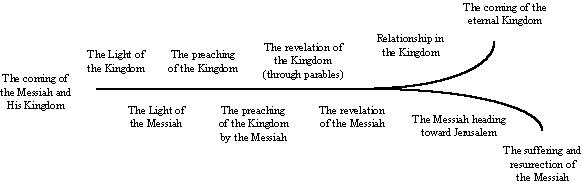
Now, we can see clearly that this gospel has two major themes, namely the Kingdom themes and the Messianic theme, interweaving together. The Kingdom theme is mainly developed through blocks of teachings of Jesus (some teachings have narratives as examples and supports). The Messianic theme is mainly developed through narratives as well as bits and pieces of teachings. In the beginning, the two themes are going side by side and gradually diverse. This can illustrated by the following diagram:
We can also summarise all the above in the following table:
| Messianic Narratives | Kingdom Disclosures |
| The coming / beginning of the Messiah and His Kingdom | |
| The Light shine from the Kingdom: the characters of its inhabitants | |
| The Light shine from the Messiah: His characters and His authority | |
| The preaching of the coming of the Kingdom and the suffering that follows this preaching | |
| The preaching of the coming of the Kingdom by the Messiah | |
| The revelation of the Kingdom through parables | |
| The revelation of the Kingdom through the revelation of its King | |
| The expected relationship of people within the Kingdom | |
| The Messiah on His way to Jerusalem | |
| The coming of the future eternal Kingdom -- the new Jerusalem | |
| The suffering and glorification of the Messiah |
Bibliography