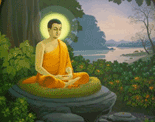
| Siddhartha
Gautama, known as the Buddha born in the city of Lumbini .
Born a prince, his father, King Suddhodana, was said to have
been visited by a wise man shortly after Siddhartha was born.
The wise man said that Siddhartha would either become a great
king or a holy man based on whether or not he ever saw life
outside of the palace walls. Determined to make Siddhartha
a king, the father tried to shield his son from the unpleasant
realities of daily life. Despite his father's efforts, at
the age of 29, he discovered the suffering of his people,
first through an encounter with an elderly man. On subsequent
trips outside the palace, he encountered various sufferings
such as a diseased man, a decaying corpse, and a monk or an
ascetic. These are often termed 'The Four Sights".These
four sights and sought to overcome birth ,old age ,illness,
and death by living the life of an ascetic.
|
After abandoning asceticism and concentrating
instead upon meditation and, according to some sources,
Anapanasati , Gautama is said to have discovered what
Buddhists call the Middle Way—a path of moderation
that lies mid-way between the extremes of self-indulgence
and self-mortification. He accepted a little milk and
rice pudding from a village girl and then, that night
Siddhartha sat under the Bodhi tree and vowed never to
arise until he had found the Truth. |
He purified his mind of all defilements
and attained enlightenment at the age of thirty-five, thus
earning the title Buddha, or "Enlightened One".
For the remainder of his eighty years, the Buddha preached
the Dharma in an effort to help other sentient beings reach
enlightenment.
| |
The Four Noble Truths
1. There is Suffering.
2. Cause of Suffering We are the cause
of our suffering.
3. End of Suffering Stop doing what
causes suffering.
4. Path to end Suffering Everyone can
be enlightened.
|
|
| |
The Noble Eightfold Path
1. Right Understanding
2. Right Thoughts
3. Right Speech
4. Right Action |
5. Right Livelihood
6. Right Effort
7. Right Mindfulness
8. Right Concentration |
|
| |
Buddhist Five Main Precepts
1. Refrain From Killing.
2. Refrain from Stealing.
3. Refrain from Lying, Slandering, Gossiping
and Spreading Rumours.
4. Refrain from Sexual Misconduct.
5. Refrain from Taking Intoxicants.
|
|
| |
Buddhist Eight Precepts
1. Abstain from Taking Life.
2. Abstain from Stealing
3. Abstain from Speaking unnecessary
4. Abstain from Sexual Activity
5. Abstain from Taking Intoxicants
6. Abstain from Taking meals at inappropriate time
7. Abstain from Entertaining, Dancing, Singing, Use of beauty products & perfumes
8. Abstain from Seating on high and luxurious chairs and beds.
|
|
|