THE SEVEN WONDERS OF THE ANCIENT WORLD
Second 9 Weeks
Although most people know that a list exists of the Seven World Wonders, only few can name them. The list of the Seven Wonders of the Ancient World was originally compiled around the second century BC. The first reference to the idea is found in History of Herodotus as long ago as the 5th century BC. Decades later, Greek historians wrote about the greatest monuments at the time. Callimachus of Cyrene (305BC-240BC), Chief Librarian of the Alexandria Mouseion, wrote "A Collection of Wonders around the World". All we know about the collection is its title, for it was destroyed with the Alexandria Library.
The final list of the Seven Wonders was compiled during the Middle Ages. The list comprised the seven most impressive monuments of the Ancient World, some of which barely survived to the Middle Ages. Others did not even co-exist. Among the oldest references to the canonical list are the engravings by the Dutch artist Maerten van Heemskerck (1498-1574), and Johann Fischer von Erlach's History of Architecture.
Today, archaeological evidence reveals some of the mysteries that
surrounded the
history of the Wonders for centuries. For their builders, the Seven
Wonders were a
celebration of religion,
mythology,
art, power, and science. For
us, they reflect the
ability of humans to change the surrounding landscape by building
massive yet beautiful
structures, one
of which stood the test of time to this very
day.
WEEK 1: The Great Pyramid of Giza
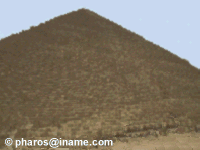
Man fears Time, yet Time fears the Pyramids
Arab proverbIt is the one and only Wonder which does not require a description by early historians and poets. It is the one and only Wonder that does not need speculations concerning its appearance, size, and shape. It is the oldest, yet it is the only surviving of the Seven Ancient Wonders. It is the Great Pyramid of Giza.
Location
At the city of Giza, a necropolis of ancient Memphis, and today part of Greater Cairo, Egypt.
History
Contrary to the common belief, only the Great Pyramid of Khufu (Cheops), not all three Great Pyramids, is on top of the list of Wonders. The monument was built by the Egyptian pharaoh Khufu of the Fourth Dynasty around the year 2560 BC to serve as a tomb when he dies. The tradition of pyramid building started in Ancient Egypt as a sophistication of the idea of a mastaba or "platform" covering the royal tomb. Later, several stacked mastabas were used. Early pyramids, such as the Step Pyramid of King Zoser (Djoser) at Saqqara by the famous Egyptian architect, Imhotep, illustrate this connection.

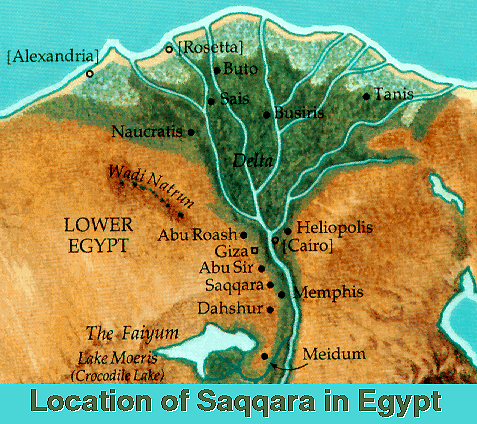
The great pyramid is believed to have been built over a 20 year period. The site was first prepared, and blocks of stone were transported and placed. An outer casing (which disappeared over the years) was then used to smooth the surface. Although it is not known how the blocks were put in place, several theories have been proposed. One theory involves the construction of a straight or spiral ramp that was raised as the construction proceeded. This ramp, coated with mud and water, eased the displacement of the blocks which were pushed (or pulled) into place. A second theory suggests that the blocks were placed using long levers with a short angled foot.
Throughout their history, the pyramids of Giza have stimulated human imagination. They were referred to as "The Granaries of Joseph" and "The Mountains of Pharaoh". When Napoleon invaded Egypt in 1798, his pride was expressed through his famous quote: "Soldats! Du haut de ces Pyramides, 40 siècles nous contemplent". (Soldiers! From the top of these Pyramids, 40 centuries are looking at us)
Today, the Great Pyramid is enclosed, together with the other pyramids and the Sphinx, in the touristic region of the Giza Plateau. Also in the area is the museum housing the mysterious Sun Boat, only discovered in 1954 near the south side of the pyramid. The boat is believed to have been used to carry the body of Khufu in his last journey on earth before being buried inside the pyramid. It may also serve him as a means of transportation in his afterlife journey according to Ancient Egyptian beliefs.


Description
When it was built, the Great pyramid was 145.75 m (481 ft) high. Over the years, it lost 10 m (30 ft) off its top. It ranked as the tallest structure on Earth for more than 43 centuries, only to be surpassed in height in the nineteenth century AD. It was covered with a casing of stones to smooth its surface (some of the casing can still be seen near the top of Khefre's pyramid). The sloping angle of its sides is 51 degrees and 51 minutes. Each side is carefully oriented with one of the cardinal points of the compass, that is, north, south, east, and west. The horizontal cross section of the pyramid is square at any level, with each side measuring 229 m (751 ft) in length. The maximum error between side lengths is astonishingly less than 0.1%.

The structure consists of approximately 2 million blocks of stone, each weighing more than two tons. It has been suggested that there are enough blocks in the three pyramids to build a 3 m (10 ft) high, 0.3 m (1 ft) thick wall around France. The area covered by the Great pyramid can accommodate St Peter's in Rome, the cathedrals of Florence and Milan, and Westminster and St Paul's in London combined.


On the north face, is the pyramid's entrance. A number of corridors, galleries, and escape shafts either lead to the King's burial chamber, or were intended to serve other functions. The King's chamber is located at the heart of the pyramid, only accessible through the Great Gallery and an ascending corridor. The King's sarcophagus is made of red granite, as are the interior walls of the King's Chamber. Most impressive is the sharp-edged stone over the doorway which is over 3 m (10 ft) long, 2.4 m (8 feet) high and 1.3 m (4 ft) thick. All of the interior stones fit so well, a card won't fit between them. The sarcophagus is oriented in accordance with the compass directions, and is only about 1 cm smaller in dimensions than the chamber entrance. It might have been introduced as the structure was progressing.
New theories concerning the origin and purpose of the Pyramids of
Giza have been
proposed... Astronomic observatories... Places of cult worship...
Geometric structures
constructed by a long-gone civilization... Even
extraterrestrial-related theories have
been proposed with little evidence in support... The overwhelming
scientific and historic
evidence still supports the
conclusion that, like many smaller pyramids in the region, the
Great Pyramids were
built by the great Ancient Egyptian civilization off the West bank of
the Nile as tombs
for their magnificent Kings... Tombs where Khufu, Khefre, and Menkaure
could start their
mystic journey to the afterlife.
Week 1: The Hanging Gardens of Babylon
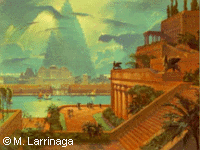
The approach to the Garden sloped like a hillside and the several parts of the structure rose from one another tier on tier... On all this, the earth had been piled... and was thickly planted with trees of every kind that, by their great size and other charm, gave pleasure to the beholder... The water machines [raised] the water in great abundance from the river, although no one outside could see it.
Diodorus SiculusFruits and flowers... Waterfalls... Gardens hanging from the palace terraces... Exotic animals... This is the picture of the Hanging Gardens of Babylon in most people's minds. It may be surprising to know that they might have never existed except in the minds of Greek poets and historians!
Location
On the east bank of the River Euphrates, about 50 km south of Baghdad, Iraq.
History
The Babylonian kingdom flourished under the rule of the famous King, Hammurabi (1792-1750 BC). It was not until the reign of Naboplashar (625-605 BC) of the Neo-Babylonian dynasty that the Mesopotamian civilization reached its ultimate glory. His son, Nebuchadnezzar II (604-562 BC) is credited for building the legendary Hanging Gardens. It is said that the Gardens were built by Nebuchadnezzar to please his wife or concubine who had been "brought up in Media and had a passion for mountain surroundings".
While the most descriptive accounts of the Gardens come from Greek historians such as Berossus and Diodorus Siculus, Babylonian records stay silent on the matter. Tablets from the time of Nebuchadnezzar do not have a single reference to the Hanging Gardens, although descriptions of his palace, the city of Babylon, and the walls are found. Even the historians who give detailed descriptions of the Hanging Gardens never saw them. Modern historians argue that when Alexander's soldiers reached the fertile land of Mesopotamia and saw Babylon, they were impressed. When they later returned to their rugged homeland, they had stories to tell about the amazing gardens and palm trees at Mesopotamia.. About the palace of Nebuchadnezzar.. About the Tower of Babel and the ziggurats. And it was the imagination of poets and ancient historians that blended all these elements together to produce one of the World Wonders.

It wasn't until the twentieth century that some of the mysteries surrounding the Hanging Gardens were revealed. Archaeologists are still struggling to gather enough evidence before reaching the final conclusions about the location of the Gardens, their irrigation system, and their true appearance. Some recent researchers even suggest that the Hanging Gardens were built by Senaherib, not by Nebuchadnezzar II (ca. 100 years earlier).
Description
Detailed descriptions of the Gardens come from ancient Greek sources, including the writings of Strabo and Philo of Byzantium. Here are some excerpts from their accounts:
"The Garden is quadrangular, and each side is four plethra long. It consists of arched vaults which are located on checkered cube-like foundations.. The ascent of the uppermost terrace-roofs is made by a stairway..."
"The Hanging Garden has plants cultivated above ground level, and the roots of the trees are embedded in an upper terrace rather than in the earth. The whole mass is supported on stone columns... Streams of water emerging from elevated sources flow down sloping channels... These waters irrigate the whole garden saturating the roots of plants and keeping the whole area moist. Hence the grass is permanently green and the leaves of trees grow firmly attached to supple branches... This is a work of art of royal luxury and its most striking feature is that the labor of cultivation is suspended above the heads of the spectators".
More recent archaeological excavations at the ancient city of
Babylon in Iraq uncovered
the foundation
of the palace. Other findings
include the Vaulted Building with thick walls and an irrigation well
near the southern
palace. A group of archaeologists surveyed the area of the southern
palace and reconstructed
the Vaulted Building as the Hanging
Gardens. However, the Greek historian Strabo had stated that the
gardens were situated by
the River Euphrates. So others argue that the site is too far from the
Euphrates to
support the theory since the Vaulted Building is several hundreds of
meters away. They
reconstructed the site of the palace and located the Gardens in the
area stretching from
the River to the Palace. On the river banks, recently discovered
massive walls 25 m thick
may have been stepped to form terraces... the ones described in Greek
references.


WEEK 2: The Statue of Zeus at Olympia
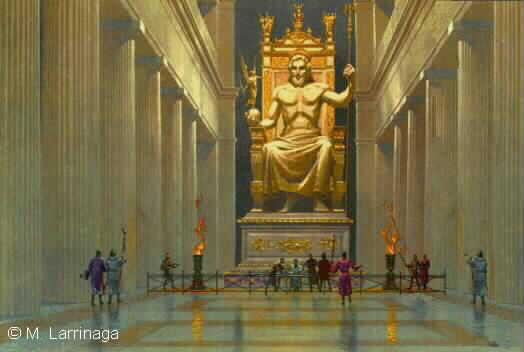
In his right hand a figure of Victory made from ivory and gold. In his left hand, his scepter inlaid with all metals, and an eagle perched on the sceptre. The sandals of the god are made of gold, as is his robe.
Pausanias the Greek (2nd century AD)This is the statue of the god in whose honor the Ancient Olympic games were held. It was located on the land that gave its very name to the Olympics. At the time of the games, wars stopped, and athletes came from Asia Minor, Syria, Egypt, and Sicily to celebrate the Olympics and to worship their king of gods: Zeus.
Location
At the ancient town of Olympia, on the west coast of modern Greece, about 150 km west of Athens.
History
The ancient Greek calendar starts in 776 BC, for the Olympic games are believed to have started that year. The magnificent temple of Zeus was designed by the architect Libon and was built around 450 BC. Under the growing power of ancient Greece, the simple Doric-style temple seemed too mundane, and modifications were needed. The solution: A majestic statue. The Athenian sculptor Pheidias was assigned for the "sacred" task, reminiscent of Michelangelo's paintings at the Sistine Chapel.

For the years that followed, the temple attracted visitors and worshippers from all over the world. In the second century BC repairs were skillfully made to the aging statue. In the first century AD, the Roman emperor Caligula attempted to transport the statue to Rome. However, his attempt failed when the scaffolding built by Caligula's workmen collapsed. After the Olympic games were banned in AD 391 by the emperor Theodosius I as Pagan practices, the temple of Zeus was ordered closed.
Olympia was further struck by earthquakes, landslides and floods, and the temple was damaged by fire in the fifth century AD. Earlier, the statue had been transported by wealthy Greeks to a palace in Constantinople. There, it survived until it was destroyed by a severe fire in AD 462. Today nothing remains at the site of the old temple except rocks and debris, the foundation of the buildings, and fallen columns.


Description
Pheidias began working on the statue around 440 BC. Years earlier, he had developed a technique to build enormous gold and ivory statues. This was done by erecting a wooden frame on which sheets of metal and ivory were placed to provide the outer covering. Pheidias' workshop in Olympia still exists, and is coincidentally -- or may be not -- identical in size and orientation to the temple of Zeus. There, he sculpted and carved the different pieces of the statue before they were assembled in the temple.

When the statue was completed, it barely fitted in the temple. Strabo wrote:
".. although the temple itself is very large, the sculptor is criticized for not having appreciated the correct proportions. He has shown Zeus seated, but with the head almost touching the ceiling, so that we have the impression that if Zeus moved to stand up he would unroof the temple."
Strabo was right, except that the sculptor is to be commended, not criticized. It is this size impression that made the statue so wonderful. It is the idea that the king of gods is capable of unroofing the temple if he stood up that fascinated poets and historians alike. The base of the statue was about 6.5 m (20 ft) wide and 1.0 meter (3 ft) high. The height of the statue itself was 13 m (40 ft), equivalent to a modern 4-story building.
The statue was so high that visitors described the throne more than Zeus body and features. The legs of the throne were decorated with sphinxes and winged figures of Victory. Greek gods and mythical figures also adorned the scene: Apollo, Artemis, and Niobe's children. The Greek Pausanias wrote:
On his head is a sculpted wreath of olive sprays. In his right hand he holds a figure of Victory made from ivory and gold... In his left hand, he holds a sceptre inlaid with every kind of metal, with an eagle perched on the sceptre. His sandals are made of gold, as is his robe. His garments are carved with animals and with lilies. The throne is decorated with gold, precious stones, ebony, and ivory.
The statue was occasionally decorated with gifts from kings and rulers. the most notable of these gifts was a woollen curtain "adorned with Assyrian woven patterns and Pheonician dye" which was dedicated by the Syrian king Antiochus IV.
Copies of the statue were made, including a large prototype at
Cyrene (Libya). None
of them, however, survived to
the present day. Early
reconstructions such as the one
by von Erlach are now believed to be rather inaccurate. For us, we can
only wonder about
the true appearance of the statue -- the greatest work in Greek
sculpture.

WEEK 2: The Temple of Artemus at Ephesus
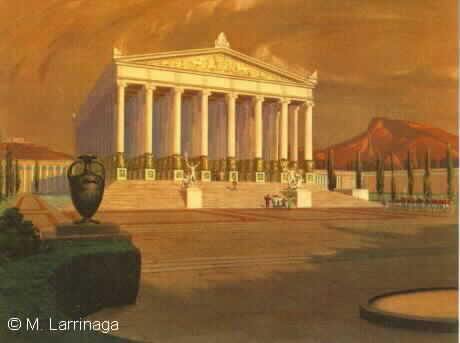
But when I saw the sacred house of Artemis that towers to the clouds, the [other Wonders] were placed in the shade, for the Sun himself has never looked upon its equal outside Olympus.
Antipater of SidonIs it simply a temple? How could it take its place among other unique structures such as the Pyramid, the Hanging Gardens, and the Colossus of Rhodes? For the people who actually visited it, the answer was simple. It was not just a temple... It was the most beautiful structure on earth... It was built in honor of the Greek goddess of hunting, wild nature, and fertility. That was the Temple of Artemis at Ephesus.
Location
The ancient city of Ephesus near the modern town of Selcuk, about 50 km south of Izmir (Smyrna) in Turkey.
History
Although the foundation of the temple dates back to the seventh century BC, the structure that earned a spot in the list of Wonders was built around 550 BC. Referred to as the great marble temple, or temple D, it was sponsored by the Lydian king Croesus and was designed by the Greek architect Chersiphron. The Temple was decorated with bronze statues sculpted by the most skilled artists of their time: Pheidias, Polycleitus, Kresilas, and Phradmon.
The temple served as both a marketplace and a religious institution. For years, the sanctuary was visited by merchants, tourists, artisans, and kings who paid homage to the goddess by sharing their profits with her. Recent archeological excavations at the site revealed gifts from pilgrims including statuettes of Artemis made of gold and ivory... earrings, bracelets, and necklaces... artifacts from as far as Persia and India.
On the night of 21 July 356 BC, a man named Herostratus burned the temple to ground in an attempt to immortalize his name, which he did indeed. Oddly enough, Alexander the Great was born the same night. The historian Plutarch later wrote that the goddess was "too busy taking care of the birth of Alexander to send help to her threatened temple". And when Alexander the Great conquered Asia Minor, he offered to rebuild the destroyed temple, but the Temple was not restored until after his death in 323 BC. The temple was eventually restored and is labeled "Temple E" by archeologists.
When St Paul visited Ephesus to preach Christianity in the first century AD, he was confronted by the Artemis' cult who had no plans to abandon their goddess. And when the temple was again destroyed by the Goths in AD 262, the Ephesians vowed to rebuild. By the fourth century AD, most Ephesians had converted to Christianity and the temple lost its religious glamor. The final chapter came when in AD 401 the Temple of Artemis was torn down by St John Chrysostom. Ephesus was later deserted, and only in the late nineteenth century has the site been excavated. The digging revealed the temple's foundation and the road to the now swampy site. Attempts were recently made to rebuilt the temple, but only a few columns have been re-erected.
Description
The foundation of the temple was rectangular in form, similar to most temples at the time. Unlike other sanctuaries, however, the building was made of marble, with a decorated façade overlooking a spacious courtyard. Marble steps surrounding the building platform led to the high terrace which was approximately 80 m (260 ft) by 130 m (430 ft) in plan. The columns were 20 m (60 ft) high with Ionic capitals and carved circular sides. There were 127 columns in total, aligned orthogonally over the whole platform area, except for the central cella or house of the goddess.
The temple housed many works of art, including four ancient bronze statues of Amazons sculpted by the finest artists at the time. When St Paul visited the city, the temple was adorned with golden pillars and silver statuettes, and was decorated with paintings. There is no evidence that a statue of the goddess herself was placed at the center of the sanctuary, but there is no reason not to believe so.
The early detailed descriptions of the temple helped archeologists
reconstruct the
building. Many reconstructions such as that by H.F.
von
Erlach depicted the façade with a four-column porch which
never existed. More
accurate reconstructions may give us an idea
about the general layout of the temple. However, its true beauty lies
in the architectural
and artistic details which will forever remain unknown.


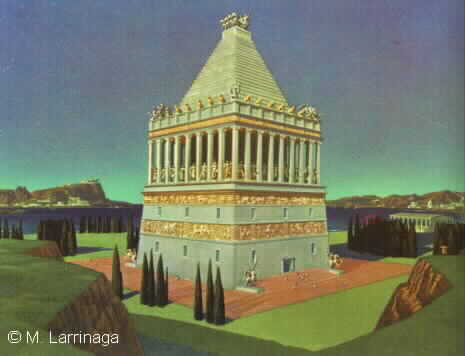
I have lying, over me in Halicarnassus, a gigantic monument such as no other dead person has, adorned in the finest way with statues of horses and men carved most realistically from the best quality marble.
King Maussollosin Lucian's "Dialogues of the Dead"
imilar to the Great Pyramid, we are now visiting the burial place of an ancient king. Yet the Mausoleum is different - so different from the Pyramid that it earned its reputation - and a spot within the list - for other reasons. Geographically, it is closer to the Temple of Artemis... And it was the beauty of the tomb rather than its size that fascinated its visitors for years.
Location
In the city of Bodrum (f.k.a. Halicarnassus) on the Aegean Sea, in south-west Turkey.
History
When the Persians expanded their ancient kingdom to include Mesopotamia, Northern India, Syria, Egypt, and Asia Minor, the king could not control his vast empire without the help of local governors or rulers -- the Satraps. Like many other provinces, the kingdom of Caria in the western part of Asia Minor (Turkey) was so far from the Persian capital that it was practically autonomous. From 377 to 353 BC, king Mausollos of Caria reigned and moved his capital to Halicarnassus. Nothing is exciting about Maussollos life except the construction of his tomb. The project was conceived by his wife and sister Artemisia, and the construction might have started during the king's lifetime. The Mausoleum was completed around 350 BC, three years after Maussollos death, and one year after Artemisia's.
For 16 centuries, the Mausoleum remained in good condition until an earthquake caused some damage to the roof and colonnade. In the early fifteenth century, the Knights of St John of Malta invaded the region and built a massive crusader castle. When they decided to fortify it in 1494, they used the stones of the Mausoleum. By 1522, almost every block of the Mausoleum had been disassembled and used for construction.
Today, the massive castle still stands in Bodrum, and the polished stone and marble blocks of the Mausoleum can be spotted within the walls of the structure. Some of the sculptures survived and are today on display at the British Museum in London. These include fragment of statues and many slabs of the frieze showing the battle between the Greeks and the Amazons. At the site of the Mausoleum itself, only the foundation remains of the once magnificent Wonder.

Description
The structure was rectangular in plan, with base dimensions of about 40 m (120 ft) by 30 m (100 ft). Overlying the foundation was a stepped podium which sides were decorated with statues. The burial chamber and the sarcophagus of white alabaster decorated with gold were located on the podium and surrounded by Ionic columns. The colonnade supported a pyramid roof which was in turn decorated with statues. A statue of a chariot pulled by four horses adorned the top of the tomb.
The total height of the Mausoleum was 45 m (140 ft). This is broken down into 20 m (60 ft) for the stepped podium, 12 m (38 ft) for the colonnade, 7 m (22 ft) for the pyramid, and 6 m (20 ft) for the chariot statue at the top.
The beauty of the Mausoleum is not only in the structure itself, but in the decorations and statues that adorned the outside at different levels on the podium and the roof. These were tens of life-size as well as under and over life-size free-standing statues of people, lions, horses, and other animals. The statues were carved by four Greek sculptors: Bryaxis, Leochares, Scopas, and Timotheus, each responsible for one side. Because the statues were of people and animals, the Mausoleum holds a special place in history as it was not dedicated to the gods of Ancient Greece.
Since the nineteenth century, archeological excavations have been
undertaken at the
Mausoleum site. These excavations together with detailed descriptions
by ancient
historians give us a fairly good idea about the shape and appearance of
the Mausoleum. A modern
reconstruction of the shorter side of the Mausoleum
illustrates the lavish nature of the art and architecture of the
building... a building
for a King whose name is celebrated in all large tombs today --
mausoleums.

Week 3: The Colossus at Rhodes
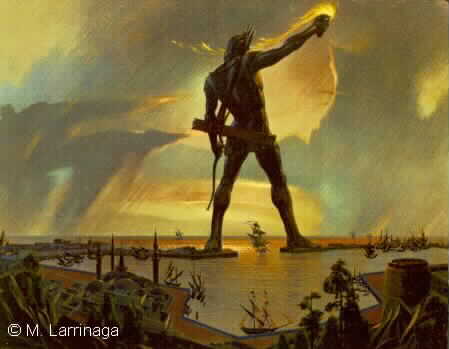
o you, O Sun, the people of Dorian Rhodes set up this bronze statue reaching to Olympus when they had pacified the waves of war and crowned their city with the spoils taken from the enemy. Not only over the seas but also on land did they kindle the lovely torch of freedom.
Dedicatory inscription of the Colossus
From its building to its destruction lies a time span of merely 56 years. Yet the colossus earned a place in the famous list of Wonders. "But even lying on the ground, it is a marvel", said Pliny the Elder. The Colossus of Rhodes was not only a gigantic statue. It was rather a symbol of unity of the people who inhabited that beautiful Mediterranean island -- Rhodes.
Location
At the entrance of the harbor of the Mediterranean island of Rhodes in Greece.
History
Throughout most of its history, ancient Greece was comprised of city-states which had limited power beyond their boundary. On the small island of Rhodes were three of these: Ialysos, Kamiros, and Lindos. In 408 BC, the cities united to form one territory, with a unified capital, Rhodes. The city thrived commercially and had strong economic ties with their main ally, Ptolemy I Soter of Egypt. In 305 BC, the Antigonids of Macedonia who were also rivals of the Ptolemies, besieged Rhodes in an attempt to break the Rhodo-Egyptian alliance. They could never penetrate the city. When a peace agreement was reached in 304 BC, the Antagonids lifted the siege, leaving a wealth of military equipment behind. To celebrate their unity, the Rhodians sold the equipment and used the money to erect an enormous statue of their sun god, Helios.
The construction of the Colossus took 12 years and was finished in 282 BC. For years, the statue stood at the harbor entrance, until a strong earthquake hit Rhodes about 226 BC. The city was badly damaged, and the Colossus was broken at its weakest point -- the knee. The Rhodians received an immediate offer from Ptolemy III Eurgetes of Egypt to cover all restoration costs for the toppled monument. However, an oracle was consulted and forbade the re-erection. Ptolemy's offer was declined.
For almost a millennium, the statue lay broken in ruins. In AD 654, the Arabs invaded Rhodes. They disassembled the remains of the broken Colossus and sold them to a Jew from Syria. It is said that the fragments had to be transported to Syria on the backs of 900 camels.
Description
Let us first clear a misconception about the appearance of the Colossus. It has long been believed that the Colossus stood in front of the Mandraki harbor, one of many in the city of Rhodes, straddling its entrance. Given the height of the statue and the width of the harbor mouth, this picture is rather impossible than improbable. Moreover, the fallen Colossus would have blocked the harbor entrance. Recent studies suggest that it was erected either on the eastern promontory of the Mandraki harbor, or even further inland. Anyway, it did never straddle the harbor entrance.
The project was commissioned by the Rhodian sculptor Chares of Lindos. To build the statue, his workers cast the outer bronze skin parts. The base was made of white marble, and the feet and ankle of the statue were first fixed. The structure was gradually erected as the bronze form was fortified with an iron and stone framework. To reach the higher parts, an earth ramp was built around the statue and was later removed. When the colossus was finished, it stood about 33 m (110 ft) high. And when it fell, "few people can make their arms meet round the thumb", wrote Pliny.
Although we do not know the true shape and appearance of the
Colossus, modern
reconstructions with the statue standing
upright are more accurate than older
drawings.
Although it disappeared from existence, the ancient World Wonder
inspired modern artists
such as French sculptor Auguste Bartholdi best known by his famous
work: The
Statue of Liberty.


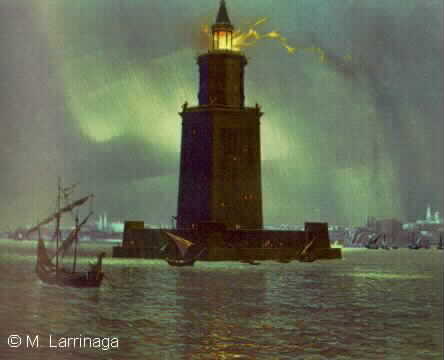
Sostratus, the son of Dexiphanes, the Cnidian, dedicated this to the Saviour Gods, on behalf of those who sail the seas.
Dedicatory inscription of the LighthouseOf the Seven Wonders of the Ancient World, only one had a practical use in addition to its architectural elegance: The Lighthouse of Alexandria. For sailors, it ensured a safe return to the Great Harbor. For architects, it meant even more: it was the tallest building on Earth. And for scientists, it was the mysterious mirror that fascinated them most... The mirror which reflection could be seen more than 50 km (35 miles) off-shore.
Location
On the ancient island of Pharos, now a promontory within the city of Alexandria in Egypt.
History
Shortly after the death of Alexander the Great, his commander Ptolemy Soter assumed power in Egypt. He had witnessed the founding of Alexandria, and established his capital there. Off of the city's coast lies a small island: Pharos. Its name, legend says, is a variation of Pharaoh's Island, but it is more likely that the name is Greek in origin. The island was connected to the mainland by means of a dike - the Heptastadion - which gave the city a double harbor. And because of dangerous sailing conditions and flat coastline in the region, the construction of a lighthouse was necessary.

The project was conceived and initiated by Ptolemy Soter around 290 BC, but was completed after his death, during the reign of his son Ptolemy Philadelphus. Sostratus, a contemporary of Euclid, was the architect, but detailed calculations for the structure and its accessories were carried out at the Alexandria Library/Mouseion. The monument was dedicated to the Savior Gods: Ptolemy Soter (lit. savior) and his wife Berenice. For centuries, the Lighthouse of Alexandria (occasionally referred to as the Pharos Lighthouse) was used to mark the harbor, using fire at night and reflecting sun rays during the day. It was even shown on Roman coins, just as famous monuments are depicted on currency today.
When the Arabs conquered Egypt, they admired Alexandria and its wealth. The Lighthouse continues to be mentioned in their writings and travelers accounts. But the new rulers moved their capital to Cairo since they had no ties to the Mediterranean. When the mirror was brought down mistakenly, they did not restore it back into place. In AD 956, an earthquake shook Alexandria, and caused little damage to the Lighthouse. It was later in 1303 and in 1323 that two stronger earthquakes left a significant impression on the structure. When the famous Arab traveler Ibn Battuta visited Alexandria in 1349, he could not enter the ruinous monument or even climb to its doorway.
The final chapter in the history of the Lighthouse came in AD 1480 when the Egyptian Mamelouk Sultan, Qaitbay, decided to fortify Alexandria's defense. He built a medieval fort on the same spot where the Lighthouse once stood, using the fallen stone and marble.

Description
Of the six vanished Wonders, the Lighthouse of Alexandria was the last to disappear. Therefore we have adequately accurate knowledge of its location and appearance. Ancient accounts such as those by Strabo and Pliny the Elder give us a brief description of the "tower" and the magnificent white marble cover. They tell us how the mysterious mirror could reflect the light tens of kilometers away. Legend says the mirror was also used to detect and burn enemy ships before they could reach the shore.
In 1166, an Arab traveler, Abou-Haggag Al-Andaloussi visited the Lighthouse. He documented a wealth of information and gave an accurate description of the structure which helped modern archeologists reconstruct the monument. It was composed of three stages: The lowest square, 55.9 m (183.4 ft) high with a cylindrical core; the middle octagonal with a side length of 18.30 m (60.0 ft) and a height of 27.45 m (90.1 ft); and the third circular 7.30 m (24.0 ft) high. The total height of the building including the foundation base was about 117 m (384 ft), equivalent to a 40-story modern building. The internal core was used as a shaft to lift the fuel needed for the fire. At the top stage, the mirror reflected sunlight during the day while fire was used during the night. In ancient times, a statue of Poseidon adorned the summit of the building.

Although the Lighthouse of Alexandria did not survive to the present day, it left its influence in various respects. From an architectural standpoint, the monument has been used as a model for many prototypes along the Mediterranean, as far away as Spain. And from a linguistic standpoint, it gave its name -- Pharos -- to all the lighthouses in the world... Just look up the dictionary for the French, Italian, or Spanish word for lighthouse.
The Seven Wonders of The Modern World
The 20th century has provided spectacular advances in design, engineering, and construction which have allowed humanity to create an assortment of colossal structures. These wonders embody an abundance of human ingenuity, showcasing man's ability to dream, plan, and achieve on a mind-boggling scale. Mankind has an incredible ability to make the impossible, possible.
Week 4: The Empire State Building, New York City
HISTORY
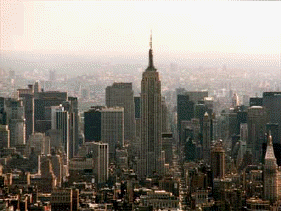
Construction of the Empire State Building began in March of 1930 on the site of the old Waldorf-Astoria Hotel at 350 Fifth Avenue at 34th Street. It was completed 14 months later in May, 1931. Designed by the architectural firm of Shreve, Lamb, & Harmon Associates, the Empire State Building, at 102 stories, was the tallest building in the world until the completion of the first tower of the World Trade Center in Lower Manhattan in 1972.
LOCATION
350 Fifth Avenue, between 33rd and 34th Streets, New York, NY 10001
DESCRIPTION
Architects: Shreve, Lamb & Harmon
Associates.
Builders: Starrett Brothers & Eken, Inc.
Height: 1,472 feet (448 meters) to top of antennae. 1,250 feet
(391 meters) to 102nd floor observatory. 1,050 feet (320 meters) to
86th floor observatory.
Volume: 37 million cubic feet.
Area of Site: 83,860 square feet.
Cost including land: $40,948,900. (451,173,508 in today's money)
Cost of building alone: $24,718,000 (272,342,000 in today's
money)
Construction schedule:
Excavation: Begun January 22, 1930, before demolition of old
Waldorf-Astoria Hotel completed.
Construction: Begun March 17, 1930. Framework rose at the rate of 4.5
stories per week.
Cornerstone: Laid by Alfred E. Smith, former governor of New York,
September 17, 1930.
Masonry completed: November 13, 1930.
Official opening: May 1, 1931, by President Herbert Hoover, who
pressed a button in Washington, D.C. to turn on the building's lights.
Total time: 7 million man hours, 1 year and 45 days work,
including Sundays and holidays.
Work Force: 3,400 during peak periods.
Building Materials:
Exterior: Indiana limestone and granite, trimmed with aluminum and
chrome-nickel steel from the 6th floor to the top.
Interior lobby: Ceiling high marble, imported from France, Italy,
Belgium and Germany.
Week 5: The Itaipu Dam,
Paraná
River
The Itaipú hydroelectric power plant is the
largest development of its kind in operation in the world. Built from
1975 to 1991, in a binational development on the Paraná River,
Itaipú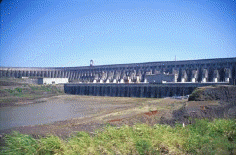 represents the efforts and accomplishments of two neighboring
countries, Brazil and Paraguay. The power plant's 18 generating units
add up to a total production capacity of 12,600 MW (megawatts) and a
reliable output of 75 million MWh a year. Itaipú's energy
production has broken several records over the recent years, after the
last generating unit was commissioned in 1991. The generation of
77.212.396 MWh a year in 1995 will again be surpassed in 1996, and the
new record will be around the 80 million MWh a year mark.
represents the efforts and accomplishments of two neighboring
countries, Brazil and Paraguay. The power plant's 18 generating units
add up to a total production capacity of 12,600 MW (megawatts) and a
reliable output of 75 million MWh a year. Itaipú's energy
production has broken several records over the recent years, after the
last generating unit was commissioned in 1991. The generation of
77.212.396 MWh a year in 1995 will again be surpassed in 1996, and the
new record will be around the 80 million MWh a year mark.
The magnitude of the project can also be demonstrated by the fact that in 1995 Itaipú alone responded for 25% of the energy supply in Brazil and 78% in Paraguay. The power plant is also a major tourism attraction in the Foz do Iguaçú area, having received around 9 million visitors from 162 countries. The Brazilian city of Foz do Iguaçu, also home of the famous Iguaçú Falls, is located at the Western tip of Paraná State, right by the border with Paraguay and Argentina.
General Outline of the ProjectThe Itaipú hydroelectric power plant, located 14 kilometers North of the International Bridge linking the cities of Foz do Iguaçú, Brazil, and Ciudad del Este, Paraguay, consists of a series of various types of dams a total distance of 7,744 meters with a crest elevation of 225 meters. The Powerhouse is located at the toe of the main Dam, most of it on the river bed and the rest on the Diversion Channel. The nominal power of the plant is 12,600 MW, divided between 18 generating units of 700 MW each, 15 of which are located in the main Powerhouse and the remaining three on the Diversion Channel. The Spillway is located on the right bank, and it has 14 segmented sluice-gates with a total discharge rate of 62,200 cubic meters per second (twice that of the highest flood- level on record). The Concrete Main Dam is of the hollow gravity type and is connected to the Spillway by a concrete buttress-type Wing Dam which continues thereon as a small Cardhfill dike. On the left bank a Rockfill Dam is linked to the Main Dam and at the other end to an Earthfill Dam. In order to build the main dam wall and the Powerhouse, the river was diverted through a Diversion Channel on the left bank.
The volumes of construction in Itaipú are also impressive. The volume of iron and steel utilized in the Dam structure would be enough to build 380 Eiffel Towers, and the volume of concrete used in Itaipú represents 15 times the volume utilized to build the Channel Tunnel between France and England. Itaipú is one of the Seven Wonders of the Modern World, according to a worldwide survey conducted by the American Society of civil Engineers (ASCE).To build the Itaipú Dam, workers reenacted a labor of Hercules: they shifted the course of the seventh biggest river in the world (Paraná River, at the Brazil/Paraguay border) and removed more than 50 million tons of earth and rock. The true marvel of Itaipú, though, is its powerhouse ... a single building that puts out 12,600 megawatts -- enough to power most of California".
Week 5: The CN Tower, Toronto
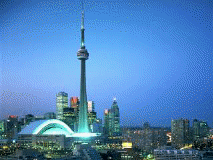 It
is fitting that television, the technological wonder that profoundly
changed life in the 20th century, spurred the building of the era's
tallest freestanding structure. In the late 1960's, Toronto's soaring
skyline began to play havoc with signals from conventional transmission
towers. Signals bouncing off the city's skyscrapers produced a number
of problems, including the annoying phenomenon of "ghosting" on
television sets. Weaker signals competed with stronger ones, giving
viewers the effects of watching two programs at once. To improve the
situation, Canadian National Railways, or CN, proposed building a
transmission tower that would stand head and shoulders - and then some
- above Toronto's tallest buildings.
It
is fitting that television, the technological wonder that profoundly
changed life in the 20th century, spurred the building of the era's
tallest freestanding structure. In the late 1960's, Toronto's soaring
skyline began to play havoc with signals from conventional transmission
towers. Signals bouncing off the city's skyscrapers produced a number
of problems, including the annoying phenomenon of "ghosting" on
television sets. Weaker signals competed with stronger ones, giving
viewers the effects of watching two programs at once. To improve the
situation, Canadian National Railways, or CN, proposed building a
transmission tower that would stand head and shoulders - and then some
- above Toronto's tallest buildings.
A Toronto firm prepared the initial design, enlisting the aid of engineering experts the world over. Their original plan showed three towers linked by structural bridges. Gradually the design evolved into a single 1,815.5-foot-tall tower comprised of three hollow "legs." Foundation work began in 1973. Giant backhoes excavated more than 62,000 tons of earth and shale to a depth of 50 feet from a along the shore of Lake Ontario in Toronto harbour. Next, prestressed concrete and reinforced steel were arranged in a Y-shaped pattern 22 feet thick. Each hollow leg of the Y would carry its fair share of the tower's 130,000-ton burden.
The foundation took only four months to complete. The tower itself presented a challenge of height never before met by the technique of poured concrete. To meet that challenge, engineers designed a huge mold known as a slip form. Concrete was poured 24 hours a day, five days a week, and as it hardened, the mold moved upward by means of a ring of hydraulic jacks. The ascending slip form gradually decreased in girth to give the tower its tapering shape. When the tower reached the 1,100-foot mark, the builders made preparations for the SkyPod, a seven-story structure housing two observation decks, a revolving restaurant, a nightclub, and broadcasting equipment. The SkyPod is anchored by 12 steel-and-wooden brackets that were slowly pushed up the tower by 45 hydraulic jacks. Concrete formed the SkyPod's "walls," and a doughnut-shaped ring, called a radome, was added to its base to protect the delicate microwave dishes receiving radio and television transmissions. The SkyPod is reached by four high-speed, glass-fronted elevators whose rapid rise simulates a jetliner's takeoff, unless weather conditions call for a much slower ascent.
The concrete tower continues above the SkyPod, ending at the Space Deck 1,465 feet up. The Space Deck receives support from cantilevers extending out of the concrete section beneath it. After a 58-second elevator ride from the SkyPod below, visitors can enjoy breathtaking vistas from a glass-enclosed balcony. On a clear day they might be able to glimpse sites 75 miles away. For the last phase of construction, a Sikorsky Skycrane helicopter arrived to install the tower's 335-foot communications mast. One by one the helicopter lifted about 40 seven-ton sections of the mast to the top of the tower, where workers braved blustery March winds to receive them. When the sections were in place, they were secured by a total of 40,000 bolts. Afterward, the entire mast was covered by a fiberglass-reinforced sheathing to prevent icing.
Of interest to Torontonians since construction began, the CN tower gained additional fans with the arrival of the helicopter. Nicknamed Olga, its daily schedule was printed in newspapers, and changes were announced as breaking news on radio and television. With Olga, the mast assembly took a little longer than three weeks; without Olga, the job would have lasted six months. Completed in 1975, the tower had cost $57 million (236,216,000 in today's money) to build, a bargain compared with other modern wonders. It also boasted incredible statistics of precision and safety. During construction, surveyors' transits up to a thousand feet away focused on optical plumbs mounted on the slip-form base. The constant surveillance kept the structure an incredible 1.1 inches within plumb.
Engineers established a wind-tolerance standard for the tower of 260 miles an hour, a level well above nature's most extreme demands. Counterweights on the antenna correct for wobble in high winds. Because the tower is an easy target for lightning, copper grounding wires were installed. As a result, visitors can safely view some 75 spectacular strikes a year. The CN Tower is a work in progress. In recent years the tower gained two new elevators to accommodate an increase in visitors. To accomplish this, the 2,579-step metal staircase was moved to the interior of the structure. In addition, a glass floor was added to the SkyPod's observation deck. Brave visitors, the majority not surprisingly children, inch out over the visual void. More often than not the experience is pronounced, "Awesome!" Almost twice as tall as the Eiffel Tower and more than three times the height of the Washington Monument, the CN Tower has taken proud ownership of Toronto's skyline, while exorcising the ghosts from its TV sets.
Week 6: The Panama Canal, Panama
Among the great peaceful endeavors of mankind that
have contributed significantly to progress in the world, the
construction of the Canal stands as an awe-inspiring achievement. The
unparalled engineering triumph was made possible by an international
work force under the leadership of American visionaries, who made the
centuries-old dream of uniting the two great oceans a reality. In 1534,
Charles I of Spain ordered the first survey of a proposed canal route
through the Isthmus of Panama. More than three centuries passed before
the first construction was started. The French labored 20 years,
beginning in 1880, but disease and financial problems defeated them.
In 1903, Panama and the United States signed a
treaty by which the United States undertook to construct an
inter-oceanic ship canal across the Isthmus of Panama. The following
year, the United States purchased from the French Canal Company its
rights and properties for $40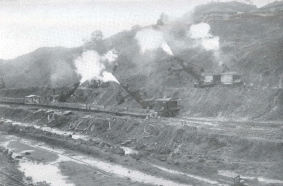 million and began construction. The monumental project was completed in
ten years at a cost of about $387 million (7,192,727,272 in today's
money).. Since 1903 the United States has invested about $3 billion in
the Canal enterprise, approximately two-thirds of which has been
recovered. The building of the Panama Canal involved three main
problems -- engineering, sanitation, and organization. Its successful
completion was due principally to the engineering and administrative
skills of such men as John F. Stevens and Col. George W. Goethals, and
to the solution of extensive health problems by Col. William C. Gorgas.
The engineering problems involved digging through the Continental
Divide; constructing the largest earth dam ever built up to that time;
designing and building the most massive canal locks ever envisioned;
constructing the largest gates ever swung; and solving environmental
problems of enormous proportions.
million and began construction. The monumental project was completed in
ten years at a cost of about $387 million (7,192,727,272 in today's
money).. Since 1903 the United States has invested about $3 billion in
the Canal enterprise, approximately two-thirds of which has been
recovered. The building of the Panama Canal involved three main
problems -- engineering, sanitation, and organization. Its successful
completion was due principally to the engineering and administrative
skills of such men as John F. Stevens and Col. George W. Goethals, and
to the solution of extensive health problems by Col. William C. Gorgas.
The engineering problems involved digging through the Continental
Divide; constructing the largest earth dam ever built up to that time;
designing and building the most massive canal locks ever envisioned;
constructing the largest gates ever swung; and solving environmental
problems of enormous proportions.
For centuries, the English Channel separating Great Britain from the rest of Europe has served as a near impregnable barrier to would-be invaders, protecting England’s sovereignty while keeping the nation culturally and socially distinct from its neighbors. The $15 billion Channel Tunnel (informally called the “Chunnel”), which began operations in 1994, provides the first land link between England and continental Europe. The Chunnel is 31 miles long; 23 miles of this distance is underwater. At present, it consists of three interconnected tubes; one rail tunnel in each direction and a service tube. For facts about the Chunnel, a diagrams, and information about traveling Europe by rail, see the Eurostar page. Obviously, the only way to experience the Chunnel is to take a train through it, so you’ll have to find some other activities to fill your time in two of the most culturally and historically rich nations in the world.
Week 6: The North Sea
Protection
Works, Netherlands
For many, the image out of the Dutch fight against
the North
Sea rests in the figure of a young boy valiantly saving his town by
using a
finger to plug a hole in the dike. But this familiar hero is a
fictional one, a
creation of American author Mary Mapes Dodge in her book, Hans Brinker.
In
reality, heroism falls on all the Dutch, who for more than a millenium
have been
wresting precious agricultural lands from the sea and fighting to hold
on to
them. Their greatest achievement-a colossal fun in the dike-if the vast
and one
dress project known as that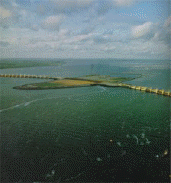 Netherlands North Sea protection works. Because much of the Netherlands
lies
below sea level, normal tides would daily inundate about half the
country if
previous generations of industrious Dutch had not raised dikes and
dams. Severe
storms often cause tidal waters to crash into the dikes and inundate
rivers and
estuaries. Although all of the coastal areas are threatened, two
particularly
vulnerable ones are the large tidal inlet formerly known as the Zuider
Zee and
the delta created by the Rhine and Meuse rivers in the southwestern
corner of
the country.
Netherlands North Sea protection works. Because much of the Netherlands
lies
below sea level, normal tides would daily inundate about half the
country if
previous generations of industrious Dutch had not raised dikes and
dams. Severe
storms often cause tidal waters to crash into the dikes and inundate
rivers and
estuaries. Although all of the coastal areas are threatened, two
particularly
vulnerable ones are the large tidal inlet formerly known as the Zuider
Zee and
the delta created by the Rhine and Meuse rivers in the southwestern
corner of
the country.
Dutch engineers purse propose that the Zuider Zee be dammed and drained in the 19th century, but the government was reluctant to tackle such an immense project. Then, in 1916, a furious storm hit the northern provinces. The difficulties of wartime agricultural production were compounded, and the way was paved for the damming of the Zuider Zee.The dam enclosing the Zuider Zee was built in two sections using traditional materials. Beginning in 1923, workers laid boulder clay in parallel layers and filled the space in between with sand, stones, and handmade, mattresses fashioned from brushwood. To curtail erosion, larger mattresses ballasted with chains and stones were sunk in the estuaries channels. Dredges, cranes, tugboats, and barges were engaged in the erection of the main dam, 300 feet wide at sea level and 25 feet high at the level of its causeway. As the tide turned on the final day of construction, fill tumbled into the dam's last gap, transforming the inlet into a freshwater lake, renamed the Ijsselmeer. The finished dam contains sluices for draining excess water and locks for maintaining shipping.
After the damming came the draining. In all, more than a half million acres of polders, or reclaimed farmland, emerged from the bottom of the former Zuider Zee. Young Dutch farmers clamoring for the right to settle the new polder lands, because farms on new, unobstructed land were far more suitable for modern, mechanized farming methods than traditional farms in older areas.In 1953, the "storm of the century" howled across the North Sea and into the Netherlands, testing the strength of the Zuider Zee enclosure. It held, with damage to the causeway heavy in places. The country's unprotected southwestern provinces felt the full brunt of the storm, with water surging over seawalls and up the delta's wide waterways. More than 1,800 people lost their lives, and livestock numbering in the hundreds of thousands perished. The country then realized that the long-intended plan to safeguard the southwestern delta, the Delta Plan or Delta Project, must be mobilized.
The plan would undergo a many incarnations. The last one involved a damming four estuaries in the middle of the delta while leaving open channels to Rotterdam in the north and Antwerp, Belgium, in the south. A two-mile-long surge barrier in the Oosterschelde estuaries was the most complex and sophisticated piece of the project.Originally, the Oosterschelde was to be a closed barrier. But lobbying by fishermen and conservationists resulted in the switch to a movable barrier. To facilitate construction, engineers fashioned islands on three sandbars in the estuaries and constructed work harbors, material yards, and work sites there. A dam connected two of the islands, effectively creating three channels in the estuaries, each to receive a section of the surge barrier.
The movable barrier consists of 65 concrete piers weighing 18,000 tons apiece. The piers support 300- to 500-ton steel gates and their hydraulic machinery, as well as a roadway above and load-bearing beams below. Constructed on the work islands, the piers and their mechanisms had to be lifted into precise positions in the estuary. But the type of equipment needed for such gargantuan and specialized tasks did not exist anywhere in the world; it had to be invented. The Oosterschelde barrier also honored traditional methods. As part of the measures taken to stabilize the sea floor, mattresses were laid under each pier to prevent erosion. They were not the hand-built weaving of trees and brush used to close the Zuider Zee, however. Instead, they were high-tech sandwiches of sand and gravel between space-age fabric covers. The Oosterschelde project finished in 1986. Since then, the Dutch have taken additional measures, including the completion in 1997 of the barrier that protects the port of Rotterdam. "In terms of magnitude," an American trade journal wrote, the North Sea project "approaches of the Great Wall of China. In terms of complexity and technical sophistication, it approaches the lunar shot. It is unique, expensive, and quite unlike any other civil engineering project to be found on this planet."
Week 7: The Golden Gate
Bridge, San
Francisco
The Golden Gate Bridge links San Francisco with
Marin County
in absolute splendor. The bridge is one of the architectural marvels of
the
Twentieth Century and a testament to human strife, as it was
constructed during
the years of the Great Depression. For years, the Golden Gate Bridge
held the
title as the longest suspension bridge in the world. Before its
completion in
1937, the bridge was considered impossible to build, due to
persistently foggy
weather, 60-mile-per-hour winds, and strong ocean currents, which
whipped
through a deep canyon below. In fact, the bridge is commonly known as
the
"Bridge that couldn't be built." Despite these unforgiving natural
elements, the bridge was constructed in a little more than four years.
The total
cost was $35 million (447,227,000 in today's money). The total length
of the
bridge spans 1.2 miles. Eleven men lost their lives during the
construction of
the bridge.
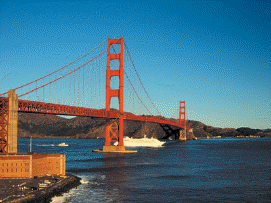 Even
today, the massive spans of the bridge are often shrouded in fog. The
bridge
sways 27 feet to withstand winds of up to 100 miles per hour.
International
Orange was the color chosen for the bridge because it blended well with
the
bridge's natural surroundings. The two great cables extending from the
bridge
contain 80,000 miles of steel wire, which is enough to circle the
equator three
times. The concrete poured to cement the bridge into the stormy waters
below
could have also been used to pave a five-foot wide sidewalk from New
York to San
Francisco. Because of the Golden Gate Bridge, San Francisco is one of
the
premier skyline cities in the nation. It was a triumphant day in the
history of
the city when the bridge was completed on May 27, 1937. Over 200,000
people
celebrated the grand opening of the Golden Gate Bridge by walking its
length.
The following day, a dedication ceremony was held to officially
christen what
would become the architectural trademark of the city. The regular flow
of
vehicular traffic began the next day.
Even
today, the massive spans of the bridge are often shrouded in fog. The
bridge
sways 27 feet to withstand winds of up to 100 miles per hour.
International
Orange was the color chosen for the bridge because it blended well with
the
bridge's natural surroundings. The two great cables extending from the
bridge
contain 80,000 miles of steel wire, which is enough to circle the
equator three
times. The concrete poured to cement the bridge into the stormy waters
below
could have also been used to pave a five-foot wide sidewalk from New
York to San
Francisco. Because of the Golden Gate Bridge, San Francisco is one of
the
premier skyline cities in the nation. It was a triumphant day in the
history of
the city when the bridge was completed on May 27, 1937. Over 200,000
people
celebrated the grand opening of the Golden Gate Bridge by walking its
length.
The following day, a dedication ceremony was held to officially
christen what
would become the architectural trademark of the city. The regular flow
of
vehicular traffic began the next day.
Efforts to begin the construction on the bridge began as early as 1928.
The
process would entail the efforts of six counties in Northern
California. In
1928, the counties formed a Golden Gate Bridge and Highway District. In
1930,
the voters appropriated a $35 million bond issue to finance the
building of the
bridge. For many years following, Joseph Baerman Strauss, a
distinguished
engineer, dreamed of raising a span across the Golden Gate. It was in
response
to his vision that people first started saying that the bridge could
not be
built. But, amazingly enough, Strauss held fast to his vision, and a
span was
eventually raised across the Golden Gate Bridge. The actual work on the
bridge
began on January 5, 1933. It was completed four-and-one-half years
later. The
result astounded the fiercest of Strauss's critics. To this day, the
bridge is
admired for its magnitude and beauty.
The bridge is nothing short of a powerful force meant to combat nature.
The
often mighty winds from the Pacific Ocean are sustained by a mid span
swing of
27 feet. The two towers of the bridge rise an impressive 746 feet,
which is 191
feet taller than the Washington Monument. The pier of the bridge is
only 1,215
feet from the shore, the distance between the two towers that support
the
cables, which in turn, support the floor of the bridge is 4,200 feet.
These two
cables are the largest bridge cables ever made at a little over 361
feet in
diameter.
Today, pedestrians and bicyclists are still allowed to cross the bridge
on
pathways with breathtaking views of the city, Alcatraz, and the Marin
Headlands.
The bridge toll for vehicles is $3 when entering San Francisco. The
first exit
of the Marin side of the bridge is Visa Point, which provides a
magnificent view
of the San Francisco skyline. But, the best way to view the bridge is
to walk
across. This usually takes about an hour.
HOME