William Shakespeare was born to John Shakespeare and mother Mary Arden some time in late April 15
64 in Stratford-upon-Avon. There is no record of his birth, but his baptism was recorded by the
church, thus his birthday is assumed to be the 23 of April. His father was a prominent and
prosperous alderman in the town of Stratford-upon-Avon, and was later granted a coat of arms by
the College of Heralds. All that is known of Shakespeare's youth is that he presumably attended
the Stratford Grammar School, and did not proceed to Oxford or Cambridge. The next record we
have of him is his marriage to Anne Hathaway in 1582. The next year she bore a daughter for him,
Susanna, followed by the twins Judith and Hamnet two years later.
Seven years later Shakespeare is recognized as an actor, poet and playwright, when a rival
playwright, Robert Greene, refers to him as "an upstart crow" in A Groatsworth of Wit. A few
years later he joined up with one of the most successful acting troupe's in London: The Lord
Chamberlain's Men. When, in 1599, the troupe lost the lease of the theatre where they performed,
(appropriately called The Theatre) they were wealthy enough to build their own theatre across
the Thames, south of London, which they called "The Globe." The new theatre opened in July of
1599, built from the timbers of The Theatre, with the motto "Totus mundus agit histrionem"
(A whole world of players) When James I came to the throne (1603) the troupe was designated by
the new king as the King's Men (or King's Company). The Letters Patent of the company
specifically charged Shakespeare and eight others "freely to use and exercise the art and faculty
of playing Comedies, Tragedies, Histories, Inerludes, Morals, Pastorals, stage plays ... as well
for recreation of our loving subjects as for our solace and pleasure."
Shakespeare entertained the king and the people for another ten years until June 19, 1613, when
a canon fired from the roof of the theatre for a gala performance of Henry VIII set fire to the
thatch roof and burned the theatre to the ground. The audience ignored the smoke from the roof
at first, being to absorbed in the play, until the flames caught the walls and the fabric of the
curtains. Amazingly there were no casualties, and the next spring the company had the theatre
"new builded in a far fairer manner than before." Although Shakespeare invested in the rebuilding
, he retired from the stage to the Great House of New Place in Statford that he had purchased in
1597, and some considerable land holdings ,where he continued to write until his death in 1616
on the day of his 52nd birthday.
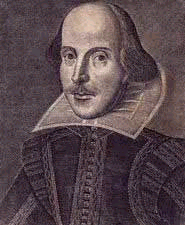 William Shakespeare was born to John Shakespeare and mother Mary Arden some time in late April 15
64 in Stratford-upon-Avon. There is no record of his birth, but his baptism was recorded by the
church, thus his birthday is assumed to be the 23 of April. His father was a prominent and
prosperous alderman in the town of Stratford-upon-Avon, and was later granted a coat of arms by
the College of Heralds. All that is known of Shakespeare's youth is that he presumably attended
the Stratford Grammar School, and did not proceed to Oxford or Cambridge. The next record we
have of him is his marriage to Anne Hathaway in 1582. The next year she bore a daughter for him,
Susanna, followed by the twins Judith and Hamnet two years later.
Seven years later Shakespeare is recognized as an actor, poet and playwright, when a rival
playwright, Robert Greene, refers to him as "an upstart crow" in A Groatsworth of Wit. A few
years later he joined up with one of the most successful acting troupe's in London: The Lord
Chamberlain's Men. When, in 1599, the troupe lost the lease of the theatre where they performed,
(appropriately called The Theatre) they were wealthy enough to build their own theatre across
the Thames, south of London, which they called "The Globe." The new theatre opened in July of
1599, built from the timbers of The Theatre, with the motto "Totus mundus agit histrionem"
(A whole world of players) When James I came to the throne (1603) the troupe was designated by
the new king as the King's Men (or King's Company). The Letters Patent of the company
specifically charged Shakespeare and eight others "freely to use and exercise the art and faculty
of playing Comedies, Tragedies, Histories, Inerludes, Morals, Pastorals, stage plays ... as well
for recreation of our loving subjects as for our solace and pleasure."
Shakespeare entertained the king and the people for another ten years until June 19, 1613, when
a canon fired from the roof of the theatre for a gala performance of Henry VIII set fire to the
thatch roof and burned the theatre to the ground. The audience ignored the smoke from the roof
at first, being to absorbed in the play, until the flames caught the walls and the fabric of the
curtains. Amazingly there were no casualties, and the next spring the company had the theatre
"new builded in a far fairer manner than before." Although Shakespeare invested in the rebuilding
, he retired from the stage to the Great House of New Place in Statford that he had purchased in
1597, and some considerable land holdings ,where he continued to write until his death in 1616
on the day of his 52nd birthday.
William Shakespeare was born to John Shakespeare and mother Mary Arden some time in late April 15
64 in Stratford-upon-Avon. There is no record of his birth, but his baptism was recorded by the
church, thus his birthday is assumed to be the 23 of April. His father was a prominent and
prosperous alderman in the town of Stratford-upon-Avon, and was later granted a coat of arms by
the College of Heralds. All that is known of Shakespeare's youth is that he presumably attended
the Stratford Grammar School, and did not proceed to Oxford or Cambridge. The next record we
have of him is his marriage to Anne Hathaway in 1582. The next year she bore a daughter for him,
Susanna, followed by the twins Judith and Hamnet two years later.
Seven years later Shakespeare is recognized as an actor, poet and playwright, when a rival
playwright, Robert Greene, refers to him as "an upstart crow" in A Groatsworth of Wit. A few
years later he joined up with one of the most successful acting troupe's in London: The Lord
Chamberlain's Men. When, in 1599, the troupe lost the lease of the theatre where they performed,
(appropriately called The Theatre) they were wealthy enough to build their own theatre across
the Thames, south of London, which they called "The Globe." The new theatre opened in July of
1599, built from the timbers of The Theatre, with the motto "Totus mundus agit histrionem"
(A whole world of players) When James I came to the throne (1603) the troupe was designated by
the new king as the King's Men (or King's Company). The Letters Patent of the company
specifically charged Shakespeare and eight others "freely to use and exercise the art and faculty
of playing Comedies, Tragedies, Histories, Inerludes, Morals, Pastorals, stage plays ... as well
for recreation of our loving subjects as for our solace and pleasure."
Shakespeare entertained the king and the people for another ten years until June 19, 1613, when
a canon fired from the roof of the theatre for a gala performance of Henry VIII set fire to the
thatch roof and burned the theatre to the ground. The audience ignored the smoke from the roof
at first, being to absorbed in the play, until the flames caught the walls and the fabric of the
curtains. Amazingly there were no casualties, and the next spring the company had the theatre
"new builded in a far fairer manner than before." Although Shakespeare invested in the rebuilding
, he retired from the stage to the Great House of New Place in Statford that he had purchased in
1597, and some considerable land holdings ,where he continued to write until his death in 1616
on the day of his 52nd birthday.
