Albert Einstein was born in Germany in 1879. He liked classical music and played the violin.
Einstein was very interested in the magnetic compass. He liked how it aways swung to the north. The compass convinced him that there had to be
"something behind things, something deeply hidden."
Even when he was a small boy Albert Einstein was self-sufficient and thoughtful. According to family
legend he talked slowly, pausing to think about what he would say. His sister remembered the
concentration and perseverance he used to build houses of cards.
In 1933, he joined the staff of the Institute for Advanced Study in Princeton, New
Jersey. He stayed in this position for life, living there until his death. Einstein is probably
famous because for his mathematical equation about the nature of energy, E = MC2.
Albert Einstein wrote a paper about the structure of light. He argued that
light can act as though it consists of discrete, independent particles of energy, in some ways
like the particles of a gas. A few years before, Max Planck's work had contained the first
suggestion of a discreteness in energy, but Einstein went far beyond this. His revolutionary
proposal seemed to contradict the universally accepted theory that light consists of smoothly
oscillating electromagnetic waves. But Einstein showed that light quanta, as he called the
particles of energy, could help to explain phenomena being studied by experimental physicists.
For example, he made clear how light ejects electrons from metals.
There was a well-known kinetic energy theory that explained heat as an effect of the ceaseless
motion of atoms; Einstein proposed a way to put the theory to a new and crucial experimental test
. If tiny but visible particles were suspended in a liquid, he said, the irregular bombardment by
the liquid's invisible atoms should cause the suspended particles to carry out a random
jittering dance. One should be able to observe this through a microscope, and if the predicted
motion were not seen, the whole kinetic theory would be in grave danger. But just such a random
dance of microscopic particles had long since been observed. Now the motion was explained in
detail. Albert Einstein had reinforced the kinetic theory, and he had created a powerful new
tool for studying the movement of atoms.
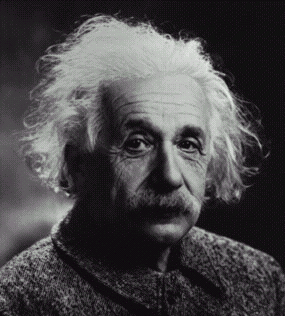 Albert Einstein was born in Germany in 1879. He liked classical music and played the violin.
Einstein was very interested in the magnetic compass. He liked how it aways swung to the north. The compass convinced him that there had to be
"something behind things, something deeply hidden."
Even when he was a small boy Albert Einstein was self-sufficient and thoughtful. According to family
legend he talked slowly, pausing to think about what he would say. His sister remembered the
concentration and perseverance he used to build houses of cards.
In 1933, he joined the staff of the Institute for Advanced Study in Princeton, New
Jersey. He stayed in this position for life, living there until his death. Einstein is probably
famous because for his mathematical equation about the nature of energy, E = MC2.
Albert Einstein wrote a paper about the structure of light. He argued that
light can act as though it consists of discrete, independent particles of energy, in some ways
like the particles of a gas. A few years before, Max Planck's work had contained the first
suggestion of a discreteness in energy, but Einstein went far beyond this. His revolutionary
proposal seemed to contradict the universally accepted theory that light consists of smoothly
oscillating electromagnetic waves. But Einstein showed that light quanta, as he called the
particles of energy, could help to explain phenomena being studied by experimental physicists.
For example, he made clear how light ejects electrons from metals.
There was a well-known kinetic energy theory that explained heat as an effect of the ceaseless
motion of atoms; Einstein proposed a way to put the theory to a new and crucial experimental test
. If tiny but visible particles were suspended in a liquid, he said, the irregular bombardment by
the liquid's invisible atoms should cause the suspended particles to carry out a random
jittering dance. One should be able to observe this through a microscope, and if the predicted
motion were not seen, the whole kinetic theory would be in grave danger. But just such a random
dance of microscopic particles had long since been observed. Now the motion was explained in
detail. Albert Einstein had reinforced the kinetic theory, and he had created a powerful new
tool for studying the movement of atoms.
Albert Einstein was born in Germany in 1879. He liked classical music and played the violin.
Einstein was very interested in the magnetic compass. He liked how it aways swung to the north. The compass convinced him that there had to be
"something behind things, something deeply hidden."
Even when he was a small boy Albert Einstein was self-sufficient and thoughtful. According to family
legend he talked slowly, pausing to think about what he would say. His sister remembered the
concentration and perseverance he used to build houses of cards.
In 1933, he joined the staff of the Institute for Advanced Study in Princeton, New
Jersey. He stayed in this position for life, living there until his death. Einstein is probably
famous because for his mathematical equation about the nature of energy, E = MC2.
Albert Einstein wrote a paper about the structure of light. He argued that
light can act as though it consists of discrete, independent particles of energy, in some ways
like the particles of a gas. A few years before, Max Planck's work had contained the first
suggestion of a discreteness in energy, but Einstein went far beyond this. His revolutionary
proposal seemed to contradict the universally accepted theory that light consists of smoothly
oscillating electromagnetic waves. But Einstein showed that light quanta, as he called the
particles of energy, could help to explain phenomena being studied by experimental physicists.
For example, he made clear how light ejects electrons from metals.
There was a well-known kinetic energy theory that explained heat as an effect of the ceaseless
motion of atoms; Einstein proposed a way to put the theory to a new and crucial experimental test
. If tiny but visible particles were suspended in a liquid, he said, the irregular bombardment by
the liquid's invisible atoms should cause the suspended particles to carry out a random
jittering dance. One should be able to observe this through a microscope, and if the predicted
motion were not seen, the whole kinetic theory would be in grave danger. But just such a random
dance of microscopic particles had long since been observed. Now the motion was explained in
detail. Albert Einstein had reinforced the kinetic theory, and he had created a powerful new
tool for studying the movement of atoms.
