next up previous contents
Next: Quantisation Up: Block Transform Coding Previous: Block Transform Coding

Discrete Cosine Transform

The two-dimensional DCT of a $N \times N$ block of pels is described by the following pair of equations.
 \begin{displaymath}
F(u,v) = \frac{2}{N} C(u) C(v) \sum_{i=0}^{N-1} \sum_{i=0}^{...
...{(2i+1)u\pi}{2N}\right) \cos\left(\frac{(2j+1)v\pi}{2N}\right)
\end{displaymath} (2.1)


 \begin{displaymath}
f(i,j) = \frac{2}{N} \sum_{i=0}^{N-1} \sum_{i=0}^{N-1} C(u) ...
...{(2i+1)u\pi}{2N}\right) \cos\left(\frac{(2j+1)v\pi}{2N}\right)
\end{displaymath} (2.2)

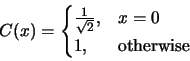
where

\begin{displaymath}C(x) =
\begin{cases}\frac{1}{\sqrt{2}},& x=0 \\ 1,& \text{otherwise}\end{cases}\end{displaymath}

and f(i,j) are the pel values, which are integers usually in the range 0-255, with F(u,v) their correspondent DCT coefficients, which are real numbers.

The DCT converts a block of pels to a same-sized block of coefficients, representing the image data in the spatial frequency domain. Upper-left corner coefficients represent low spatial frequencies, and therefore contain most of the information for the majority of blocks within a picture, while lower-right corner coefficients represent high spatial frequencies, most of which are usually near zero. The first coefficient, at the top-left position of the block is called the DC value and represents zero spatial frequency, while all the remaining are the AC coefficients.



Isaac Kokkinidis
1998-08-27
Hosted by www.Geocities.ws

1