



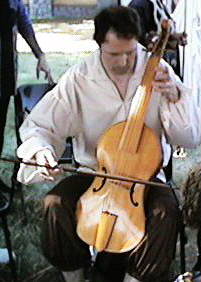
The body of the viol was lightly constructed and the six strings were under rather low tension. Common sizes included the treble, alto, small tenor, tenor, and bass. The strings were usually tuned in a sequence of a 4th, 4th, M3rd, 4th, 4th (d-g-c'-e'-a'-d" for the treble). The frets were made from pieces of stretched gut, and were tied around the neck with a special fret knot. The frets could be pushed around for easy tuning.
The bow is rather convex in shape, as opposed to the violin bow's concave bend. It is held in an underhand grip, the palm facing upwards. C. Simpson said in 1659, Hold the Bow betwixt the ends of your Thumb and two foremost fingers, near to the Nut. The Thumb and first finger fastned on the Stalk; and the second fingers end turned in shorter, against the Hairs thereof; by which you may poize and keep up the point of the Bow. Danoville in 1687 gave the advice that the viol bow must be of Chinese wood, and should not be too heavy, because it makes the hand clumsy, nor too light, because than it cannot play chords enough; but a weight proportioned to the hand, which is why I leave that to the choice of the one who plays the Viol.
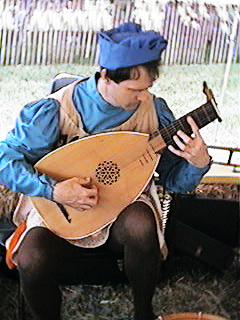
During the Renaissance the lute held the highest respect of all musical instruments. The repertoire for this courtly instrument is vast. Delicacy, expressiveness and nuance of performance were made possible when the use of a plectrum to pluck the strings was replaced by use of the fingers. The lute was an ideal accompaniment for voice and other soft instruments, and the most eloquent of all solo instruments. In paintings and other art works the lute is often associated with Apollo, angels, or Orpheus, and it is often mentioned at climactic points in tragedies. The lute also played a prominent role in comedy.
Although the greatest repertoire for the lute is from England, the best makers were Germans who lived in Italy. The delicacy and expressiveness of Renaissance lute music is mirrored in the light construction of the instrument. Its belly is made of pine, often only one-sixteenth inch thick, with a carved sound-hole or rose in the middle. Wooden bars glued underneath the belly strengthen it and add to the resonance. The pear shaped back is constructed from several ribs, shaped and bent over a mold, and then glued together edge to edge. These ribs may be made of sycamore, cedar, yew, or cypress, and often are no more than one-thirty-second of an inch in thickness. Stringing is light since the body is not able to withstand twelve or more strings at high tension. Plucking is done with the soft part of the fingers and thumb, not the nails. The best lute players use little motion of either hand.
The lute goes out of tune easily, which prompted Mattheson to complain that a lutenist spends most of his life tuning rather than actually playing the instrument. During the Baroque period, the lute was replaced by various keyboard instruments which could more easily accomodate the new viertuoso solo and continuo style playing typical of that period.
The term "bard" comes from the ancient Celtic term for poet. In ancient and medieval Ireland, Scotland, and Wales the bards where responsible for singing the history of the people. Bards were musicians and poets, but also historians of a sort, pledged to the preservation of their culture. They sang the laws and the heroic tales of the people and they praised worthy kings and lords by recounting their genealogies, often traced back to heroes and gods. When leaders were evil or selfish, the satires of the bards brought down ridicule and a loss of face that even the most powerful feared.
As a consequence, the bards were highly respected and when they traveled around the country from village to town to castle, they were received with high honors and given many gifts in exchange for the service they performed. It was customary in ancient Ireland, for bards to be paid in cows and horses, the measure of wealth in that agrarian society. The bardic poets are often associated with medieval troubadours and minstrels, or court poets supported by noble lords and ladies. To the bards is attributed the survival of the "Matter of Britain" which evolved through the troubadours of France and Brittany into the Arthurian Romances. This same tradition, with its roots in Welsh and Irish myths, has been endowed with a mystic or esoteric dimension by such writers as Robert Graves in his famous book, The White Goddess. The very term "bard" seems to impart a kind of supernatural power of enchantment and magic, which is perhaps why it is used as an honorific for "The Bard" William Shakespeare.
 |