Gade.Karthik Pavan for AndhraNews.info
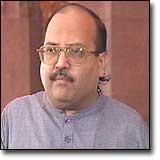
The phone tapping controversy involving Samajwadi Party General Secretary Amar Singh has been blown into a rather murky affair with virtually the entire political class echoing allegations in the case.
It all began with Amar Singh claiming that his phones were being tapped at the behest of some very "influential" people.
The party, crying foul from the rooftops, even released copies of letters allegedly authorising the tapping.
Echoing allegations
Amar Singh pointed an accusing finger at Congress President Sonia Gandhi, thus putting the ruling establishment in a tight spot. He also named senior officials like National Security Advisor M K Narayanan and Joint Secretary in the Prime Minister’s Office Pulok Chatterjee.
As the indignant politician flew around the country rallying support, others joined the fray, alleging that the government had wired their telephones too.
Former president of the Bharatiya Janata Party, LK Advani made separate claims of his phone being tapped after the UN report on the Iraq oil-for-food scandal was published in October.
Other allegations were made by Tamil Nadu Chief Minister Jayalalithaa, and former chief minister of Andhra Pradesh, N Chandrababu Naidu.
Police investigation
The government, quite predictably, was put on the defensive. While making a strong case for his officials against charges of wrongdoing, Prime Minister Manmohan Singh assured a full-fledged investigation.
Owing to its high profile nature, the probe in the case has progressed at a fast pace. The Delhi police have arrested three men who are believed to have illegally wiretapped Amar Singh's telephone. The motives however, are yet to be clear.
Since none of the accused is connected to the government, the conjecture that the illegality may have been committed by private individuals, can be granted the benefit of doubt.
The political mudslinging aside, the fact remains that controversies over telephone tapping have broken out intermittently.
Threat to security
The latest uproar is a reminder of the need to review the safeguards of the existing surveillance system. Surveillance of messages and conversations may become imperative under certain circumstances, particularly when tackling the terrorist menace.
The Indian Telegraph Act, 1885 gives the Centre and state governments the power to intercept messages in times of "public emergency" or "in the interest of public safety"
The Supreme Court had also framed guidelines to prevent the arbitrary exercise of such powers.
Officials within the government however, insist that telephones are tapped only if a person whose conversations it wants to monitor poses a threat to the security of the state or to prevent incitement to the commission of an offence.
Political realties
But the rapid expansion of the telecom sector, owing to the entry of a large number of private companies, has changed the ground rules. To prevent serious abuse by intelligence agencies, there lies a need for effective laws to deal with tapping complaints.
Amidst all political justifications, lies another reality. The charge that phones are tapped to settle political scores cannot entirely be rebutted.
Governments using telephone tapping to keep a tab on what is going on in the opposition ranks is hardly a surprising discovery. But then so is a politician's fascination with leading a political propaganda without substantial evidence.
As the political debate rages on, for the common man the case spells no more than a serious threat to privacy