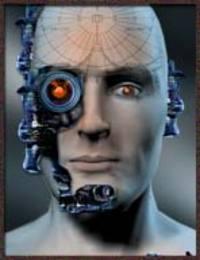
We’ve all thought about it…Well, I at least know that I have. How cool it would be to be a man with machine and computer upgrades integrated into me. This Idea used to be nothing more than science fiction, filling the pages of novels and the screens of bad Sci-Fi flicks. But many recent advances in computers, mechanics and studies of the human brain have brought us closer than we ever were before.
Scientists have already done experiments that allow monkeys to control robotic arms with nothing more than their minds, paraplegics who can control computers to do a multitude of tasks and even robots controlled by a person’s brain. These studies have also helped to spawn studies of how complex and adaptable the human brain actually is.
The first article I could find was of a 2003 experiment, by scientists from Duke University Medical Center, MIT and the State University of New York Medical Center, where monkey’s brains were linked up to a computer. They were given a joystick to control a robotic arm. The computer then recorded brain activity as the monkeys moved the arm. After enough data had been recorded the control of the arm was taken from the joystick and given to the program that decodes the brainwaves. The experiment worked with an even greater success than anticipated. The monkeys quickly learned that they could control the arm by simply thinking it and began to do so without the use of the joystick.
I found a similar article, from 2005, where scientists conducted a similar experiment but they attached the arm to the monkeys as sort of a “third arm” and restricted their arms so that they would have to use the robotic arm to feed themselves. This experiment showed similar results. The monkeys real arms would twitch as they moved robotic one but they were eventually able to adjust to using only the robotic limb with their mind.
Scientists have been adapting these experiments and a few have started trial on paraplegics. One trial done at Brown University and Cyberkinetics Neurotechnology Systems has been able to allow a paraplegic to perform many tasks such as move a cursor on a computer, control a TV and move a robotic arm.
About two months ago the University of Michigan announced that they have developed a prototype robotic ankle exoskeleton.
“The ankle exoskeleton uses the brain's electrical signals to know what to do and how to move. Electromyography (EMG) signals are processed in real time by a computer; the signals are used to control air pressure supplied to the artificial pneumatic muscle.”
This last development was made possible because many different studies have been done to re-map the human brain. Ultimately, though it is the power of the human brain to rewire itself that has made it possible for us to integrate mechanical parts with our bodies. The January 29th, 2007 issue of Time Magazine ran a great many articles about these studies done on the human brain. One Particular article was titled “How the Brain Rewires Itself.” Here are several clips from that article:
“If a stroke knocks out, say, the neighborhood of motor cortex that moves the right arm, a new technique called constraint-induced movement therapy can coax next-door regions to take over the function of the damaged area. The brain can be rewired.”
“When no transmissions arrive from the eyes in someone who has been blind from a young age, for instance, the visual cortex can learn to hear or feel or even support verbal memory.”
“An extreme example of how changes in the input reaching the brain can alter its structure is the silence that falls over the somatosensory cortex after its owner has lost a limb. Soon after a car crash took Victor Quintero's left arm from just above the elbow… he could still feel the missing arm. He [neuroscientist V.S. Ramachandran] had Victor sit still with his eyes closed and lightly brushed the teenager's left cheek with a cotton swab. Where do you feel that? Ramachandran asked. On his left cheek, Victor answered--and the back of his missing hand. Ramachandran stroked another spot on the cheek. Where do you feel that? On his absent thumb, Victor replied. Ramachandran touched the skin between Victor's nose and mouth. His missing index finger was being brushed, Victor said. A spot just below Victor's left nostril caused the boy to feel a tingling on his left pinkie. And when Victor felt an itch in his phantom hand, scratching his lower face relieved the itch. In people who have lost a limb, Ramachandran concluded, the brain reorganizes: the strip of cortex that processes input from the face takes over the area that originally received input from a now missing hand. That's why touching Victor's face caused brain to ‘feel’ his missing hand.”
Not only does the brain re-wire itself to make up for lost senses or limbs but a person can actually rewire their brain by simply thinking. The clip below is describing an experiment where transcranial-magnetic-stimulation (TMS) is used to detect brain activity while volunteers practiced a piano tune.
“He then extended the experiment by having another group of volunteers merely think about practicing the piano exercise. They played the simple piece of music in their head, holding their hands still while imagining how they would move their fingers. Then they too sat beneath the TMS coil.
When the scientists compared the TMS data on the two groups--those who actually tickled the ivories and those who only imagined doing so--they glimpsed a revolutionary idea about the brain: the ability of mere thought to alter the physical structure and function of our gray matter. For what the TMS revealed was that the region of motor cortex that controls the piano-playing fingers also expanded in the brains of volunteers who imagined playing the music--just as it had in those who actually played it.”
So now the question on my mind is, how long until these experiments show military application? I predict that soon we will have soldiers on the battlefield using mechanical exoskeletons to give them greater speed, strength and enhanced sensory perception and quite possibly soon after that we may even have UAVs and armies of robot warriors being controlled simply by thought. As amazing as the whole idea sounds it also scares the hell out of me.