
|
|
Communication
If not the single, most important element, communication is one of the most important elements affecting the overall success of an organization.
Good communication is especially essential to organizations undergoing transformations, such as those introducing new policies into their daily processes. Good communication is equally important to organizations making minor adjustments to an existing set of policies.
As important as communication is, it can be and often is mismanaged. One of the main reasons communication is mismanaged is because it is misunderstood.
|
|
|
|
|
From Its Origin
In its original form, to communicate meant to share. It meant to share in the sense of having something in common with someone else. In its more contemporary form, the word has come to mean to transmit, to impart, or to convey information or knowledge. Not only in business, but also in life, the process of communication includes all the means and methods, all the vehicles, and all the technologies by which people exchange information.
|
|
|
|
|
The Elements Underlying Good Communication
Putting it simply, the following elements underlie good communication:
q
It is open.
q
It is fully duplex.
q
It is clear.
q
It is complete.
q
It is honest.
|
|
|
|
|
Types of Communication
There various vehicles and technologies used in the communication process, include:
q�����
Electronic - moving pictures, telegraph, and telephone
q�����
Printed/written - e-mails, memorandums, user guides, and letters
q�����
Oral/verbal - instructions, education, broadcasts, and announcements
q�����
Other - music, pictograms, paintings, bio-chemical messages, body language, and stained glass windows
|
|
|
|
|
Styles of Communication
Communication comes in many different styles, including:
q�����
Formal - interview, job negotiation, debate, performance review
q�����
Informal - break room chatter, hyperbole, email
q�����
Open or overt - announcements, campfire stories
q�����
Closed or covert - staff meetings, surprise party planning, certain gossip
q�����
Public speaking - lecture, sermon, award acceptance speech
q�����
Conversational - dialog or talk, repartee
q�����
Non-verbal - body language, gesticulation
|
|
|
|
|
A Communication Model
While working at the Bell Telephone Laboratories in the late 1940s, researchers Claude Shannon and Warren Weaver developed a good model for the various elements that comprise communication. In their model, they broke down the phenomenon into the following elements:
q�����
Message - the specific data that are selected from an information source
q�����
Encoder - the bits or language by which the message is shaped
q�����
Transmitter - the mechanism by which the message is sent
q�����
Signal - the message as it is moved through media
q�����
Noise - factors surrounding the message that can interfere with the signal
q�����
Decoder - the bits or language by which the message is broken down
q�����
Receiver - the device that receives the message
q�����
Feedback - a response or a result caused by the receipt of the message.
|
|
|
|
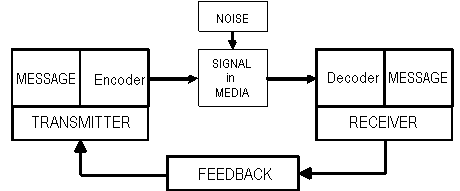
Communication Model
|
|
|
|
Although the communication model shown above was developed to help researchers improve the technology used to transmit and receive voice communications, it has value to those outside the field. By studying it, one can better understand the elements involved in all communication. Understanding the elements can speed the location of problems that may arise during communication.
NOTE: Feedback is not always a part of all communication, even good communication. Sometimes feedback is not possible, and sometimes it is not allowed. On some occasions, feedback is an option, but it must be delayed. When feedback is an option, it should be carefully conceived, and it should be carefully delivered in order to make it more valuable.
|
|
|
|
|
References
Cortada, J. & Woods, J., Encyclopedia of Quality Terms and Concepts, pages 70-1, McGraw-Hill, (1995)
Deterline, W. A., Feedback Systems, from Handbook of Human Performance and Technology, Stolovitch, H. & Keeps, E., eds. Jossey-Bass Inc., (1992)
Heinich, R., Molenda, M., & Russell, J. D., Instructional Media, the New Technologies of Instruction, Macmillan Publishing Co., (1989)
|
|

