Bushings. Almost everyone that fingerboards seems to have the ultimate bushing. I have yet to try any other than those I make myself, but have ordered some Moshmelloz.

One of the parts seriously lacking on Tech Decks and most other fingerboards are the bushings. Mostly due to manufacturing costs, companies use hard plastic for their bushings. This is fine and offers the proper 'look' but provides little in the way of performance.

If you have the time and can think of some softer material to use, try making your own bushings. Regardless of who's bushings are best, those made with your own hands will seem to have mystical powers. You'll wonder what you ever did without them, or more precisely, why you took so long to dump those hard plastic blobs that come from the factory.

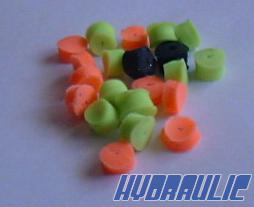
In the top right photo you can see the bushings I make. The orange coloured ones are a soft compound, the bright green coloured ones are a medium compound, and the old standard black coloured bushings are a medium/firm compound. It took a total of 15 minutes to make the bushings in this photo...with black taking the longest to make.

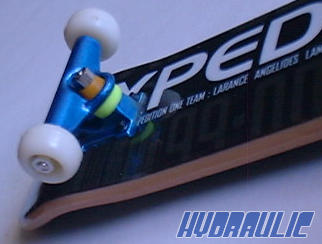
The middle photo shows the green bushings mounted on an Element Tech Deck. Note how the bushing sits. It doesn't buldge out past the hanger and offers quite a realistic appearance. I use the green bushings for 'street' fingerboarding and for some outdoor stuff.

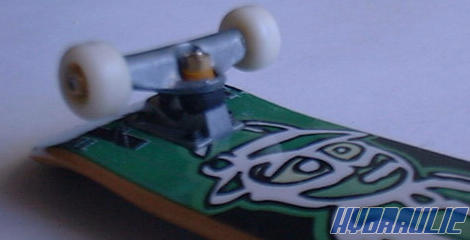
The third photo shows some black bushings in use. While these are not the stiffest bushing I make, they are stiffer then the green, and much harder than the orange. I use them for vert fingerboarding.

Many message boards dealing with Tech Decks and other fingerboards are littered with the same question... "How do I make bushings?". Making bushings that perform better than the stock bushings is not rocket science, it just takes a little thought.. Experiment. Try different materials.

If you are using stock bushings and want an inexpensive replacement, try stacking some pieces of rubber band on the kingpin to replace the stock lower bushing. How many people don't have an elastic lying around?

Tried the elastic band already? Want something that is going to last a little longer and work a little better? Think. Use your imagination. What do you have that is readily available and might work as a bushing? The grips off of an old fingerbike? An eraser? A cut up shock pad off your old skateboard? A small rubber o-ring from the hardware store?

Try some different stuff. It's all going to work and it's going to work differently for how YOU fingerboard. How well it works is another story. If money is a concern, work with the best you have. If that means your stuck with stacking pieces of elastic, then stack pieces of elastic. If that means you can afford to buy some of the bushings offered by other fingerboarders, then buy those bushings.

Some tips for making your own-

1. Find the material source (rubber band, shock pad, handlebar grip, eraser, etc..)
2. Cut selected material to shape and/or size.
3. Make a hole in the material.(drill, small nail, needle, etc...) What you use depends on the material chosen.
4. Mount finished bushing onto the kingpin in place of the lower bushing.
5. Put the hanger, remaining bushing, and nut back on.
6. Go fingerboard with your new functional bushing in place.

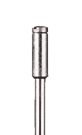
Below is a picture of the 'bushing mandrel' I use. This item comes with most Dremel tools (or similar) and is normally used for cutting wheels, grinding stones, etc...). I have found that the outside diameter of this tool is a good size for a bushing.

The top of the mandrel is actually a screw that threads into the main body. When making a bushing you will remove this screw and place it in the hole you've made in the bushing material. Once you have re-attached the screw you will be able to trim the material close to the mandrel's ouside edge. It is not necessary to trim it perfectly because you'll be finishing it in just a few moments.

Once you have most of the material removed turn the Dremel on (low speed) and while it is spinning use an emery board (fingernail file) to sand it smooth. You can take the material down so that it is even with the mandrels/screw outside edge. Back the screw off and carefully slide the bushing off (or twist it off using the threads). Repeat for each bushing you want to make.


email hydraulic

:: BEST VIEWED AT 800 x 600 ::

Hosted by www.Geocities.ws

1