Minimising total cost
An approach to development
Development is the key word any time and anywhere. Development needs resources particularly funds. Savings and loans are the sources of funds for the private developer while taxes and loans are the sources of funds for the public/state development.
There had been no society and there will not be any society without taxes and subsidies; only the extents of taxes and subsidies vary. Development for whom? Who are to be taxed? And who are to be subsidised? are the ultimate questions for political choice. Whatever the choice is, funds are limited and the priorities are made based on planning or (social) cost benefit analysis or both. Often the cut-off point of the benefit/cost ratio is moved up and down depending on the availability of funds. Thus the benefit/cost ratio is a fiscal policy tool and not a tool for economic analysis or development policy. At best cost-benefit analysis helps to manage the available funds; it does not tell where or how to find additional funds.
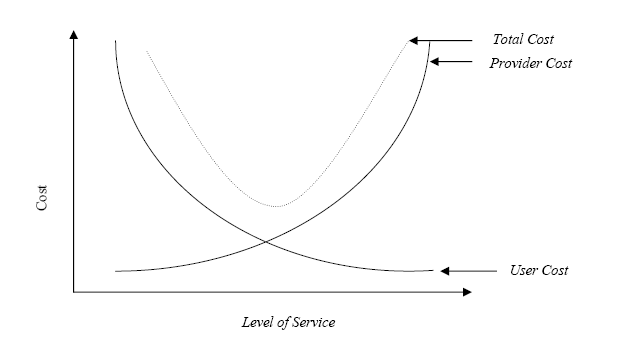
What are the means of economic justification of development projects and how are the funds to be found? In any sector of development, costs are incurred to construct and maintain projects (i.e. cost of providing the utility/facility) at a particular level of service and also costs are incurred in using the utility/facility depending on the level of service. The former can be called as the “provider cost” and the latter as “user cost”. Thus, in any sector of development, a particular level of service can be associated with a provider cost and a corresponding user cost. The provider cost increases with the level of service and the user cost decreases with the level of service as shown in the sketch below:
As seen in the sketch, the total cost (provider cost + user cost) is a minimum at a particular level of service. The aim of development is to operate at that optimum level of service not above or below. Normally, due to difficulty in obtaining funds for investment, services are operated at levels of service below the optimum. Investigations need to be carried out to define the optimum level of service and confirm that the reduction in the cost to the user is more than the cost to be incurred by the provider to achieve the optimum level of service. If the provider can agree to a contract to provide the utility at the optimum level of service, then there should not be any difficulty for the user to provide the necessary investment funds which will be less than the cost he would have incurred in using the utility at the pre-development level of service.
Although the above concept is applicable to any developmental activity, providing the riding surface of our roads is a good example. The roughness levels of our roads are very high and consequently vehicle owners are incurring very high expenses for operating vehicles. There is no contract between the provider and the user for the surfaces to be maintained at any defined level of roughness. Even though no values are given, roughness can be measured and change in vehicle operating cost for a particular change in roughness can be calculated. Although measurements and investigations are required to confirm, it is expected on average to reduce the vehicle operating cost by about 6 cents for a vehicle kilometer by maintaining the surfaces at the optimum roughness levels at a cost much less than 6 cents per vehicle kilometer and the vehicle owners should be agreeable to pay that amount since they will save more in their vehicle operating cost provided the optimum roughness level is achieved and maintained. This is an area for development which will generate employment and also results in saving (by the reduction of total costs incurred) which could be invested in other developmental activities. The optimum level of roughness will also result in reduction of noise levels and hence an environmental-friendly activity. All other cost including accident costs, pollution costs and congestion costs could be considered by adding appropriate values to the existing scenario and the developed scenario. Thus, the concept of minimising the total cost as an approach to development enables appropriate trade-off to be made among economic, political, social and environmental costs and public discussion could be directed to the objective of minimising total cost without any subjective, emotional prejudices. Even resource depletion or sustainability issues could be considered by allocating suitable cost for resource regeneration and those funds should in fact be used on resource regeneration like re-forestation. Further, this approach should result in the development of appropriate technology that will develop/convert the available resources into our present requirements and be compatible with our vision of the future.
As stated earlier, the roading sector was considered only as an example to illustrate the concept. The concept is applicable to any sector provided a measurable/quantifiable level of service could be identified and after suitable investigations, we could be able to assign provider cost and user cost to a particular level of service. In the case of storm water project, the return period (100 year flood/10 year flood) related to the standard of flood protection could be defined as the level of service. The provider cost would be the amount required to provide a chosen standard of flood protection (say 10 year return period) and the user cost will be the expenses to be incurred to meet the consequences of higher floods.
In the case of utilities, and quantities consumed per head could be a measure of the levels of service. The wrong method of pricing by the utility, authorities in levying fixed charges favours those with high per capita consumption. If all costs including environmental costs and resource depletion costs are considered, higher per capita consumption should cost more. Therefore, instead of levying fixed charges on all users, higher per capita consumption should be charged at rates higher than the basic rate. Even road licensing or vehicle insurance should be related to the weight/ axle load of the vehicle and the distance travelled. The larger the vehicle and the longer the distance travelled, the higher should be the charges. The slabs for the different charges could be adjusted to reduce congestion.
In the case of consumable items, the variety of products or the choice factor could be the level of service.
Identifying all costs and allocating them appropriately is the key to success.
P.A. Subramaniam
19.04.2000