It's alarmingly charming!
Christian (sings): The hills are animated with, the euphonious symphony of descant...
Satie: It doesn't fit the music. What if he sings: "The hills are vital intoning the descant"?
The Doctor: No; "The hill intones the wondrous orchestra of suffering."
Argentinian: The hills are incarnate with symphonic melodies.
Christian (sings): The hills are alive with the sound of music?
Toulouse: The hills are alive with the sound of music. It's so modern. ... so completely revolutionary, Bohemian ... that's it. Yes, yes, that's it!
Just when I think that maybe I've watched Moulin Rouge one too many times and you can get too much of a good thing, I watch it again and I'm immediately drawn in and can't help but watch it with a big smile on my face. I don't know what it is about this particular film, but few have inspired me and completely capture my imagination like Moulin Rouge manages to each time I watch it. The film's simple plot, revolving around music and dance, is a re-working of the Orphean myth. In this ancient Greek tragedy, Orpheus, the son of Apollo and Calliope, has the power to enchant with his music. When his love, Eurydice was killed, Orpheus descended into the Underworld to plead for her return. Enchanting Hades, monarch of the Underworld, with his music, Orpheus is permitted to leave with Eurydice on condition he does not look back to see if she is following him. When Orpheus nears the entrance to the underworld, fear overpowers him, he turns back to see if Eurydice is following, and he loses her forever. In line with the Orpheus myth, the Moulin Rouge is meant to be seen as hell. This is why the opening dance scenes are grotesque not beautiful.
Set in Paris in the 1890s, against a backdrop of contemporary music, the famous Moulin Rouge (red windmill) is a night-club and a den of decadence, incorporating a world of cabaret, dance hall, bordello, drugs, newly discovered electricity, roaming performers, side show freaks, witty social comedy and stand-up and the shocking Can-Can. The large spirited and rouged impresario Charles Zidler (roughly based on the character of that name who owned and managed the real-life Moulin Rouge) is a nightmare of unctuousness who makes the "Cabaret" emcee look demure. Zidler had created a world where the rich, the powerful and the old could party. A world where they could mix with the young, the beautiful and the penniless and where fantasy was real, a world where you could be anything you wanted to be.
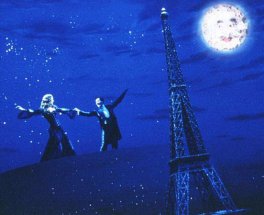
This beautiful film's story opens with wide-eyed, enthusiastic, sincere and boyish Christian (Ewan McGregor), a young writer with a magical gift for poetry, who defies his bourgeois father by setting off from England, accompanied only by his trusty typewriter, in search of the underground Bohemian ethics of Truth, Beauty, Freedom, and above all, Love, his colourfully diverse destination; Montmartre, Paris. McGregor plays the innocent in a lunatic asylum, with exactly the right degree of naivety and passion. Christian finds a place to stay in a rather shabby hotel, the "Chambres A La Journee" - room of the journey - and a bizarre episode involving an unconscious Argentinian crashing through his ceiling, leads to his fateful introduction to the absinthe soaked, slightly built, lisping artist Toulouse-Lautrec (loosely based on Henri de Toulouse-Lautrec, a prolific French post-impressionist painter, lithographer, and illustrator who frequented the cabarets of the Montmartre district of Paris, where his wit attracted a large group of artists and intellectuals, including Irish author Oscar Wilde, Dutch painter Vincent van Gogh and French performer Yvette Guilbert) and his cronies, surely the most Bohemian of all Bohemians, whose party-hard life centres around the Moulin Rouge night- club, a life which Christian now gets inevitably swept along with. Toulouse and his friends decide Christian is the perfect person to write their cabaret show, "Spectacular! Spectacular!" which is to be performed at the Moulin Rouge, as they are highly impressed when Christian, donned in lederhosen, composes "The Sound of Music" off the top of his head right in front of them, reciting it line by line as if they have just come to him there and then.

Christian: "I had come to Paris to write about freedom, truth, beauty and above all things, love. There was only one problem. I had never been in love."
The story develops and Christian meets and falls into a passionate but ultimately doomed love affair with Satine, the Sparkling Diamond (Nicole Kidman), the most beautiful prostitute in Paris and star of the Moulin Rouge, who lives in an elephant. However, this love affair is not meant to be and besides, Satine has her sights set on higher places than the Moulin Rouge; she can't allow anything, not even love, to get in her way. The plan is that she is to seduce the sleazy, weasley, camp, villainous, whiney, uncharming, possessive, nutcase (but rich and influential) Duke of Monroth to encourage him to invests funds in the production of "Spectacular! Spectacular!", turn the Moulin Rouge into a proper theatre and she into a reputable actress.
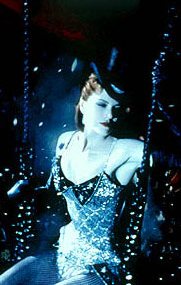
The Duke agrees to finance the play as long as he has "exclusive rights" to Satine. She wants to be a proper actress, so the Duke's offer is acceptable, except that after a mix up over his identity and against her better judgement, she and the sweet, handsome, humble and penniless young writer, Christian, fall in love so they must keep their love a secret while rehearsing for the play. Can Satine keep the Duke at bay without losing his patronage, will he discover the lovers and kill Christian, and can love triumph jealousy?
Satine: I can't believe it. I'm in love with a talented, rich, handsome duke.
Christian: Duke?
Satine: Not that the title's important, of course!
Christian: I'm not a duke.
Satine: Not a duke?
Christian: I'm a writer.
Satine: A writer?!
As I said before, Moulin Rouge is all about music and dance. The amalgamation of the incredibly broad range of music in the film is a feat of daring creativity that drives this entirely unique cinematic experience. It contributes to the sensory overload, but at the same time, every song - be it McGregor singing "The Sound of Music" or The Police's "Roxanne" being turned into a lusty tango - occurs quite naturally in the story. And that is the litmus test of a truly good musical. The musical medleys work and it's thanks to the sustaining spirit of the singer (or singers) and the original, inspired and highly imaginative writing and direction of the mad scientist of celluloid, Australian Baz Luhrmann. There are numerous and emotional break-out in song moments, songs via traditional devices and also newly invented ones, such as dialogue spoken to music. Luhrmann encouraged the cast to sing live to make their voices more honest and almost the entire scene of "Spectacular! Spectacular!" when Satine is singing to Christian was sung live on camera. Every note Ewan and Nicole sing in the movie are their own voices, which adds a certain charm to the entire proceedings. The characters break into song so naturally, it is simply an extension of their speech and the world seems to stop when Satine and Christian sing to each other.

Moulin Rouge is exciting, exasperating and daring, a film that's never afraid to go one step too far � or even three. It makes me laugh, smile and cry, in the words of Luhrmann himself, a �comic, tragic, musical, operatic, Bollywood inspired, cinema piece.� It's set in a world that's heading toward tragedy; it's impossible love. It's an all-singing, all-dancing Titanic. Yikes. Poor poet meets classy courtesan girl = true love. Plus music, laughs, drama, dance and a jealous duke who is bound to ruin everything. The film was shot largely at Fox Studios in Sydney, Australia, with no location filming whatsoever, the entire production being shot indoors. The surreal 1890s Paris landscape was digitally produced and the two longest visual effects shots to date appear in this film, along with the skyline sets which were built at one-fifth scale. There were 2,625 costumes handmade for Moulin Rouge. The 30 can-can dresses had 5 or 6 ruffles measuring 66 feet each, around 390 feet of ruffle for each skirt. It took one person a week to gather just the ruffles into each can-can skirt. The film took 188 days to shoot, along with 480 hours of dance rehearsals, involving more than 650 extras and over 750 crew. While some people are put off by Moulin Rouge's flashy effects, odd camera angles and generally irregular atmosphere, it is at its core a basic love story and is the third and final instalment of Baz Luhrmann's "Red Curtain" trilogy which he describes as "a simple story based on a recognizable primary myth and set it in a heightened, created world that is at once exotic yet also recognizable." In other words, the director uses poetic license to evoke the mood and energy of the Moulin Rouge, without focusing on period correctness. Strictly Ballroom and William Shakespeare's Romeo + Juliet are the other films in the "Red Curtain" series.
We know throughout the film that a tragic conclusion is awaiting us, because we are informed more or less from the opening scenes. The film concludes with Christian writing his and Satine's story finally after a year has passed and he is still in a bit of a state about her death, the final scene conveying to us these words; "It is a story about love. A love that will live forever. The end." I would suggest viewing this film once with an open mind to sort of get used to it, then watch it again. Those who allow themselves to suspend disbelief and to just sit back and relax are in for quite a glorious ride, while those who cannot go with the flow may experience a cinematic version of motion sickness.
Cast:
Nicole Kidman - Satine
Ewan McGregor - Christian
John Leguizamo - Toulouse-Lautrec
Jim Broadbent - Zidler
Richard Roxburgh - The Duke
Garry McDonald - The Doctor
Jacek Koman - The Narcoleptic Argentinian
Matthew Whittet - Satie
Kerry Walker - Marie
Caroline O'Connor - Nini-Legs-in-the-Air
David Wenham - Audrey
Christine Anu - Arabia
Natalie Jackson Mendoza - China Doll
Lara Mulcahy - Mome Fromage
Kylie Minogue - The Green Fairy
Moulin Rouge is � Twentieth Century Fox
Have a nice day.
antecedently