|
In fact, there is a strong element of self portraiture in all his human figures. All, from Acteon (pursued by the hounds) to the chap waiting with his family for a long overdue train, seem to view life with a mixture of surprise and scepticism. 'Therein', says Ms Atkins, 'lay the incipient genius of the man: a rare ability to cartoon in wood'. He is also a sculptor in wood. But one has the distinct feeling that he would shudder at the thought. He would never, one suspects, lampoon friend or foe, or make a definitive statement. He is not in the line of the Punch humorist or, artistically speaking, of Moore or Hepworth; certainly not of Picasso. The provenance of his work is that of the conscientious craftsman, the medieval stone mason. The tradition is that of Grindling Gibbons; the method, a confident wielding of chisel and blade, an apposite choice of wood; the justification, a passing commentary on life and humanity, keenly observed in its endless |
variety of mood and gesture, occasionally and perhaps inadvertently, profound. He speaks of 'wit and pathos' as the essential elements of his work. He achieves both in good measure. Fun and sadness too. His work nowadays has an increasingly enthusiastic international following. He was the only Britisher to have his work chosen for an international symposium sponsored by Denmark in 1995 and his submission, one of 135 from 35 countries, was acquired by the British ambassador in Copenhagen. The name of the piece was 'The Elopement' and it was presented as a wedding gift to the Danish royals Prince Joachim and Princess Alexandra. Much of his work has an airing in his own museum or at the Plough Arts Centre in nearby Torrington, before it finds a home in the world at large. It contributes appreciably to the clout of North Devon in the world of arts and crafts. |
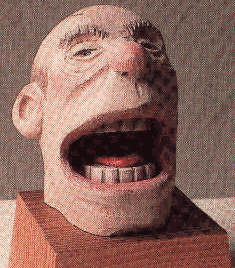
Talking Head
Limewood 28 cm high