For those unfamiliar
with the location, Ladakh is a remote high-altitude district north-east of the
main Himalaya mountains and geologically a
western extension of the Tibetan plateau. It is sandwiched between the vast
ranges of Karokaram and Himalaya and minor ranges of Ladakh and Zanskar,
straddling the main IndusRiver valley. The name is
derived from Ladags meaning “The Land of High Passes” (la=pass,
dakh=land). Ladakh is still disputed to be Western Tibet by the Chinese (a
north-eastern chunk – Aksai Chin – is part of China since 1962) and culturally
this is quite true. It has been said that Ladakh is a more accurate
representation of Tibet
before the Chinese takeover of Tibet
than Tibet
itself. To the west of Ladakh is Kashmir valley, to the north-west is
Baltistan, controlled by Pakistan
since 1947, and further north-west is Afghanistan. From 1974 Ladakh,
relatively insulated from modern conditions by its tough physical environment,
emerged into the modern world when it was opened up to tourism.
Ladakhis (or Tibetans)
and Indians have a religious heritage in common but even this is historical
rather than a living connection since Buddhism has been virtually dead in India
for seven hundred years. By language, culture, climate and history, the
Tibetans from north of the Himalayas have much more in common with Mongolia and and even Siberia than India though that is not completely true of
Tibetans (the Ladakhis) south of the Himalayas.Tibetan Buddhism incorporated
elements of Mahayana Buddhism and Hinduism (Tantric Buddhism) but has several
unique features such as reincarnation lineages of llamas and that Buddha can
manifest in human form. In general most elements are similar to others, namely
interpretation of sutras can only be interpreted by religious master and
tantric because enlightenment is accelerated by use of certain external rituals
and objects (e.g. are mandalas – certain cosmic diagrams assisting in spiritual
development the symbols which are prevalent in all gompas and monasteries,
mudras and mantras, prayer wheels, specific daily offerings of water, yak
butter – these days replaced by regular vegenated oils, and specific dances
performed during festivals). There is also a significant Shiite Muslim
population mostly in the Kargil area.
For hundreds of years
Leh had stood on the caravan routes of many nations but remained intact in its
identity of rich tapestry of cultures and trade. From China and Mongolia,
Xinjiang and Tibet, Kazakhstan and Kashmir, Iran and Russia, the traders passed
with their salt and borax, wool and dried meat, silks and spices, semi-precious
stones and gold but all more importantly Pashimina wool the shawls which
made Kashmir famous. Camels, horses and donkeys moving traditional goods along
rough and treachourous mountain trails for hundreds of kilometres. Vestiges of
the Mongolian Bactrian camel are found in the Nubra valley parts of which are
so surreal in its desert and high mountains. Reena, myself and the kids took a
little excursion on these camels on the sand dunes on the outskirts of Deskit.
It is an
amazing land. Travel China-wards to the Pangong Tso, and you’ll see the
largest salt-water lake in Asia. The water’s
unbelievably clear and appears in bands of colour: blue-green, and deep blue.
Head for Nubra, and mountains which look like colourful riot. The rock here is
purple, pink, crimson, bright green- and gold. Between Deskit and Hundar you
will find sand dunes. Go towards Kargil, and the village of Batalik
was the fabled point from where Alexander’s armies turned back, with some
Greeks apparently deciding to forego the long trek home.
And
all along, right through Ladakh, are old stupas, chortens and mani walls. In
the most inaccessible of places, devout hands have carefully carved verses on
polished stones, or painted religious text onto squares of thin cloth. The
piety isn’t misplaced; this land’s a harsh one; the roads are treacherous, and
every little prayer helps. As does every little exhortation: all along the
highways are the yellow signboards set up by the Border Roads Organisation.
Many of them are sweet (“Ladakh is the pride of our country”), some
philosophical (“Child is the father of man”) and some downright wacky (“Be Mr
Late not Late Mr”). Pretty entertaining, and all supposed to encourage drivers
to go slow. Especially along the passes- Khardungla, Changla.
I liked Leh. It is surrounded
by mountains and desert but is very green. Poplar and willow trees are
everywhere. The fields are full of wheat and barley. During the day it’s quite
hot, at night it’s cool. There are few clouds and the stars are very bright.
Venus stands out very clearly. Overlooking the city is the Ladakhi palace and
the Namgyal fort. The palace is deserted and the royal family lives in the
Thikse gompa these days. Nearby is Shanti Stupa, a Buddhist monument built by
the Japanese, on a hill overlooking the town. We staggered up the steps in
between bouts of pouring rain of a thunderstorm and were rewarded by awesome
views over the town. Finally we visited the Sanskar gompa just on
the outskirts of Leh. It was a quiet enclosure among the living quarters of the
llamas. As the most pronounced AMS symptoms faded we managed to slowly hobble
around town. Old ladies, soldiers, shop keepers and children seemed universally
delighted that we had made the journey to their “country” and greeting us with
a friendly “Jullay” and a smile. The uncommon hospitality and the Star Wars
landscape combined to give this place an unreal sense of mystery; it was easy
to imagine smugglers and raiders (or the more menacing bin Laden and his ilk)
plotting in the hills. During the days we weren’t traveling out of
Leh we had a chance to explore the local food – Tibetan, Chinese and the German
bakeries (for some reason almost all bakeries in Leh were named German
bakeries). The food was cheap. We bargained for curios and spent time in very
expensive internet café (Rs 10 for 5 mins). There were also some nice book
stores to browse in the main market.
Cultural
Ladakh
A jeep tour of
the neighbouring towns and monasteries gave us a taste of the surrounding
country. The next day we visited a set of monasteries and gompas on the east,
crossing the Indus once and the subsequent day
we visited the beautiful gompas of Lumayuru and the Alchi almost halfway to
Kargil. Hemis is the wealthiest,best known and biggest gompa of Ladakh.The
annual festival of the Hemis gompa is held in summer. It also has the largest
thanka(scroll painting on silk or brocade) in Ladakh which is unfurled once in
12 years.The Thikse
monastery closer to Leh is one of the largest and architecturally most
impressive gompas.The gompa has images,stupas and wall paintings of Buddha
which are exquisite.The
Shey palace is believed to have been the seat of power of the pre-Tibetan
kings. A 7.5 metre high copper statue of Buddha,plated with gold,and the
largest of its kind,is installed in the palace.The road to Lumayuru was spectacular. The Indus river merged with the Zanskar river and the flow of
water very rapid at points. The road was rough and one way at points along the
cliffs and have to give right of way along the edges to approaching traffic.
The road to Lumayuru was blocked because of a big army convoy so our driver
decided to take a different route. The location of Lumayuru is quite dramatic.
The prayer wheels line the edges and the gompa carries big gilded Buddha. We
continued to Alchi, Ladakh's oldest intact monastery, hidden in a bend of the Indus. The dramatic two-hour drive from Leh is worth the
trip in itself, although Alchi's original 11th century murals and statues are
stunning (one of the few that survived iconoclastic destructions the Islamic
invasions).
Pangong Tso
We left Leh early for a long day on
the road. PangongLake straddles the Indian
and Chinese border. The area is military sensitive and requires inner line permits
– and have to be cleared at numerous checkpoints along the way. We made it to
Chang La around 11am (the third highest pass in the world). The road down past
the Himalayan range to the salt marshes was quite dramatic. Yaks, wild horses
and nomadic herdsmen and their tents dot the green landscape. At the road
descends the greenery disappears, salt marshes and sandy terrain fill the
landscape. As we approach the Chinese border – it is not difficult to find the
hidden bunkers and tanks along the edges of the valleys. There is a small
restaurant at the lake – offering tea and Maggie noodles. The salt lake is
biggest in Central Asia and the changing
colors it exhibits at the passing of each cloud is very beautiful. We spent
about an hour and half at the lake and then headed back to Leh.
The worlds highest motorable road or
is it? (Road to Nubra)
It is certainly an interesting ride
up Khardung-La with constant reminders from BRO – “speed thrills but kills”.
Took us more than 2hrs to cover 38km from Leh to the top with a army checkpoint
stop at South Pulu. At the top one is invited
by the army to take a free cup of tea – to help with AMS and soothe frayed
nerves. At Khardung top one is at 18380 ft about 300ft higher than Everest Base
Camp – not bad for a local trip. Although it is claimed it is the highest
motorable trip in the world, there is another road which also stakes its claim
at the Uturuncu Volcano in Bolivia
(19360ft). We took a tea break at North Pulu.
Anav threw stones in the water along with his adoring grandparents. When we
continued we got stuck at a road block which took about half and hour to clear.
The road followed the Shyok river the banks of which were wide and dry sand –
from far it was difficult to distinguish the muddy river. In two hours we
reached Deksit. We took rest in a farm guesthouse in the middle of barley
fields with running streams on the sides and snowcapped peaks gracing the edges
of the valley. Later in the afternoon we went to Hundar to a monastery in the
middle of the fields and streams. The monastery was closed – but some local
kids found the keys for us. The gompa had a beautiful gilded Buddha and
paintings. The kids even gave us a receipt when we paid them for opening the
gompa. Later around 4:30 we went to the sand dunes and took a little excursion
in the desert with the kids on Bactrian camels. The next day we went up the
Deskit gompa which had one of the finest locations and views. Each inner gompa
led to another one progressively at the top. At the top of the monastery was a
little library. After lunch we made it back to Leh in about 2 ½ hours.
§ This travelogue is
as important as a photograph and captures our first impressions. You could skip
to end if not interested in reading personal digressions or experiences or
opinions or check out the photos by clicking on the title
on here
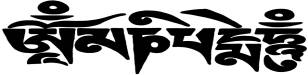
YThe script in the boxed text is a photographed version of Om mani padme hum. This is the great mantra
of Tibetan Buddhists constantly affirming the compassion of all Buddhas. Om is the syllable which precedes most mantras, mani is jewel
in Sanskrit, padme means lotus. This mantra is inscribed on all prayer flags,
wheels and carved into rocks throughout the Ladakhi Himalayas reminding every
passer by.