 The recent distribution in Taiwan
Save the Endangered Clouded Leopard in South Tropical
Taiwan
A Social Issue : Economical Development vs Environmental
Conservation
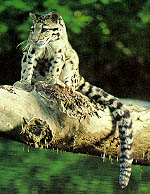
The Clouded Leopard (Neofelis nebulosa brachyurus) is an endemic species of Asiatic big cats and also the largest carnivore in Taiwan, a small island locates in the Pacific margin of South-eastern Asia with a high population density of 590 people per Km2. This cat is protected under Appendix I of CITES (Convention on Int’l Trade in Endangered Species of Wild Fauna and Flora, 1973). IUCN(Int’l Union for the Conservation of Nature) states its status as “Vulnerable” and seemingly extinct in Taiwan. This animals have the small-population issue in conservation due to habitat loss, prey declining and proaching, and become a deeply painful symbol to reflect whether or not a overdeveloped society exploit their natural and human resource.
The recent distribution in Taiwan
People in the developing Taiwan realized that they needed land to build houses, business centers and industrial sites to make a living. During recent decades, deforestation, agriculture and human settlement continue to encroach on the Clouded Leopard’s habitat, mainly low-land wilderness, and consequently there are fewer and fewer Clouded Leopards being reported by sighting or any other means. After 40 years of economic and industrial development, Taiwan people have created a rich society but with a huge population living in the highly-polluted areas in the West Taiwan plain. Simultaneously the Clouded Leopard is also becoming a symbol of mystery in museums and zoos. However in other areas in Taiwan, the Clouded Leopard has more serious impact by human crowded development. For example, the development of South and East Taiwan, in contrast to the rich West Taiwan, is retarded by the steep mountains and inconvenient traffic. Local people and county government there still struggle with the economically unequal development and are eager to enhance income by attracting outside investment. In the south tropical Taiwan, the last largest original forest where the Clouded Leopards live, some people are acquiring lands for the building of the South Transverse Highway crossing that high central-range to improve the traffic capacity between the crowded westshore and rural eastshore. In addition, people propose building a huge dam, Ma-chia Reservoir, in this mountain area to satisfy the increasing downstream water demands for urban and industrious development. These “great” projects affect the environmental condition with certain hard-to-predict effects, against the objections of many environmentalists. Do we really have a good enough reason for building this highway and dam, while disregarding the destruction of the habitat of our endangered Clouded Leopard?
Environmentalists discuss the negative impacts on the ecological system of those kinds of large-scaled building projects. For example, logging in a geologically unstable area and cutting down a watershed will lead to ecological. In addition, opening working roads will fragment the wildlife habitat so deeply as to destroy nature. Economists responded that to build a difficult highway or a big dam, we only need some capital and expensive technology to overcome several difficult architectured troubles, but we could create a lot of jobs and expand economic development. To those skilled experts, the Clouded Leopard has only an aesthetic value rather than any value in real life. According to Charles Krauthammer(1991), the Pulitzer Prize Winner writing in Time magazine, it is really the environmental-luxury and not necessary at all to maintain such animals. But more and more people in Taiwan didn’t satisfy to this crude solution. Why don’t we have two ideals, to have wealth and a healthy earth at the same time. If we want both, we need to think of alternative strategies to integrate these conflicting issues? So the problem becomes what kind of economic development should we improve? Following the old-fashioned, highly-polluted but less productive mode of traditional industries to use our rare resource is not the best way to sustain this island. We should reflect to our land use, instead of just being short-sightedly concerned about how much money we can get right now, ignoring the fact we are ruining the treasure of our children’s children.
The Clouded Leopard is a symbol of treasure. Unspoiled forests and clean rivers are treasures too. Abundant prey animals and natural vegetation there are also treasure. Of course beautiful sunshine and fresh air are our crowning jewels. Within this century, we have almost lost all our treasures, because greedy and near-sighted policy ran over them and broke them into pieces. At first, the Holland and Japanese Army successfully changed dense green landscape into yellow farms. They cut down Laureate trees to get oil-extract. They planted endless sugarcane to make factories and agricultural towns keep busy. They exterminated most wild creatures by replacing them with a lot of human villages. They cleaned out the golden spotted Sika deer from wetlands and low hills with guns and traps. They chased, shot, captured and killed that gold under the blue sky. Then they exported their bloody pelts overseas, to earn a lot, but without paying anything. Recorded by local official record, Taiwan had sold more then 0.1 million deer pelts annually for an expended period in the 1900s. After this busy business stage, the Sika Deer and the Clouded Leopard disappeared together from the vivid river-canyon silently. The Clouded Leopard went hiding in the secretary mountains, and finally, in 1965, the last deer was shot by a hunter in the East Taiwan. We were tearing down the web of our ecosystem by a piece by a piece.
The story continued. About 40 years ago we began to change green farms into black factories. We ignored and lost our treasures again and again. Today we are driving golden shiny cars. But we are breathing black air with a bad-smell. We are watching the black sky shaded by gray clouds without seeing anything. We can no longer eat our fresh fish because our black rivers are floating with oil-layered bubbles. We exported TVs, chemicals and plastic materials recently but we paid a lot to regret destroying our Mother Earth. Now we face a similar dilemma about the blueprint for that dam and highway in South Tropical Taiwan. Can we lose our treasure again? Can we let several communities of indigenous people migrate to downstream areas and give up their lifestyle? Can we tolerate native plants and animals, including the Clouded Leopard and the whole eco-pyramid below, disappear again from their last home country? Of course not! If we do that, we will just get limited money within a short period, but we decrease the diversity of land and life, sacrifice the world around us and torture ourselves as victims.
To conclude, the Clouded Leopard is not only a large beautiful cat in a very small range of Asia, but also a debated symbol for social and natural values. The top animal means the healthy condition of whole ecosystem, which supports the necessary service(e.g. sunshine, air flower and water) to our lives, our histories and our further civilization. E. O. Wilson(1992), a noted professor and scientist in ecology and biodiversity at Yale University, said that we should realize that every specific biological individual is one sort of resource, which is irreplaceable to either human society or our planet. The conservation of the Clouded Leopard with the whole ecosystem is just the tip of the huge iceberg. If we don’t see the risk behind the highway and big dam, our planet is going to sink like the Titanic under the cosmic Galaxy.