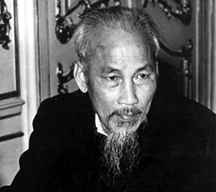
| Ho Chi Mihn |
 |
| --------------------------------------- |
| Country Known For Birth Place Born\Death Vietman |
| Leading guerilla forces in wars of attrition against France and the United States |
| Kim Li�n, Vietnam |
| (1890 1969) |
| --------------------------------------- |
| --------------------------------------- |
| H.S. Ranking --- Communist |
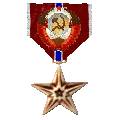
| Awards - Commie Medal |
 |
| --------------------------------------- |
| Ho Chi Minh (1890-1969), Vietnamese Communist leader, who was the first president (1945-1969) of the Democratic Republic of Vietnam and the principal force behind the Vietnamese struggle against French colonial rule after World War II (1939-1945). Ho�s childhood name was Nguyen Sinh Cung, but in accordance with Vietnamese custom, he received a new name, Nguyen Tat Thanh, at the age of 10 . Ho was born in the village of Kim Li�n in Annam, a region that now makes up central Vietnam. At the time, Vietnam was part of a French colony known as the Indochinese Union, or French Indochina, although it remained under the nominal rule of an emperor. Ho�s father served as an official at the Vietnamese imperial court, but French authorities eventually dismissed him for criticizing French domination of his country. As an adolescent, Ho attended a French-run school in Hue. Expelled for rebellious activities in 1908, he then briefly taught at a private school in Phan Thiet. In 1911 Ho signed on as a cook for a French steamship liner, and then worked in the United States and London, England. It was while living abroad that Ho evidently became acquainted with the ideas of German political theorist Karl Marx, which form the basis of communism |
| Ho settled in Paris in 1917 as World War I (1914-1918) was concluding. There, under the name Nguyen Ai Quoc (Nguyen the Patriot), he attempted to present a petition demanding self-determination for the Vietnamese people to the victorious Allied leaders attending the Paris Peace Conference at Versailles. The petition was ignored. Rebuffed, Ho began to engage in radical activities and became a founding member of the French Communist Party. In 1923 he was summoned to the Union of Soviet Socialist Republics (USSR) for training at the Moscow headquarters of the Communist International (popularly known as Comintern), an organization created by Soviet leader Vladimir Lenin to promote revolution throughout the world. In late 1924 Ho traveled to the city of Guangzhou (Canton) in southern China, where he organized a revolutionary movement among Vietnamese exiles. He was forced to leave China in 1927 when local authorities cracked down on Communist activities, but he returned to the region in 1930 to found the Indochinese Communist Party (ICP) in Hong Kong. He remained in Hong Kong as a Comintern representative responsible for overseeing the creation of Communist parties throughout Southeast Asia. In June 1931 British police arrested Ho in Hong Kong during a crackdown on political revolutionaries. After his release from prison in 1932, Ho made his way back to the Soviet Union, where he spent several years in relative obscurity. He was reportedly under suspicion by Soviet leader Joseph Stalin at this time because of his unorthodox views. Contrary to Marxist theory, Ho emphasized national liberation over social revolution, and he believed that rural peasants rather than urban workers were likely to be the driving force behind Asian revolutions. In 1938 Ho returned to China and served as an adviser to Chinese Communist armed forces during the Second Sino-Japanese War (1937-1945). After Japan occupied Indochina at the beginning of World War II (1939-1945), Ho resumed contact with ICP leaders, and in 1941 returned to Vietnam for the first time in 30 years. There, he helped found a new Communist-dominated independence movement, popularly known as the Viet Minh, which began to fight Japanese military forces inside Indochina. |