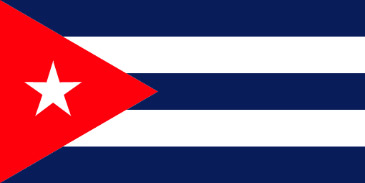
Cuba, largest and most western island of the West Indies. It forms, with various adjacent islands, the Republic of Cuba. Cuba occupies a central location between North and South America and lies on the lanes of sea travel to all countries bounded by the Caribbean Sea and the Gulf of Mexico. For most of its history, Cuba�s fertile soil and abundant sugar and tobacco production made it the wealthiest island of the Caribbean.The Republic of Cuba is an archipelago, or group of islands . The main island of Cuba covers 105,006 sq km (40,543 sq mi). It is 1,199 km (745 mi) long and 200 km (124 mi) across its widest and 35 km (22 mi) across its narrowest points. The next largest island, Isla de la Juventud, or the Isle of Youth (formerly known as the Isle of Pines), off Cuba�s southwest shore, covers 3,056 sq km (1,180 sq mi). Four sets of smaller archipelagos�the Sabana, the Colorados, the Jardines de la Reina, and the Canarreos archipelagos�and numerous other islands are part of the Cuban nation. Havana is the capital city with a population of 2,189,716 in 2000. In 2002 the nation�s population was estimated to be 11,224,321.
Cuba�s proximity to Haiti, the United States, Mexico�s Yucatan Peninsula, and Jamaica has allowed people to migrate easily onto and off of the island. This movement contributed to the rich mixture of people and customs in Cuba and throughout the Caribbean area. Although agriculturally rich, Cuba exports only a few products, such as sugar, tobacco, citrus fruits, and several manufactured products.
Cuba�s rich soil, abundant harbors, and mineral reserves have enticed foreign powers such as Spain, the United States, and the Union of Soviet Socialist Republics (USSR) to use Cuba for their own interests. For 400 years Cuba was a colony of Spain. Spain�s conquistadores (Spanish for �conquerors�) launched their invasion of Mexico and South America from the island. In the mid-19th century, the Cuban people formed an independence movement, decades after most of Spain�s other colonies had become independent. By 1868 Cubans began to fight the first of three wars of independence. In 1898 the United States entered the war against Spain and declared Cuba independent but under the protection of the United States |
|