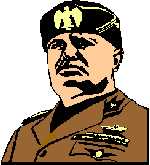
Mussolini, Benito (1883-1945), founder of Fascism and prime minister and dictator of Italy (1922-1943). Known as Il Duce (Italian for �the leader�), Mussolini centralized political power in Italy and bound the nation to him with his charisma. His vast personal power, strong-arm methods, and extreme nationalism made him a model for leaders of like-minded authoritarian movements in the 1920s and 1930s. German dictator Adolf Hitler saw Mussolini as a precursor, and many similarities existed between the Fascist and German Nazi movements. Allied with Hitler from 1938 to 1943, Mussolini helped plunge Europe into World War II (1939-1945).
Mussolini was born in Predappio, a small town in north central Italy, near the city of Forl�
. He was the first son of a striving lower-class couple. His father was a blacksmith and his mother was a schoolteacher. Like many other families of this time and region, Mussolini�s family held socialist convictions and was opposed to the influence of the Roman Catholic Church. The couple named their first son after Mexican revolutionary hero Benito Ju�rez, and his younger brother after medieval Catholic heretic Arnold of Brescia.
As a youth, Mussolini was known for his quick temper and arrogance. Educated in local schools, he earned a diploma in 1901 that qualified him to teach elementary school. Employment prospects in the area were scarce, however, and in 1902 he moved to Switzerland. Political Development
print section
While abroad, Mussolini studied the works of socialist thinkers such as Karl Marx and became involved with socialist groups. Returning to Italy in 1904, he drew on his exposure to leftist ideas, his quick intelligence, and his growing talent as a journalist and speechmaker to advance in local socialist circles. In 1910 he married Rachele Guidi, with whom he would have five children. |