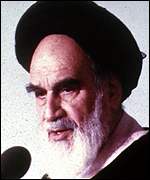
Khomeini, Ayatollah Ruhollah (1900?-1989), full name Sayyid Ruhollah al-Musavi al-Khomeini, religious leader who, from exile, led the popular revolution that toppled Muhammad Reza Shah Pahlavi of Iran in 1979. Khomeini was the son of Sayyid Mostafa, a religious scholar who died six months after Khomeini was born. After Khomeini�s mother and aunt died when he was 15, he was raised by an older brother. With his brother, he memorized the Qur'an (Koran) and learned the basics of Shia Islam.
Shortly thereafter Khomeini traveled to Ar?k, where he studied Islamic law
. In the early 1920s his teacher moved to Qom (Qum) and Khomeini followed, rising from the rank of pupil to ayatollah, a term for a leading Shia scholar that literally means �gift of God.� He embraced mysticism, which teaches the relinquishing of earthly pleasures in favor of a life spent contemplating God�s mysteries. Because it was a combination of law, logic, and philosophy, Khomeini�s brand of mysticism attracted many disciples.
Like many Iranians, Khomeini was angered by the interference of foreign powers in Iran; foreign governments often supported Iranian leaders who promoted modern policies that violated Islamic traditions. The first of these leaders was Reza Shah Pahlavi, who in 1921 overthrew Iran�s first constitutional government with the support of the Russian government. In 1941 Khomeini wrote of Pahlavi�s government, �all orders issued by the dictatorial regime...have no value at all.� Pahlavi was succeeded by his son, Muhammad Reza Shah Pahlavi, who came to power in 1941 with the help of Great Britain, France, and the United States. Twelve years later the U.S. Central Intelligence Agency helped allies of the shah overthrow his enemy, Prime Minister Mohammad Mosaddeq. The coup gave Khomeini extra impetus for criticizing the shah.
In the early 1960s the shah proclaimed a White Revolution in which he introduced many Western ideas, such as equal rights for women and secular (nonreligious) education. From his Faziye Seminary in Qom, Khomeini vehemently attacked the shah�s policies, prompting the shah to imprison him in 1963 and expel him from Iran in 1964. Khomeini settled in An Najaf, a Shia holy city in northern Iraq. There he forged his doctrine of the �Rule of the Jurist,� which called for the clergy to govern. Khomeini spread his ideas through a network of 12,000 students. From An Najaf and later from Paris, where he lived after 1978, Khomeini urged Iranians to topple the shah and his American allies, who he claimed were �robbing us of our brains.� When the shah was finally overthrown and forced to flee the country in January 1979, Khomeini returned to Iran. In December a new constitution was passed declaring Iran an Islamic republic, and Khomeini was named imam (a successor of Muhammad) and supreme leader for life. |