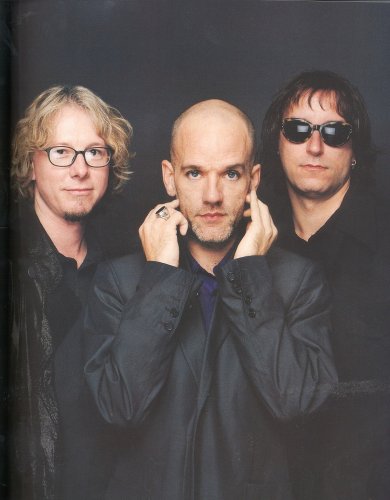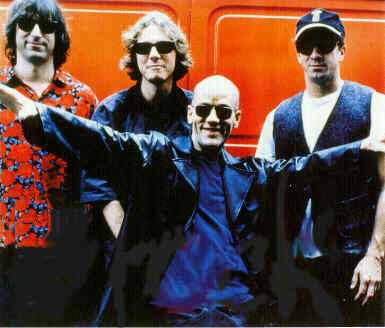
Newly signed to IRS Records, they gained further favourable notices for August 1982's mini-album, Chronic Town. Their eagerly awaited full-length debut arrived in April 1983. Murmur surpassed all expectations, and was eventually made Album Of The Year by Rolling Stone magazine.
As in the USA, the band earned a devoted cult following in Europe, largely comprised of college students., Reckoning appeared the following year and was permeated by a reckless spontaneity that had been missing from their earlier work. Recorded in only 12 days, the tracks varied in mood from frustration, as on "So. Central Rain (I'm Sorry)", to the tongue-in-cheek sing along "(Don't Go Back To) Rockville". The songs were accessible enough but, as would be the case for most of the 80s, the singles culled from R.E.M.'s albums were generally deemed uncommercial by mainstream radio programmers. However, their cult reputation benefited from a series of flop singles on both sides of the Atlantic. Although received enthusiastically by critics, Fables Of The Reconstruction was a stark, morose album that mirrored a period of despondency within the band. Peter Buck summed it up in the 90s - "If we were to record those songs again, they would be very different".
Lifes Rich Pageant, produced by Don Gehman, showed the first signs of a politicization within the band that would come to a head and coincide with their commercial breakthrough in the late 80s. Stipe's lyrics began to dwell increasingly on the prevailing amorality in the USA and question its inherited ethics, while retaining their much vaunted obliqueness. Tracks such as "These Days" and "Cuyahoga" were rallying cries to the young and disaffected; although the lyrics were reflective and almost bitter, the music was the most joyous and uplifting the band had recorded to date. This ironic approach to songwriting was typified by "It's The End Of The World As We Know It (And I Feel Fine)', from 1987"s equally impressive Document, which intentionally trivialized its subject matter with a witty and up-tempo infectiousness. In a similar vein was "The One I Love", a deliberately cold and detached dismissal of an ex-lover that was, nevertheless, completely misinterpreted as romantic by countless record-buyers who pushed the single up to number 9 in the US. The album was produced by Scott Litt, who would continue to work with the band over the next few years.
The band ended their relationship with IRS records and signed a contract with Warner Bros in 1988.Their major label debut Green sold slowly but steadily in the USA. The attendant single "Stand" reached US number 6 in January 1989, while "Orange Crush" entered the UK Top 30 the same June. Apart from demonstrating their environmental awareness, particularly on "You Are The Everything', the album laid more emphasis on Stipe"s vocals and lyrics. This, to the singer's dismay, led to his elevation as "spokesman for a generation", particularly with the apparent self-revelation of "World Leader Pretend". Already hero-worshipped by adoring long-term fans who saw him as both pin-up and creative genius, Stipe insisted: "Rock 'n' roll is a joke, people who take it seriously are the butt of the joke". The world tour that coincided with the album's release saw R.E.M. making a smooth transition from medium-size venues to the stadium circuit, owing as much to Stipe's individual choreography as to the elaborate, projected backdrops.
The band re-emerged after two years with Out Of Time. Their previous use of horns and mandolins to embroider songs did not prepare their audience for the deployment of an entire string section, nor were the contributions from B-52's singer Kate Pierson and Boogie Down Productions' KRS-One expected. Ostensibly the band's first album to contain "love" songs, it was unanimously hailed as a masterpiece and topped both the US and UK album charts. The accompanying singles from the album, "Losing My Religion" (US number 4/UK number 19), "Shiny Happy People" (US number 10/UK number 6), "Near Wild Heaven" (UK number 27) and "Radio Song" (UK number 28), gave them further hits.
Automatic For The People was released in October 1992 to universal favour, reaching the top of the charts in the UK and USA. The album produced a number of memorable singles including the moody "Drive" (US number 28/UK number 11), the joyous Andy Kaufman tribute "Man On The Moon" (US number 30/UK number 18) with its classic Elvis Presley vocal inflections from Stipe and an award-winning accompanying monochrome video, "The Sidewinder Sleeps Tonite" (UK number 17) and "Everybody Hurts" (US number 29/UK number 7).
Monster showed the band in grunge-like mode, not letting any accusations of selling out bother them, and certainly letting fans and critics alike know that they had not gone soft. "What's The Frequency, Kenneth?" (UK number 9) started a run of hit singles taken from the album and further awards were heaped upon them. Following the collapse of Bill Berry in Switzerland while on a major tour in 1995, the band were forced to rest. Berry was operated on for a ruptured aneurysm and made a full recovery. In August 1996, the band re-signed with Warner Brothers Records for the largest recording contract advance in history: $80 million was guaranteed for a five-album contract. New Adventures In Hi-Fi was released in September. Recorded mostly during soundchecks during the ill-fated Monster tour, it was nevertheless another excellent collection. From the epic chord changes of "Be Mine" to the cool understated calm of "How The West Was Won And Where It Got Us', it showed the band"s remarkable creative depth. "E-Bow The Letter", featuring Patti Smith, also provided the band with a UK Top 5 single.
In October 1997, Bill Berry shocked the music world by announcing his intention to leave R.E.M. after 17 years with the band; the remaining members were quick to confirm that they would be continuing without him, using the adage "a three-legged dog can still walk". Although there was no official replacement on drums, with the rest of the band electing to continue R.E.M. as a three-piece, ex- Screaming Trees drummer Barrett Martin contributed to sessions for 1998's Up, which also featured new producer Pat McCarthy. Introduced by the single "Daysleeper' (a UK Top 10 hit), this album was the band"s most adventurous recording since the mid-80s. The following year they provided the soundtrack for the Andy Kaufman biopic Man On The Moon, which included the track, "The Great Beyond".
The band are about to release their twelfth album, Reveal. Already it is being hailed as a return to form from the greatest band in the world.