Field-trip report
Wetlands of eastern Hokkaido
From 5 to 13 July
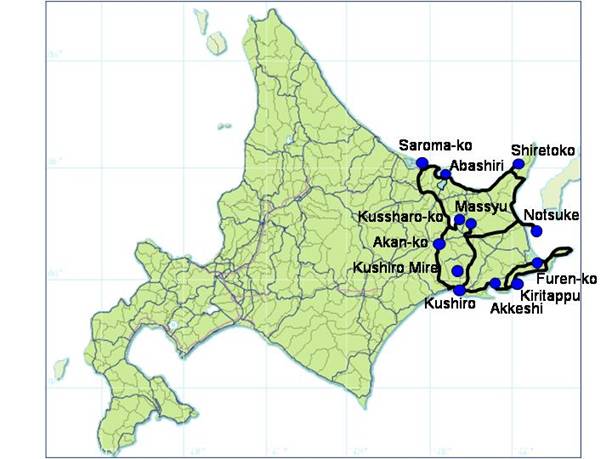
2005 a trip was made to several sites in the eastern half of Hokkaido,
the northernmost island of Japan.
This report gives some background information on the Hokkaido
landscape, and wetland conservation issues particularly focussed on the sites
that were visited. Also, I will give a brief outline of the vegetation
encountered and some birdwatching data.
The trip was made by me and Yasushi Miyamoto using a rental
car starting and ending at Kushiro Airport.
We had made appointments with local researchers at four sites: Akkeshi Marine
Station (Akkeshi), Ministry of Environment (Kushiro),
Abashiri Marine
Research Center
(Abashiri), and Lake Saroma Fisheries Station (Sakeura).
General characteristics
of Hokkaido
Hokkaido is
the northernmost of the four large islands of Japan
and has a very distinct landscape and climate. It is much less inhabited than
the other parts of the country, and the lowlands are partly forest, partly
pasture-type agriculture (large dairy-farms dotted in a hilly landscape). There
are many coastal lakes that are not as much affected by high nutrient loads as
elsewhere in the country, though seafood production is very predominant. In the
interior, there are mountain ranges of volcanic origin with some beautiful
volcanic lakes.
Akkeshi Marine
Station
Meeting with Masakazu HORI (University
of Tokyo), Natsuki HASEGAWA and YAMADA (Hokkaido
University).
Beautifully and remotely located at the Akkeshi
Bay, the station hosts a limited
number of researchers and students, while also accomodating teams of scientists
from Hokkaido University
and other institutes. We took a day tour by boat to sample in Akkeshi-ko, which
is connected to the bay by a wide inlet channel. The lake is shallow and for
the greater part covered by Zostera
marina (Eelgrass). Near the entrance, mudflats have been reclaimed for
culturing clams. The lake is largely used for seaweed production (using
ropelines attached to buoys) and oyster culturing (using cages).Except near the
lake’s entrance, where the fisheries port
of Akkeshi is located, the
shorelines are undeveloped and there are great adjoining wetlands transgressing
into wooded uplands.
The seagrass beds are extensively studied, especially with
concern to potential shifts induced by epiphytic algae, and the relationships
between seagrass and macro-invertebrates.
In the Bay of Akkeshi
we also visited a site where Z. marina
and Z. asiatica occurred together.
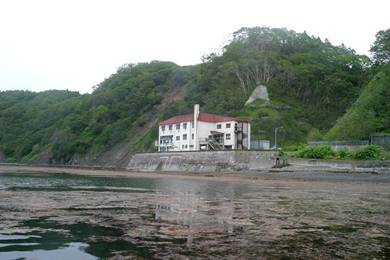
Akkeshi Marine Station
Kushiro Wetland
Professor Futoshi NAKAMURA (University
of Hokkaido) had organised a tour
of the famous Kushiro Marsh (Japan’s
largest wetland) and introduced us to employees of the Ministry of the
Environment, Katsuhiko TABATA and Keiichi NAKANO. On 8 July they showed us the
Hirosato restoration area, where a 260 ha-area of embanked, derelict
agricultural land (developed in the late 1960’s) is being restored. The wetland
however has no direct inflow of water from the Kushiro
River and a reduced groundwater
influence, causing the vegetation to become dominated by alder forest instead
of the desired wetland vegetation. Alder is controlled by cutting the trees,
and soil excavation is now experimentally conducted to enhance groundwater
influence.
After this site visit we went on to Iwahogi Water Gate,
which is the point where the inflow into the Hirosato area and surroundings is
blocked and the Kushiro River
proceeds in an artificial channel towards its mouth. We overlooked the core of
the wetland, and saw the progressing alder vegetation surrounding it.
The next stop was Lake
Takkobu, a lake surrounded by
wetlands and forests, where eutrophication has occurred and the extensive
macrophyte vegetation was strongly reduced (partly replaced by floating-leaved Trapa japonica cover). Its condition,
however, was less severe than in Lake
Toro, where we observed blooming of
cyanobacteria (despite the early time in the season).
In the evening of 8 July we met Kazuaki HOSHINO (Director of
the East Hokkaido Regional Office for Nature Conservation) and Hiroya OHGUSHI
(Director of the Hokkaido Branch of the Ministry of Land, Infrastructure and
Transport) who attended the meeting where I gave my presentation “Wetland
Restoration in The Netherlands�E
The next day (9 July) we had a meeting with Jun-ichi OTSUKA
(Director for River Planning, Ministry of Land, Infrastructure and Transport,
Kushiro Dept.) and visited the Kayanuma site. A stretch of channelized river
here will be remeandered by reconnecting the former oxbows and filling in the
straight channel, starting in 2006.
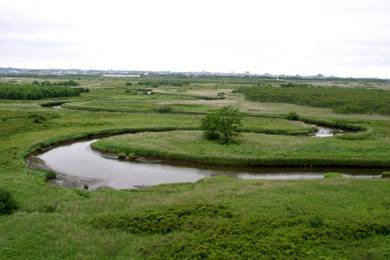
The old Kushiro River
Abashiri Marine Research Center
Meeting with Susumu CHIBA (Tokyo University of Agriculture)
at the Abashiri Marine
Center, which hosts a research
facility of the Abashiri branch of the University
of Agriculture, the office of the
local fisheries research organisation, and a visitor center.
The Center is located on the coast of Lake
Notoro, a saline lake with extensive tidal and shallow areas. In the shallow
areas, seagrasses abound: Z. caespitosa,
Z. marina and Z. japonica. We discussed the contrasting growth strategies of
these species.
Lake Abashiri,
a freshwater lake, was rather clear and –as far as we could notice from shore-
several species of submerged plans occurred (Myriophyllum sp., Potamogeton
sp.). Particularly interesting was the large wetland area along the south shore
of the lake, of which a width of c. 100 m had remained after reclamation of the
greater part. According to the newly-constructed dam and punping stations, the
larger wetland would have been destroyed very recently.
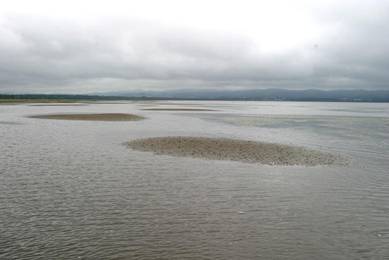
Tidal flats, Lake Notoro
Saroma-ko Fisheries
Cooperation
Meeting with Kimihiko MAEKAWA and Shigenobu KATOH of the
Aquaculture Cooperation of Lake Saroma.
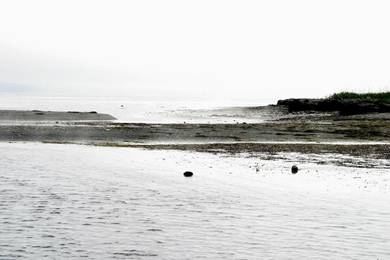
We had an interesting discussion on the management of Lake
Saroma, which is the second largest
lake in Japan. It
is a brackish lake, connected to the Sea
of Ochotsk by two channels that
were cut through the coastal levee. Since a few decades, the lake is heavily
exploited for scallop production, and some 10 000 scallop lines are in the
lake. The shallow areas have a very high cover of Zostera. Fears that the Zostera-vegetation
is in decline was not confirmed by two subsequent mappings (based on aerial
photos) made in 1992 and 2004, respectively. We received a lot of data reports
including water quality data.
We observed some of the characteristic features of the lake
including the dense Zostera marina
beds during a short field trip.
Lake Saroma
Further points of
interest
Shallow tidal lagoons and bays, such as Akkeshi-ko, Akkeshi-wan,
Furen-ko, Notsuke-wan, Notoro-ko, and Saroma-ko, were characterized by very
dense and extensive beds of seagrass.
Lake Toufutsu,
east of Abashiri, showed a very good fresh-to-saline transitional gradient,
with Zostera marina in the saline
part, Ruppia, Schoenoplectus and Potamogeton
in the respective brackish zones.
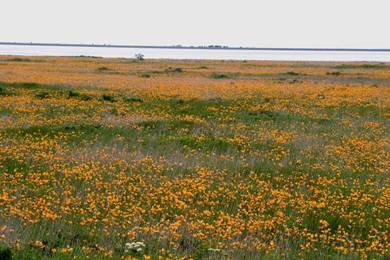
Of special interest were the drowning forests and bogs of
Kiritappu, Furen and Notsuke-hanto. Because of geological sinking the sea is
progressing in these areas, and salinity of the water is increasing, resulting
in large-scale mortality of forest species (pines).
Shiretoko-Go-Ko (the Five
Lakes of Shiretoko) are a group of
attractive small lakes in the Shiretoko
National Park. The lakes are very
famous and attract large crowds. Unfortunately, only two lakes could be
visited, because the longer trail was closed due to the presence of bears.
The volcanic lakes were interesting from a quite different
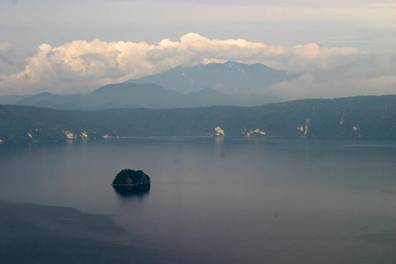
point-of-view. Lake Massyu,
in Akan National Park,
is one of the clearest lakes in the world (Secchi depths some decades ago
around 35 m, recently 25 m). Lake Akan,
also in Akan N.P., has some fame because of the “Marimo�E algal balls (Cladophora aegagropila) that grow in
deeper water (diameter up to 50 cm) but can be washed to the littoral where
they disintegrate.
Notsuke-hanto
Lake Massyu
A note on birds
East Hokkaido is a very good
birdwatching place and two very special bird species can be found here: the
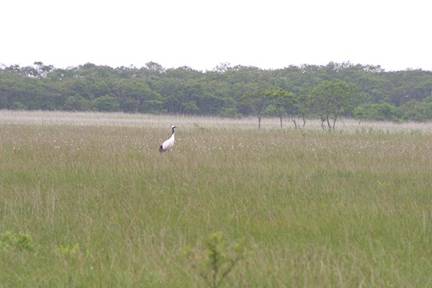
Japanese Red-crowned Crane and the Blakiston Fish Owl. The first appeared to be
rather easily spotted in wetlands around esatern Hokkaido,
the second one was not observed by us (as it happens, only a dozen of pairs may
be present in very remote areas and they are strictly nocturnal).
We observed quite a high number of Japanese Cranes at
different locations. At Akkeshi, a juvenile bird was foraging in the surf zone
just outside the Station on the first morning, while we saw 3 pairs of adult
birds in the lakeshore later that day. We also observed cranes in Furen-ko (5),
Notsuke (4) and Abashiri (1). The highest number we observed during our visit
to Kushiro Marsh (8).
White-tailed Sea
Eagles are also very conspicuous and in total some 20-30 birds were observed,
including a nest at very close distance near Akkeshi Marine Station. Other
birds of prey included Osprey (very frequent), Black Kite (abundant), Aian
Marsh-harrier and Eurasian Hobby.
Because of the timing of our visit in high summer, water
birds were not very abundant, but we observed Whooper Swan, Mallard, Gadwall,
Tufted Duck, Greater Scaup and Goosander; several species of wader were seen
also (Redshank, Mongolian Plover, Oystercatcher, Common Sandpiper, Japanese
Snipe, Latham’s Snipe, Dunlin). Grey heron was extremely plentiful, Great Egret
only few.
Stonechats were very common (in contrast to other parts of Japan),
and also Black-faced bunting, Yellow-breasted Bunting, (Japanese) Skylark, Tree
Sparrow and Oriental Greenfinch were observed frequently. Other passerines that
we observed were Brown-eared Bulbul, Wren, Brown Shrike, Japanese Accentor,
Japanese Robin, Short-tailed Bush-warbler, Black-striped Warbler, Oriental
Great Reed-warbler, Middendorf’s Grasshopper-warbler, Pale-legged
Willow-warbler, Goldcrest, Narcissus flycatcher, Brown Flycatcher, Long-tailed
Tit, Coal Tit, Marsh Tit, Willow Tit, Great Tit, Nuthatch, Japanese White-eye,
Reed Bunting, Long-tailed Rosefinch, Siberian Rubythroat, Gray Thrush, Carrion
Crow and Jungle Crow. Other species: Little Cuckoo (very frequent), Oriental
Cuckoo (few), Common Cuckoo (quite frequent), Northern White-rumped Swift,
Asian House-martin, Common Kingfisher, Japanese Pygmy Woodpecker, White-backed
and Great-spotted Woodpecker, Japanese agtail, Olive-backed Tree-pipit.
Japanese Crane in Kushiro Marsh