 The general learning theoretical principle a bout Gagne, Bloom, Malone
and Keller.
The general learning theoretical principle a bout Gagne, Bloom, Malone
and Keller.Evaluation of lesson Science built on constructivist
learning
Johannes
croje (2000), construction is designed in such away that learners construct
their own meaning intrinsically by building on previous knowledge. It is
principle advantages are effectiveness and transfer. It is typically the domain
of teachers supporting the “new paradigm” and corresponds closely with what
is traditionally written a bout constructivism and cognitivism.
This article reports on a constructivist-learning event designed and presented to investigate in theoretical of Gagne nine steps of instructional design; and his five categories of learning. Also he has eight classes of situations for people learning.
This article reports also investigates in the levels of Bloom Taxonomy, and also investigates in the research perspective handle with general theoretical perspective.
The literature survey covered:
The general learning theoretical principle a bout Gagne, Bloom, Malone
and Keller.
The aspects of constructivism that, you proposed by on Glasersfeld and
Riber.
Assessment and evaluation issues of Taylor.
The general design issues of Jonassen.
The project description covered the target population and activities of learning, also described which outcome was effective. In finding description what occur actually through applying the lesson “ Identification of cationic Radicals”, and how computer is contributed in the lesson.
The conclusion explained some factors that contributed in the success of the lesson:
1. The class size.
2. Information simplicity.
3. Using new concept(s) in learning.
4. Using discovery approach in learning and so on.
To the best of my belief, when somebody wants to make a similar lesson similar, should remember:
The lesson should include meaningful idea(s), and make the
students activities through
the lesson.
The lesson should put the students in real life situation.
The lesson should feedback the students with their responses

The lesson is Chemistry; Chemistry is considered as one of the important natural Sciences, and it is contributed to the success of human life.
Because these types of sciences include different branches, these branches influence all industry fields and human needs insurance.
The lesson is “ Identification of Cationic Radicals”, includes six groups of cationic Radicals from which, I chose the first, and this group includes three elements: Lead, Silver and Mercury. These elements responses to two types of interactions:
· Main test with hydrochloric acid (HCL).
· Confirmatory tests with different chemical reagents.
The outcomes Expected after this lesson; students should be able:
· To know general properties of cationic Radicals.
· To distinguish between primary and secondary cationic Radicals interaction.
· To distinguish between the cationic Radicals compounds through the colored precipitates.
· To write the formula of a compound when information about the cationic Radicals to be presented to him or her.
· To recognize whether the precipitate is soluble or insoluble in specific solution.
Choosing this lesson because it is a part specialization
of study. And I went forward to present chemistry lessons in a new
fashion acceptable, recognizable and
easily understood to students.
Also I chose that lesson
to look up responses to these questions:
· Is the lesson appropriate for the purpose of the application?
· Has the preparation of lesson aided the students to understand the new information?
· Did the lesson raise the curiosity of students?
This lesson requires three
computers devices, Mice, Spreed sheet and Microsoft word program, also site (www.modelscince.com),
Camera videotape, some students and teacher.
.
According
to Merrill (1983) “ A
complete lesson would consist of objective followed by some combination of
rules, examples, recall, practice, feedback, helps and mnemonics appropriate to
the subject matter and learning task.”
According to Duchastel (1998), instructional design is a synthesis of one's deep-seated beliefs about the educational process, particularly about what is important to learn and about how learning occurs. It is one's thinking, via the interaction with information in the instructional environment (including "live" information from a teacher) that leads to learning.
According to Reigeluth, (1996),instructional theories should provide guidance
for giving learners initiative and responsibility for their own learning, while
still providing support that makes the learning process more effective,
efficient, and appealing. And the Learning-Focused theory must include guidelines for an
area that has been largely overlooked in instructional design: deciding among
such variable methods of instruction as problem-based learning, project-based
learning, simulations, tutorials, and team-based learning. Instructional theory
should result in designs that allow learners to make more decisions about their
instructional methods, by allowing them to choose from among sound alternative
approaches.
Also, ID2 (1996), The purpose of instructional design is to
develop experiences and environments, which facilitate the student's acquisition
of this knowledge and skills. Also Instructional design is a technology which
incorporates known and verified learning strategies into instructional
experiences which make the acquisition of knowledge and skill more efficient,
effective, and appealing.
In addition Instruction involves directing students to appropriate learning activities; guiding students to appropriate knowledge; helping students rehearse, encode, and process information; monitoring student performance; and providing feedback as to the appropriateness of the student's learning activities and practice performance.
Jansson (1994) support the cooperative learning than
individual learning, he said, “When students work in cooperative teams in
which "all work for one" and "one works for all," team
members receive the emotional and academic support that helps them persevere
against the many obstacles they face in school”
The
acquisition of knowledge and skill is an individual event, on the other hand, ID2 Research groups (1995) are support the
individual learning, because they said, “student cannot learn without
individual practice”.
According to Bruner (1990), Claims that learning takes place when the learner actively constructs new ideas or concepts based upon their current/ past knowledge.
Malone (1981) suggested three
relevant factors to motivation: challenge,
curiosity and fantasy. In
late work (Malone & Lepper,
1987) he added learner Control.
Challenge:
The important principle is that level of challenge should be individualized for
and adjusted to the learner; a lesson should not be too easy, also not too
difficult. Varying the difficulty of material as learner performance improves
support challenge throughout the lesson.
Curiosity
is Encourage the learner to seek new information that remedies the conflict.
Malone differentiates between sensory curiosity and cognitive curiosity.
Visual
or auditory effects that are surprising or attract attention arouse sensory
curiosity.
Cognitive
curiosity is aroused by information that conflicts with the learner’s existing
knowledge or exception, is contradictory, or is in some way incomplete.
Learner
Control: three rules are relevant to learner control; Contingency, Choice and
Power.
Fantasy
is encouraging learners to imagine themselves in imaginary contexts or events
using vivid realistic images. In any lesson, it may be valuable to encourage
learners to envision themselves in a situation
where they can really use the information they are learning.
(Lepper,
1985; Lepper & Chabay, 1985; Malone & Lepper, 1987) have argued that
motivations may be either Intrinsic or Extrinsic.
Extrinsic motivators are independent of the instruction, such as paying learners or other wise offering learners rewards they consider desirable. Lapper’s research has provided evidence that extrinsic motivators diminish one’s interest in learning because the goal becomes the reward rather than learning.
Intrinsic
motivators, incotrast, are inherent in the instruction. Lepper and his
associates suggest several techniques to enhance intrinsic motivation:
 Use game techniques.
Give the learner personal control.
Challenge the leaner.
Arouse the learner curiosity.
Give encouragement, even when errors are made.
Keller (1983) indicates four
design considerations for creating motivating instruction: Attention,
Relevance, Confidence and Satisfaction.
Allessi & trollip (2001) mentioned that Malone suggested that, in order to enhance intrinsic motivation we should Use games techniques, Use visual techniques to increase intensity work and attention encourage deeper cognitive processing, Use expletory environment. Give learner personal control, challenge and arouse learner curiosity and Give feedback ever when errors are made.
Between (1964) and (1972) American educational
technologist Benjamin Bloom wrote extensively on the taxonomy of educational
objectives. He proposed that a task stimulates one of three psychological
domains and that the objectives concerned with learning the task could be
categorized using those domains. There are the Cognitive Domain, Affective
Domain and Psychomotor Domain.
The cognitive domain: involves knowledge and the development of intellectual skills include:
Knowledge
Student recalls or
recognizes information, ideas, and principles
in the approximate form in which they were learned.
Comprehension
Student translates, comprehends, or interprets information
based on prior learning.
Application
Student selects, trans- fers, and uses data and principles to
complete a problem or task with a mini- mum of direction.
Analysis
Student distinguishes,
classifies, and relates the assumptions, hypotheses, evidence, or structure of a
statement or question.
Synthesis
Student originates,
integrates, and combines ideas into a product, plan or proposal that is new to
him or her.
Evaluation
Student
appraises, assesses, or critiques on a basis of specific standards and criteria.
Psychomotor Domain: Involves
the learning of physical task that require Eye – Hand – Mind coordination.
(Rieber, 2000 P.47)
Affective
Domain: Largely comprises a person’s attitudes and value system. (Rieber,
2000 P.47)
On the other
hand, Robert Gagne (1985) has refined and extended
Bloom’s original
descriptions to include five dominations:
Ø
Cognitive
domain divided to, Verbal information, Intellectual skills and cognitive
strategies.
Ø
Psychomotor
domain
Ø
Affective domain
Cognitive domain:
* Verbal
information domain involves the learning of factual material and includes
verbatim learning, Non verbatim learning and substance learning.
*Intellectual
skills domain, it is comprise a hierarchy of skills, each considered being
prerequisite to the other, beginning with concepts, then rules and
problem- solving.
Psychomotor domain:
The
psychomotor involves the learning of motor skills that require Eye –Hand
coordination, such as typing, riding abike, and sharpening pencil. (Rieber,
2000.P.P, 50-51).
Affective domain:
Is
best thought of as a person’s attitudes, beliefs and value system (Keller,
1983)?
Most
graphics used in Magazine, Newspaper and Television commercials deal with the
affective domain.
Gagné (1965, 1985)
indicated nine events of instruction, which include these three phases on
instruction. Appropriate conditions for learning always require all of these
activities. Information, which does not include presentation, practice, and
learner guidance, is information but not instruction. Different instructional
outcomes (objectives) require different types of presentation, different types
of practice, and different
kinds of learner guidance. It is this difference in the required conditions for
learning that distinguishes different kinds of learning outcomes.
The aspects of
constructivism:
Ernst von
Glasersfeld's basic principles of radical constructivism are the following:
1.
Knowledge is not passively received either through the senses or by way
of communication, but the cognizing subject actively builds it up.
2. The function of cognition is adaptive and serves the subject's organization of the experiential world, not the discovery of an objective ontological reality. (Von Glasersfeld, 1988)
His principles
are built on the ideas of Jean Piaget, who applied the biological concept of
adaptation to epistemology (von Glasersfeld, 1996). Von Glasersfeld (1993) refers to his ideas as
"postepistemological" because
his radical constructivism posits a different relationship between knowledge and
the external world than does traditional epistemology.
Constructivist approaches to teaching and cooperative-learning techniques can be thought of as having both personal and interpersonal components. Each person constructs his or her own mental frameworks and conceptions using preferred learning styles. However, this is seldom done in isolation. The cognitive developmental perspective emphasizes that participants should engage in discussion in which cognitive conflict is resolved and inadequate reasoning is modified. Language passing back and forth between individuals in written and oral forms is viewed as indispensable for the development of understanding (Belenky ET al, 1986; Driver, 1995; von Glasersfeld, 1995). Interpersonal factors and joint aspirations generate intrinsic motivation. At the same time that students become more aware of and take more responsibility for their own thinking, they increase their understanding and appreciation of other people’s thinking.
According to Jonassen (1994), Computer technologies as cognitive tools represent a significant departure from traditional conceptions of technologies. In cognitive tools, information and intelligence is not encoded in the educational communications, which are designed to efficiently transmit that knowledge to the learners. Learners function as designers using the technology as tools for analyzing the world, accessing information, interpreting and organizing their personal knowledge, and representing what they know to others.
Assessment and evaluation
issues:
According to Taylar (2000) to use the word wide web (the web) for teaching in higher education, especially for postgraduate professional development programs for which social constructivism is a key pedagogical referent. For teaching in higher education, especially for postgraduate professional development programs for which social constructivism is key pedagogical referent.
Also, according to Taylor, evaluating an instructional program requires measurement of students’ perception of:
Professional relevance; the extent to which engagement in the classroom
environment is relevant to students’ professional worldviews and related
practice.
Reflective thinking; the extent to which critical reflective thinking is
occurring in association with discussion.
Interactivity; the extent to which communicative interactivities
occurring between students and between students and instructors.
Cognitive demand; the extent to which challenges and communicative role
modeling are provided by instructors.
Instructors provide affective supports; the extent to which sensitive and
encouraging support.
Interpretation of meaning; the extent to which students and instructors
co- construct meaning in a congruent and connected manner.
Advances used constructivist approaches in learning:
The students lead the learning process.
Encourages the student inquiry.
Encourages learners to engage in dialogue with other
students and the teacher.
The students’ learning skills develop and improve.
Encourages co-operative learning.
To nurture the student independent on himself.
Nurture learners’ natural curiosity.
Meta-cognition abilities of learner develop.
In my lesson I followed the Gagné ten steps of instructional design:
Step (1)
Identify the types of learning outcomes:
Learning outcomes desired for this lesson were firstly, each student would demonstrate learning outcomes and understand learning concept.
The first outcomes, the students can be should know general properties and specific symbols elements group one, this skills satisfy Gagné’s verbal information categories, also satisfy Bloom’s first level (knowledge).
The second outcome, the students should know, understands and distinguishes between the cationic redicals interaction, and apply this step. This skill satisfy Gagné’s intellectual skills and psychomotor categories, also satisfy Bloom’s level one, two and three.
The third outcome, is understand and comprehension distinguish between the compounds of elements through the colored precipitates and apply this step.
This satisfies Gagné’s intellectual skills (Rule learning and problem solving). And satisfy Bloom’s second and three levels.
The four outcomes, is write the formula of compound and distinguishes between that symbol of formula. This skill satisfies Gagné’s intellectual skills and psychomotor categories, also it satisfy Bloom’s third (application) level.
The fifth outcomes, is know what the precipitate is soluble and insoluble in specific solution, also apply this step and make analysis for this. These skills satisfy Gagné’s cognitive domain and psychomotor domain, and satisfy Bloom’s first, second and fourth levels.
Step (2) Identify prerequisite knowledge and skills:
Basic computer skills were necessary and English Language for applies that lesson, also needed background about the lesson subject.
Step (3) Identify internal processes the learner
needs to achieve the outcomes:
The students needed knew and understand information, then apply it.
Step (4) Identify external condition needed achieve
the outcomes:
The
lesson requires the students using to computer, mouse and network connection,
also using paper and pencil.
Step (5) Specify the learning context:
The students in fact deal with computer, each student was volunteered to the computer lesson and was desired to apply that lesson.
Step (6) Record the characteristics of the learners:
the
characteristics of the learners studied in previous performance from answer
per-test and questions , from through all this factors I evaluate students’
ability.
Computer –then click on hyperlink for study general information, also using web page to apply some chemical test about those elements.
Step (8) Plan to motivate the learners:
Gave learners some questions, also put some picture in the lesson.
Step (9) Instruction tested with learners as a
formative evaluation:
It was planned to compare mark pre-post test, and
analysis the questionnaire to know how the students enjoyed with apply the
lesson.
Step (10) Summative evaluation as to effectiveness of
lesson:
After the lesson is made analysis of to outcome of lesson, it is evaluation investigate the constructivist approach and effective those approaches on the lesson.
Also, Gagné claimed that the
sequences of event in a lesson or instruction are important specific order you
enhance the learning process. He’s situation nine of situations are
identified, in below show these categories.
1-
Gaining Attention:
The
students’ attention by using questions and using some pictures.
2-
Informing learners of the objective:
In this
step the learners should be informed of what the outcomes of the lesson are
supposed to be. The five outcomes motioned above were briefly discussed with the
students.
3-
Recall prior learning:
I gave
the students pre-test and for recall the pre-knowledge at the students.
4-
Presenting the stimulus:
The lesson was to take the form of a cooperative and collaborative
learning; also the cognitive process that takes place in the learner is one of
selective perception.
5-
Providing learning guidance:
Made
control on the students; while they work on the lesson, this provided guidance
to them by explaining how to work? And help them to use.
6-
Eliciting performance:
The
performance involves; the students study the introduction about those elements
in groups, and teach specific information to each element, also using the web
side page for apply some experience and made competition with other groups
members lesson, then answer test.
7-
Providing feedback:
I provided feedback by mention them
that their answers were correct or wrong.
8-
Assessing performance:
I used per-post test to assess
the students’ performance.
9-
Enhancing retention and transfer:
I used some hyperlink to
help the students transfer during lesson and make them apply what they have
learned.
I expected some outcome
before the students study the lesson (see back ground). After students studied
that lesson; the out come was verified:
The
students knew the general information of the elements; and they were able to
distinguish between primary and secondary cationic radical interaction.
In
addition, the students were able to know the precipitates through their colors;
also they knew what soluble and insoluble precipitates.
More
over, I can know that lesson is appropriate serves the purposes or goals.
The target group is formed of six students. The students were chosen from
the Sudan University of Science and Technology, which is one of the largest
higher education establishments in Sudan.
The teacher chose those learners from the first level in the college of
science – chemistry department- the group contained multi- gender; boys and
girls. Those students had best knowledge of using the computer and their ages
were between 18-19 years.
Before
the students started the lesson, the teacher explained the purpose of the lesson
and what they should do. Also they performed different activities to study that
lesson:
First,
these students answered the test before beginning the lesson – in 5
min -; then the teacher divided the students to three groups; each group
including two students and having variable capabilities (English Language and
computer use).
First step in the lesson: the students read information about the elements in first group;
Lead, Silver and Mercury to aid the students to distinguish between these
elements.
The
second step the learners studied more information about the lesson using the
mouse and Spreed sheet program; in this part the students discovered by
themselves the new information about each element. The role of the teacher was
to direct the students and help them when needed. The feedback provided to
students aided them to know the correct
answer.
The third step the
students learned also some information about these elements in order to be able
to recapture their information.
The students’ activities
were performed; using the mouse and Microsoft ward. They received the feedback;
after they pressed the answer chosen and they were able to correct his answer.
The fourth step the
students used the site (www.modelscience.com)
they used simulation fashion to apply some test. They applied those tests by
using mouse / drag and drop to tools and materials chemical. For example to
these application:
·
Interaction of Silver nitrate (AgNO3)
with Hydro Choride acid (HCL) and use of Nitric acid (HNO3)
for confirmatory test.
·
Interaction of Silver nitrate (AgNO3)
with Potassium Iodide (KI).
·
Interaction of Silver nitrate (AgNO3)
with Potassium chromate (K2CrO4).
During
these tests the students were able reagents to distinguish between different
Silver’ precipitates and know which solutions dissolve and which do not
dissolve those precipitates also they knew colors of precipitates.
The fifth step by using the keyboard and Microsoft
ward the students were able to write information required from them by other
students. The role of the teacher was to make control over the students and
direct them.
Final step the students replied again the same test
(post- test) to make evaluation to students’ performance after they studied
the lesson; also made comparison with the result of per- test.
After the learners had completed the lesson the teacher gave
them questionnaire.
(Trochim 1996) dynamic evaluation
includes the interaction between the target group and the program or lesson.
This Lesson a dynamic because the
students centered in learning process, while a teacher role only as facilitator,
and it is make students work in participation.
Summative evaluation is a method
of judging the worth of the activities; the focus is on the outcome (Bhola
1990).
The lesson is summative
evaluation because, after complete the lesson the teacher collection the data
for example, students’ performance in pre and posttest and collection those
answers from questionnaire, then make analysis of outcome of lesson, for know
what was helped learner to learn and what is wrong.
Kirkpatrick
(1996) suggest that their four levels at which should be evaluate, reaction,
learning, behavior and result. In this lesson use level (1) reaction and level
(2) learning.
Used level (1), to assess how much students like the lesson?
And assess a good lesson of measuring the reaction and feeling people who
participate? The methods used here, observation and questionnaire.
Reaction is important to
determine how students feel about the lesson they attend.
Also used level (2), assess the
extent students have advanced in skills and knowledge. The methods used here
tests, observation and questionnaire.
The students’ preformed well on
the posttest in the lesson that is evidence effective learning. Also used pre
and posttest, for measure what learners know at the end of the lesson. Use
Observation to assess classroom activities such as individual or group
performance.
|
Instrument Question |
Observation
|
Questionnaire
|
Test
|
|
This lesson is improve learns’ performance? |
ü |
|
ü |
|
Dose computer use in learning, aided the students? |
ü |
ü |
ü |
|
Is the cooperative learning help the students to understanding information? |
ü |
|
|
|
Are the students’ skills improved with practice? |
ü |
|
ü |
It is basic to assess human skills and behaviors. Use this instrument for make control about students before and after they are working of the lesson.
It is a printed or computerized from using questions such as multiple-choice, ranking scale, rating or open-ended. Use this instrument for make evaluate to lesson and students.
It is can be administered as a standardized method for measuring knowledge (paper and pencil test) and skills (performance test). Use this instrument for makes measure learning effectiveness, pre- and post test is given to determine change after learning (Marrlli, 1993).
In fact, students performed the test – per-test- before starting the lesson“ Identification of Cationic Radicals”, then the teacher explained to students the purpose of the lesson and what they should do.
And
After that the students- in-groups –started the lesson at first read an
introduction about the elements Silver, Lead Mercury, each group are preformed
this step by a good away; because that step is demanded the student read
information, through this step the student able to know some point importance
about those elements. The role of the teacher was direct the students.
After that with teacher’s help, those groups were able to use the
Spreed sheets, while is found group (2)
applied that step by a good a way than group (1) and (3), because that group has
a good capability to use computer than other groups.
The
role of a teacher was direct the groups and help them when needed. The feedback
provided to students’ aided them to know the correct answer. Also
those groups are able to use mouse and Microsoft ward by a good way, because all
students used Microsoft ward before and that information are simplify. The role
a teacher was observance and directs the groups. The students received feedback,
after they pressed the answer chosen and they were able to correct his answers.
Also those groups used the simulation on the computer to apply the some
tests, but they found difficulty in the beginning to use the web site; because
those students did not used this method before.
In addition they needed to repeat one step more than once. Besides using
more the time –limit. And all groups did not carry out this step in a good
away. But groups (2) are able to apply this step a good than other groups. The
role a teacher was facilitator and directs the groups. The students received
feedback immediately; according to they saw the result, when he applied that
test.
Also the groups were able to use
the Keyboard to write formulas, equations and so on. The groups carried out this
step reasonably, except group (3); they needed more time than another groups.
The role a teacher was makes control over the groups and directs them.
After the learner completed the lesson, they are preformed post-test
(see table 1). And
responded questionnaire
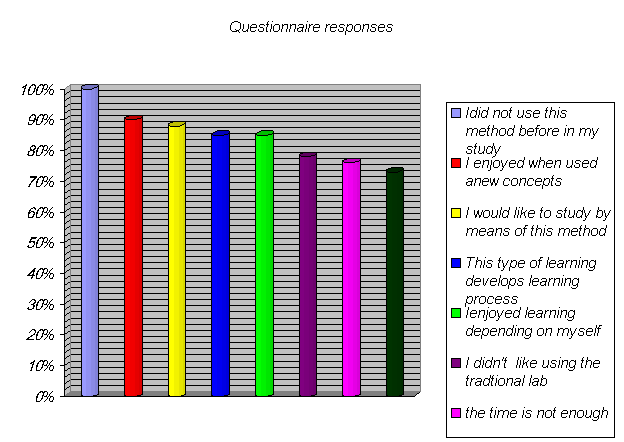
(see figure 3).
Computer
technology has become a necessity in today’s society, and as a result, is
becoming essential in our schools.
Computer technology aids the learners, and contributes in the type of Education goals structure; also it can solve some Educational problems. In this lesson, the computer contribute support to success of the lesson, because:
· The Computer aided in the preparation and presentation of the lesson.
· Computer tools facilitated learning process.
Those contribute effectively in the lesson because:
Interest and motivates students, also it made them work with desire and encouraged collaborative learning.
The instrument that yielded the best information to answer this question was observation and test, through observation; it is found the students react to the lesson and their performance improve, support this instrument the test, the teacher found the students’ performance is improve in post test than pre test (look the table (1):
Learner |
Pre
–test score |
Post
– test score |
Different |
|
Learner
(1) |
6 |
10 |
4 |
|
Learner
(2) |
8 |
16 |
8 |
|
Learner
(3) |
6 |
13 |
7 |
|
Learner
(4) |
8 |
12 |
4 |
|
Learner
(5) |
4 |
14 |
10 |
|
8 |
12 |
4 |
The instrument that yielded the best information to answer this question was observation and questionnaire, during the observation; it found that the computer is a helped student to understanding that lesson.
Through the questionnaire is
explained the computer aided the students to study that lesson; and it is
important in learning process.
Cooperative learning is the instructional use of small
groups so that students’ work together to maximize their own and each other's
learning (Johnson, Johnson, & Holubec, 1993). The instrument that yielded the
best information to answer this question was observations,
through this instrument; it is found the cooperative learning is aided the
students to understanding those information, and improve students’
performance, in addition, it is encourage each other to work hard. It would seem then that
cooperative learning, students’ benefit from sharing ideas rather than working
alone. Students help one another so that all can reach some measure of success. Practice requires feedback to be effective. The practice
that is most effective for learning is practice in which learners are encouraged
to try things and then given immediate feedback as to whether they've done the
right thing or not. The
instrument that yielded the best information to answer this question was
observations, through observation; it is found the students’ skills improved
step after step. Also found Practice is enhanced
learning and students’ achievement because
it can help to activate students’ prior knowledge. The test instrument
supports this result, (see table (1) above). It would seem then that the Practice important to students
for consistent information and to reach learning goals. Success is exceeding hinders attaining to the goals one
planned for. The learning process success, it is served the purpose of
learning. The students were able to understand the new concept(s), and their
performance improved (see pre-post test). Also that lesson raised the
student’s curiosity (the teacher observed this during the students were
studding the lesson). In addition the questionnaire explained the students
enjoyed the new concept. Also enjoyed to discovery new information depended on
themselves and so on (See questionnaire). And the students’ performance
improved and developed after students studied the lesson. Question
Number Pre- test Students’
performance N. Of
correct answer N. Of
incorrect answer N. Of
correct answer N. Of
incorrect answer Pre- test Post- test 1 2 3 3 Sensible Good 2 0 6 4 2 Bad Very good 3 1 5 4 2 Bad Good 4 2 4 4 2 Sensible Very good 5 3 3 5 1 Sensible Better 6 2 4 4 2 Sensible Very good 7 3 3 5 1 Sensible Very good 8 0 6 3 3 Bad Good 9 2 4 5 1 Sensible Better 10 3 3 4 2 Sensible Good
·
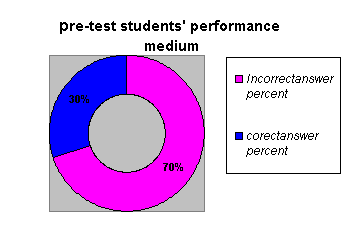
Students’ performance is medium.
·
The students chose their answer randomly.
·
Figure (1)
·
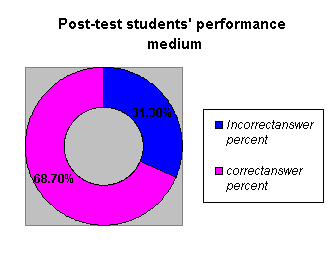
Students’ performance improved.
·
The student knew what to do.
·
The student chose the
answer, after a good comprehension to the information.
Figure
(2) Figure
(1)
Some factors contributed to success of the lesson: The use of new concept(s) outside
the traditional approach to explain the lesson motivated and encouraged the
students to continue in study. Simplicity and clarity aided the
students in understanding new information. Encouraging the students to
discover information by themselves was an exercise for them in depending on
themselves, and their performance will improve accordingly. Few students in
the class aided them in understanding the lesson, and aid the teacher in
guidance and observation. That
lesson achieved the targets; but not in the way expected; but did not fail. I learnt and conclusions from
this work, that individual learning should teach some information, while
cooperative/ collaborative learning should teach another information. And learnt
through apply that lesson use technology in learning process, it is facilitate
learning process. In addition that learnt, when student’s discovery
information by himself or herself to aid promote students’ learning process.
Used this method for Observation
and study verbal and nonverbal students’ behavior and performance throughout
the lesson, because the video is very actually to presentation the students’
actions, in addition it is development the ideas from class perform. That video
entered on that lesson about 50 min. The details I observation after showed that video; the
students are interactions with a lesson. Also I Conclusions these points:
If I do that lesson again, I do the same steps, but I try
improving information. If some one will do it lesson should remember:
In future, recommend myself and
others peoples, when to designed any lesson should be observance these
points:
Bloom, B. (Ed). (1956). Taxonomy of educational Objectives.
Hand book I: Cognitive Domain. New York: Longman. Bruner, J. S.
(1990). Acts of Meaning. Cambridge, MA: Harvard Univ. Press. Lepper, M. R., & Malone, T. W. (1987). Intrinsic
motivation and instructional effectiveness in computer-based education. In R. E.
Snow & M. J. Farr (Eds.), Aptitude, learning, and instruction: Vol. 3.
Cognitive and affective process analysis (pp. 255-286). Hillsdale, NJ:
Erlbaum. Malone, T. (1981). Toward a theory of Intrinsically
Motivating Instruction. Cognitive Science, 4,333-369. ISBN 0 7507 0387 3.
Are the students’ skills improved with practice?
Conclusions
Comparison between pre
– post tests
Post- test
After collected those data from pre and posttest and
make analysis to those data, the result I reached after that, about students’
performance and improve their learning skills between doing per and posttest:
Pre – test
The student faced difficulties to understand some questions.
Post - test
Video
 Use a computer was
enhanced the learning process, and it was raised the students’ curiosity.
Include
a computer in that lesson; aided the students to study that lesson and it was
improved the students’ learning skills.
The
cooperative or collaborative learning was facilities that lesson via used a
computer.
Use a computer was
enhanced the learning process, and it was raised the students’ curiosity.
Include
a computer in that lesson; aided the students to study that lesson and it was
improved the students’ learning skills.
The
cooperative or collaborative learning was facilities that lesson via used a
computer. Recommendations
The lesson should include meaningful idea(s), and make the students
activities through the lesson.
The lesson should put the students in real life situation.
The lesson should feedback the students with their responses.
Use information clear and easy to understand.
The
designer
should be put clear goals.
The lessons’ should be realizing
those goals to put in the first.
One lesson should be includes one or two new idea (s) just.
The lessons should be includes hints to aid the students to reach
to end goal.
References