(A Work in Progress)
Updated 8 April 2006
- Introduction
- Phonology
- Grammar
- Morphology
- Other
- Word List
- Sample Sentences
- Charai Rhenão - Rhena Lessons
- Rhena Word List
According to the Xerox language identifier, Rhena resembles Albanian. Though it happens to share the same vowels as that language, this was coincidental. It was originally based on Portuguese phonetically, though I've drawn inspiration from many other places, especially the Baltic languages. Its prettiness is debateable, but I like its personality. (The problem with designing a language that's meant to be as beautiful as possible is that such a language cannot express ugly, evil, and bad concepts well. Thus, to be pragmatic, I've included a few sounds most people consider unaesthetically pleasing.) Perhaps it's not as flowing as Finnish or Quenya, but it has its moments of pleasantness. It's quite nice for cursing in, as well.
Phonology
(Phonetics in X-SAMPA or IPA)
Standard Rhena Consonants:
| Labial | Alveolar | Postalveolar | Palatal | Velar | Uvular | |
| Voiceless stop | p | t | k | |||
| Voiced stop | b | d | ||||
| Voiceless fricative | f | s | S | x | ||
| Voiced fricative | v | z | Z | R\ | ||
| Nasal | m | n | ||||
| Trill | r | |||||
| Approximant | w | j | ||||
| Lateral Approximant | l |
Vowels:
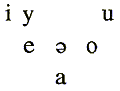
/a/ & /o/ can be nasalized.
In reality, the "a" vowel is somewhere between /a/ and /{/. This is particularly evident when it's nasalized.
When two vowels are next to each other they are dipthongized. Furthermore, Rhena speakers don't often put audible spaces between words, so the vowel that ends a word usually creates a dipthong if the following word begins with another vowel. (Of course, this is not the case when spoken slowly, as for emphasis.)
Allophones
/x/ is pronounced /C/ after front vowels, as in German.
/n/ is pronounced /N/ before /k/ and /x/.
/@/ is closer to /@\/ when it's on a stressed syllable.
The trill /r/ is a flap /4/ directly after consonants.
Transcription:
| Labial | Alveolar | Postalveolar | Palatal | Velar | Uvular | |
| Voiceless stop | p | t | c | |||
| Voiced stop | b | d | ||||
| Voiceless fricative | f | s | sh | ch | ||
| Voiced fricative | v | z | zh | rh | ||
| Nasal | m | n | ||||
| Trill | r | |||||
| Approximant | w | j | ||||
| Lateral Approximant | l |
(Vowels are the same as their IPA, except the schwa, which is represented by an e with umlaut: ë.)
The rules for stress are quite regular: the penultimate syllable is stressed, except when there's a nasal vowel elsewhere in the word. Nasal vowels are always stressed.
Grammar
The Noun, and the Joys of Declension
Rhena nouns are inflected, and can have either "female" or "male" gender. However, the gender of a word doesn't necessarily correspond to the gender of the thing the word means: even the word for "mother", mina, is masculine! It seems that at some time in the distant past Rhena distinguished between two grammatical genders for some reason, but it is not known what this distinction was. Its origins are lost in the mists of time.
The five cases are as follows:
| Feminine | Masculine | meaning | |
| Nominative | --- | -a | (subject) |
| Genitive | -o | -ão | "of ___" |
| Objective | -en | -an | (object) |
| Ablative | -ule | -ala | "because of ___," "by means of ___" |
| Vocative | -aco | -aca | "O ___!" |
The Rhena genitive, besides being used in "of ___" constructions, is used in making adjectives (see Adjectives below), and furthermore is used in locative constructions. For example, to say "the bird is on the branch":
Opazhi pere sã ebo.
/o"paZi "pere sa~ "ebo/
"Be-it-does bird on of-branch."
As you can infer, the normal word order is VSO.
There are three types of motion case constructions in Rhena: to (towards, into, etc.), from (away from, out of, etc.), and via (by means of). For to the objective suffix is used. For from, the genitive, once again, is used. (It's a very busy suffix, isn't it? In reality there should be some other name for it, as it's clearly more than just the genitive, but there you are.) Like locative constructions, these two rely on prepositions as well. The third type of motion case, via, is fully indicated by the ablative, sans prepositions.
Rhena's ablative, like Latin's, combines the functions of several different cases, including the causal and the instrumental.
Naturally there are irregularities in declension of certain words, but fortunately all of those are to be found in the feminine gender. The masculine gender is far more consistent; it never changes its mind and then expects you to sense something's wrong without telling you...
The Pronoun
Pronouns are declined, just like other nouns. You'll notice there is no vocative form for "I", "he", "she", and "it"; this is because the vocative case is only used for directly addressing someone or something.
| Nom. | Gen. | Obj. | Abl. | Voc. | |
| 1st person | ja | jo | jon | jol | --- |
| "You" (to a superior) | ti | to | ten | tel | techa |
| "You" (equal) | së | so | son | sol | secha |
| "You" (inferior) | në | no | nin | nil | ny |
| "He" | ij | ija | ijn | ijl | --- |
| "She" | ej | eja | ejn | ejl | --- |
| "It" | pa | pa | pan | pal | --- |
Rhenar society being as hierarchial as it is, Rhena pronouns have three levels of formality for the word "you" - for speaking to those higher on the social ladder (as well as elders), equals, and inferiors (such as children and servants).
There's no distinction made for number; thus, "we" is the same word as "I", "youse" is "you", and "he", "she", and "it" are the same as "they". When referring to a group of mixed gender, one uses the feminine pronoun. Naturally, this has caused much confusion: Rhena speakers often must rely on hand gestures to motion whether they mean "I" or "we", "she" or "they".
The Verb, or, Conjugation and You
Nearly all verbs are agglutinative, to an extent. Any verb is made of four components: the root, the person, the tense, and the mood.
You'll notice the person component of the verb is identical to the nominative pronoun. (This reminds me: Rhena is partially a pronoun-dropping language, and thus it isn't necessary to put a subjective pronoun in a sentence since it can be inferred from the conjugation of the verb. However, when a pronoun serves as an object, it cannot be forgotten.)
Persons
| infix | |
| 1st person | ja |
| "You" (to a superior) | ti |
| "You" (equal) | së |
| "You" (inferior) | në |
| "He" | ij |
| "She" | ej |
| "It" | pa |
Tenses
| suffix | |
| present | -zhi |
| perfect | -zhu |
| imperfect | -zhão |
| pluperfect | -do |
| future | -ma |
Moods
| suffix | |
| imperative | -cha |
| subjunctive | -cwi |
| conditional | -re |
| admirative | -sha |
| energetic | -fei |
When adding mood to a verb, if the verb is present tense, the mood suffix simply replaces the present suffix. For combining tense and mood, one must modify the suffixes a bit:
| suffix | |
| (doesn't exist) | |
| perfect subjunctive | -zhui |
| perfect conditional | -zhure |
| perfect admirative | -zhash |
| perfect energetic | -zhufei |
| (doesn't exist) | |
| (perfect subjunctive used instead) | |
| imperfect conditional | -zhare |
| imperfect admirative | -zhãosh |
| imperfect energetic | -zhãofei |
| (doesn't exist) | |
| pluperfect subjunctive | -docy |
| pluperfect conditional | -dore |
| pluperfect admirative | -dosha |
| pluperfect energetic | -dofei |
| future imperative | -macha |
| (present subjunctive used instead) | |
| future conditional | -mare |
| future admirative | masha |
| future energetic | -mafei |
When combining the three components of a verb, there's naturally some modification of the phonemes. For example, to say "it speaks" (whatever it happens to be) requires three components: the root Rhen, the person pa, and the present tense zhi. Combined, these make the word Rhentazhi; consonants assimilate to the alveolar, as you can see.
When there's such a conflict (/m/ + /t/, for example), the consonants assimilate to the point of articulation further back in the mouth (those two I just mentioned become /nt/). When /m/ conflicts with something further back than the alveolar, the two consonants become something in between. Three consonants or fricatives being placed next to each other would be considered barbaric - chances are you'd receive funny looks if you mentioned such a thing.
Although Rhena has adjectives, it has many verbs that serve to describe. Thus there are action words for "to be surly", "to be simple", etc. When using these verbs, one can form comparative expressions by placing short modifiers before the verb: for example, to say "he's the surliest man in the house", we have
Mi brancijzhi aman õ cabão (/mi "brankiZi "aman o~ ka"ba~w/)literally "most surly-he-is man in of-house". You'll notice that the genitive case is used there in caba, as well as that there's no distinction between the definite and the indefinite.
Relative Clauses
To make relative clauses a certain word order is used. For example,
"I insult the man who loves my sister."A Note on the Imperative
Preitjazhi aman velijzhi ma fijen. or Aman velijzhi ma fijen preitjazhi.
/p4e_it"jaZi "aman ve"liZi ma "fijen/ or /"aman ve"liZi ma "fijen p4e_it"jaZi/
"Insult-I-do man loves-he-does my sister." or "Man loves-he-does my sister insult-I-do."
The imperative form is very commonly used in Rhena. For example, "welcome", Sensëchaija, is actually a command: Sensëcha Aija means "Be pleased to come!" Additionally, the imperative is used in lieu of the cohortative mood (English "let us"): speakers of Rhena are not known for their politeness.
Negating a statement
To negate a sentence, Rhena employs a special word, Në, at the beginning of the clause. In poetry the word can be placed elsewhere in the clause, but this would be considered odd in everyday speech.
Në veljazhi ma jamen.
/n@\ vel"jaZi ma "jamen/
"No love-I-do my wife."
"I don't love my wife."
Questions
They're really quite simple: just add the word Cei to the beginning of a clause to make it a question. Thus, the language needs no change of intonation or word order to ask questions. Though Rhena has no equivalent of a question mark, I include one in transcription to make things easier for terrestrial speakers.
Like Në, Cei can be put elsewhere in the clause in poetry, but this is becoming rare.
Cei rhecsëzhufei cratan?(Note that the verb rhec, "to kill", here becomes "to murder" via the use of the emphatic mood.)
/ke_i R\eks@"Zufe_i "k4atan/
"(Question) Kill-you-did(emphatic) vicar?"
"Did you murder the vicar?"
When a question is negative, either the Cei or the Në can come first.
Adjectives
Rhena did not originally have many adjectives at all, relying instead on stative verbs. But due to influence from neighboring languages, it has since picked up many more adjectives. As you might expect, many of these are of foreign origin: later, native Rhena adjectives were formed. Adjectives are placed after the noun they describe. To make an adjective from a noun, the genitive form of it is used. For instance, "Rhena lessons" is Charai Rhenão - "Lessons of-Rhena".
Morphology
Making Plurals
It would be very silly to come this far without knowing how to make a plural. Actually, it is quite simple: one must merely add an i after the noun. For those few words that already end in an -i or -ij, the same rule applies: one just makes the vowel longer in duration.
Important Suffixes
Taking a look at the verb and noun lists, you'll notice that infinitives become verbal nouns with the addition of the -a suffix.
The agentive suffix (English "employ-er") is -el, and the suffix that makes a verb into a objective noun (English "employ-ee") is -ec. With some verbs it makes little sense, of course, to have the second sort: how can someone be "one who is be-clevered-to"? (Some modern Rhena authors have experimented with the semantic implications of such nouns, but the popularity of their works is not widespread outside of intellectual and pseudo-intellectual circles. Among the masses such a word is never used.) However, in some cases, passivity or agressivity can be implied by which suffix is chosen on which verb; compare zhutel, "one who dies", with rhecec, "one who is killed".
Sample sentences.
Mirrors and copulation are abominable because they increase the number of mankind.
Bechacejzhi zhefai i cruta cwal cravejzhi imãen amãoi.I will speak with you tomorrow.
/bexa"ke_iZi "Zefa_i "k4uta_i kwal kra"ve_iZi im"a_e~n am"a_wi~/
Be-abominable-they-do mirrors and copulation because increase-they-do amount of-mankind.
Sezuva rhenjama son.I will kill you tomorrow.
/se"zuva R\e"Jama son/
Tomorrow speak-I-will to-you.
Sezuva rhecjama son.
/se"zuva R\ek"jama son/
Tomorrow kill-I-will to-you.
Questions? Comments? Compliments? Complaints?
Write me.