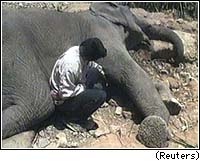
Hla Maung Crying After Moe Haine's Death

by Htet Htet Wunn (1997)
 soft wind was blowing when the sun came up between the mountains.
People were ready to start to work for the day again. This was a jungle
in the middle of Burma and they were teak wood loggers. Teak from Burma
is very famous in the world.
soft wind was blowing when the sun came up between the mountains.
People were ready to start to work for the day again. This was a jungle
in the middle of Burma and they were teak wood loggers. Teak from Burma
is very famous in the world.
At that time Moe Haine, an eight years old black and strong elephant, was coming back to the forest reserve with his attendant, Hla Maung. They went to the river to take a bath. Moe Haine used his trunk as a hose to bathe himself and Hla Maung too. Hla Maung laughed; he always loved his showers.
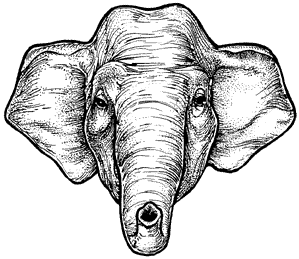
Moe Haine was the most famous elephant in the forest reserve because of his strength and obedience. He looked beautiful with his two long, pointed tusks and ears that were as big as fans. Hla Maung loved Moe Haine as his own son. It was difficult to see Hla Maung and Moe Haine separated for long.
As usual, they had their breakfast – Moe Haine ate banana and sugar cane and Hla Maung had his rice in a bowl - and then they started their work. Hla Maung cut the trees and Moe Haine dragged the felled tree trunks into a pile. They worked till noon, rested and then worked again until there was no sun in the sky.
Hla Maung was interested in gambling but he was always down on his luck. He was frequently in debt and trouble because of his one vice. He would say he would stop, but he could not – gambling pulled him like a magnet.
One day Hla Maung lost a lot of money in a card game. He needed to pay but had no idea from where he would get so much money. He was desperate and in his desperation a germ of an idea began to nag him: he could sell Moe Haine’s tusks to a merchant. The next day he called Moe Haine to go into the forest. Moe Haine carried Hla Maung and he looked happy; he gathered flowers along the way with his trunk and gave them to Hla Maung. Then they stopped under a shadowy tree and Hla Maung said to Moe Haine, "Son, I need money, so I want to sell your tusk. Please understand me." Moe Haine stared at Hla Maung with surprise. He understood what his master was saying. He sat down in front of Hla Maung and looked on patiently.
Hla Maung took the saw and began to cut. "Wait!", thought Hla Maung, "If I can cut from the very base I can get some more money." So he started cutting Moe Haine’s tusk from the very base. Moe Haine did not grumble but there was tear in his eyes. He felt much pain but he sat obediently throughout this ordeal. After cutting the tusk Hla Maung said to Moe Haine, "Thank you, my son, now go back to the reserve. I will come later." Then Hla Maung went to sell the tusks to the merchant.
Moe Haine went into the forest. There was this unbearable pain. It would not go away. He cried and even trumpeted a few notes of anguish when it became too much for him to bear.
For about a week he roamed the forest, unable to stand still and unable to eat or drink. Many people - including Hla Maung - tried to find him but they could not. The elephant became delirious one day and came running into the reserve. People saw that the anguished creature had no tusks and was in terrible pain. Hla Maung, his master, was in a nearby village at the time; however, some of the men were able to persuade Moe Haine and put him into stockade. Then they called a vet to look at him. But unfortunately Moe Haine already had tetanus and it was late to do anything about it. Next day Moe Haine died.
When Hla Maung heard of Moe Haine’s death he came running. He was in grief and tears cascaded down his face continuously.
When he saw the dead elephant he shouted, "Oh, my poor one, what have I done to you!" and sobbed endlessly. Other loggers tried to console him. Then amid his crying he explained what he had done. Moe Haine had been infected from the saw and died. Had Hla Maung cut only a few centimetres away from the base of the tusks Moe Haine would not have died.
The next day all villagers and loggers came for Moe Haine’s funeral because he was the most reliable and caring elephant in that reserve.
Today Hla Maung curses himself for the death of Moe Haine but his repenting will never bring that caring elephant back into life. Hla Maung knows this and with this knowledge will he live for the rest of his life.
[Adapted from a Burmese novel.]



