
*'America has no credibility'

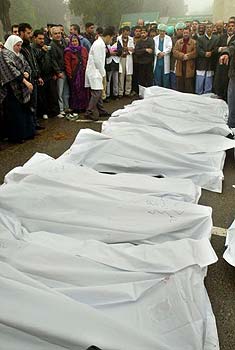
The bloody battle of Bethlehem By Robert Fisk
Rotting bodies in Bethlehem, Israeli soldiers surrounding Palestinian civilians and militiamen in the place of Christ's birth, unburied corpses in Ramallah -- Israel's latest war is turning into a human and political tragedy on a vast scale as the last physical symbols of the Oslo peace agreement are destroyed.
For two days, the suicide bombers have been silent. But the coming weeks will decide the future of the Holy Land for years to come.
If the Church of the Nativity is now a battleground, what is sacred any longer? The details are as indistinct as the smoke that still rises close to Manger Square, but Christian officials speak of at least 100 Palestinian civilians seeking the sanctuary of the church that marks the spot where Jesus is believed to have been born in a stable.
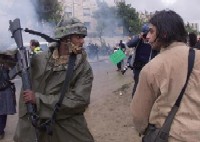
With them, it seems, are at least 10 Palestinian militiamen from the Tanzim movement. The Israeli army has surrounded the church with tanks. According to the Israelis, the Tanzim men have opened fire on the occupying soldiers. The Palestinians denied it.
But no one can deny the carnage elsewhere. Take the phone call I received from Sami Abda yesterday afternoon. On Tuesday, he told me, Israeli soldiers arrived at his house in the centre of Bethlehem and, despite being warned by a neighbour that his home was filled with women and children, opened fire on the building. The Israelis claimed that "terrorists'' were in the house.
Sami Abda was crying as he spoke to me and these are his exact words: "They fired 18 bullets through our front door. They hit my mother, Sumaya, and my brother Jacoub. My mother was 64, my brother was 37. They both fell to the floor. I called everyone I could to take them to the hospital. But there was no one to help us. They were dying. When an ambulance came, an Israeli officer refused permission for it to enter our street. So for 30 hours, we have lived with their bodies. We put the children into the bathroom so they could not see the corpses. Help us, please.''
But that insistent question "What is sacred?" could be asked again by anyone who read The Jerusalem Post this week: a whole page of tiny photographs of the dozens of Israeli civilians torn to pieces by Palestinian suicide bombers in just one month. One teenage Israeli girl was the same age as the Palestinian girl who destroyed her life. It was a page of horror and misery.
And, yes, war compounds human tragedy. Even as Sami Abda was trying to shield his own children from their grandmother's and uncle's blood, a young female doctor was shot dead inside her home in Jenin as 30 Israeli tanks smashed into the northern West Bank city to be met by fusillades of gunfire from Palestinians.
They invaded Salfat, too, and hundreds of tanks last night invaded the ancient city of Nablus, with its Palestinian Authority officers and kasbah of narrow streets.
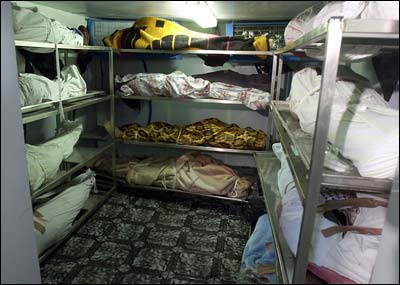
In Ramallah, the hospital authorities " tired of waiting for Israeli permission to bury the dead " interred the corpses of 25 Palestinians that had been decaying in the mortuary for four days.
Palestinians are demanding an inquiry " there will be none, of course " into the killing of five policemen gunned down by Israeli soldiers in a tiny Ramallah room. A gun battle, said the Israelis. But the bullets that killed them all appeared to have been fired at close-range and at least two of the men were in their mid-50s.
More than 1,000 prisoners have now been taken away by the Israelis and, except for a dozen or so, no one knows where they have been taken or if they are alive. A group of several dozen were transported to a Jewish settlement before being taken away yet again.
So is the State of Israel crushing any hope of a state of Palestine? A tiny flower of hope came in the cold and rain at the Kalandia checkpoint outside Ramallah yesterday, when Israeli Jews and Israeli Arabs and a few of the Western protesters, whose courage has gone sadly unrecognised, arrived to demand peace and an end to Israeli occupation.
There is life after war. But will there be a Palestine? Will the world, through this Israeli reoccupation, see Palestine as it saw Bosnia or Kosovo?
Hanan Ashrawi, one of the few credible Palestinian figures, is also one of the few sane voices in the war. Exhausted, bags below her eyes, keeping herself awake with scalding coffee, she spoke to me with an air of resignation in Jerusalem.
"The Oslo agreement is being deconstructed, deliberately," she said. "Sharon is being obsessively consistent. He always said he wanted the destruction of the Oslo agreement. This reoccupation was planned many months ago.
"But Sharon lacks the ability to assess the ramifications of his actions. His attempts to destroy Arafat have backfired. He has made Arafat more legitimate among Palestinians.
"Everyone--the left, the right, the centre, the radicals, the Islamists -- have now rallied behind him. So don't expect anyone to propose another Palestinian leader.''
Could this be true, that Yasser Arafat's weakness is turning into his strength, that Ariel Sharon's military power is turning into a weakness? For if the Israeli army is achieving the astonishing success it claims, why does it not want journalists to witness this great victory?
As the Europeans, the UN Security Council and the Arab League were all deliberating on this turning point in Middle Eastern history, the world's last colonial war "between a settlement-planting nation and an occupied people "was entering its gravest phase.
Robert Fisk: A speech laced with obsessions and little else
Ariel Sharon could not have done better. The heaping of blame upon an occupied people, the obsessive use of the word terror " by my rough count there were 50 references in just 10 minutes " and the brief, frightened remarks about "occupation" and (one mention only) to Jewish settlements and the need for Israeli "compassion" at the end were proof enough that President Bush had totally failed to understand the tragedy he is supposedly trying to solve.
The mugger became the victim and the victim became the mugger. What, I wonder, is the exact distance between the Rose Garden and Bethlehem? So the US Secretary of State, Colin Powell, is travelling to "the region'' next week. Next week? Why not now?
But of course, the White House, which according to the Israeli press has repeatedly been asking Mr Sharon how long he intends to reoccupy the Palestinian cities of the West Bank, is to give the Israeli Prime Minister more time to finish his invasion, destroy the Palestinian infrastructure and dismantle the Palestinian Authority.
The speech was laced with all the "war on terror'' obsessions: Iraq as a sponsor of terror for donating money to a family of Palestinian "martyrs'', and Syria for not making up its mind if it is "for or against terror''.
The European Union, fearful of rising oil prices and their effect on the eurozone economy, had earlier dispatched a mission to Israel; with typical contempt, Mr Sharon told its members they could not visit Yasser Arafat in Ramallah. The delegation, which had earlier announced that the Americans had failed in their mission as peacemaker in the Middle East, simply packed up and left Tel Aviv within hours.
But will Mr Powell do any better? The dollar has fallen against world currencies because of the Middle East crisis " as good a reason as any for Mr Bush to act " and the possible restrictions on Middle East oil production, though more damaging to Europe, must have helped to prompt the President's decision to dispatch Mr Powell.
The Palestinian suicide bombings, however, were the core of Mr Bush's address. He talked of the 18-year-old Palestinian girl who blew herself up and killed a 17-year-old Israeli girl, the Jewish state's "dream'' of peace with its neighbours. "Terror must be stopped ... no nation can negotiate with terrorists ... leaderships not terror ... you're either with the civilised world or you're with the terrorists ... all in the Middle East ... must move in word and deed against terrorists ... I call on the Palestinian Authority to do everything in their power to stop terrorist activities.'' Arafat had agreed to control "terrorism'' -- "he failed'.' The reoccupation of the West Bank was a "temporary measure'', Mr Bush announced, trusting the word of the Israeli occupiers. "Suicide bombing missions could well blow up the only hope of a Palestinian state.''
On it went, 11 September-speak applied to the Middle East. Israel's enemies must be eliminated -- Al Aqsa, Hamas, Islamic Jihad and Hizbollah, which yesterday beat up a UN observer on the Lebanese border in the most dangerous incident of its kind since the Israeli withdrawal in 2000. The whole Bush speech revolved around Israel's wellbeing, with scarcely three minutes devoted to the Palestinians and their 35 years under occupation. Israel should, Mr Bush decided, show a "respect'' for and "concern'' for the Palestinian people.
There was some ritual mention of UN Security Council resolutions 242 and 338, which calls for Israeli withdrawal from territories occupied in the 1967 war but which Mr Sharon has already said he cannot accept, and an appeal to halt settlement building. But Jewish settlements are still being built, at an ever-faster rate, on Palestinian land.
Only a heart of stone could not respond to the suffering of those Israeli families whose loved ones have been so wickedly cut down by the Palestinian suicide bombers. But where was Mr Bush's compassion for the vastly greater number of Palestinians who have been killed by the Israelis over the past 19 months, or his condemnation of Israel's death squads, house demolition and land theft? They simply didn't exist in the Bush speech.
The money for "martyrs" does not, of course, only go to the kin of suicide bombers -- it goes to families of all those killed by Israelis, most of whom have been struck down by American-made weapons. Certainly, America has never offered to make reparations for the innocents killed by the air-to-ground missiles and shells it has sold to Israel.
Far more instructive than the Bush speech was the measured, fair way in which Terje Larson, the UN's special Middle East envoy, and Nigel Roberts, the local director of the World Bank, tried to describe the tragedy. In a short press conference they appealed to both sides to end violence and respect international law and cited Israel as well as the Palestinians for breaking it. The so-called Israeli "closed military areas" were, Mr Larson said, "illegitimate and in direct violation of the [Oslo] Agreements". Mr Roberts talked of the surge in violence as a threat that could "consign to history the unique opportunity for reconciliation''.
But "closed military areas" achieved another Israeli victory over the Western television satellite stations. Yesterday, the BBC, Sky and CNN, with their own crews largely prevented from filming in the reoccupied Palestinian cities, all ran footage of the Bethlehem battle taken by Israeli soldiers. Rather than refuse to use the tape unless their own crews were permitted access to the carnage, the three channels all dutifully used the film taken by the army of occupation. Another milestone in the collapse of journalism in the Middle East. But not so serious as the collapse of America's peace-making.
Palestinians Dismiss Bush's Accusations Of "Their Elected President"
GAZA CITY, April 4 (IslamOnline & News Agencies) - Palestinian officials Thursday blasted U.S. President George W. Bush's charge that their leader Yasser Arafat "betrayed his people" and was to blame for the current violence in the Palestinian territories.
"We cannot approve what President Bush said about President Arafat because Mr Arafat is the elected leader of his people," chief Palestinian negotiator Saeb Erakat told Agence France-Presse (AFP).
Stressing the same meaning, but in a clearer reading of Bush's statements, a minister in Arafat's Palestinian Authority (PA) charged that Bush gave Israeli Prime Minister Ariel Sharon a "license to kill" Arafat by blaming the Palestinian leader for the current crisis.
Civil organizations minister Hassan Asfur was speaking on Qatar-based Al-Jazeera television from Ramallah.
"The crux (of Bush's address) is that it confers legitimacy on (Israeli army chief Shaul) Mofaz and Sharon to press ahead with their plan ... (to finish off) Arafat," Asfur said.
"He (Bush) was telling the Palestinian people that ... (Arafat's) leadership is the obstacle to a solution," he charged.
The gist of Bush's message is that "president Arafat is to blame for the terror and we must get rid of him. Bush today gave the go-ahead for the liquidation of the president (Arafat) and the leadership," Asfur said.
Erakat, however, added that Arafat, trapped for a week in what remains of his West Bank headquarters by the Israeli occupation army, was prepared to see U.S. Secretary of State Colin Powell, sent to the region by Bush.
He wanted to see the implementation of last week's UN Security Council resolution 1402, calling for Israel's withdrawal from Ramallah and an immediate ceasefire, and the Tenet and Mitchell peace plans, Erakat added.
"We want an American political vision on the Israeli withdrawal and an implementation of this vision. The Israeli occupation constitutes the highest form of terrorism," he said.
For his part, Palestinian information minister Yasser Abed Rabbo echoed the same message. "Arafat is the elected president of the Palestinians and we want America to end the Israeli occupation and aggression," Abd Rabbo said.
He demanded to know if the Israeli occupation would continue until Powell arrived next week.
In another development, Sharon reportedly authorized U.S. peace envoy Anthony Zinni Thursday to see the besieged Arafat, an Israeli official said.
The official said Sharon made the decision after a meeting with the American envoy. An Israeli spokesman said it would be up to Zinni to fix a date to meet with Arafat.
It would be the first time Zinni met with Arafat since the start of the ongoing Israeli onslaught on the Palestinian territories that began on Friday. Arafat has been pinned in his West Bank offices by Israeli troops since then.
Bush on Thursday harshly criticized Arafat for (allegedly) having "betrayed the hopes" of his own people and demanded "better leadership" for the Palestinians.
Arafat, he accused, had "missed his opportunities" to bring peace to the region, "and thereby betrayed the hopes of the people he is supposed to lead."
"The situation he finds himself in today is largely of his own making," the U.S. president said outside the White House in a major address on the volatile situation in the Middle East.
Bush also took a strong tack on Israel, calling on the U.S. ally to "halt incursions into Palestinian-controlled areas and begin the withdrawal from those cities it has recently occupied.
Urgent: Eyewitness report from Ramallah
Posted by The Editor
Ramallah, Occupied Palestine -- My name is Tzaporah Ryter. I am an American student from the University of Minnesota. I currently am in Ramallah. We are under a terrible siege and people are being massacred by both the Israeli army and armed militia groups of Israeli settlers. They are shooting outside at anything that moves.
I am urgently pleading for as much outside help as possible to help save lives here.
I arrived in Ramallah last Thursday. I had come back for a visit to the Palestinian city where I had been previously living and studying. On Thursday afternoon, the Israeli army began sealing off each entrance to Ramallah and there were rumors that they planned to invade.
People were rushing back home from across checkpoints and also people were trying to flee. People were not allowed to go out and many working people -- with homes and children to return to -- were not allowed in, everyone was trying to take cover. Those traveling in began desperately searching for alternative ways and traveling in groups, but the Israelis were firing upon them and everyone was running and screaming.
Women carrying their children were trying desperately to flee from Ramallah, carrying infants and toddlers, and their young children were running along in the rain through the fields, slipping and falling on the rocks, trying to reach safety. Israeli jeeps were speeding across the terrain pulling up from every direction and shooting at the women and children, and also at me, as we ran in opposite directions. They were chasing down people, hunting them like that in the fields.
When I reached Ramallah, people were panicking and trying to buy bread, rice and milk from corner stores, but most supplies were already gone. We bought what we could and went inside to wait for what was coming.
When night fell, Israeli tanks began to invade and also we saw Israeli troops coming on foot from the valley, and surrounding our house. I could hear them calling to each other in Hebrew. They were against our door and all around. They were firing everywhere a barrage of bullets and there was tank fire. We had to lay on the floor and keep silent. We stayed there, on the floor, for nearly four days in the darkness.
Nobody can go outside. We knew that our circumstances were better than others because old people or infants or people with medical emergency needs had no help. It was very cold, with most families packed all in one room. Some people are without life sustaining medicines like insulin, and they are altering their doses dangerously if they have any medicine left to take. People are becoming dangerously sick from lack of food and water and heat. The fear and terror only makes things worse, but it cannot be avoided.
In the daytime, we heard them shooting people in the streets, and could hear them screaming and screaming. No ambulance was allowed through. Then their screams stopped and there was just silence.
We had a telephone and would receive calls from all over telling us what was happening. Everyone is in grave danger and Israeli soldiers were killing people everywhere. They are arresting medics and ambulance drivers, including foreign volunteer medical workers.
They keep taking doctors and medics, just now another call. Again, this time the wife of a doctor telling us her husband has been taken from the ambulance.
Groups of people have been found in rooms, shot dead, there are blood marks where they have lined people up on their knees and shot them, and there are photos of them on the news with their ID cards laying on top of them. There have been reports that the Israelis are taking people from their homes, blindfolding them, removing their clothes, taking them away or lining them up and shooting them against the wall. There is no way of verifying this.
People are making phone calls and saying that these soldiers and militia have come in and are shooting people and then the line cuts off. This could be because the Israelis are hanging the phone up but this is the point, we just don't know. The fear is bad enough.
The numbers of these killings I fear are much greater than the numbers confirmed in the press, because the human rights offices and the media centers have been stormed, and everything is shut down. No one can move without almost certain chance of being shot by the Isreali snipers, who are everywhere.
The Israelis are demanding that all journalists leave Ramallah and today another foreign journalist was shot. They do not want any more internationals here and are deporting people. It seems quite clear that they do not want eyewitnesses which is only heightening my own fears.
The hospitals have also been surrounded and invaded and Israeli troops are taking the injured people and interrogating them. Today a woman, a patient, tried to walk out from hospital. The Israelis shot her in the neck and killed her.
The Palestinian Ministry of Health is saying that they fear the spread of diseases because of the number of unburied corpses.
The numbers are only growing in reports of the mass killings here and Israeli troops continue to round up people. People are calling frantically, missing a relative and we do not know where they have been taken, including children.
The numbers of detainees we know about exceeds 600, and we are estimating between 700 and 800 Palestinians have been taken away. All human rights groups and legal advocates are being denied any information of where the detained are being held. The people we have spoken to confirm that 10% of those detained so far have been children under age 18.
On the fourth day I decided to try to move. People were running out of supplies and I also was so worried about people, and had to check to see if they were okay. If I didn't, I feared panic would overtake me so badly that I really had no other choice but to try and go.
It was not safe where I was in any case and at least if I left I would still have my sanity. It was really terrifying as there are some internationals here, usually traveling in groups, and the Israelis are saying on the radio that they will arrest or shoot the internationals. They did shoot some yesterday and regardless, it's not as if snipers differentiate and they are everywhere.
My friends told me not to go, and were really scared for me, but I had to go. When I went outside, there were cars all shot up and hit by multiple bullets and shells in the middle of the road, unparked. There must have been people in them but I don't know where their bodies are. There are no reports of them, but they must exist.
I got to the corner trying to go to the bakery for bread and food for people. Some people were calling and calling with only one cup of rice left. I made it to the corner but they opened fire on my first try, and shot at me, so I had to turn back.
After that I tried again and it took me one day to make it a block because I had to start over again and again. I had to climb through the valley, and as I passed house by house, people were warning me and pointing out what path seemed safest for these two minutes. In the next two minutes, it would be something different. They really helped to keep my path safe.
Today is Day Five and they are still rounding up people like this and we hear them shooting all day long.
This afternoon the Israelis suddenly lifted the curfew, suddenly announcing that everyone had two hours to go out to get food. However, the Israeli soldiers also took food from many of the stores, looted, and there is no bread or things. People went to get whatever they could.
Even though the Israeli army said it had lifted the closure for two hours -- in which we still were not able to transfer medical supplies and still was not long enough to everything that was badly needed -- the Israelis continued shooting people in the streets indiscriminately on their way, so people were running around trying to make it to the store or find a safe route only to have to run back home again. It was an added cruelty and terror tactic in this macabre situation, a sick joke: starve people and then shoot them when they try to find food with your permission.
In an apartment building in Beitunia neighborhood where I used to live, they took 60 people who were my neighbors, including several familes, and pushed them into one room since last night. The Israelis told them that they are to be used as "human shields", as the apartment building is across from a building that they were invading.
One child needs to go to the hospital since last night and, initially, the families were able to call outside. Now, the Israelis have taken their phones.
There are reports that they are rounding up men between the ages of 14 and 45 in that neighborhood, and these civilians, from these same Palestinian families trapped in that building, were just used to walk in front of an Israeli tank as it invaded the Preventative Security Compound.
Reports also have alleged that the Israelis were saying that some could leave but shot them when they attempted to leave. The buildings there are burning, and people are trapped inside.
We keep calling to try to find people but there has been no electricity and most people's phones are dead now. I do not know what is happening to many people. The only solution to this is to try to brave the deadly streets in order to check, but its almost impossible and terrifying to leave the house at all.
Each place I come to, I am afraid to leave not only for myself but for everyone else in this horrifying position. I hear only shooting and shooting, with no return fire. This suggest that unarmed civilians are being gunned down mercilessly everywhere and I am so scared for everyone. I feel like maybe if I leave one place, one area or neighborhood that I will never see people alive again.
There are more explosions outside now and more shooting. Another explosion. More firing, it just doesn't stop. This is a massacre. The foreign delegations tried to get in but were turned back, the International Committee of the Red Cross is trying to help but they are being ignored. Please help.
I am not only scared for myself and for people here, but if this cannot be stopped, I am truly scared for all of humanity, for a world in which we send men to the moon but cannot stop ethnic cleansing. On the news in America, we see hardly anything of demonstrations. What are you doing over there?
There do not seem to be any reports of what is happening. In truth, its got to stop. Please go out to the streets, please demand a response from your representatives. Be loud, march up to the capitals, refuse to leave until the Israelis withdraw. Act now! Tell them the Israelis are murdering innocent people whose only crime is being born in their own homeland, a Palestinian under a military occupation.
Demand international protection for the Palestinian people, scream that this is an affront to humanity and that it is time that the US not only stop supporting Israel, but that the US stop its abuse of human rights within its own borders. This is about all of our struggles. For the love of God, please stop this slaughter. Please help.
Bush has finally grasped that Sharon is the problem
American prestige is now on the line: the president must not fail
Martin Woollacott
The Guardian
It has been a long time coming, but President Bush has finally engaged with the Middle Eastern crisis which his administration has skirted for so many months. One American commentator recently called on the United States to wake up, and behave, "for God's sake, like a superpower". Yesterday Bush seemed to be acting on such advice. When the rhetoric, and long exposition of anti-terrorist principles, are set aside, at the heart of his speech was a series of orders.
Even as he told Yasser Arafat to repudiate suicide bombings, he told Ariel Sharon to get his troops out of the West Bank and to end settlement activity. He told the moderate Arab states to put maximum pressure on the Palestinians to renounce the attacks; he told Syria to decide which side it was on; he told Iran to cease arms shipments to the Palestinians. He made demands in a manner expecting obedience, almost as if chastising inadequate members of his own administration, or incompetent viceroys in foreign parts.
In other circumstances Bush's peremptory style might be resented, but as an index of American seriousness it is welcome. The length (and tone) of his speech was one thing that distinguished it from previous statements by Bush and by his secretary of state, Colin Powell. The other was that it included specific requirements that Israel withdraw from West Bank cities it has reoccupied, that a political process must follow a ceasefire, and that the process must end in a Palestinian state that would be "viable".
Viable in this context will be instantly interpreted by Palestinians as meaning a state with something close to the attributes which were discussed at Camp David and Taba. At the very least, viable could never apply to what we know about Sharon's ideas of a Palestinian state without coherent territory, without control over any part of Jerusalem, and without command over resources such as water and power. Given that Israeli spokesmen have been almost daily emphasising that what was offered at the time of Camp David and Taba will never be repeated, this is a gage thrown down before the Israeli leader.
It may be that the American administration has finally grasped that Sharon is not only part of the problem, but actually constitutes much of the problem facing those, on either side, who are ready to make peace. Doubts must remain about how far the US administration understands that skilful use of the terror argument has allowed Sharon to obfuscate his own responsibility for the violence and his pursuit of a "solution" that, insofar as it can be sketched, would be deeply unjust - and unattainable without the flight of much of the Palestinian population.
The most important change is that the Bush administration has committed itself in this speech, in a manner which is close to unequivocal, to steer the conflict between the Israelis and Palestinians through to a settlement. American prestige is now on the line in a way it has not been before, even during President Clinton's efforts to mediate; and the most important aspect of any act of policy now becomes its success or otherwise in leading to such a settlement. That now matters more than Israeli wishes, Palestinian wishes, the influence of the Israeli lobby, or the attitudes of diaspora Jews.
Whereas the critical element used to be that the president wanted to steer a course that would keep him clear of trouble, the new critical element is that the president must not fail. That changes a great deal. But it does not mean that the parties will fail to fasten instantly on America's new policy in an attempt to bend it to their purposes, or to sabotage it completely. They will certainly do so, and there is no guarantee that they may not succeed, given the fissures still apparent within the Bush administration over Israel and the conduct of the campaign against terror. The administration has agonised so long over how to deal with the conflict between Israelis and Palestinians that it has allowed the conflict to grow almost into a full-scale war. From the start the administration was torn over whether Sharon was an ally whose activities represented another front in the campaign against terrorism, or whether his fight gravely weakened the US in the pursuit of that campaign. This argument is hardly over, but Bush's speech, together with recent American moves at the United Nations, suggests that the administration has moved several degrees toward the latter position.
In Israel and the territories there will be relief and hope, as well as rage in some quarters. Israelis and Palestinians had become so manifestly incapable of extricating themselves from this crisis on their own that many craved, some in public and some less openly, a forceful takeover of their affairs by the only country with serious leverage on both sides.
Yossi Sarid, the leader of the Meretz party, for instance, wrote recently that "The US says that if both sides don't want to reach an understanding, it cannot force them to accept one. This is not true. In Kosovo, Bosnia and Macedonia, the sides might not really have wanted an agreement but the international community, with American backing, spoke and acted." Sarid, who advocates a US-led international force, adds: "When victims fall every day and both sides are blinded by hatred and revenge, we are Kosovo. And a Kosovo-like reality demands a Kosovo-like solution."
On the Palestinian side there are many like Afif Safieh, the Palestinian representative in London, who concluded long ago that the dysfunctional nature of the Israeli political system, which gives disproportionate influence to minorities, meant that the crisis could only be resolved by outside power. No doubt there are also Palestinians who, more privately, wanted to see their own leadership rescued from a different kind of paralysis.
The promise of the Bush speech for that leadership if they take it at face value (and they have little alternative but to do so) is that, if suicide attacks cease, the Americans are now undertaking to force the Israelis into political concessions that will lead in time to a state. The chances are there will be such a cessation, following an Israeli withdrawal.
Then will come the real test of the new US policy, as ceasefire arrangements give way to a political phase in which the Sharon government is likely to try to evade substantive talks, and to cut down what is to be offered. There will also be wreckers on the Palestinian side, possibly assisted by Israeli provocations. A civil war among Palestinians is not impossible.
Colin Powell, now designated as Bush's envoy, will need the coolest of heads if there is not to be a relapse into war. But, as Sarid wrote: "America does not have the luxury of deciding when and where it will intervene. I have bad news for the US government: when you try to run away from the Middle East, the Middle East will run after you - and catch up.
The British Eye Israel Differently
By Tarek A. Ghanem
Staff writer ? IslamOnline
Watching the BBC on April 1st, its camera in Beit Jala was telling the world that nothing could be further from the truth. The BBC crew, which can easily be differentiated from Palestinians by skin color, outfit, tags and equipment, was repeatedly shot at in order to evacuate the site as the reporter angrily noted (this is not even Ramallah, which was declared a military zone and where no reporters are allowed). The picture is getting clearer and clearer; add the apartheid policies, bullying annihilation, and violations to international laws and UN resolutions ? all to the recent obstruction to journalistic integrity ? and that is ?Israel.?
But the hands of falsehood are more far reaching than what they occupy. The old elastic ?anti-Semitic? accusations are resurrected again once a writer pinpoints the carnage inflicted by Israeli army on Palestinians and on the occupied territories! The editorial of New Statesman, March 18th, challenged the passed over Palestinian rights and occupation:
Go to the heart of the dispute and you are left with two fundamental points. First, the Jewish state is a creation of the Western powers? later, the idea of Israel became the Second World War allied powers' version of the final solution to Europe's Jewish ?problem.? Arabs in general and Palestinians in particular naturally wonder why the tragic results of Europe's inability to tolerate a harmless minority should be exported to them. As for the Jewish claim to biblical lands, it makes no more sense to the Arab mind than an Italian claim to establish a Roman state along the length of the A5 would to the British.
And in his article ?Far From the Promised Land,? John Kampfner deconstructed the myth of the aliyah (the ?come home? campaign) of Jewish immigrants and showed that hatred towards the Palestinians has become the glue that holds the Israeli community together. In response to that, Israel started a wave of anti-Semitic accusations, carried out by Jewish rabbis, against the editor and other writers who censured these vague accusations by differentiating between criticism centered on occupation and oppression and anti-Semitic overtones (New Statement March 18, 2002).
Many British intellectuals started to echo the guiltiness of the UK in the creation of Israel and crushing the Palestinian resistance in 1939. Some of them, like Paul Foot, take a stronger stance in standing by the Palestinian resistance by arguing that ?the violence of the Israeli army and police in those regions is the violence of the oppressor, and the consequent violence of the Palestinians is the resistance of the oppressed. Anyone who favors the Israeli occupation of the areas, or the settlements, or who denies the right of violent resistance to the Palestinians is siding unequivocally with the oppressor against the oppressed.? (The Guardian March 5, 2002)
Lately, a number of British human rights activists, most of them are members of the International Solidarity Movement to Free Palestine, and among them comedian and writer Jeremy Hardy, started a nonviolent campaign in the Palestinian territories. 12 British members of the movement, all Sussex university students, have been acting like ?human shields? to protect people in refugee camps of self-sacrificing bombers. And another 4 British activists were wounded. On their web site www.freepalestinecampaign.org, Israeli naked intrusions, even against international peace activists, are posted. In an Interview with the BBC Radio 4 programme on April 2nd, they said that they had never seen such "brutality" as when the Israeli soldiers fired towards the peaceful protesters.
In the eyes of many Britons, especially leftists, Israel?s position has bounded from an underdog to an oppressor. They feel that the Palestinian suffering ? which can be traced back to British imperialism and the Balfour Declaration ? is completely unacceptable, especially with the current partial role of the UK under Blair. This is the reason behind the great numbers of anti-Israel demonstrators in London. Among the flyers that were handed out was a call on the British Parliament to ban selling arms to Israel for the use of those weapons against unarmed civilians.
The shift in public opinion is continuing to attract more British people on all levels after a long history that started with guilt and lasted in unfairness. The British are like all peoples, once unequivocally introduced to the reality of Palestinian suffering under Israel?s racist war, it becomes so hard for them to deny solidarity and to withstand the world?s greatest injustice.
'America has no credibility'
Few plaudits for Bush speech
Peter Beaumont in Jerusalem
The Guardian
Reaction in Palestinian cities to Mr Bush's speech was marked by hostility and scepticism. In Hebron Khalid Amayreh, an independent journalist and commentator, poured scorn on the plan.
"Mr Bush is conspicuously ignorant of the situation in the Middle East," he said. "All that he knows comes from the rightwing pro-Israeli extreme in US politics.
"If it is so urgent, why is secretary of state Powell coming next week and not tomorrow?"
Bassem Eid of the Palestinian Human Rights Monitoring Group said: "If Mr Bush says that he wants to fight against terror then he should declare what the Israelis are doing in the occupied territories as state terror.
"America has had no credibility in this region really since the Gulf war and it has intensified in recent months with America's collusion with Israel. No one here expects anything any more from American interventions."
The latest crisis has seen massive demonstrations against the Israeli military action across the Islamic world.
In Lebanon, tens of thousands of protesters took to the streets to denounce Israel's raids on Palestinian towns and its siege of Yasser Arafat at his headquarters in Ramallah.
Some 20,000 demonstrators marched through the southern port of Sidon, carrying pictures of Mr Arafat and chanting "Sharon you pig" and burning the Israeli flag. Thousands more Lebanese and Palestinians from refugee camps demonstrated in the northern city of Tripoli.
In the Indonesian capital, Jakarta, 2,000 people called for an end to Israeli military action on the third day of protests in the world's most populous Muslim nation.
In Cairo the Egyptian president, Hosni Mubarak, urged Israel to grasp the hand of peace extended by Arabs and accept that military force would never crush Palestinian resistance to occupation.
"Arab countries have extended their hands in peace to Israel twice, first in the Cairo Arab summit of 1996... and secondly at the Beirut summit [last month]," Mr Mubarak said in a formal televised address.