

By Salam Al-Marayati
Excerpted with permission of the author from a speech given to the U.S. State Department's "Open Forum" on January 28, 2002.
When we speak of the rising voice of moderate Muslims, there are two important points: that it is rising because in the past it has been the silent majority, and that it is an authentic moderate voice as a result of acting in accordance with the Quran, not against it.
These two points are critical to the policy-making process and therefore to America's image and interests in the Muslim world. There exists a healthy and eager segment in Muslim countries interested in dialogue and constructive engagement, and in serving as a bridge between our society and the Muslim world. This voice is central to a more effective and representative US policy toward that region. More importantly, former special envoy to the Middle East peace process Dennis Ross stated that one main reason for Oslo's failure was that the environment around the negotiating table sharply contrasted with the environment on the streets.
Seeing that our embassies have become more isolated from the masses, and our channel of information is more technological than human, and our traditional means of relying on foreign government sources is not always reliable, then understanding the moderate Muslim voices become valuable.
Some observations on the moderate voice are in order. The moderate voice is not an elitist or Westernized voice. It is not a lonely or persecuted voice. And it is not a purely secular voice. It is a voice of the Muslim mainstream, grounded in a Quranic verse: We have willed you to be a community of moderation (2:143) and in the admonition of the Prophet Muhammad to stay away from extremism.
There are Muslim extremists, just as there are Christian and Jewish extremists. That is different from saying, however, that there is split in Islam, and unfortunately, moderates are at times defined as those who are not religiously observant or they are fighting, even repressing, other Muslims. The focus must remain on the interests at stake: ending the scourge of global terrorism, promoting Middle East peace, and preventing nuclear conflicts. Consistency on human rights and democracy will help us in achieving these goals. The moderate Muslim voice does not acquiesce to issues of freedom and justice. It is the inevitable voice of the future.
The word reform is found in the Qur'an. In Arabic, it is called islah and is the root meaning of the word maslahah, which means the public interest. Intellectual giants such as Wali Allah, Afghani and Abdu are among the most notable that used reason to create revivalist movements. Wali Allah of India helped to re-open the gates of ijtihaad and condemned blind imitation. Afghani challenged Muslims to think of Islam consistent with reason and science. Abdu believed in educational reforms throughout Muslim society.
These same concerns are raised today with respect to the plight of Muslims as illiteracy, poverty and a lack of effective political systems create an environment that is more susceptible to criminal activity. One challenge for Muslims today is to shift from the paradigm of the colonial model, which perpetuates the notion of Jews and Christians as agents of colonialism. The perception that globalization is merely a tool of Western imperialism, closely reminiscent of the past under colonialist rule, results in antagonism, instead of efforts of change in Muslim society.
One concern over Islamic movements is the apprehension that they will come into power with an anti-democratic orientation. As a reflection of support for the status quo, the official US government response is to remain silent when these groups are banned from political activity. When that suppression takes place, however, the transformation leads to more radicalized groups. Prevention of dissent in Saudi Arabia led to bin Laden's eruption in Afghanistan and hence the formation of the Al-Qaeda. Banning groups anywhere forces them to go underground and creates a more radicalized current. Despite the fact that these radical groups are real and are ongoing, the moderate voice, while remaining alive, has not been heard.
When 500,000 Muslims rallied in Pakistan last October for peace and moderation, it was a footnote in the press reports. In that rally, statements against terrorism and for tolerance were made, yet attention remained fixated on the few who burned effigies. After Sept. 11, Muslims from around the world expressed shock and remorse over the terrorist attacks, ranging from a moment of silence during a soccer match in Iran, to candlelight vigils throughout the Occupied Territories of Palestine. Statements of solidarity with the American people coupled with condemnations of the terrorist attacks were sent from practically every Muslim country.
Lack of widespread hostility toward Americans and even many aspects of American culture is one feature of mainstream Muslims. On a more substantive level, however, is the yearning for self-government and freedom, a sentiment found on the streets of every Muslim city. To some, a form of Islamic democracy is a means to achieve those goals. The moderate Muslim voice is based on the need for equity, civil society within each Muslim country and on rapprochement with the West on the global level.
Some may say that the expressions of moderation and support for the US are made for political expediency, for survival. But, to many Muslims standing firm against terrorism is an Islamic obligation. In principle, Islam has no room for terrorism. In practical terms, more Muslims die from terrorist attacks than any other group, whether instigated by Muslim extremists or Christian, Jewish, Hindu or Bhuddist extremists.
When 200,000 Bosnians were killed by paramilitary groups and 20,000 Bosnian Muslim women were systematically raped by forces under control of the Serbian government which is closely linked to the Serbian Orthodox Church, that to the Bosnians is terrorism. When 100,000 Algerians perished because of the problem of terrorism, the main victims are Muslims.
The prognosis for Muslims worldwide is bleak, for conditions are more ripe for anarchy and lawlessness than stability and economic advancements. Refugees emanate from Muslim countries more than any other part of the world. The Muslim masses want Islam to be a vehicle for change. While terrorism has become a problem in the Muslim world, it is erroneous to explain this problem of violence as one rooted in Islam or Islamic thinking. Rather, the Muslim world turns to religion as respite from economic hardship, political instability and other consequences of failed states.
It is popular of late to quote verses out of context from the Qur'an to somehow argue that war-mongering and terrorism are central to Muslim belief and practice. Those who perpetrate violence in the name of Islam distort and abuse the texts in the name of their cause, but the texts themselves are not to blame and should not be the subject of scrutiny, since legitimate Muslim scholarship utterly rejects the aberrant interpretations. Qur'an and hadith are clear in terms of supporting conflict only as a last resort in order to defend oneself against clear military aggression. Numerous restrictions apply, including the prohibition against killing civilians, destroying buildings and fighting other Muslims.
Because many Muslims seek forms of government that incorporate Islamic law to one degree or another, the concept of Sharia needs more thoughtful approaches in US policy-making. Sharia is a core of laws that comprise basic principles (based on Qur'an and hadith) and man-made laws that are derived from the basic principles (fiqh). Imposing Sharia violates the Quranic injunction: Let there be no compulsion in matters of faith. The notion of religious police, therefore, violates this code. The exploitation of Sharia leads to persecution of religious minorities and women.
There is this oversimplification done by both self-proclaimed experts and Muslim extremists that use Sharia as a political football fixating on the penal code and not the call for government responsibilities--for example, to be accountable to the people through a social contract. The five goals of Sharia, accepted by all Islamic jurists are to secure and develop life, mind, faith, property and family. These are consistent with human rights declarations and the U.S. Constitution. In a national conference the Muslim Public Affairs Council held over the winter break, one speaker presented the thesis that the U.S. Constitution is the closest human document that fulfills the goals of Sharia. His message was well-received by all 1,000 participants.
While it is wrong to impose the Sharia on non-Muslims or Muslims against their will, it is also wrong to disallow Muslims, who seek Sharia as a way of advancing their societies, from participating in political affairs. Legal systems based on Shari'a are a reality of the 21st century in that they already exist in many parts of the Muslim world. To suggest that the only acceptable form of government involves the absolute separation of church and state is to ask for more tension and rejection.
Other challenges are facing us as Americans interested in U.S. policy in the Muslim world. American values of freedom, human rights and justice are cherished by all of us as citizens of this great country. Those values are not perceived to be America's foreign policy goals.
Anti-American sentiment is a problem, and not just in the Middle East or South Asia, but also Latin America and Southeast Asia and even Europe. On a positive note, the Bush Administration has been very constructive and thoughtful in building an international coalition against terrorism, in seeking international authorization for the attempt to defeat international terrorism. As a result, Afghani men and women are now free to choose their form of attire and seek rights to education.
The President has also stated that he would like to deal with root causes of terrorism such as poverty. That's important because it begins to build a dual track approach in counter-terrorism policy-one that brings the culprits to justice and another that deals with the inequities in the world. Nothing justifies criminal activities, especially terrorism, but when we dealt with uprisings in Los Angeles, report after report told us the same thing-eliminate injustice, poverty and hopelessness and the propensity for rioting will dissipate.
Assertions that Wahhabism is the problem are misguided attempts to seek easy solutions. Before, Shiism was the problem, and perhaps tomorrow Sufism will be the problem. Muhammad ibn Abdul Wahhab created a historical interpretation to purify his environment during impure conditions. He is considered progressive for his time and place, and rigidity came afterwards. The more we fight these isms and not deal with real sociological factors, the more difficult it will be to see a resolution to the conflict.
So we have those with a political agenda lumping everything into one basket claiming that Islamism is the problem, leaving us under their mercy to define it in the most imprecise, convoluted and confusing way possible. In the early 1940s and 1950s, Arabists were frowned upon in the foreign policy community. It was wrong to assert Arab identity or Arab sympathy then, and it seems wrong to identify or sympathize with those who want to assert their Islam in the global arena. Those who continuously raise this red flag promote the clash of civilizations. In that manner, rather than bringing solutions to the table, they only bring more fuel to the religious war theorists.
These self-proclaimed and unqualified experts on Islam only increase divisiveness and the gulf of misunderstanding. They point to one poisonous piece of candy in a box so people will be afraid of the whole box. The importance of including American Muslims and Arab Americans in the decision making process, therefore, will help debunk some of the myths being promoted by these opportunists and will also bring us closer to a model of cooperation with the Muslim world, not one of confrontation. The international terrorists of 9/11 used the cover of the American Muslim community. The only effective way of dealing with their likes in the future is for successful community policing methods.
For effective counter-terrorism policy to take shape, terrorism must be viewed as a global problem. It is wrong for rogue states and extremist groups to use it and it should be wrong even if our allies use it. Double standards, however, will impede our progress in counter-terrorism policy. Hindu militants, such as the Tamil Tigers, caused the greatest amount of terrorist fatalities in the 2000 report on patterns of global terrorism. Kahane Chai, the Jewish extremist group that was founded in America, has links with the Jewish Defense League, which has allegedly aimed to eliminate moderate Muslim voices, including leaders of our organization. They were actually successful in killing Alex Odeh of the American Arab Anti- Discrimination Committee in 1985. His assassin remains at large to this day. And when the Irish Republican Army was on the terrorist list, it was given room to allow fund raising for it's political wing, Sinn Fein. When the U.S. government is viewed as soft on terrorism with some groups, the result is an undermining of U.S. credibility among the masses.
While the moderate Muslim voice opposes the double standard, it rejects the extremist exploitation of the legitimate grievances among the Muslim masses. It is time to talk specifics, especially in terms of advancing the human conditions of people, including people of all faiths, in the Muslim world. We must come with reasonable and constructive stands on how to resolve the Palestinian/Israeli conflict. Coexistence is essential for Jewish and Muslim people to gain security for themselves, and let's not forget that Christians in the Holy Land have been reduced to a fraction of their original population since the Israeli occupation of the West Bank and Gaza began in 1967. It is not realistic to expect peace while not expecting the end of Israeli settlements or of the military occupation. Nothing shapes the psyche of the Muslim world more than the events related to the Palestinian issue, and nothing else impacts America's image in the Muslim world as much as the Palestinian problem.
As this crisis spirals out of control each day, the notion that the U.S. is an honest broker rings hollow throughout the Muslim world. Indeed, the passive approach reflecting the absence of any will at all to bring meaningful pressure to bear on both parties will prove to be a disastrous policy that betrays Palestinians, Israelis and even Americans, who, by virtue of their tax dollars that support Israel, have an interest in seeing peace and justice advanced in a sustainable way.
Kashmir is yet another country that deserves our attention. It is a potential flashpoint for nuclear conflict. The situation can degenerate rapidly with more flare- ups over border disputes, violent clashes, or even extremist religious rhetoric, be it Muslim or Hindu. For so long, Kashmir has been ignored as a policy issue, even though it is a region that constitutes the greatest military concentration in the world, around 600,000 troops. Kashmiris must have a say in the future of their land, and Pakistan plays an instrumental role in dealing with this conflict. Pakistan, with all its internal problems, must be viewed as the close and friendly ally it has been throughout the Cold War and in the war on terrorism. To treat it as the problem or the scapegoat for the troubled Indian subcontinent will damage our image even further and our interests in the long run.
In dealing with Muslim countries, Muslim groups and the Muslim masses, it is important to recognize that the use of reason, a pillar in the foundation of our secular society, is not alien or modern to Muslim cultures. The Quran stipulates that the use of reason is one of the commandments of God, alongside justice and decency. The Quran also challenges people to use reflection, and it defines itself as a book made for those who think.
It is time to include American Muslims in not only the celebrations in Washington, but also in the difficult discussions that will affect the future of the United States and the world. I feel privileged to be a Muslim living in America, as many American Muslims do. We can live Islam according to our human understanding and be responsible American citizens at the same time. This expression can be admired and gain the respect it deserves from Muslims worldwide.
Reaction to Ashcroft Statement: We're Disappointed in You
God, Love, Mercy, and Islam
By Hesham A. Hassaballa
"Islam is a religion in which God requires you to send your son to die for him. Christianity is a faith in which God sends his son to die for you." This is what Attorney General John Ashcroft told syndicated columnist Cal Thomas in an interview published on the internet site Crosswalk. He later distanced himself from those remarks, stating that he was speaking of the terrorists who hijacked the faith.
Despite the clarification of his remarks, I remained disappointed that our chief law enforcement officer would make such a hurtful statement about the faith of millions of his fellow Americans. It reveals the still prevalent notion among many Americans that Islam is a violent, hateful religion whose God is distant, warmongering, and intolerant.
Many Christians have even gone as far as saying that the God of Islam is not the same God of Christians and Jews. Nothing could be farther from the truth.
The God of Islam is Creator and Sustainer of the Universe. He is the God of all humanity, regardless of faith or creed. In Arabic, His name is "Allah," which is roughly translated to mean "The God." Arab Jews and Christians call God "Allah." In an Arabic translation of the Bible, God is also translated as "Allah." To posit that the "Muslim" God is not the Judeo-Christian God is inaccurate and absurd.
In Islam, Muslims have a direct, personal relationship with God Almighty. In the Qur'an, God says, "We have indeed created humanity and know what is whispered in his own self, and We are closer to him than his jugular vein." (50:16)
In another verse the Prophet Mohammed is told: "When My servants ask thee concerning Me, I am indeed close: I answer the prayer of the one who prays to Me." (2:186)
God in Islam is infinitely Merciful. All but one of the 114 chapters of the Koran begin with the phrase: "In the Name of God, Most Gracious, Most Merciful." In one verse, God addresses humanity directly and says, "O my servants who have transgressed against themselves, despair not of the Mercy of God. For God forgives all sins, He is Oft-forgiving, Most Merciful." (39:53)
The story of God's mercy is outlined in greater detail in the sayings of Prophet Mohammed. In one tradition, the Prophet said that if one were to come to God with the earth full of sins, God would come back with the earth full of forgiveness. In another saying, God forgave a prostitute simply because she gave a thirsty dog water to drink. The Prophet told us that all of the mercy we see on the earth, such as the love of a mother for her child, is a tiny fraction of the mercy God will show us on Judgement Day.
In a particularly famous tradition, it is related that a man who murdered 100 people was forgiven by God and admitted to Paradise simply because he intended to change his evil ways.
Islamic tradition is rich with descriptions of God's infinite mercy and forgiveness, and Muslims are comforted by the fact that any sin can be forgiven by God if the penitent is sincere in repentance.
There is not an hour that goes by that I do not sin. I can't help it. But Islam, as does Christianity and Judaism, teaches me not to despair; God is always there with open arms, ready and willing to forgive my trespasses and look upon my face with warmth and kindness. My continued presence on earth is open testimony to God's mercy.
Americans' Surprising Take on Islam
Despite Ashcroft Statement, A new poll shows that Americans have not turned anti-Islam
By Steven Waldman and Deborah Caldwell
This would seem to be a bleak time for Muslims in America. They've been targeted for police questioning, singled out on airplanes, seen mosques vandalized and heard popular religious figures such as Franklin Graham describe Islam as "evil." Not surprisingly, surveys show that Muslims believe other Americans don't like them.
But a new ABC News/Beliefnet poll points to a different reality. Despite the fact that America is at war with a terrorist who regularly invokes Islam to justify mass murder, Americans have a surprisingly positive view of the religion:
41% of Americans view Islam favorably, compared to 24% whose views are unfavorable.
42% of Americans believe Islam teaches respect for the beliefs of non-Muslims, compared to 22% who believe it doesn't.
57% of Americans don't believe Islam encourages violence, versus 14% who view it as a violent religion.
The percentage of Americans with an unfavorable view of Islam has been dropping. In an Oct. 9 poll 47% had a favorable view, 39% said unfavorable and 13% said they didn't know. Today: 41% said favorable, 24% said unfavorable and 35% said don't know.
These positive impressions persist, even though 61% say they know little about the religion.
Part of the explanation may lie with President Bush. Since Sept. 11, he's gone out of his way to portray Islam positively. Primarily, he has done this to to further his anti-terrorism goals, but he has mentioned Muslims favorably since his days in Texas, before his run for the Presidency. In November, Bush hosted a Ramadan dinner at the White House (a first). Earlier, he posed for pictures with the "holy Qur'an" on his desk and declared Islam a peaceful religion.
Bush's efforts may have been partially responsible for the drop in the number of people with an unfavorable view of Islam and an increase in the percentage with "no opinion" to 35%, up from 13% in October. "We've had a great campaign from the President arguing that we shoudn't discriminate against Muslims, so the public may be picking up on this idea of being nice to your Muslim neighbor," says John Green, a religion and politics expert who directs the Bliss Institute for Applied Politics at the University of Akron.
The ABCNews/Beliefnet poll also showed that those who did know more about the religion were more positive. "Americans who feel they're familiar with the basic tenets of Islam are much more likely than others to call it peaceful, to say it teachest respect for non-Mulsims and to view it favorably overall," says Gary Langer, director of polling for ABC News.
Perhaps because they are not sure what to think, Americans are inquiring more directly about the faith, prompting a big increase in sales of books about Islam. According to Publishers Weekly, before to Sept. 11, not one of the top 1,000 religion books on Amazon dealt with Islam. Today, among the top 10 titles in religion, four deal in part or entirely with Islam. During the same time period, 23% of Internet users turned to online sources to get information about Islam, according to a December survey by the Pew Internet & American Life Project. Meanwhile, mosques nationwide have opened their doors to non-Muslim neighbors for open houses--only to be surprised by an outpouring of curiosity, when as many as a couple hundred people have appeared.
Interestingly, however, most American Muslims believe their neighbors dislike Islam. Fifty-seven percent of American Muslims said in a December survey by Zogby International that they believe the attitude of Americans toward Muslims and Arabs since Sept. 11 has been unfavorable. And 52% said they have experienced the very backlash Bush is trying to prevent.
"This latest [ABCNews/Beliefnet] survey challenges Muslims," says Zahid Bukhari, co-director of Georgetown University's Project MAPS: Muslims in the American Public Square. "It shows that the American public wants to make an informed decision about Islam. The silver lining for Muslims is that if they tell their story, the general opinion of them will be more favorable."
There is no doubt that even before Sept. 11, Islam was well on its way to becoming a mainstream American religion. In the 1940s, politicians felt comfortable talking about Christian beliefs. In the 1950s, they started to refer to "Judeo-Christian values." Now, they include Islam as one of the Big Three, as Bush did during the 2000 Presidential campaign when he talked regularly about the beneficial activities of "churches, synagogues and mosques."
This is, to be sure, a delicate balancing act for Bush. The ABCNews/Beliefnet poll shows that while conservative evangelical Christians are favorably inclined toward the faith (37% say they have a favorable view, versus 32% who say they don?t), they have a noticeably more negative opinion of Islam on one particular question. When asked if they believe Islam teaches "respect for other religions," 41% of all respondents said yes, and 22% said no. But among white evangelical Protestants--Bush's bread-and-butter constituency--the numbers are almost equal (34% say the faith teaches respect, while 35% say it doesn't).
"We may be about to see a big debate in the evangelical community about how to approach the Islam issue," says Green.
Comments by Franklin Graham, son of Billy Graham, that Islam is an "evil" faith drew support from big pockets of evangelicals--and other evangelical leaders are still quietly grumbling that Bush is being too nice to Islam. But so far, Bush is successfully balancing the multiple agendas.
The Sept. 11 attacks may prove to be a positive turning point for Islam for another reason. Under the radar screen, there is a major discussion going on among American Muslims about the direction of their religion.
Even before last fall, American Muslims were growing their own style of Islam (just as Protestants, then Catholics, then Jews, and now Buddhists and Hindus did when they immigrated). In the last two decades, immigrant Muslims have built mosques all across the country and turned them into vibrant Islamic community centers--in a way that is unheard of in their home countries. Their children have shed the ways of the old countries and now, coming of age in the late 1990s, they have begun grappling with issues such as gender equality, reconciling democracy and Islam, throwing off anti-Semitism, and embracing interfaith dialogue, among other issues. Meanwhile, African-American Muslims, who make up about one-third of all Muslims in this country, have been quietly and ever-more-forcefully asserting themselves as leaders on the path toward a truly American style of Islam.
But Sept. 11 speeded up the process and dramatically increased the soul-searching of American Muslims. In the last four months, a movement to "reclaim" Islam in the West is emerging. An assortment of moderate and liberal Muslims have begun organizing, writing and speaking about "modernizing," even "reforming," their faith.
Zahid Bukhari of Georgetown says he notices a new clarity among American Muslims. "They know that they've gone from playing in the Little League to being pushed into a stadium to play Major League ball," he says. "Instead of being in their own cocoon, they have to be involved in American society."
American Muslims are in a very difficult position. They want to remain loyal to their countries of origin at the same time they defend what they view as the core values of their faith. But the terrorist attacks have forced their hands. The events of the past fall will probably accelerate a positive process that was occurring anyway. Though it hardly seems like it now, 20 years from today we may very well view this as the moment when Islam became a mainstream American religion.
America's Black Muslims Close a Rift
By Daniel B. Wood
The Christian Science Monitor
LOS ANGELES - When Imam W. Deen Mohammed ascends a wooden podium at the Los Angeles Convention Center here on Friday (Feb. 15), the gaze of 20,000 Nation of Islam faithful will rest upon his countenance for Friday prayer.
The proceeding, an orthodox Islamic ritual known as Jummah, will mark an important milestone for the famously radical group headed by Louis Farrakhan.
Known for his inflammatory black nationalist ideology, Mr. Farrakhan has been seeking a more moderate profile - and reconciliation with the broad majority of African-American Muslims.
It's been evident, in the past two years, in his toned-down rhetoric since a recovery from illness. Now, in a sign of softening perhaps heightened by Sept. 11, Mr. Farrakhan has invited longtime rival Imam Mohammed, who leads the largest group of African American Muslims, to conduct the special prayer this week at the Nation of Islam's annual convention here.
For decades, Farrakhan's much smaller band of followers has largely ignored the Jummah, a pillar of practice for most Muslims. Mohammed's appearance at the dais represents a further step in a detente that could help end 26 years of division between the two groups - at a time when the American Muslims face renewed public scrutiny.
"The fact that Farrakhan has asked Rev. Mohammed to lead the ... Jummah ... at his organization's biggest event will be one of the most important healing gestures in the history of Islam in America," says Imam Faheem Shuaibe, of Masjid Waritheen in Oakland, Calif. "This is the stitching of a wound that has lasted for decades. The only thing after that will be to wait for natural healing."
Mr. Farrakhan is expected to praise and embrace Mohammed, a sign of easing in divisions over ideology going back to 1976. It may also reflect a chastening of heart for Mr. Farrakhan in the wake of Sept. 11 attacks on America by terrorists claiming Islamic faith as a motivation.
"What happened in the terrorist attacks on America made us realize that as Muslims we need to bury our petty differences because there is a bigger picture to consider now," says Akbar Muhammad, international representative for the Nation of Islam. "It has given us a new sense that we must strive to come together for the good of society and future generations of American Muslims."
Beyond America's shores, the gesture is also important as Muslim countries around the globe try to assess America's relationship to Islam, within and without its borders.
"The story of African American Muslims has become key to how America is viewed internationally, both in the Middle East and elsewhere across the Muslim world," says Fathi Osman, an Islamic scholar and for the Omar Ibn Al Khattab Foundation. Of all non-immigrant Muslims in this country, more than 85 percent are black "They are the ones who have planted the roots of Islam firmly in this country, establishing mosques and centers of civic outreach, working in prisons and communities.... And they are also perhaps the most misunderstood."
Indeed, the strident black nationalist rhetoric of Farrakhan - and the media attention it garnered over the years - reinforced one key misunderstanding: the view that the Nation of Islam represents most black Muslims in America.
The group rose to prominence during the civil rights era of the 1960s as a black separatist movement that labeled other religions as oppressors and whites as "blue-eyed devils." But leader Elijah Mohammed died in 1975. His immediate leadership heir, son W. D. Mohammed, abandoned such notions as blasphemy to true Islam, and embraced orthodox interpretations of the Koran, which encourages the universal acceptance of races and genders.
The vast majority of African-American Muslims (now about 2.5 million) followed him into a new organization known as The Muslim Society of America. Only a small percentage - perhaps 30,000 to 70,000 members by most accounts - remain in the Nation of Islam under Farrakhan.
But because of Farrakhan's persuasive charisma and ability to attract controversy and press, the image of African American Muslims as militant separatists persists to this day.
"For many Americans, the Nation of Islam still is the face of Islam in America, and so they associate Muslims with the harmful and even demonic rhetoric espoused by Rev. Farrakhan," says Anthony Pinn, professor of religion at Macalester College. The confusion persists, say Pinn and others, because Farrakhan often reaches out to society at large and to blacks of other faiths, as during his "Million Man March" on Washington in 1997.
To many African-American Muslims, who disagree with Farrakhan and feel unfairly tarred with his views in the public eye, the leader's recent evolution is encouraging.
In recent years, experts say, Farrakhan has lowered the tone of his separatist and black nationalist rhetoric. He has embraced other races, appointed women in high positions, and played down doctrinal differences that were points of division between his followers and those of W.D. Mohammed.
"It is very clear to me that Minister Farrakhan and the Nation of Islam are very serious in embracing the love and peace message of Islam and putting harsh rhetoric behind," says W. D. Mohammed in a Monitor interview. Recounting a meeting between himself, Farrakhan, and Christian minister Robert Schuller in December, he says Farrakhan openly repented of confusing the picture of Muslims before the US public, and vowed to discontinue his message of black nationalism.
"The old rhetoric [of Farrakhan] is changing," says Dr. Maher Hathout of the Muslim Public Affairs Council. "We will see if his behavior changes as well."
Television Wrestles With Images of Islam
By Patrick Rogers
Religion News Service
The pictures stream into Americans' living rooms around the clock: Islamic terrorist Osama bin Laden's bearded face, Muslim fighters battling with U.S. forces in Afghanistan or escaping to Muslim countries, and Islamic extremists ready to kill Americans in a twisted jihad.
Between the network news and the three 24-hour cable news stations, the images are almost inescapable and they seem to paint a relentlessly negative portrait of the Islamic world.
It could be grim stuff if you are a Muslim in the United States, and a full-on public relations nightmare if it's your job to look out for Muslims living here.
But surprisingly, some Muslim leaders in this country say television coverage of their faith hasn't been all bad. In fact, they say, all the attention focused on Islam has given them a unique opportunity to explain the Muslim world to an American public woefully uneducated about one of the world's fastest growing religions.
Those leaders also say when it comes to the Islamic angle of the story, the dominant television news theme since Sept. 11 has been one of tolerance and respect for Muslims, echoing and amplifying President George Bush's message. Like Bush, television reporters have been careful to make clear distinctions between Islamic terrorists such as Osama bin Laden and his al-Qaida terrorist network and peace-loving Muslims. "In general broadcast coverage has been pretty good. I would say there have been a lot of attempts to offer information about Islam, mostly accurate, some of it not so accurate, and some of it biased -- but I would say on the whole not so bad," says Ibrahim Hooper, spokesman for the Council on American Islamic Relations, a Washington-based Islamic advocacy group.
Hooper says television news coverage of Islam is more accurate and features more tolerance than it would have just a decade ago because even though Muslims are still a tiny religious minority in the United States, they continue to move further into the American mainstream. "They are viewed as less foreign and exotic more so than even 10 years ago. It is harder to stereotype people when you are more familiar with them," Hooper said.
He and other Muslim leaders say coverage of the Sept. 11 attacks and the conflict in Afghanistan have given them a chance to appear on television talk shows and in news stories to explain Islamic beliefs and practices. "It is clear that people are hungry for information about Islam right now," Hooper said.
No one is hungrier for that information than television journalists, who, unlike their print colleagues, must balance the news with the sites and sounds being fed from the Islamic world. Many are taking a crash-course in Islam 101, learning about Islam as they report the story. But according to Hussein Ibish of the American-Arab Anti-Discrimination Committee, some of those reporters are failing that on-the-job course by making some staggering mistakes about even the most basic Islamic tenets. "The confusion is so deep that it doesn't even get to questions of theology. People cannot even recognize the difference between the Arab ethnicity and the Islamic faith. They can't even deal with that," said Ibish. "We are at such a profound ignorance that we can't tell the difference between being an Arab and being a Muslim, where the two are overlapping but not synonymous.
But could Ibish be asking too much of television news? After all, none of the three major networks has a religion reporter that can readily explain Islam.
ABC News was the exception, but in June they did not renew the contract of their full-time religion correspondent, Peggy Wehmeyer. Peter Jennings, anchor of ABC's World News Tonight, pushed the Disney-owned company to hire a religion reporter, but he also says reporters do not necessarily have to be specialists in order to tell the religious side of the story that has dominated the news since Sept. 11. "It's not that hard to get up to speed in order to describe does the Quran say this, what is the difference between Shia, Sunni and Sufi, etc. And I think a good reporter can do that. We now have a list of imams and mullahs and various other clerics, various other religious scholars and figures in the country who are there at the drop of the hat to help us understand something that quite frankly the whole country needs to understand better," Jennings said.
Jennings, who has lived in and reported from several Muslim countries, gets credit from critics for the breadth of his knowledge. Still, Jennings knows institutional barriers keep the networks from doing more. "I think that newsrooms are uncomfortable with religion because newsrooms are accustomed to dealing with what we have traditionally regarded as more tangible issues. It is a subject which has been uncomfortable for newsrooms for a very long time, we have made progress here, we could make more."
Television and media critics say television reporters have done a reasonably good job learning about Islam and explaining it as they go, and that they have done even better when it comes to getting across President Bush's message of religious tolerance. "And because of that television has been I think more intelligent than usual in its coverage of religious issues," says Los Angeles Times television writer Howard Rosenberg.
But sometimes, when the tide of violent pictures washes away those tolerant words, the images contradict the story's text. "There have certainly been enough images of anti-Western Islamic fundamentalism that people in their own minds may make connections," says Boston Globe media writer Mark Jurkowitz. "Whatever journalists are telling you, you are seeing pictures of what looks to be threatening," Jurkowitz said.
And while some Muslim leaders in the United States might be moderately satisfied with their treatment by television news, there is another group who is not so happy with the coverage. Pacifists say television news has all but ignored their viewpoint. "Predictably the coverage has been one sided, pseudo-patriotic and sparklingly uninformative," says pacifist Colman McCarthy, head of the Washington-based Center for Teaching Peace. "Every night without fail one or more of the evening networks has a guest analyst to explain, justify and celebrate the United States killing machine. I've yet to see any interviews by someone from a major peace organization. The anti-war side has been all but shut out," McCarthy said.
Muslim Dolls a Change from Barbie
By Julie Finnan Day
Christian Science Monitor
Feburary 13, 2002
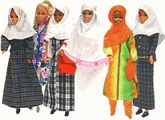
She's smart, she's professional - and she won't leave young girls with warped expectations about their appearance.
Her name is Razanne, and for many American Muslim parents, she's an antidote to a culture that measures women with the numbers 36-24-34.
"My husband and I used to watch with dismay when the girls in our community all received Barbie dolls as gifts for the holidays," says Sherrie Saadeh, an opera singer who's a convert to Islam. "We thought,'This is not the right role model for our girls.' "
So she and her husband, Ammar, created Razanne, a Muslim doll, three years ago. Their Livonia, Mich.-based company, NoorArt, sells a variety of Muslim toys and books, but the most popular is Razanne.
Just ask Yunna and Imaan Patel. Between them, the sisters now have six Razanne dolls: the original Razanne, Teacher Razanne, Praying Razanne, and several Playing Razannes, wearing the casual Muslim dress of girls in Asia.
"My favorite is Teacher Razanne, because she's an Islamic teacher...," says Yunna, who attends a Muslim school in Sharon, Mass. "She has nice clothes and a laptop."
For their mother, Fiona, a doctor, the dolls reinforce values she is trying to instill in her daughters.
"You'd go to the store, and what do you see? A blonde Barbie, or an African-American Barbie," she says, noting that her daughters also have Barbie dolls. "But there was nothing that my girls could identify with ... nothing that had the head scarf they see me wearing."
For Mrs. Patel, it's important that the dolls portray women doing professional things. "They didn't just make her a mom that stays home.... Not just the typical, supposedly repressed Muslim woman."
In fact, in one Muslim home, Razanne gives the orders. "Razanne talks to the Barbie doll and tells her she should wear hijab," a Razanne fan wrote to NoorArt.
Intellectuals Issue 'Just War' Appeal to Muslim World
By Kevin Eckstrom
Religion News Service
February 14, 2002
WASHINGTON (RNS) Sixty leading intellectuals from the left, right and center have signed a letter supporting the war on terrorism, saying the military campaign is both "morally permitted" and "morally necessary."
The 10-page statement, issued Tuesday (Feb. 12), seeks to explain to the rest of the world -- especially Muslims -- why the U.S. military campaign is justified. While the scholars readily admit the failings and excesses of American society, they said certain American values are universal values.
In speaking specifically to Muslims and the Arab world, the letter says, "We are not enemies but friends. ... Your human dignity, no less than ours -- your rights and opportunities for a good life, no less than ours -- are what we believe we're fighting for."
Signers spoke frankly against growing Islamic militancy, calling it a "violent, extremist and radically intolerant religious-political movement that now threatens the world, including the Muslim world."
The letter is the latest in a series of statements that have garnered widespread support in defense of the war on terrorism. Earlier statements include "Deny Them Their Victory," drafted by social and religious progressives, which gained thousands of signatures, and a statement approved in November by the nation's Roman Catholic bishops.
The newest letter, coordinated by the Institute for American Values, found support across the ideological spectrum, drawing democratic socialist Michael Walzer of Princeton University on the left to Jean Bethke Elshtain, a moderate conservative ethicist from the University of Chicago.
The statement pulls together centuries of "Just War Theory," the political and moral parameters that form a framework for military combat. The letter said the "first and most important reply to evil is to stop it," and called the terror network a "clear and present danger to all people of goodwill everywhere in the world, not just in the United States."
"Such acts are a pure example of naked aggression against innocent human life, a world-threatening evil that clearly requires the use of force to remove it."
Here are some of American Muslim Websites that will give you more informations about Islam in America
American Muslim Alliance (AMA) - promotes Muslim and pro Muslim candidates running for different political offices throughout America.
http://www.Amaweb.org/
More sites about: U.S. Government > Political Organizations
American Muslim Council - non-profit socio-political organization dedicated to political empowerment of American Muslims.
http://www.amconline.org
More sites about: Islamic Political Parties and Groups
Latin American Muslim Unity (LAMU) - promotes Islam in Central and South America with list of masjids and organizations.
http://www.latinmuslims.com/
More sites about: Islam > Organizations
United American Muslim Association - headquartered in Brooklyn with branches throughout the Northeast, this organization is dedicated to providing services and resources to Muslims. In English and Turkish.
http://www.fatihcami.org/
More sites about: New York State > Brooklyn > Islam
American Muslims for Jerusalem - American Muslim perspective regarding Jerusalem and its environs.
http://www.amjerusalem.org/
More sites about: Islam > Organizations
Muslim American Society National Young Adult Association - dedicated to the development of young adult leaders in the Muslim community.
http://www.masyoungadult.org/
More sites about: Islamic Youth Organizations
Muslim Marriage Contract in American Courts - text of speech given by Azizah y. al-Hibri at the University of Richmond, May 20, 2000.
http://www.minaret.org/azizah.htm
More sites about: Islam Beliefs and Practices > Marriage
United Muslim Americans Association - nonprofit political, social, civic, and educational public organization.
http://www.theumaa.org/
More sites about: Islamic Political Parties and Groups
Muslim Public Affairs Council - clearinghouse of American Muslim activist information and resources.
http://www.mpac.org/
More sites about: Islam > Organizations
American Moslem Foundation - center for the preservation of Islamic cultural and religious traditions for Muslims living in the United States.
http://www.oz.net/~msarram/
More sites about: Washington State > Kent > Islam
Council on American-Islamic Relations (CAIR) - promotes a positive image of Islam and Muslims in America and presents an Islamic perspective on issues of public importance.
http://www.cair-net.org/
More sites about: Islam > Organizations
American Druze Society
http://www.druze.com/
More sites about: American Druze Society
Saudi American Bank - bank for local and international customers.
http://www.samba.com.sa/
More sites about: Islamic Banks
Michigan Chapter
http://www.druze.org
More sites about: American Druze Society
Latino American Dawah Organization (LADO) - promotes Islam among the Latino community of the United States. Includes newsletter, an online art gallery, and related links.
http://www.LatinoDawah.org/
More sites about: Islam > Organizations
Islamic American University - offering distance learning curriculum taught in English and Arabic. Seeking accreditation from American and Islamic universities.
http://www.islamicau.org/
More sites about: Islam > College and University
Emergence of Islam in the African-American Community - examines the development of the American Muslim movement.
http://www.answering-islam.org/ReachOut/emergence.html
More sites about: Black Nationalism
American Sufi Institute - Riaz Ahmed Gohar Shahi is a man sent by God, whose spiritual teachings allow you to taste the purest source of love.
http://www.geocities.com/Athens/Acropolis/2717
More sites about: Islamic Movements > Sufism
Islamic Broadcasting Network - IBN - offers family programs, news, and current affairs. Aims to meet the religious and cultural needs of American Muslim youth, as well as dispel myths and stereotypes about Islam and Muslims.
http://www.ibn.net/
More sites about: Radio Networks
Sister Clara Muhammad Health and Wellness Center - Muslim African-American style recipes.
http://www.seventhfam.com/scmhwc/ourfamily/ramadan.htm
More sites about: Ramadan Recipes