

By Bradley Peniston
Friday, December 21, 2001; Page A45
The coverage of the Afghanistan campaign has had its military-media disputes -- reporters and Pentagon officials sparring over access to troops and the public's right to know details of the operation. But closer to home, sweeping attempts to cut off defense-related information have gone relatively unnoticed.
Since the Sept. 11 attacks, senior military officials have worked to prevent uniformed military personnel, Defense Department employees and even civilian contractors from talking to the press and to the public.
On Oct. 2, Pentagon acquisition chief Edward "Pete" Aldridge sent a letter asking defense firms to use discretion in their official statements: "As we all know, even seemingly innocuous industrial information can reveal much about military activities and intentions to the trained intelligence collector," the defense undersecretary wrote. "Statistical, production, contracting and delivery information can convey a tremendous amount of information that hostile intelligence organizations might find relevant."
Two days later Air Force officials went further in a letter to the service's procurement officers.
"Effective immediately, I do not want anyone within the Air Force acquisition community discussing any of our programs with the media (on or off the record)," wrote Darleen Druyun, the Air Force secretary's principal deputy for acquisitions.
Prodded for explanation, an Air Force spokesman first denied the Oct. 4 letter was a gag order, then said the no-talk policy applied only to programs connected with "current operations."
Druyun soon retreated.
"We will continue to respond to inquiries from the media. . . . We will also continue to issue announcements on major contracts," and to conduct news conferences on acquisition issues, she wrote in an Oct. 10 letter.
But within a week, Deputy Defense Secretary Paul Wolfowitz issued the broadest injunction yet. In a memo to military and civilian leaders, Wolfowitz forbade employees of the Department of Defense and "persons in other organizations that support DOD" to talk about their work in public spaces, on unsecure telephones, or via e-mail on commercial networks.
After reminding recipients about existing regulations governing classified material, Wolfowitz's memo broke new ground by discouraging the public discussion of unclassified subjects as well.
Unclassified material "can often be compiled to reveal sensitive conclusions," said the Oct. 18 memo, addressed to the chairman of the Joint Chiefs of Staff, service secretaries and other senior DOD officials. "Much of the information we use to conduct DOD's operations must be withheld from public release because of its sensitivity. If in doubt, do not release or discuss official information except with other DOD personnel."
The Pentagon's desire to control information in wartime is understandable, and all the more so in a battle against terrorists. Among the harsh lessons of Sept. 11: Public knowledge can be exploited in unexpected and deadly ways.
But official duty includes accountability as well as security. The Defense Department will spend more than one-third of a trillion dollars in 2002. Even in wartime -- or at least shortly thereafter -- the public is entitled to know how well its money is being spent.
Information policies that protect bureaucrats instead of national security are inappropriate in a democracy, even one locked in battle with terrorists. If Pentagon officials must extend the bounds of secrecy during this national emergency, accountability requires them to set clear limits.
So does credibility, which is essential to public support. Military officials who would hamper public scrutiny of the Pentagon risk losing the faith of the citizens they are attempting to protect.
"People will accept secrecy when the purpose is well-designed, but when there is any hint of self-serving, it'll be a disaster," says Steven Aftergood, an analyst with the Federation of American Scientists.
The recent campaign to limit information is working, to some extent. Reporters who cover the military and the defense industry say some sources have clammed up; others have not.
But no matter how long the war on terrorism lasts, the public's right to know will remain. Operation Enduring Freedom should not turn into Operation Public Lockout.
The writer is deputy editor of Defense News.
The credibility gap
Pentagon lies and civilian deaths in Afghanistan
by David Corn
My fantasy of the week: Donald Rumsfeld meets a young Afghan boy named Noor Muhammad.
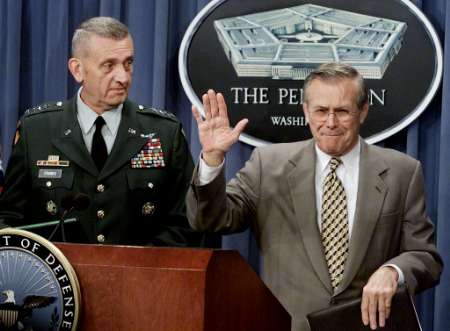
At the start of the daily Pentagon press briefing on December 4, the Defense Secretary delivered a short lecture on the subject of civilian casualties in Afghanistan. "One of the unpleasant aspects of war is the reality that innocent bystanders are sometimes caught in the crossfire," Rumsfeld said, "and we're often asked to answer Taliban accusations about civilian casualties. Indeed one of today's headlines is, quote 'Pentagon Avoids Subject of Civilian Deaths.' The short answer is that that's simply not so."
He then proceeded to prove, in a way, the offending headline's point: "With the disorder that reigns in Afghanistan, it is next to impossible to get factual information about civilian casualties. First, the Taliban have lied repeatedly. They intentionally mislead the press for their own purposes. Second, we generally do not have access to sites of alleged civilian casualties on the ground. Third, in cases where someone does have access to a site, it is often impossible to know how many people were killed, how they died, and by whose hand they did die."
Look at the World Trade Center, Rumsfeld declared. The number of dead there keeps shifting: "If we cannot know for certain how many people were killed in Lower Manhattan, where we have full access to the site, thousands of reporters, investigators, rescue workers combing the wreckage, and no enemy propaganda to confuse the situation, one ought to be sensitive to how difficult it is to know with certainty, in real time, what may have happened in any given situation in Afghanistan ... What we at the Pentagon try to do is to tell the press what we do know that's accurate, and we try to say what we don't know ... We lost thousands of innocent civilians on September 11th, and we understand what it means to lose a father, a mother, a brother, a sister, a son or a daughter, and we mourn every civilian death."
Rumsfeld's remarks, seemingly heartfelt, were an exercise in profound cynicism. If we can't count the dead in New York, how can you expect us to know anything about civilian casualties in Afghanistan? He portrayed it as an impossible task, and he suggested that claims of civilian casualties were only coming from Taliban scumbags. Of course, you can't believe them.
But as he was talking, Washington Post reporter Susan Glasser was filing a piece based on a visit to Jalalabad's Public Hospital No. 1. In the previous four days, the hospital had taken in 36 patients who said they were victims of the U.S. bombing strikes targeting villages southwest of Jalalabad, in an area where Osama bin Laden and al Qaeda remnants are thought to be hiding in cave compounds. The hospital had also received 35 dead.
One of the injured was Noor Mohammed, who had lost both eyes and both arms. Noor, who is somewhere between 10 and 12 years old, told his uncle he heard the sound of an airplane overhead, ran from his room, and did not know what happened next. Asked how he felt, the boy whispered, "I feel cold and I cannot talk." Glasser found other wounded children from families who claimed they had been struck by bombs while in their mud houses.
Two days earlier, The New York Times had run a dispatch (in a not-too-prominent spot) from Tim Weiner, reporting that, according to witnesses and local officials, U.S. bombers flying over this area of Tora Bora had struck three villages, killing dozens of civilians. Weiner quoted the local law and order minister and the region's defense minister, who each maintained such attacks had occurred. Survivors interviewed by Weiner spoke of horrific devastation in these areas.
"The village is no more," said a man named Khalil. "All my family, 12 people, were killed. I am the only one left in this family. I have lost my children, my wife. They are no more." Another survivor said she had lost 38 relatives; another estimated up to 200 were dead.
The Pentagon denied everything. Weiner quoted Rear Admiral Craig Quigley, chief spokesman for the Central Command, asserting that American bombers had hit their targets twenty miles away from these villages: "If we had hit a village causing widespread death that was unintended, we would have said so. We have been meticulous [in] reporting whenever we have killed a single person." (Interest declared: Weiner is a friend. He can be trusted to suss out a difficult situation.)
The day after Weiner's account appeared, at the Pentagon briefing, Rear Admiral John Stufflebeem was questioned about the reports of civilian deaths around Tora Bora. He replied, "I have seen the press reports about alleged civilian casualties, and I would just ask us all to remember that this was orchestrated by the Taliban, and therefore it's not clear to us in fact were there innocent civilians who in fact may have been injured." (Note the double "in fact.")
The Dickensian-named admiral added, "We know for a fact that these were legitimate military targets in that area that were struck. We know that there was terrific traditional, consistent planning to ensure that only these targets were struck. We know there were no off-target hits, so there were no collateral damage worries in this series of strikes. And therefore I can't comment on the civilian casualties because I don't know them to be true." A few moments later, he added, "I find it a little bit suspect to hear that villages are being flattened."
Yet Richard Lloyd Parry, a reporter for the London-based Independent visited the area and found homes replaced by craters, a cemetery containing 40 freshly dug graves (some, he was told, contained only body parts), and a fragment bearing the words "Surface Attack Guided Missile AGM 114."
Truth is often difficult to ascertain in war. But it is clear that Stufflebeem and Rumsfeld were not speaking truthfully. The reports of these casualties were not "orchestrated by the Taliban." In fact, as the Admiral might say, the information was coming from officials of a government that replaced the Taliban. What, then, to make of Noor Muhammad and his tale? And the others who tell of hearing airplanes and being bombed in their homes?
If Rumsfeld and Stufflebeem are to be believed, it must be that Noor and the rest were all participating in an elaborate and sophisticated propaganda campaign that entailed faking craters, persuading anti-Taliban officials who are working with American forces to lie to benefit the Taliban, enlisting dozens of persons with god-awful injuries for the con, and encouraging children to tell false stories about how they came to be harmed.
The reports filed by Weiner, Glasser and Parry demonstrate that Rumsfeld was engaging in champion dissembling when he maintained the Pentagon cannot possibly keep track of civilian casualties in wild and wooly Afghanistan. The U.S. military may not be able to discern figures with the same precision it claims for its bombing. Yet in many instances it can determine if civilian casualties have happened by doing what Weiner and the other reporters did: asking people on the ground.
Instead, in this latest episode, the Pentagon rushed out a denial that does not hold and then further insulted local Afghan officials and survivors by dismissing their reports as Taliban disinformation -- and waited for that news cycle to whiz by. I would like to watch Rumsfeld and Stufflebeem tell the eyeless and armless Noor Muhammad he's lying. It is not, as Rumsfeld asserted, "impossible to get factual information about civilian casualties." His military just hasn't bothered. It could start by sending someone to interview Noor and his fellow survivors.
WorkingForChange cosponsors this weekly column by David Corn, Washington editor for The Nation.
U.S. casualties being low-balled?
Rivera gets attention, casualties among U.S. servicemen don't
By Laura Flanders
Geraldo Rivera's come in for a lot of criticism recently. "War News from Rivera Seems off the Mark," headlined the Baltimore Sun (12/12/01), and ABC and CBS and CNN have all joined in attack.
It seems that the Fox News Channel's war correspondent told viewers he'd visited the site Geraldo Rivera's come in for a lot of criticism recently. "War News from Rivera Seems off the Mark," headlined the Baltimore Sun (12/12/01), and ABC and CBS and CNN have all joined in attack.
It seems that the Fox News Channel's war correspondent told viewers he'd visited the site of a friendly fire incident in Tora Bora when actually he was hundreds of miles away. It's all got the self-proclaimed respectable folks in a snit.
Depending on who you read, Rivera's "a clown" (the New York Times' Frank Rich,) a liability (his decision to work armed could endanger the lives of other correspondents) or a self-promoter. Vanity Fair's James Wolcott told CNN of the Fox News staff: "They're doing everything but renting their own helicopters and, you know, firing rockets."
Whichever complaint you prefer, criticizing Rivera and Fox News for inaccuracies and self-promotion seems like pillorying the Pope for being too orthodox. Besides, when it comes to coverage, there's enough bombast, bias and mischief in every network's broadcasts to make Rupert Murdoch proud.
Rather than roasting Rivera for misleading the public about friendly-fire victims, the power press would do better to challenge the Pentagon on U.S. casualties. One independent news service suggests the count may be far higher than the U.S. public knows.
"Afghanistan: U.S. Casualties Spiral," a story distributed by the Soros Foundation's Institute for War and Peace Reporting alleges that scores of U.S. soldiers wounded in Afghanistan have been arriving at the Khanabad Airbase in southern Uzbekistan — far more than official reports admit.
While Rivera was seeking the dead in Tora Bora (or was it Khandahar?) and the D.C. crowd poked fun at him, Uzbek reporter Andrei Sukhozhilov (a pseudonym,) claims to have visited Khanabad, across Afghanistan's northern border, and found it busy receiving increasing numbers of Americans wounded in the Afghan war.
"Uzbek sources at Khanabad suggest that the real figures of U.S. casualties are far higher than the Pentagon's official totals," he reported. "This IWPR reporter, who smuggled himself onto the facility on December 2, witnessed soldiers scrambling to meet an incoming U.S. helicopter. They lifted out five wounded men on stretchers and loaded them into waiting vehicles."
Uzbek army personnel working at the air base told IWPR that scores of U.S. casualties had been arriving there. "From November 25 to December 2, an Uzbek orderly working with American medical staff said he had witnessed the arrival of four to five U.S. helicopters -- carrying between them 10-15 American casualties -- each day."
Over the same period of time, the Pentagon reported just five injured American servicemen, who were evacuated to Khanabad and then on to Germany.
The Pentagon kept reporters out of Khandahar after a B-52 bomb went astray there -- killing three U.S. special forces soldiers and wounding 19 more. Both the Washington Post and the Associated Press complained, but the story died right there.
The case of John Walker, the "American Taliban" has come in for no end of coverage, and the public's heard plenty about the CIA agent killed in the prison uprising where Walker was arrested. But IWPR alleges that there is more that the U.S. press may be missing. "A lot of American troops died there -- it was a real battle," one Uzbek pilot told the IWPR.
It's likely that even Americans who have little space in their heart for Afghan civilians care about U.S. service personnel. If even U.S. service personnel can't get the attention they deserve from the press, the public can't judge the success of what Bush and Rumsfeld are calling their "victory." Sadly, most of the press seem to care less about the public's ability to judge than they do about judging Geraldo.
Journalist Laura Flanders is the host of Working Assets Radio and author of "Real Majority, Media Minority: The Cost of Sidelining Women in Reporting." Her Spin Doctor Laura columns appears Monday, Wednesday and Friday on WorkingForChange. You can contact her at [email protected]
After US Massacre of Taliban POWs: The Stench of Death and More Media Lies
By Jerry White
Journalists and International Red Cross representatives reported a horrific scene of carnage Wednesday as they entered the prison compound near Mazar-i-Sharif, where up to 800 foreign Taliban prisoners were slaughtered during a three-day siege of the fortress directed by US special forces and CIA operatives.
Most of those killed, according to Northern Alliance sources quoted in the American press, died as a result of US air strikes on the prison compound. Throughout the three-day siege at least 30 bombing attacks were carried out by US warplanes and helicopter gunships, whose targets were pinpointed by special forces at the prison.
Witnesses reported seeing the dismembered corpses of hundreds of Taliban prisoners strewn amidst the rubble and still burning buildings, the blasted parts of dozens of dead horses and bullet-raked vehicles. An acrid smell of death filled the air as Red Cross personnel began loading bodies onto trailers to remove them for burial.
Northern Alliance General Rashid Dostum sought to prevent reporters from going into the Southern sector of the compound, claiming live prisoners might still be hiding among the piles of corpses, or others may have booby-trapped their bodies before being killed.
An Associated Press photographer who wandered into the area saw the dead bodies of 50 prisoners, who appeared to have been executed with their hands tied behind their backs with black scarves. Alliance soldiers were busy removing the scarves with knives and scissors.
The BBC reported that alliance troops continued to shoot at Taliban bodies in case any of the prisoners were still alive.
The dead were mostly Pakistanis, Chechens, Arabs and other non-Afghans who surrendered Saturday, November 24, when the Taliban's northern stronghold of Kunduz fell to the Northern Alliance troops.
Various American media outlets broadcast some of these bloody scenes, along with warnings that the film footage might be disturbing to viewers. But the networks and newspapers refused to say what was obvious: that the bloodbath in Mazar-i-Sharif was a massacre, directed and chiefly carried out by the US—a war crime recalling such atrocities as the Nazi slaughters of World War II and the My Lai Massacre.
Rather the US media, exhibiting its contempt for the slaughtered prisoners and the people of Central Asia in general--whom the US claims to be defending against the Al Qaeda terrorists--focused its attention on the death of a CIA agent at the prison compound. They portrayed this professional killer as a national hero, seeking to use his death to stoke up pro-war sentiment.
Amnesty International called Tuesday for an inquiry into the events at the Qala-i-Janghi prison and the "proportionality of the response" of Northern Alliance, US and British military forces. The International Committee of the Red Cross declared that the US had a moral obligation to abide by the full terms of the Geneva Convention, which mandates the humane treatment of prisoners of war.
The major preoccupation of the US media, however, has been to cover up the direct role of the CIA, the US military and the Bush administration in the slaughter. The media has uncritically repeated the American government's claim that the killing was justified because Taliban prisoners had smuggled weapons into the fortress and launched an unprovoked attack against their Northern Alliance captors. This version is directly contradicted by various eyewitness testimonies. But even if it were truthful, it would not justify, even from a military standpoint, the mass murder of largely defenseless prisoners.
There is increasing evidence that the so-called uprising was provoked by US forces and their Northern Alliance proxies as a pretext for the massacre of foreign Taliban prisoners. According to a report in Wednesday's Times of London, widespread resistance by the Taliban prisoners did not erupt until Sunday morning, after CIA agents interrogating Taliban POWs got involved in a confrontation and shot and killed at least five unarmed prisoners.
The Times reported that the "rebellion may have also been sparked by efforts to tie up the Taliban prisoners, many of whom apparently believed they were about to be killed. About 250 prisoners had been bound by their guards, according to one report, before the rest rebelled."
The article noted the strange fact that at least two of the vehicles containing the surrendering Taliban were not searched, leaving open the possibility that Northern Alliance forces and their American allies deliberately allowed weapons to be brought into the compound in order to facilitate an "uprising," which they would then crush with superior firepower.
The newspaper provided the following account of the incident that set off the rebellion. A witness told the Times: "The fighting started when the Taleban were being questioned by two men from the CIA. They wanted to know where they had come from and whether they might be al-Qaeda."
Both CIA operatives were dressed in Afghan robes, had grey beards and spoke Persian. One of them was known as Michael, the other as David, the Times reported.
The Times' eyewitness account continued: "Michael asked one Taleb why he had come to Afghanistan. He replied: "We're here to kill you," and jumped at Michael, who killed him and three others with his pistol before being wrestled to the ground."
Several other Taliban prisoners reportedly responded by beating, kicking and biting to death one CIA agent (now identified by the CIA as paramilitary operations officers Johnny "Mike" Spann), and then turning on the alliance guards.
The Times: eyewitness said the second CIA agent, "David," also killed "at least one prisoner," and then ran out of the building where the prisoners were being interrogated to the main building, where he used a satellite phone to call the US Embassy in Uzbekistan and ask for helicopters and troops to storm the prison.
US and British special forces, based at a military airport just outside the fort, arrived first and began the assault. Footage from German television showed soldiers firing over the walls into the mass of prisoners inside. Others entered the fort in an apparent effort to rescue the agents or recover their bodies. In the meantime, the second agent scrambled down a fortress wall to safety.
Any Taliban prisoners who attempted to escape were quickly put to death by US, British or Alliance forces. There were news reports of Taliban corpses propped in a gateway, each killed by a single bullet to the head.
The US bomb assault began on Sunday and intensified on Monday. By nightfall on November 26 the number of surviving prisoners had fallen to perhaps 100, from the original 800 in the compound. Bombing continued throughout the night, reducing the number of survivors even further.
Describing the gruesome scene, the Times of London wrote: "The nighttime raids left many bodies half-buried in the ground. Limbs and torsos rose out of the disturbed ground like tree trunks after a forest fire."
Early Tuesday, November 27, trucks carrying 200 Alliance troops and an anti-aircraft gun arrived at the fortress, as American special forces moved in and US warplanes circled above. Taking no prisoners, the Alliance forces went room by room, killing anyone left alive, including the wounded, and even firing bullets and rockets into corpses.
The fighting ended Tuesday afternoon after US and British special forces set fire to oil poured into a shelter where three Taliban prisoners remained. A Northern Alliance tank then drove over the bodies of several Pakistani and Arab Taliban volunteers and fired three rounds at a range of 20 yards, obliterating the building and killing the last holdouts.
Underestimating the number of prisoners, Abdullah Jan Tawhidi, a deputy in the Alliance's Ministry of Security and Intelligence, said, "Up to 300 foreign troops were killed. It was not a big deal."
The foreign prisoners were brought to the fortress under an agreement between the Taliban commander in Kunduz and Alliance leader General Rashid Dostum to give up the city. Five thousand Afghan Taliban soldiers were reportedly allowed to defect, or given safe passage to return to their villages, while non-Afghans were imprisoned in Dostum's fortress headquarters, Qala-i-Janghi. Top US officials, including Defense Secretary Donald Rumsfeld, publicly opposed any deal that would have allowed safe passage of foreign Taliban troops to Pakistan in exchange for their surrender, and made clear their preference that the foreign Taliban be killed.
In the face of increasing evidence to the contrary, Dostum denied any ill-treatment of the foreign POWs by his forces. But Dostum is already under investigation for the initial assault earlier this month in Mazar-i-Sharif, where the Red Cross discovered 600 bodies. Moreover, reports have surfaced of his troops massacring local and foreign Taliban soldiers in Kunduz this week. The Associated Press reported, "Stomping on faces of captured Taliban and shooting others as they lay wounded, opposition forces rampaged through Kunduz on Monday."
Dostum is said to be holding another 6,000 Taliban prisoners in the nearby town of Sheberghan.
There is little doubt that similar massacres are taking place in the south of Afghanistan, where US Marines have begun a search and destroy mission in Kandahar, the Taliban's last stronghold. Gul Agha, a senior commander with ethnic Pashtun forces in southern Afghanistan, said Wednesday that 160 captured Taliban fighters who refused to surrender were executed with machine guns before the eyes of US military personnel, according to a Reuters news dispatch.
The whitewash of US war crimes by the American media has included the so-called liberal press, such as the New York Times and Washington Post, which have not even published editorial comments on the prison massacre. On the contrary, in a cowardly editorial Tuesday, the New York Times gave backhanded support to the Pentagon's cold-blooded policy, writing, "One problem left over from earlier combat is the fate of foreigners who fought for the Taliban in northern Afghanistan and have now been defeated. Defense Secretary Donald Rumsfeld is right to demand that they not simply be allowed to drift away..."
Ignorance is not bliss
Lack of reporting civilian casualties from the war in Afghanistan is keeping Americans in the dark -- and endangering their future
Roberto J. Gonzalez
FOR THE PAST three months, Pentagon officials have veiled an essential aspect of the 'war on terrorism': civilian casualties in Afghanistan. Blocking access to information about the human costs of U.S. bombing -- and its consequences -- might create a dangerous future for Americans.
Such restrictions keep us from understanding how the rest of the world views the war, and why it might provoke future attacks on the United States. They may also breed complacency, ignorance and national insecurity.
Measures taken by military officials obscure information about the effects of U.S. bombing.
For example, since Oct. 11, the Pentagon has purchased exclusive rights to all satellite images from Space Imaging, a U.S. company that produces accurate pictures that might allow independent media to survey bomb damage.
In addition, U.S. bombs destroyed Al-Jazeera's television station in Kabul in October. The Qatar-based independent network reaches much of the Arab world and frequently broadcasts images from Afghanistan.
Official acknowledgment of civilian deaths has been minimal.
Descriptions of heavily bombed frontline positions never mention that they sometimes traverse densely populated neighborhoods. Frequently, officials claim that civilian deaths 'cannot be independently confirmed.'
Yet, according to a recent report by Professor Marc Herold, an economist at the University of New Hampshire, the number of Afghan civilians killed by American bombs has surpassed casualties from Sept. 11.
Herold's report -- the first independent survey of its kind -- claims that 3,767 civilian deaths were caused by U.S. bombing between Oct. 7 and Dec. 10. Not included are indirect deaths caused by land mines, lack of water, food or medicine.
The data, drawn from independent news sources and first-hand accounts, include: dates, locations, types of munitions used and sources. Much of it is based upon mainstream British, French and Indian press agencies such as the BBC and The India Times.
While respected news agencies abroad have reviewed Herold's report, the American media have largely ignored it. Only a few journals, Internet sites and the radio program 'Democracy Now!' have analyzed it.
Why have the U.S. media missed the story?
Part of the explanation may be related to the industry itself. Recent mergers between media corporations have homogenized news, especially television news. AOL/Time Warner, Viacom, News Corporation, Disney and GE own CNN, CBS News, Fox News, ABC News and NBC, respectively.
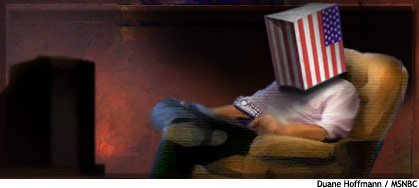
Many Americans rely exclusively upon this cartel for information on the 'war on terrorism,' which is presented more as entertainment than news.
Broadcasts include repetitive accounts of the search for Osama bin Laden, trivia about weapons, war images that resemble video games and footage of cheerful Afghans trimming their beards and playing music.
These pictures are punctuated by angry pundits and politicians who reduce complex events to simplified formulas ('good versus evil') using language reminiscent of Hollywood Westerns ('dead or alive').
Whether such misinformation stems from Pentagon pressure, fear of offending advertisers or shabby journalism is largely irrelevant. The effect is the same:
Warfare is presented as light entertainment.
While American viewers remain oblivious, Europeans, Asians and others have access to information about the catastrophic effects of U.S. bombing. They have seen images of dead and wounded civilians and the many widows, widowers and orphans created by Operation Enduring Freedom.
Many are convinced that this is a U.S. crusade against Islam, and with each passing week, violent 'blowback' -- the CIA's term for unintended foreign policy consequences -- appears more likely.
Ignorance may be dangerous in the current climate.
Murky official statements and a distracted mass media deny us information which might help prevent future attacks.
George Orwell once noted that in free societies, censorship is more sophisticated and thorough than in dictatorships because 'unpopular ideas can be silenced, and inconvenient facts kept dark, without any need for an official ban.'
But keeping Americans in the dark about inconvenient facts in Afghanistan is reckless at best, and potentially dangerous.
Civilian deaths should be openly acknowledged by the Pentagon and reported by the mass media if we wish to minimize the possibility of future attacks on American soil.
Roberto J. Gonzalez is an assistant professor in the Department of Anthropology at San Jose State University.