
By Lev Grinberg
What is the difference between State terrorism and individual terrorist acts? If we understand this difference we'll understand also the evilness of U.S. Middle East policies and the forthcoming disasters. When Yassir Arafat was put under siege in his offices and kept hostage by the Israeli occupation forces, he was constantly pressed into condemning terror and combating terrorism. Israel's State terrorism is defined by U.S. officials as "self-defense," while individual suicide bombers are called terrorists.
The only "small" difference is that Israeli aggression is the direct responsibility of Ariel Sharon, Benjamin Ben Eliezer, Shimon Peres, and Shaul Mofaz, while the individual terrorist acts are done by individuals in despair--usually against Arafat's will. One hour after Arafat declared his support of a ceasefire and wished the Jews a Happy Passover feast, a suicide bomber exploded himself in an hotel in Netanya, killing 22 innocent Jews celebrating Passover. Arafat was blamed as responsible for this act, and the present IDF offensive has been justified by this accusation.
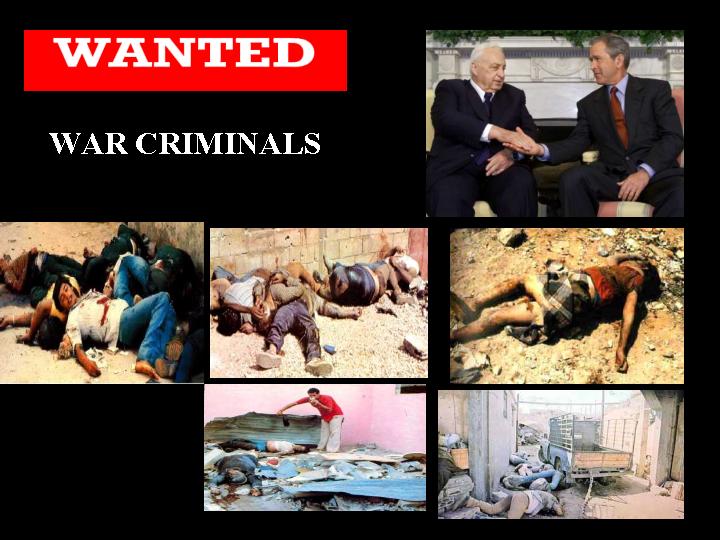
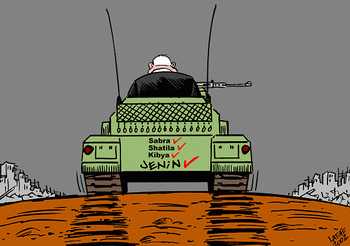
At the same time, Sharon's responsibility for Israeli war crimes is being completely ignored. Who should be arrested for the targeted killing of almost 100 Palestinians? Who will be sent to jail for the killing of more than 120 Palestinian paramedics? Who will be sentenced for the killing of more than 1,200 Palestinians and for the collective punishment of more than 3,000,000 civilians during the past 18 months? And who will face the International Tribunal for the illegal settlement of occupied Palestinian Lands, and the disobedience of UN decisions for more than 35 years?
Suicide bombs killing innocent citizens must be unequivocally condemned; they are immoral acts, and their perpetrators should be sent to jail. But they cannot be compared to State terrorism carried out by the Israeli government. The former are individual acts of despair by a people that sees no future, vastly ignored by an unfair and distorted international public opinion. The latter are cold and "rational" decisions of a State and a military apparatus of occupation, well equipped, financed, and backed by the only superpower in the world.
Yet in public debate, State terrorism and individual suicide bombs are not even considered as comparable cases of terrorism. The State terror and war crimes perpetrated by the Israeli government are legitimized as "self- defense," while Arafat, even under siege, is commanded to arrest "terrorists."
I want to ask: Who will arrest Sharon, the person directly responsible for the orders to kill Palestinians? When is he going to be defined a terrorist too? How long will the world ignore the Palestinian cry that all they want is freedom and independence? When will it stop neglecting the fact that the goal of the Israeli government is not security, but the continued occupation and subjugation of the Palestinian people?
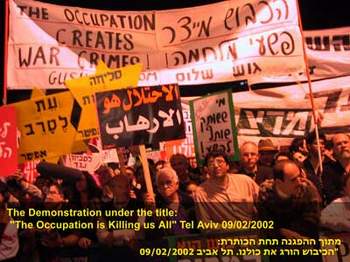
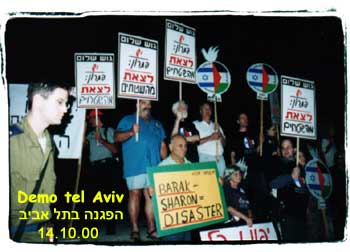
As Israelis in the opposition, we are fighting against our government, but the international support that Sharon receives is constantly jeopardizing our struggle. The whole international public opinion must be reverted, and the UN must deploy intervention forces in order to stop the bloodshed and the imminent deterioration. Israelis and Palestinians desperately need the awakening of the international community's public opinion and a reversal in the global attitude. These are needed both in order to save our lives (literally), and preserve our hope for a better future.
(Dr. Lev Grinberg is a political sociologist and Director of the Humphrey Institute for Social Research, at Ben Gurion University.)
A Way Out
By Sam Bahour and Michael Dahan
Every foreign military invasion has a predefined end called withdrawal. The hideous Israeli incursion of internationally recognized Palestinian territories is no exception. Every military operation has a defined political goal, yet Sharon seems to be keeping this a secret from his cabinet, the Israeli people and, indeed, the world.
Tomorrow, next week, next month, next year, Israel will need to decide to which border they will withdraw their troops. Israel can choose to move back to one of the hundreds of its self-defined security borders, or it can, once and for all, choose to end the spiral of violence by finally implementing UN resolutions and withdrawing back to the June 4, 1967 borders, thus closing one chapter of its senseless military occupation.
The infamous Israeli Prime Minister, Ariel Sharon, knows this very well and he also knows that his time is limited for rampaging Palestinian cities, institutions, and lives. The fact of the matter is that U.S.-armed Israel can occupy, and re-occupy, Palestinian lands over and over, and under any media slogan that fits the times, but it will never rid itself of the legitimate Palestinian resistance to end the illegal Israeli occupation that has haunted it, and the world, for 37 years now.
Palestinians went to Madrid, Oslo, Camp David, and Taba and extended the greatest concession ever voluntarily made by an indigenous people--to relinquish 78% of their ancestral homeland so Jews around the world could fulfill their own dream of a homeland. In return, the world community expected the Israeli occupiers to dismantle their illegal occupation on the 22% of Palestinian lands that remained: the West Bank, Gaza Strip, and East Jerusalem. What Palestinians received instead was a package of Israeli aggression like never before.
Israeli policymakers have become blinded by the suicide bombings to the point that they cannot comprehend that their own, homemade, military occupation of Palestinian lands is generating not only suicide bombers, but a united community that is increasingly feeling that any future co-existence may be impossible given the deafening silence of the Israeli public opinion toward the continuing occupation. Suicide bombings are totally immoral and serve no strategic goal, but have been totally successful in feeding into the political plans of maniac military professionals like Ariel Sharon and Shimon Peres.
Well-oiled public relation campaigns are emanating from Washington and Tel Aviv to portray the Palestinian victim as the rapist and the Israeli rapist as a poor soul with a dire need for a security fix. In spite of this, Palestinians are going out of their way to facilitate the entry of Israel into the Middle East as an equal, legitimate entity, and a partner for the future. Now with the Arab League offer for normalization with Israel if UN resolutions are implemented, the Arab World too, as a whole, is giving Israel a respectable way out as well. Unfortunately, Sharon and Peres are missing this once in a lifetime opportunity and would rather turn every single Palestinian citizen's life upside down hoping for mass submission--which will never come.
History will judge the Palestinian leadership for its political wisdom, but Israel cannot wait for history. Israel must choose today between peace on internationally recognized terms with the dispossessed indigenous people of their State, or face another half-century of isolation with the backdrop of a rapidly encroaching demographics dilemma.
For our part, we, as two citizens of this troubled region, offer President Bush and his administration a history book of Palestine and the Palestinians. For the Palestinian and Israeli leaderships, their part starts with an Israeli withdrawal to the 1967 borders and a Palestinian commitment to remain committed--which Mr. Arafat amazingly still is, even under gunfire--to resolving the remaining issues of refugees, settlements, and security in a new and improved peace process.
Today, we write not as colleagues, but as a Palestinian living under Israeli attack, a few hundred meters from Arafat's compound, and an Israeli, living a few hundred meters from one of the latest suicide bombings.
There is a way out.
(Sam Bahour <[email protected]> is a Palestinian-American living in the Palestinian City of Al-Bireh in the West Bank. He is a co-author of Homeland: Oral Histories of Palestine and Palestinians (1994). Michael Dahan <[email protected]> is an Israeli-American political scientist living in Jerusalem.)
Operation "Destroy the Data"
by Amira Hass
It's a scene that is repeating itself in hundreds of Palestinian offices taken over by IDF troops for a few hours or days in the West Bank: smashed, burned and broken computer terminals heaped in piles and thrown into yards; server cabling cut, hard disks missing, disks and diskettes scattered and broken, printers and scanners broken or missing, laptops gone, telephone exchanges that disappeared or were vandalized, and paper files burned, torn, scattered, or defaced - if not taken. And it's all in rooms full of smashed furniture, torn curtains, broken windows, smashed-in doors, walls full of holes, filthy floors and soiled bathrooms. Here and there, the soldiers left obscene graffiti or letters full of hatred, but compared to the data that was destroyed or taken, the insults read like poetry. Even the overflowing toilets look more like human weakness compared to the organized vandalism reflected in the piles of smashed computers.
It's not merely the expense of the hardware that has to be replaced. The loss is immeasurable in shekels or dollars. Years of information built into knowledge, time spent thinking by thousands of people working to build their civil society and their future or trying to build a private sector that would bring a sense of economic stability to their country.
These are the data banks developed in Palestinian Authority institutions like the Education Ministry, the Higher Education Ministry and the Health Ministry. These are the data banks of the non-governmental organizations and research institutes devoted to developing a modern health system, modern agricultural, environmental protection and water conservation. These are the data banks of human rights organizations, banks and private commercial enterprises, infirmaries, and supermarkets. They all were clearly the targets for destruction in the military operation called Defensive Shield.
The Israeli public has been spared the sights of the destruction. Here and there, a photo of some demolished office sneaks into the TV news shows. But Israeli TV news doesn't find a few seconds to report on a Palestinian woman or a child of nine who was shot dead from a distance, inside their homes, by an anonymous Israeli soldier, so how can it find time or reason to report on the crazed destruction perpetrated by a unit of soldiers in one office.
The IDF has given up denying that some soldiers looted - money, jewels and video cameras - private homes. That can be explained by officers too weak to impose discipline on their soldiers and by soldiers too weak to fight material temptation. But the systematic destruction of the data banks was not a matter of personal weakness by either officers or soldiers.
Let's not deceive ourselves; this was not a mission to search and destroy the terrorist infrastructure. If the forces breaking into every hard disk of every bank and clinic, commercial consultant's office or PA ministry, thought that a list of weapons or wanted men was inside the disk, all they had to do was copy the information and pass it on to the Shin Bet. If they thought incriminating evidence was hidden in the Education Ministry and the International Bank of Palestine and in a shop that rents prosthetics, the soldiers would have examined document after document, and not thrown the files on the floor without opening them.
This was not a whim, or crazed vengeance, by this or that unit, nor a personal vandalistic urge of a soldier whose buddies didn't dare stop him. There was a decision made to vandalize the civic, administrative, cultural infrastructure developed by Palestinian society. Was it an explicit order or one given with a wink? Was it an order or was it the result of permission given to soldiers to do what they want? Did the order - or wink - come down from the battalion commander or from the brigadier? Was it from the headquarters of IDF forces in the West Bank or from IDF Operations? Did it come from the general in command of the Central Command or from general headquarters?
Either way, the scenes of systematic destruction show how the IDF translated into the field the instructions inherent in the political echelon's policies: Israel must destroy Palestinian civil institutions, sabotaging for years to come the Palestinian goal for independence, sending all of Palestinian society backward. It's so easy and comforting to think of the entire Palestinian society as primitive, bloodthirsty terrorists, after the raw material and product of their intellectual, cultural, social and economic activity has been destroyed. That way, the Israeli public can continue to be deceived into believing that terror is a genetic problem and not a sociological and political mutation, horrific as it may be, derived from the horrors of the occupation. (Gush Shalom)
A mission too far
Haim Weiss, who was once glad to serve in the Israeli army, tells his defence secretary why he will not go to the West Bank
(The Guardian)
Dear Ben Eliezer
I must put in writing the reasons that have led me to one of the most difficult decisions of my life - to refuse the call for reserve duty in the areas of Judea and Samaria [the West Bank], and the Gaza Strip.
This decision was difficult for two reasons. First and foremost is a matter of principle: I believe that living in a democracy offers equal parts privilege and obligation, and that it is my duty to adhere to the decisions made by majority rule, barring exceptional circumstances. The second reason is that over many years of reserve duty, I have not only served a very important cause, but also formed close bonds with the soldiers in my company and battalion. It is extremely difficult to imagine them serving on dangerous missions while I sit at home.
Despite this, the current situation leaves me no choice but to refuse. The citizen's conscience provides a critical foundation for the checks and balances inherent in a democracy. Israel has done more than grant citizens full rights to protest against injustices. By including the concept of "a clearly illegal command" in the code of military law, it has obliged its soldiers to refuse to carry out orders that are immoral or opposed to the values on which a democracy is based.
As I see it, this concept means that when a soldier is issued with a command opposed to his moral values, he must refuse to obey it, report the event, and ensure that such orders will not be repeated. A soldier who does not do so cannot escape being held morally responsible by claiming that he only carried out orders, but can expect to be tried for his actions. This law indicates that the military and the state see the soldier as an autonomous moral being, who must carry out commands only if they pass his moral scrutiny.
The most critical question that arises is "what exactly is an illegal command?" What is immoral as opposed to just inconvenient or unpleasant, and into which category does the current situation in the territories fall?
An order to fire on a child standing before a roadblock is clearly illegal. But if the order is to shoot above his head to chase him from the roadblock, does the emotional damage the shooting causes the child make the order illegal? Is it illegal to continually enter Palestinian citizens' homes in the middle of the night? Is it illegal to prevent the free movement of Palestinian citizens? Aren't the searches, the humiliation, our many mistakes, an indication that our treatment of the Palestinian population under our rule is clearly illegal?
Military law does not define what a clearly illegal order is, but leaves it to the soldier. My interpretation of the law does not limit it to orders involving attacking, killing or injuring people. Rather, it includes any command that, when obeyed, leads to humiliating human beings, robbing them of self-respect, and depriving them of the basic human rights protected under the UN declaration of human rights, a document signed by Israel.
I used to believe there was a purpose to my presence in the territories. I believed the solutions I offered would prevent problems. Today, I believe my presence cannot solve those problems and that the orders issued are illegal because they deprive the Palestinian population of its basic rights and freedoms.
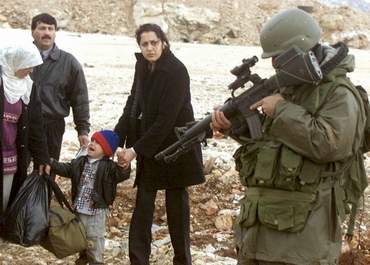
Prohibiting Palestinians from travelling along roads without providing alternative routes, the never-ending delays at roadblocks, the many hours required to travel short distances, the humiliation, the destruction of homes, the incessant searches, the need to aim weapons at innocent women and children - all these actions turn the Israeli Defence Force into an immoral occupying force, and in these I refuse to participate.
These actions on the part of the IDF provide no protection to Israel. They protect only the settlements built on conquered territory, where Israel has no right to establish settlements. The friction with the Palestinian population is caused by the need to provide settlers with freedom of movement, not by the need to prevent suicide bombers entering Israeli territory. As long as Israel continues to hold the settlements, it will be forced to act immorally toward the Palestinian population.
In addition to the great harm we are causing daily to Palestinians, we damage ourselves as a society. Our society is based on moral precepts in Judaism, which states that "loved is a person created in God's image". Instead, we are raising a generation of violent young people immune to pain and human suffering, a generation who don't see in the Palestinian a human being, only part of a mass to be avoided and feared. We are raising a generation that stops pregnant women, old people and children from getting to hospital.
I am very sorry that things have reached this point. I would be very glad to serve the IDF on any mission entrusted to us, as long as its objective is not connected with subduing the Palestinian population under our rule.
Sincerely,
Captain Haim Weiss
Haim Weiss, 32, is a captain in the tank corps and served in the IDF for four years during his military service. He is completing a PhD in Hebrew literature at the Hebrew University of Jerusalem
Iraq hits at UN for hypocrisy on Israel
Ewen MacAskill in Baghdad
(The Guardian)
The Iraqi deputy prime minister, Tariq Aziz, accused the United Nations of double standards yesterday for imposing sanctions on Baghdad for 11 years, but failing to take any action against Israel for blocking a fact-finding inquiry into military action at the Jenin refugee camp.
"The secretary general cannot challenge America and its ally Israel," Mr Aziz said in Baghdad as he tried to step up the pressure on the UN ahead of the opening of three days of talks on allowing UN weapons inspectors back into Iraq.
The Iraqi foreign minister, Naji Sabri, was due to meet the UN secretary general, Kofi Annan, in New York. Sources in Iraq insist that Baghdad is ready to bow to international pressure by allowing the inspectors back in, a move that would reduce tensions and might prevent war. It could also open the way to ending UN sanctions.
President George Bush claims that the Iraqi president, Saddam Hussein, is secretly building an arsenal of chemical and biological weapons and developing nuclear ones, and has hinted at military action if Iraq continues to refuse to allow the weapons inspectors back in to check. Tony Blair has lined up with Mr Bush on the issue.
Mr Aziz said Mr Annan's handling of the Jenin fact-finding issue was proof of double standards, arguing that while the UN stood firm on its resolutions on Iraq, it had done little in the face of Israel's resistance to security council resolutions, even those supported by the US.
The UN imposed sanctions on Iraq after it invaded Kuwait in 1990. Weapons inspectors, claiming obstruction by Baghdad, left the country in 1998 ahead of a US-British bombing raid and Iraq has refused to allow them back in.
Amos Oz: What we Israelis must do to bring peace to our land
The Israeli public can be mobilised to topple the settlers' government and elect a realistic coalition
What can an ordinary man do when he faces an enormous fire? He can try to flee the flames, abandoning to their fate all those who either cannot run or have nowhere to run to. He can stand around and moan. He can blame others. And he can also fill the teaspoon he holds in his hand with water, over and over again, and splash it on the blaze.
Every one of us has a teaspoon.
During these days, every man of peace must draw water -- at least enough to fill the spoon he holds -- and pour it on the fire: make his voice heard, object to war crimes by either side, help the victims of these war crimes; demonstrate, persuade, write, debate, garner support for reasonable compromise, oppose the continuation of the Israeli occupation and the Islamic/anti-Semitic campaign for Israel's extermination. The spoon in the ordinary man's hand is truly very small, and the fire large indeed ? but even so he must use it.
In Israel, and in Palestine as well, there must be a "teaspoon muster", joined by every person willing to do his utmost to halt the wheels of the repression, the killing, the retaliation, and the retaliation for retaliation.
On the Israeli side, it is best to talk not of "unilateral separation", but specifically of an Israeli initiative to end the occupation, for the defence of the state of Israel.
Today, the majority of the Israeli public can be mobilised to topple the settlers' government and elect in its stead a coalition with realistic positions. All this is to be based on a plan. If the Palestinian leadership agrees to this plan, all the better; but this plan's great advantage is that it can be implemented even if the Palestinian leadership remains neck-deep in belligerency, or prisoner in the hands of the forces of jihad.
1. Israel will end the occupation of the Palestinian population, and will set up a closed, fortified line in accordance with demographic reality -- a line not the same as the Green Line, but adjacent to it -- that will include no occupied Palestinian population. The permanent Israel-Palestine borders will be determined through negotiation, with the Palestinian leadership proving, by its deeds, that it has renounced the Islamic campaign to annihilate Israel.
2. Israel will agree to the immediate establishment of a Palestinian state in the populated Palestinian areas, even if this state arises before a peace treaty is signed between the sides. Militarily and morally, it will be easier for Israel to face an enemy state than to continue fighting a cluster of armed gangs.
3. Israel will morally acknowledge that it played a role in bringing about the Israeli-Palestinian tragedy. At the same time, it will demand of every decent man that he acknowledge the role of the Arab countries and the Palestinians in this tragedy.
The calamity of the Palestinian refugees is one of the origins of the violence, the hatred, and the terror. Israel must accept no solution that does not include the human, economic, and political rehabilitation of the Palestinian refugees -- not within Israel's borders, but in their homeland, Palestine -- through international and Israeli participation in the task of rehabilitation.
4. A comprehensive solution to the Israeli-Arab war must be sought not only between Israel and the Palestinian leadership, but also, and perhaps primarily, between Israel and the Arab League (which perhaps has the power to restrain displays of Palestinian extremism). The Saudi plan, some of whose elements were adopted by the Arab League, can serve as a point of departure -- but definitely not as the finish line -- for negotiations between Israel and the League on a comprehensive solution to the Israel-Arab war.
5. A unilateral Israeli move to end the occupation, including the dismantling of the vast majority of the settlements, would come about only if the burden of minimising the danger that Israeli society is being asked to face is shouldered by those who demand that Israel carry out such a move in the absence of an Israeli-Palestinian agreement.
The condition for ending the occupation will not be some paper signed by Yasser Arafat, but a solid agreement concretely linking Israel with Nato and the European Union, so as to deter the promoters of the Islamic holy war and to lay to rest once and for all the dream of eliminating Israel -- and also to ensure that the end of the occupation will not be a shot in the arm encouraging those who are inflamed with warmongering Arab nationalism, and will not enable them to attack Israel after it relinquishes its control over the Palestinians.
Around such a plan as this, it will be possible to consolidate a majority of the public, a majority in the next elections, and perhaps even a majority in the current Knesset ? a majority that consists of the left, the centre and the more pragmatic elements of the moderate right.
� Amos Oz 2002
The author's novel 'The Same Sea' has just been published in paperback by Viking at �6.99
Across West Bank, daily tragedies go unseen
Suzanne Goldenberg reveals the extent of abuses against civilians in Israel's four-week military offensive
(The Guardian)
Arif Said Ahmed's life ended at 5.05am on April 9 when two Israeli helicopter gunships soared over the hillside, firing a rocket at him and his cousin Naif as they walked home from morning prayers.
The helicopters returned, firing their machine guns for several terrifying minutes as Arif's wife, Samira, stumbled out to their bodies with her infant daughter. Mother and daughter were saved from serious injury by her brother Farooq, who flung himself over them.
A bullet pierced his side and fragments ripped his leg.
That was the beginning of the invasion of Dura, a village south-west of Hebron which marks the southernmost extent of the Israeli army's offensive in the West Bank.
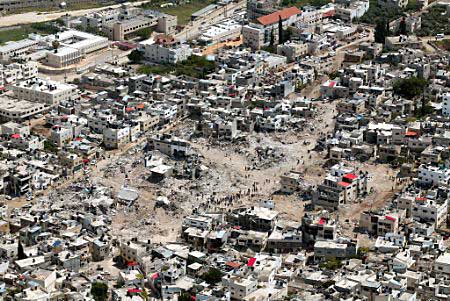
The Jenin refugee camp, whose physical erasure has come to symbolise the devastation and death inflicted by the Israeli army in the past four weeks, lies at the northern extremity of the territory.
While the world has been preoccupied with the camp, the stories beginning to unfold from the Palestinian cities, towns, refugee camps and villages that lie between Jenin and Dura show that the Israeli army has been engaged in systematic abusethe length of the West Bank.
"Jenin is not so different from any of the other attacks," said Peter Bouckaert, a senior researcher at Human Rights Watch. "The focus of the international community has been on events in Jenin, but equally serious violations took place in Ramallah, particularly, and in Nablus."
The most grievous abuses break down into four categories: the killing of Palestinian civilians, the denial of medical care, the wanton destruction of civilian property, and the use of Palestinian civilians as human shields for house-to-house searches.
Human rights organisations have not even begun to investigate the raids on the smaller West Bank towns and villages such as Dura. The scale of the offensive, the biggest since Israel occupied the West Bank in 1967, is too forbidding, as is its use of a military curfew to deny international organisations access.
The first human rights field worker, from the Israeli group B'Tselem, reached Dura on Thursday, when the village had been under curfew for 17 days.
The first civilian deaths B'Tselem recorded were those of Arif Said Ahmed, 34, a teacher and the acting imam of the local mosque, and Naif Said Ahmed, 33, who was his cousin and brother-in-law. After dawn prayers they had paused outside the mosque to smoke a cigarette when the rocket killed them.
Their bodies were not removed for 36 hours. Despite his serious injuries, Farooq Said Ahmed was rounded up with the other Palestinian men of the village, propped up by two other men. One asked the soldiers for a doctor.
"The soldier told him in Arabic: 'Whoever is dead is dead, and whoever is injured can wait'," he said.
The army allowed an ambulance through 10 hours later, by which time his jeans were so soaked in his own blood that he considered wringing them out.
It took three hours to reach the hospital, he said. Twice soldiers shot at the ambulance, and twice they stopped it, unloading him on his stretcher, prodding his injured leg until he yelled in pain, and flipping him over on his face to check for weapons on both occasions.
Nothing that happened in Dura is extraordinary in the context of the past month.
Six Palestinians were killed - three wanted militants and three civilians - two houses were blown up, hundreds of men were rounded up and a few men were used as human shields.
Human rights organisations accuse the Israeli defence force of failing in its duty to the Geneva conventions to "refrain from deciding to launch any attack which may be expected to cause incidental loss of civilian life, injury to civilians, damage to civilian objects, or a combination therefore which would be excessive in relation to the concrete and direct military advantage anticipated".
The Israeli army spokesman Captain Jacob Dallal said: "Considering the type of war we are engaged in we have done very, very well to protect civilians.
"This is a war being conducted in an urban setting. We are not on a hilltop fighting another army. We are fighting an army of terrorists, and terrorists hide in civilian areas."
In Arrabah, south-west of Jenin, a pair of helicopter gunships fired on Mohammed Nabil Hardan and his wives, Amal and Jamila, killing all three as they walked home from their fields. Jamila was five months pregnant.
A few minutes later they fired a rocket at the barn where Mohammed's father, Nafeh Abed Hardan, 67, was sleeping, wounding him in the hand and the foot. The foot may have to be amputated.
"I swear I don't know why," he said. "There was no reason for them to kill my son and his wives, and if I knew they were going to fire on the barn, I certainly would not have slept there."
During the siege of the Nablus casbah, doctors used a mosque as a mortuary and hospital. It was strewn with the stained mattresses of the wounded who bled their lives away. Two dozen corpses lay there for six days, stacked up like firewood, before a chaotic evacuation on April 8.
"If the Israelis are calling it a military zone, and not allowing others in, there is an obligation to provide aid to friend and foe," said Hanna Megally, director of Human Rights Watch.
"They can prevent medical aid coming in for military reasons, but they have to provide it themselves."
Capt Dallal said: "There have been very many cases where we have allowed the ambulances to go through, but the drivers say they are afraid of shooting."
He also denies that the army caused unwarranted destruction, saying the buildings destroyed were used by snipers.
But the fighting devastated much of the West Bank. In the Nablus casbah several historic buildings with 2ft-thick stone walls, including a soap factory, were reduced to mounds of rubble.
In the Balata refugee camp, homes were destroyed as punishment. The army blew up four houses near the entrance of the camp. One belonged to the Badawi family, whose two sons were commanders in a Palestinian militant group.
Ramallah, the seat of Yasser Arafat's administration, was another destruction zone.
This was where the army established its pattern of compelling male civilians to walk in front of soldiers when they were hunting the Palestinian militants and police.
On March 30, Israeli soldiers exchanged fire with more than 20 Palestinian policemen and threw grenades into their hideout in a third-floor flat in a town centre building.
Moments later Nader Mansi, 22, an architecture student, was ordered to enter the building and approach the flat to see if the policemen would surrender.
In Jenin refugee camp the following Friday, Ali Mustafa Abu Siria, 43, an Arabic teacher, was marched from his flat in handcuffs and at gunpoint and forced to walk ahead of troops and 13army sniffer dogs seeking gunmen.
He went to 11 houses before he was shot in the kneecap. "As soon as I knocked on the door, a bullet was fired at me," he said.
Capt Dallal emphatically rejected the term "human shield", though he admitted that Palestinian civilians were used as "guides".
On the eve of the arrival of a UN team to investigate the nine-day battle for Jenin, such disputes about terminology, and what really happened in the refugee camp, will likely grow more heated.
Samira, wife of the dead Arif Said Ahmed, would like to welcome the team to Dura.
"I believe this mission should visit every place in Palestine. The behaviour of the Israeli army was savage, and it didn't distinguish between Jenin, Hebron, Dura or any other place."