
By Justin Huggler (The Independent)
A woman with her leg all but ripped off by a helicopter rocket, the mangled remains hanging on by a thread of skin as she slowly bleeds to death. A 10-year-old boy lying dead in the street, his arm blown off and a great hole in his side. A mother shot dead when she ran into the street to scream for help for her dying son. The wounded left to die slowly, in horrible agony, because the ambulances were not allowed in to treat them.
A terrible crime has been committed by Israel in Jenin refugee camp, and the world is turning a blind eye. Colin Powell, the US Secretary of State, visited the scene of a suicide bombing that murdered six Israelis in Jerusalem, but he did not visit Jenin, where the Israelis admit they killed at least 100 Palestinians. The Israel army claims all of the dead were armed men, that it took special care to avoid civilian casualties. But we saw the helicopter rockets rain down on desperately crowded areas: civilian casualties could not have been prevented.
The Israeli army sealed off the entire area around Jenin yesterday, arresting journalists who ventured into it. That is because they have something to hide in Jenin: the bodies.
The Israeli army has told the Israeli courts that it will not start burying the bodies until Sunday. But there are abundant eyewitnesses who say they have already seen the soldiers piling the bodies in mass graves. Hiding the bodies is what Slobodan Milosevic did in Kosovo.
Either way, the Palestinians are not allowed to bury their own dead, because Israel does not want the world to see what happened inside Jenin refugee camp. The grieving have no way of knowing where to find the bodies of those they have lost.
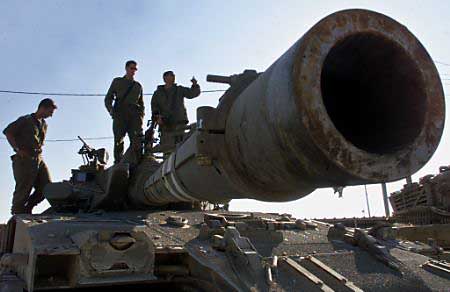
For nine days, Jenin camp became a slaughterhouse. Fifteen thousand Palestinians lived in a square kilometre in the camp, a packed warren of narrow lanes. Thousands of terrified civilians, women and children, cowered inside their homes while the Israeli helicopters rained down rockets on them and tanks fired shells into the camp.
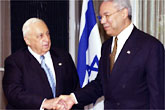
The wounded were left to die. The Israeli army refused to allow ambulances in to treat them, which is a war crime under the Geneva Conventions. The Red Cross has publicly said people have died because Israel blocked the ambulances. Slobodan Milosevic is on trial in the Hague for breaking the Geneva Conventions, while Ariel Sharon shakes Colin Powell's hand for the television cameras. The Geneva Conventions are in tatters in Israel.
The Israeli authorities may be able to hide the evidence, but they cannot silence the stories that have been pouring out of those who managed to escape the carnage in the camp. These stories cannot be verified yet, but there are scores of them, and many agree in details. Fikri abu al-Heija was one of those who came out of the carnage in the camp.
"At the beginning the soldiers came and surrounded the camp with tanks," he says. "There were two Apache helicopters. A rocket hit our house ? they were concentrating the rockets on the houses. All the windows were broken by the explosions. All you could hear was explosions. When the rocket hit the house, everybody gathered together on the lower floors. A woman was with us from the second floor who had had her leg almost cut off by the rocket. It was just hanging on by a little piece of skin. We saw the ambulance coming for her but the soldiers stopped it."
Six days after the attack, Mr abu al-Heija was captured by the soldiers. "They made us take off our clothes and tied us in groups of five with metal wire. As we were walking through the camp we saw demolished houses, burning houses, bodies in the street. Every 10 or 20 metres there was a body. I recognised some. One was a cousin of mine. His name was Ashraf abu al-Heija."
The Palestinians have been writing all the accounts like Mr abu al-Heija's down: they are not going to allow what happened at Jenin to be covered up. The Independent on Sunday has seen these meticulous handwritten notes, of which several copies have been made. There are records of everybody who used to live in the camp, and it will be possible to match the missing with the accounts of the dead. The Palestinians say there are 200 missing.
The names are coming out now: Mohammed Hamad, Nidal Nubam, Mustafa Shnewa. A man who asked to remain anonymous says he saw their bodies being put in a mass grave in the Haret al-Hawashin neighbourhood.
Yusra Ahmad, a mentally disabled woman, was killed by a helicopter rocket in her home. Her nephew Mufid Ahmad says he saw it happen.
Munir Washashi bled to death over several hours after a helicopter round came through the wall of his home. When an ambulance came for him, Israeli soldiers shot at it.
Munir's mother, Maryam, ran into the street screaming for help for her son and was shot in the head by Israeli soldiers. Abdullah, her other son, told The Independent on Sunday he saw it all happen.
The events of the last two weeks in Jenin will not go away, however hard Israel tries to keep the refugee camp away from the eyes of the world. For the Palestinians, this is the place where they finally stood and fought, and where Palestinian fighters armed only with rifles managed to hold off the Israeli tanks and helicopters for nine days. It is also the place where at least 100 Palestinians were slaughtered by the Israeli army.
World finally gets glimpse of refugee camp devastation
By Justin Huggler outside Jenin
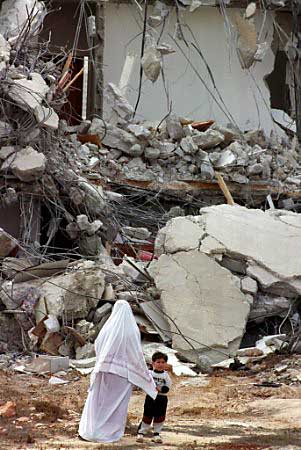
The world finally got to see what Israel has done in the Jenin refugee camp yesterday. Piles of rubble where homes once stood. Gaping holes rent in the sides of buildings. Electricity wires torn down and strewn amid the wreckage. Water flooding out of broken mains and running down the broken streets.
This was our first glimpse of what is left of the packed warren of narrow lanes that became the scene of the worst fighting of Israel's onslaught in the West Bank. These are scenes of devastation that will haunt the mission of Colin Powell, who flew in yesterday.
This is the wreckage where hundreds of terrified civilians were trapped inside their homes as Israeli helicopters poured rockets all around them, ambulances not allowed to treat the wounded as they bled, where Palestinians captured by the Israelis say they were forces to strip in front of their families, where Palestinian fighters armed only with rifles resisted the Israeli attack for nine days. This is where the Israeli army admits it killed 100 Palestinians.
For out of the misery, humiliation and death of Jenin camp, the Palestinians are already fashioning a legend. Out of the rubble staggered a 13-year-old boy yesterday.
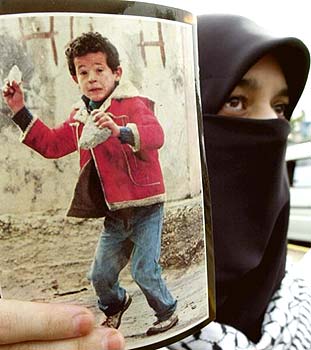
Amazingly, he was one of the last group of fighters who held out against the helicopters and the tanks. And already the stories are being passed from Palestinian to Palestinian: how the 13-year-old fought because his father was killed fighting the last time Israeli forces moved into the camp in March; how, when they ran out of ammunition, the fighters started throwing stones at the Israeli soldiers.
"I feel very proud of what the fighters did in Jenin," Deya al-Ahmad, a Palestinian in a neighbouring village, said yesterday. "I will tell my children this story, and I hope they will tell it to their grandchildren."
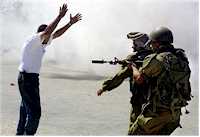
The Palestinians wrested this from a battle in which those detained tell horrific tales of their treatment by the Israelis. One told us he was forced to strip naked and act as a human shield, standing with an Israeli soldier behind him resting his gun on his shoulder. Another told us when he asked for a drink the soldiers forced a stick into his mouth. Then, he said, they brought him water that tasted of urine.
The shots were still echoing over the camp yesterday, even as Israeli forces claimed the battle was all but over. A few pockets of Palestinian fighters were holding out, though they had no chance of winning.
Rashid Hassan said: "I don't believe this is a victory for Israel, because a victory would mean they had achieved their goals and solved their problem once and for all. But I think the problem is going to start again for Israel. If they killed so many people, the next generation will fight even harder."
The Israeli authorities insist their onslaught on the West Bank is the only way to stop suicide bombings.
Among the refugees who fled Jenin camp, we found a teenager who would not give his name. He had been separated from his family and could not find them. He told us he was going to be a suicide bomber.
The Palestinians are claiming that far more than 100 of their number were killed in Jenin. Many of those who fled say they saw civilians, including women, carelessly cut down. The last thing Israel wants the world to see are the bodies of women in the streets. Rumours abound that the bodies are being hidden, taken away in trucks and buried by Israeli soldiers.
But local Palestinians say they are not going to allow the Israelis to hide the evidence. They have painstakingly documented the stories of those who have fled the camp. They claim their notes account for about 200 dead. The Independent has seen the detailed handwritten notes.
That means that it should be possible to find the bodies at specific addresses. Bodies such as that of Mufid Ahmad's mentally disabled aunt Yusra. He says he saw her die when a helicopter round came through the wall of their house. When police captured him and took him away he says Yusra's body was still in their second-floor flat. He told us the address. It should be possible to find the block of flats if it is still standing, but many have been bulldozed by the army to make a route for tanks.
But the figure of 100 dead, from military sources, means at least 100 bodies were lying among the ruins of Jenin. Even if someone has hidden them, 100 bodies are not going to do Israel's image any good at all.
Robert Fisk: Mr Powell must see for himself what Israel inflicted on Jenin
The credibility of US policy on the conflict has been shattered
Why doesn't Colin Powell go to Jenin? What has happened to the world's moral compass ? indeed to the United States ? when America's most famous ex-general, the Secretary of State of the most powerful country on earth, on a supposedly desperate mission to stop the bloodshed in the Middle East, fails to grasp what is taking place in front of his nose? The stench of decaying corpses is wafting out of the Palestinian city. The Israeli army is still keeping the Red Cross and journalists from seeing the evidence of the mass killings that have taken place there. "Hundreds'' ? on Israel's own admission ? have died, including civilians. Why, for God's sake, can't Mr Powell do the decent thing and demand an explanation for the extraordinary, sinister events that have taken place in Jenin?
Instead, after joshing with Ariel Sharon after his arrival in Jerusalem on Friday, Mr Powell is playing games, demanding that Yasser Arafat condemn Friday's bloody suicide bombing in Jerusalem (total, six dead and 65 wounded) while failing to utter more than a word of "concern'' for the infinitely more terrible death toll in Jenin. Is Mr Powell frightened of the Israelis? Does he really have to debase himself in this way? Does he think that meeting Arafat, or refusing to do so, takes precedence over the enormous humanitarian tragedy and slaughter that has overwhelmed the Palestinians? Is President Bush ? whose demand that Ariel Sharon withdraw his troops from the West Bank has been blandly ignored ? so gutless, so cynical, as to allow this charade to continue? For this is the endgame, the very final proof that the United States is no longer morally worthy of being a Middle East peacemaker.
Even for one who has witnessed so much duplicity in the Middle East, it is a shock to reflect on the events of the past nine days. Let's just remember, as the Americans would say, "the facts". Almost two weeks ago, the United Nations Security Council, with the active participation and support of the United States, demanded an immediate end to Israel's reoccupation of the West Bank and Gaza. President Bush insisted that Mr Sharon should follow the advice of "Israel's American friends'' and ? because our own Mr Blair was with the President at the time ? of "Israel's British friends", and withdraw. "When I say withdraw, I mean it," Mr Bush snapped three days later. But of course, it's now clear that he meant nothing of the kind.
Instead, he sent Mr Powell off on his "urgent" mission of peace, a journey to Israel and the West Bank that would take the Secretary of State an incredible eight days ? just enough time, Mr Bush presumably thought, to allow his "good friend'' Mr Sharon to finish his latest bloody adventure in the West Bank. Supposedly unaware that Israel's chief of staff, Shoal Mofaz, had told Mr Sharon that he needed at least eight weeks to "finish the job'' of crushing the Palestinians, Mr Powell wandered off around the Mediterranean, dawdling in Morocco, Spain, Egypt and Jordan before finally washing up in Israel on Friday morning. If Washington firefighters took that long to reach a blaze, the American capital would long ago have turned to ashes. But of course, the purpose of Mr Powell's idleness was to allow enough time for Jenin to be turned to ashes. Mission, I suppose, accomplished.
As Israel's indisciplined soldiery yesterday continued to hide their deeds from the outside world by preventing the Red Cross, aid workers, ambulances and journalists from entering the rubble of Jenin, Mr Powell was sitting idly by in Israel, calling for the "utmost restraint'' from an army that has not yet finished filling the mass graves of Jenin. That he should see a visit to Yasser Arafat ? the grotesque, corrupt old man of Ramallah ? as the make-or-break issue of his "peacemaking" shows just how skewed Mr Powell's morality has become. Mr Arafat's advisers (let's not give any credit to the would-be "martyr-chairman" of the Palestinian Authority for this) shrewdly announced that it is for Mr Powell to condemn the killings in Jenin, for Mr Arafat could be expected to condemn the vicious suicide bombing in Jerusalem on Friday. And even though Mr Arafat mouthed the relevant words of contrition and condemnation yesterday afternoon, it makes little difference.
All last week, while Mr Sharon's soldiers were running amok in Jenin, White House spokesman Ari Fleischer was playing the role of Mr Sharon's point man in Washington. When Israel announced that its army was pulling out of three tiny West Bank villages ? so tiny that no one had ever heard of them before ? Mr Fleischer announced that this was "a step in the right direction''. Then by Friday morning, when even the most dimwitted observer had grasped that something was terribly wrong in Jenin, Mr Fleischer was telling us that Sharon was "a man of peace''. How much longer, one wonders, could this nonsense continue?
Of course, the Palestinians ? or whoever directs the sepulchral, nightmarish campaign of suicide bombing, for it surely cannot be the preposterous Mr Arafat ? are going for the jugular. The Al Aqsa Brigades or Hamas or Islamic Jihad clearly intend to ensure that Mr Sharon's ruthless operation fails (the Israeli reoccupation, after all, was supposed to be preventing these wicked Palestinian crimes) and to ensure that Mr Powell is made to look impotent. They seem certain to accomplish both goals. The Palestinian Authority, to all intents and purposes, has for now ceased to exist. That was surely one of Mr Sharon's intentions. And Mr Powell's weakness, his failure of nerve, his cowardice, are now likely to set off an Israeli-Palestinian war even more terrible than what we have witnessed so far.
But let's pause for a quick journey down memory lane; to September 1982, when Ariel Sharon was "rooting out the network of terror" in the Sabra and Chatila refugee camps in Beirut. Before sending Israel's murderous Phalangist militia allies into the camps, Mr Sharon told the world that the Palestinians had assassinated the Phalangist leader, Bashir Gemayel. This was totally untrue, but the Phalange believed him. And evidence is now emerging in Beirut that, long after the Americans had called for Israel to withdraw the killers from the camp, the Israeli army, commanded by then Defence Minister Sharon, handed more than 1,000 survivors over to those same murderers to be slaughtered over the following two weeks. This, primarily, is why Mr Sharon is so worried by the attempts to indict him for war crimes in Brussels.
Hasn't Mr Powell glanced through the State Department archives for 1982? Hasn't he read what Mr Sharon said back then, the same ranting about "terror networks" and "rooting out terror" that he employs today? A lexicon which Mr Powell himself is now enthusiastically using? Has he forgotten that the Israeli Kahan commission held Mr Sharon "personally responsible'' for the massacre of those 1,700 civilians? Does Mr Powell really think that Jenin, albeit on a smaller scale, is much different? Even if we dismiss all the Palestinian claims of civilian butchery, extrajudicial executions and the wholesale destruction of thousands of homes, what on earth does he think the Israelis are hiding in Jenin? Why doesn't he go and look?
Yes, the Palestinians' suicide campaign is immoral, unforgivable, insupportable. One day, the Arabs ? never ones to look in the mirror when it comes to their own crimes ? will have to acknowledge the sheer cruelty of their tactics. They have not done this so far. But since the Israelis never attempted to confront the immorality of shooting to death child stone-throwers in the early days of the intifada or the evil of their reckless death squads who went around murdering Palestinians on their wanted list, along with the usual clutch of women and kids who got in the way, is this any wonder?
In the annals of war, the conflict in the Middle East has reached a new apogee, but the story of the United States' involvement in the Middle East will never be the same again. Thanks to Mr Powell, President Bush and Mr Sharon, America's credibility has been shattered. Israel, it turns out, does indeed run US policy in the region. The Secretary of State sings from the Israeli songbook. So when, oh when, will the Europeans screw their courage to the sticking-place and become the peacemakers of the Middle East?
Survivors of Jenin creep home to see destruction
By Phil Reeves, outside Jenin refugee camp
The old woman did not dare to look out of her window to see the destruction being committed within a few feet of her rose garden, but she could hear it clearly enough.
A giant Israeli military bulldozer, mounted with a machine-gun, was crashing through her neighbour's house, reducing it to dust, close to the edge of the killing fields of Jenin refugee camp.
We had arrived in time to see 65-year-old Rashida Raji Ahmed's trauma as she examined what was left of her house after an 11-day invasion by the Israeli army into Jenin, which has left hundreds dead and injured.
The Palestinians and international humanitarian organisations were still trying yesterday to establish how many people had been killed; how many were still lyingwounded, and how many were buried beneath the rubble. Rashida wanted to see her home. She had crept back, for the first time in days.
She was crying uncontrollably when we arrived at her door. The upper floor of her home had been destroyed by a rocket, and chewed up by machine-gun bullets, like many other homes in the area. The house had then been taken over by the armed forces as a sniper's nest.
Her misery was one small part of the misery of Jenin that continued yesterday. Israel again barred Red Cross and United Nations ambulances and aid lorries from entering the camp, as it continued systematically to cover up the atrocities under the nose of Colin Powell, the visiting US Secretary of State.
And the stories of the death and destruction inside the camp of 15,000 also continued. Palestinians, ecstatic at the arrival into the no-go area of foreign journalists to whom they could tell their stories, described how camp residents had leapt from window to window to escape the advancing bulldozers; how some, equipped with mobile phones, had survived beneath the rubble; how some people had been cut in half by tanks.
The reports were, of course, impossible to verify, and will be denied by the Israeli army, which says that no atrocities have occurred, and that the dead were "terrorists" killed in fighting. But the horror stories keep on coming, rising steadily from the camp, like the fine haze of dust that hung over its ruins yesterday as the bulldozers continued their work.
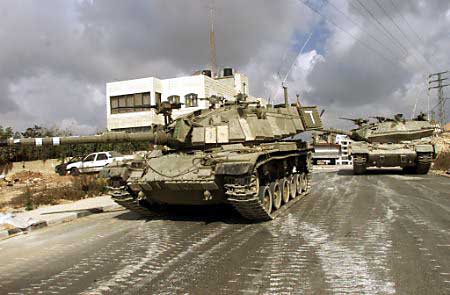
One week ago, nine Palestinian policemen had been bound hand and foot, stripped to their underpants, and executed against a wall, said Mai Ziyad, a 21-year-old student. The relatives, who had been forced to watch, had come to her house deeply distraught. She could remember several names, the Abu Jamda and Abu Hjab families had both lost men. "The wives and children of those who were killed were here. They told us all about it," she said, as we hid in a courtyard with an Israeli Merkava tank passing close by.
"They say that only a few hundred people were killed in there, but we think it was far more. The noise was enormous. The soldiers were all around us."
According to the Jenin municipality authorities, two-thirds of the homes have either been flattened or rendered uninhabitable. Adanan al-Sabah, their spokesman, said there were about 5,000 people still inside the camp, surrounded by tanks and snipers. "Many are still under the houses. We have seen a few bodies, one burnt inside a house, some buried in rubble, and one lying on the floor with his hands tied. But we still do not know how many were killed.
"One woman cradled her dead son in her arms all night. Their children kept on coming up to their father and trying to wake him up, asking for food and milk." His version of the execution story differed slightly: seven had been executed.
Residents around the edge of the camp say their water supplies were running out. In al-Razi Hospital, Dr Mahmoud Abu Eslieh said the staff had taken about 15 calls from worried mothers saying that they had been feeding their babies powdered milk mixed with sewage water.
Inside his hospital, Ali Abu Sariah, 42, who said he was a teacher, was lying in bed with a bullet in his left leg.
He said the Israeli forces used him as a human shield to go house-to-house through the camp, ahead of an Israeli patrol. They ran into another patrol, which shot him in the leg, he said. "They left me on the ground, bleeding."
He said that he had spent five days in houses, still injured, before he was carried to the hospital on a ladder. "Half of the camp has been flattened. I am not talking about bullets and rockets. It is totally destroyed and they have driven a highway through it. Alleyways that were three metres wide are now 20 metres wide."
We pressed him for more, warning of the importance of not exaggerating but getting it right. He did not waver for a second. "The bodies will tell you if we are lying or not," he said quietly.
Nablus victims rejoin the living
Couple survive eight days under rubble
Suzanne Goldenberg in Nablus
The Guardian
An elderly Palestinian couple were restored to life after eight days among the dead, entombed in the rubble of a home demolished by Israeli army bulldozers - the unlikely survivors of the deadliest single episode of Israel's crushing military offensive.
Three generations of the Shuabi family were buried alive when the shovel of an Israeli army bulldozer clawed the second floor off their home in the old town of Nablus, collapsing the building on 10 occupants.
Abdallah Shuabi, a baker, 68, and his wife, Shams, were trapped in a small dark room on the ground floor. "We could not tell if it was night or day," said Shams.
The couple listened to the distant thud of Israeli tank shells pummelling the old city of Nablus, and the crackle of gunfire. Occasionally, they heard Israeli soldiers speaking in Hebrew in the rubble above their heads.
They had a bottle of mineral water and two rounds of pitta bread. But after several days, the air inside their underground prison grew stale. Their food and water ran out, and the couple grew weak and disoriented.
"On the eighth day, my wife said, 'Today is our last. We are going to die today,'" Mr Shuabi recalled yesterday. "I started to tell her to forgive me, that we were going to die. We had no hope." In tears, the couple began reciting the Muslim affirmation of faith: There is no god but Allah, and Mohammed is his prophet.
Above ground, relatives gave the couple up for dead.
"After that, I heard somebody knocking," Mr Shuabi said. "I told her there is somebody above. I heard people calling my name, saying, 'Are you there? Don't be afraid, we are coming to rescue you.'"
It was an extraordinary rescue mission, launched under gunfire from Israel soldiers enforcing the 24-hour curfew imposed on Nablus since Israeli tanks entered 12 days ago.
The Palestinian fire brigade dug through a 2-metre mound of masonry and debris, looped a rope harness around Mr Shuabi and winched him back to life. It was a more difficult proposition to extricate his wife, who weighs nearly 20 stone.
The 14 Palestinian firemen were forced to burrow further still to haul out the corpses: Mr Shuabi's brother, Omar, 85, and his daughters, Fatima and Abir, and son, Samir. By clawing through the rubble until 3am on Saturday, they also recovered the bodies of Samir's pregnant wife, Nabila, and the couple's three small sons, Abdallah, Azam, and Anas.
"I felt like someone who died and was brought back to life," said Mr Shuabi.
Details of the ordeals suffered by the Shuabi family and others are slowly beginning to emerge, days after the Israeli army's wrecking missions in the centres of Palestinian resistance: the vaulted alleys of Nablus's old city, and the refugee camp of Jenin.
Amid the chaos, it remains impossible to be certain how many Palestinians have died. The old city of Nablus yesterday was a scene of destruction, with buildings sheared in half by Israeli rockets. Elsewhere, there were heaps of rubble where old stone houses once stood.
The confusion has fuelled accusations of a massacre in the Jenin refugee camp, where Palestinians say the Israeli army slaughtered hundreds of people - civilians as well as gunmen - and then tried to cover up the carnage by bulldozing the bodies where they fell, or stealing them away for burial.
Yesterday, Israel's supreme court barred the army from collecting the dead for burial in a remote cemetery in the Jordan Valley. The court ruled the army should allow Palestinians to bury their own dead, and authorised the Red Cross to monitor burials.
However, it said that if the funerals were not carried out quickly, the army could then move in.
Israel's ban on journalists and humanitarian organisations has made it impossible to verify the death toll of Palestinians in Jenin or Nablus. Palestinian estimates of the dead in the Jenin refugee camp run into the hundreds, but the Israeli army yesterday cut its original estimate of 150 dead to 37.
The Israeli defence minister, Binyamin Ben-Eliezer, said the number of deaths in Jenin stands at "tens of killed and not hundreds - most of them gunmen who shot at our forces".
Colonel Dan Reisner, an international law adviser in the army advocate-general's office, said 37 Palestinian bodies had been found in army searches of the Jenin refugee camp.
Thus far, Israeli officials said 11 Palestinian bodies found have been turned over to relatives and hospitals and have been buried.
The Israeli army says it has no information about the collapse of the Shuabi family home, and claims that army engineers were on the scene when homes were demolished to prevent damage to neighbouring buildings.
It also says the Shuabis' home was close to a Palestinian homemade bomb factory.
The Shuabis say that the women of the house had screamed at the Israeli soldiers that there were civilians and many children inside, but their protests went unheeded.
Palestinian captives 'tortured and humiliated' at Israeli army base
By Justin Huggler, outside Ofer, West Bank
Hundreds of Palestinians have disappeared since Israel began its onslaught in the West Bank less than two weeks ago. Details are only now emerging about what has happened to them, and how they say they have been tortured and humiliated by Israeli forces.
The wife of a man called Hussein has not seen her husband for six days. She said the Israeli army came to their village, Salseed, at 4am. They blindfolded the men and made them stand outside in their night clothes. She has no idea where her husband is.
The answer, for hundreds like her, lies behind the razor wire and lookout posts at Ofer, an Israeli army base that sits in a valley surrounded on three sides by hills, overlooked by the scruffy outskirts of Ramallah.
It appears that many of the disappeared are still alive. But that is where the good news ends. Inside Ofer up to 1,000 Palestinians are detained and have been regularly beaten with wooden batons. They are forced to spend nights sitting in the dirt outside in the cold, in their underwear. They are refused food for days at a time.
This is according to evidence collected by respected Israeli human rights organisations, and interviews The Independent has conducted with released prisoners. Those held in Ofer are not allowed to see lawyers or anyone else from the outside world. Yesterday, the International Red Cross was trying to negotiate access after having an earlier request refused.
The Israelis are opening more centres to hold the huge number of detainees. The Israeli authorities have admitted in an Israeli court that many of the men being held in Ofer are not suspected Palestinian militants, but innocent civilians who happened to be in the wrong place at the wrong time.
Nour Hamed lives in Beit Rur, a small village close to the forbidding gates of Ofer. Mr Hamed has just been released after 10 days. His family did not know that, while they feared for his safety, he was near by in Ofer. Mr Hamed is a director of Ajaill, a Palestinian radio station in Ramallah. He was detained with 10 of his colleagues, on 31 March, after Israeli forces moved into Ramallah.
"Nine soldiers came into the office and arrested us," Mr Hamed said. "They searched us and then blindfolded us.
"They made us sit on the ground outside. There were between 300 and 400 of us sitting there waiting to go in and be questioned. There was heavy rain and a cold wind. We spent three days in that situation. We had no food. Every day the soldiers came and hit us very hard with wooden batons.
"When it was my turn to go for questioning they took off my blindfold and took a photo of me holding up a placard with my name on it. They asked me my name and where I worked, the names of my father and brothers. They said to me, 'You are sons of bitches'. After the last question they made me sit outside on the ground again."
After three days outside, Mr Hamed says, he and the others were taken to a large room inside one of the buildings. "Every day the soldiers still came and hit us," he said. "I was lucky, they didn't take me for any more questioning.
"Some they took every day for more questions, and hit them hard. Some of them were badly bruised. I saw one man with his arm broken."
Another recently released man, Mohammed, said Israeli soldiers told him and 16 others that they would be killed "in revenge for the Israelis". He recalled: "They made us stand in a group and drove an armoured personnel carrier at us. It swerved away at the last minute."
It is impossible to verify the claims, not least because the Israeli authorities are refusing anyone access to Ofer. But many of the details are similar to accounts obtained by respected independent Israeli human rights organisations.
An Israeli soldier inside Ofer told B'Tselem, the Israeli Information Centre for Human Rights in the Occupied Territories, that torture was being used inside the camp and that he had seen captives whose toes had been broken.
Captives can be held without charge or evidence under Israeli military law. A warrant has been issued allowing the authorities to refuse access to lawyers for up to 18 days.