

By Phil Reeves in Jenin
Gaunt and exhausted, tormented with worry about his missing family, Jamal Fayed yesterday wandered round the vast heap of reeking detritus where Israel has buried the war crimes of Jenin refugee camp.
The last time Mr Fayed, a Palestinian science teacher, saw his wife and children, eight-year-old Majed and six-year-old Ahmed, was just after Israeli forces had invaded a fortnight ago. He told the family to leave their house because he feared a nearby Israeli tank was about to begin shelling. He stayed behind, because he thought that if he left with them the soldiers would open fire on them, assuming him to be a fighter.
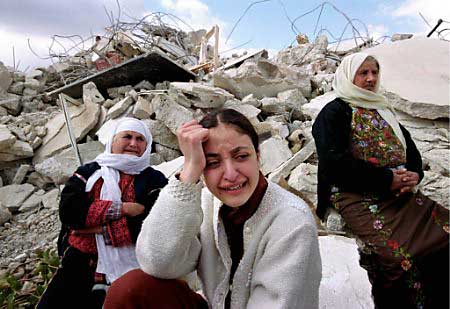
"Maybe they have gone to another village," he said. "I just don't know where they are." He stood in the dust of what used to be a large residential area, now reduced by Israeli bombardment and bulldozers to a wasteland, fetid with the stench of decomposing human bodies beneath it. Nearby, old women picked through the debris, trying to salvage the pitiful, battered remains of their lives.
International aid workers are beginning the arduous task of establishing how many people were killed in the camp in the Israeli's so-called counter- terrorism operation, a long bout of fighting which culminated with the bulldozing by the army of hundreds of dwellings. Witnesses said civilians were inside. The UN agencies and Red Cross say they find a growing number of refugees who are missing relatives.
Humanitarian aid workers who got into the devastated area of the camp yesterday reacted with deep anger and shock. A large area, about a third of a mile wide, has been flattened. Many other homes, half-wrecked by the heavy fighting, including rocket bombardments from Israeli helicopters, are uninhabitable. One official called the sight "absolutely unbelievable" and a "humanitarian catastrophe".
A senior UN official said: "Given the deplorable and unprecedented refusal to allow international relief organisations in to the camps while people were slowly dying in the rubble of their wounds and thirst, the onus is definitely on the state of Israel to account for the missing thousands of refugees who lived in that camp until a few weeks ago.
"I have not met one person in the international community who had any other explanation for this refusal other than the fact that they were hiding a war crime, in fact, two war crimes: the mass killing and the denial of humanitarian relief."
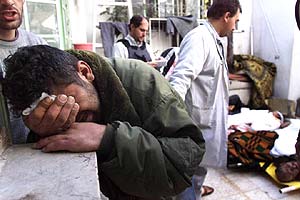
The Palestinian minister for planning and international cooperation, Nabil Shaath, called for an inquiry into the "massacre" in Jenin. Amnesty International also called for a full investigation by the UN Security Council. A spokeswoman for the International Committee of the Red Cross said the camp "looks as if it has been hit by an earthquake". Barred entry for a week, the Red Cross found and rescued a badly injured man trapped under rubble. The Israelis appear to have made no efforts to use heat-seeking equipment, or dogs, to find survivors, aid workers said.
Amnesty investigators in Jenin have taken dozens of witness statements covering the past fortnight. People say they saw bodies being buried in individual graves. One claims Israeli soldiers buried 32 corpses in a trench. They have also interviewed many refugees who fled the camp after their houses were demolished. Derrick Pounder, a professor of forensic medicine from Dundee University working with the Amnesty team, said a "pattern of credible evidence" is emerging from witnesses that residents were not warned by the army before bulldozers crashed into their homes. "The only warning was their house collapsing," he said.
Professor Pounder, who has worked in Sarajevo and Kosovo, believes the Israeli tactics inevitably means large numbers of dead civilians. "Sooner or later those bodies will be discovered and the facts will become absolutely clear."
Unrwa, the UN agency for Palestinian refugees, is to re-register all surviving refugees and match their names to its previous list of 13,000 camp residents in the hope of establishing the number of dead. But the task is expected to take months. Thousands are unaccounted for, although many fled to surrounding villages. Hundreds of men were rounded up and are thought to be in Israeli detention. (The Independent)
Amid the ruins of Jenin, the grisly evidence of a war crime
From Phil Reeves in Jenin
A monstrous war crime that Israel has tried to cover up for a fortnight has finally been exposed. Its troops have caused devastation in the centre of the Jenin refugee camp, reached yesterday by The Independent, where thousands of people are still living amid the ruins.
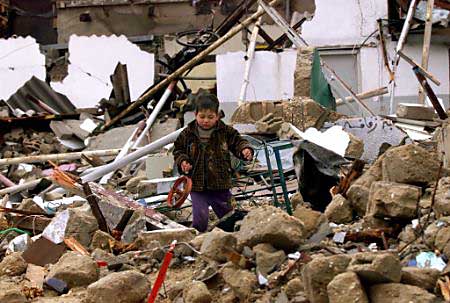
A residential area roughly 160,000 square yards about a third of a mile wide has been reduced to dust. Rubble has been shovelled by bulldozers into 30ft piles. The sweet and ghastly reek of rotting human bodies is everywhere, evidence that it is a human tomb. The people, who spent days hiding in basements crowded into single rooms as the rockets pounded in, say there are hundreds of corpses, entombed beneath the dust, under a field of debris, criss-crossed with tank and bulldozer treadmarks.
In one nearby half-wrecked building, gutted by fire, lies the fly-blown corpse of a man covered by a tartan rug. In another we found the remains of 23-year-old Ashraf Abu Hejar beneath the ruins of a fire-blackened room that collapsed on him after being hit by a rocket. His head is shrunken and blackened. In a third, five long-dead men lay under blankets.
A quiet. sad-looking young man called Kamal Anis led us across the wasteland, littered now with detritus of what were once households, foam rubber, torn clothes, shoes, tin cans, children's toys. He suddenly stopped. This was a mass grave, he said, pointing.
We stared at a mound of debris. Here, he said, he saw the Israeli soldiers pile 30 bodies beneath a half-wrecked house. When the pile was complete, they bulldozed the building, bringing its ruins down on the corpses. Then they flattened the area with a tank. We could not see the bodies. But we could smell them.
A few days ago, we might not have believed Kamal Anis. But the descriptions given by the many other refugees who escaped from Jenin camp were understated, not, as many feared and Israel encouraged us to believe, exaggerations. Their stories had not prepared me for what I saw yesterday. I believe them now.
Until two weeks ago, there were several hundred tightly-packed homes in this neighbourhood called Hanat al-Hawashim. They no longer exist.
Around the central ruins, there are many hundreds of half-wrecked homes. Much of the camp -- once home to 15,000 Palestinian refugees from the 1948 war -- is falling down. Every wall is speckled and torn with bullet holes and shrapnel, testimony of the awesome, random firepower of Cobra and Apache helicopters that hovered over the camp.
Building after building has been torn apart, their contents of cheap fake furnishings, mattresses, white plastic chairs spewed out into the road. Every other building bears the giant, charred, impact mark of a helicopter missile. Last night there were still many families and weeping children still living amid the ruins, cut off from the humanitarian aid. Ominously, we found no wounded, although there was a report of a man being rescued from beneath ruins only an hour before we arrived.
Those who did not flee the camp, or not detained by the army, have spent the bombardment in basements, enduring day after day of terror. Some were forced into rooms by the soldiers, who smashed their way into houses through the walls. The UN says half of the camp's 15,000 residents were under 18. As the evening hush fell over these killing fields, we could suddenly hear the children chattering. The mosques, once so noisy at prayer time, were silent.
Israel was still trying to conceal these scenes yesterday. It had refused entry to Red Cross ambulances for nearly a week, in violation of the Geneva Convention. Yesterday it continued to try to keep us out.
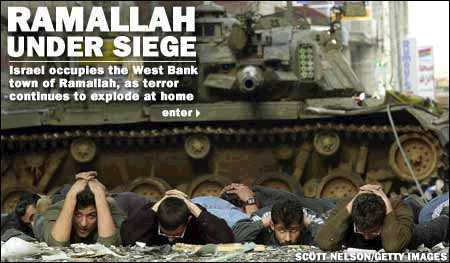
Jenin, in the northern end of the occupied West Bank, remained "a closed military zone", was ringed Merkava tanks, army Jeep patrols, and armoured personnel carriers. Reporters caught trying to get in were escorted out. A day earlier the Israeli armed forces took in a few selected journalists to see sanitised parts of the camp. We simply walked across the fields, flitted through an olive orchard overlooked by two Israeli tanks, and into the camp itself.
We were led in by hands gesturing at windows. Hidden, whispering people directed us through narrow alleys they thought were clear. When there were soldiers about, a finger would raise in warning, or a hand waved us back. We were welcomed by people desperate to tell what had occurred. They spoke of executions, and bulldozers wrecking homes with people inside. "This is mass murder committed by Ariel Sharon," Jamel Saleh, 43, said. "We feel more hate for Israel now than ever. Look at this boy." He placed his hand on the tousled head of a little boy, Mohammed, the eight-year-old son of a friend. "He saw all this evil. He will remember it all." So will everyone else who saw the horror of Jenin refugee camp. Palestinians who entered the camp yesterday were almost speechless.
Rajib Ahmed, from the Palestinian Energy Authority, came to try to repair the power lines. He was trembling with fury and shock. "This is mass murder. I have come here to help by I have found nothing but devastation. Just look for yourself." All had the same message: tell the world. (The Independent)
The lunar landscape that was the Jenin refugee camp
Suzanne Goldenberg in Jenin
The Guardian
A fortnight ago, before Israeli forces invaded, this was a crowded, bustling place. The narrow alleys between the cinderblock homes - spanning barely the width of outstretched arms - were packed with children.
Yesterday, the Hart al-Hawashin neighbourhood, the heart of the Jenin refugee camp, was a silent wasteland, permeated with the stench of rotting corpses and cordite. The evidence of lives interrupted was everywhere. Plates of food sat in refrigerators in houses sheared in half by Israeli bulldozers. Pages from children's exercise books fluttered in the breeze.
In a ruined house, the charred corpse of a gunman wearing the green bandana of Hamas lay where it fell, beside his ammunition belt. Electric cables snaked through the ruins.
Alleys leading off the square deepened the image of wanton destruction: entire sides of buildings gouged out, stripped out to the kitchen tiles like discarded dolls' houses. The scale is almost beyond imagination: a vast expanse of rubble and mangled iron rods, surrounded by the gaping carcasses of shattered homes.
Yesterday the first definitive accounts of the battle of Jenin began to emerge as journalists broke through the Israeli cordon and gained access to the heart of the refugee camp. Palestinians describe a systematic campaign of destruction, with the Israeli army ploughing through occupied homes to broaden the alleys of the camp and make them accessible to tanks and vehicles.
But they also say the demolition campaign increased dramatically in the last two days of the battle for Jenin, with Israeli bulldozers exacting harsh retribution for the killing of 13 Israeli soldiers last Tuesday. "When the soldiers were killed, the Israelis became more aggressive," said Ali Damaj, who lives on the eastern edge of the camp. "In one night, I counted 71 missiles from a helicopter."
For the Palestinians, the battle for the Jenin refugee camp has become a legend. Before the last of the Palestinians surrendered last Wednesday, the camp saw the bloodiest fighting of Israel's offensive on West Bank towns. The brutal close-quarters combat claimed the lives of 23 Israeli soldiers, and an unknown number of Palestinians, civilians as well as fighters.
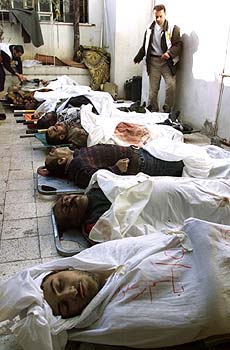
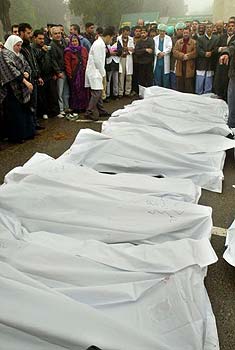
Palestinians accuse Israel of a massacre, and there are convincing accounts from local people of the occasional summary execution. However, there are no reliable figures for Palestinian dead and injured. The Red Cross carried away seven bodies yesterday, but the smell of rotting corpses remained.
"The soldiers had a map with them of the houses they wanted bulldozed, and outlined them with a blue marker," said Aisha Salah, whose house overlooks the field of destruction. "You could see the houses, you could see the trees. It was a very detailed map. I could even find my own home."
Ms Salah's home was occupied by Israeli soldiers who entered her living room by punching a hole through the neighbour's wall. Before they withdrew, one of the soldiers wrote a message on the wall in neat blue ink: "I don't have another land".
A week ago, one of the Israeli soldiers bedded down in Ms Salah's house was shot in the face by a Palestinian sniper as he stood at the window. Two days later, 13 Israeli soldiers were lured to their deaths in a nearby alley by a series of booby trap explosives, and then picked off by Palestinian gunmen.
"When there was resistance, especially after the 13 soldiers were killed, I could see a lot more squares on the map," said Ms Salah.
The systematic bulldozing of Palestinian homes began four days after Israeli forces blasted their way into the camp on the night of April 3, strafing houses from helicopter gunships, and pounding them with tank shells. Several civilians were killed in the initial assault, including Afif al-Dasuki. An elderly woman, who lived alone, she was evidently too slow when the Israeli soldiers pounded on her door and asked her to open up. Her neighbours discovered her body a week after her death, by the smell of decomposition, huddled behind the yellow-painted steel door, with the large hole in the middle.
Four days later, the army razed six houses in the Damaj neighbourhood on its eastern edges. They began with the house of Fatima Abu Tak, flattening homes on both sides of the street, "When I saw the house of Ahmed Goraj collapse, there was a tremendous amount of smoke and dust. I never expected that the bulldozers would continue moving. I was in a state of shock," said Mr Damaj, who fled to a neighbour's when his own home became dangerously unstable.
A few hours later, soldiers entered the camp on foot, shooting their way between the cinderblock homes in groups of 15 or 20.
Israeli soldiers injured in Jenin describe this as the most nerve-wracking part of the battle. "They booby trapped every centimetre. In one metre you would find 20 small booby traps or a big balloon attached with a wire. Every metre was very dangerous," said Dori Scheuer, who was shot in the stomach by a Palestinian gunman a week ago on Monday. "It was much more dangerous for us than it was for them because they knew the territory."
People in the camp say the capability of their fighters did not run much beyond pipe bombs packed with homemade explosives. However, the fighters were organised.
Palestinians admit the camp was liberally mined two or three days before the assault. But the strategy failed because Israel had no compunction about razing homes to make roads for its tanks.
"The thing we did not count on was the bulldozer. It was a catastrophe. If the Israelis had only gone one by one inside the camp, they would never have succeeded in entering," said Mr Damaj.
After the 13 soldiers were killed, Israel appears to have abandoned foot patrols. Instead, the army began knocking houses down indiscriminately, creating a vast plaza of rubble in the centre of the camp, a crossroads for the Israeli tanks.
"They just started demolishing with the people inside," said Hania al-Kabia, a mother of six whose flat is on the edge of the lunar landscape. "I used to hear them on the loudspeaker saying come out, come out. Then they stopped doing that, but they went on bulldozing."
Immortal heroes of Jenin
Sharon's war is not only failing to bring Israelis security, it is laying the foundations of a new Palestinian nation and state
Uri Avnery
The Guardian
In 1897, the day after the First Zionist Congress in Basel, Theodor Herzl, wrote in his diary: "In Basel I founded the State of the Jews." This week, Ariel Sharon should note in his diary: "In Jenin I founded the State of the Palestinians."
Of course, he did not mean to. His intention was to destroy the Palestinian nation, its institutions and leadership, once and for all, leaving only bits and pieces, human wreckage that could be disposed of anywhere.
In practice, something quite different happened. Faced with the onslaught of the biggest military machine in the region and the most modern arms in the world, submerged in a sea of suffering, surrounded by bodies, the Palestinian nation straightened its back as never before.
In the small refugee camp near Jenin, a group of Palestinian fighters from all the organisations gathered for a battle of defence that will be enshrined forever in the hearts of all Arabs. This is the Palestinian Massada, as an Israeli officer called it, alluding to the legendary stand of the remnants of the great Jewish rebellion against Rome in 71 AD.
When the international media cannot be kept out any more and the pictures of horror are published, two possible versions may emerge: Jenin as a story of massacre, a second Sabra and Shatila; and Jenin, the Palestinian Stalingrad, a story of immortal heroism. The second will surely prevail.
Nations are built on myths. I was raised on the myths of Massada and Tel-Chai. They formed the consciousness of the new Hebrew nation. (At Tel-Chai, in 1920, a group of Jewish defenders, led by the one-armed hero Josef Trumpeldor, were killed in an incident with anti-French Syrian fighters.) The myths of Jenin and Arafat's compound in Ramallah will form the consciousness of the new Palestinian nation.
A primitive military robot, who sees everything in terms of fire power and body counts, will not understand this. But Napoleon, a military genius, said that in war, moral considerations account for three quarters, and the balance of force for the other quarter.
How does Sharon's war look in this perspective? As for the actual forces, the balance is clear. A few dozen Israelis killed, many hundreds of Palestinians dead. No destruction in Israel, horrible destruction in the Palestinian towns.
The aim was, so it was claimed, to "destroy the terror infrastructure". This definition is by itself nonsensical: the "terror infrastructure" exists in the souls of millions of Palestinians and tens of millions of Arabs, whose hearts are bursting with rage. The more fighters and suicide bombers are killed, the more fighters and suicide bombers are ready to take their place. We saw the "laboratories of explosives" - sacks of material obtainable in Israeli shops. The Israeli army is proud of discovering tens of them. There will soon be hundreds.
When dozens of wounded people lie in the streets and slowly bleed to death because the army shoots at every moving ambulance, it creates terrible hatred. When the army secretly buries hundreds of bodies of men, women and children, it creates terrible hatred. When tanks destroy houses, topple electricity poles, open water pipes, leave behind thousands of homeless people and cause children to drink from puddles, it causes terrible hatred.
A Palestinian child, who sees all this with his eyes, becomes the suicide bomber of tomorrow. Thus Sharon and his chief of staff, Shaul Mofaz, create the terrorist infrastructure.
In the meantime, they have created the foundations of the Palestinian nation and the Palestinian state. The people saw their fighters in Jenin and believe that they are far greater heroes than the Israeli soldiers, protected inside their tanks. They saw their leader in the historic TV sequence, his face lit by a single candle in his dark, surrounded office, ready for death at any moment, and compare him with the hedonistic Israeli ministers, sitting in their offices far from the battlefront, surrounded by hordes of bodyguards. Thus national pride is engendered.
No good for Israel will come out of this adventure, as no good came out of any of Sharon's previous adventures. The concept was stupid, the implementation cruel, the results will be disastrous. It will not bring peace and security, solve no problem, but it will isolate Israel and endanger the Jews throughout the world.
In the end, only one thing will be remembered: our giant military machine assaulted the small Palestinian people, and the small Palestinian people and its leader held on. In the eyes of the Palestinians, and not only theirs, it will look like a tremendous victory, the victory of a modern David against Goliath.
� Uri Avnery is co-founder of Israel's Gush Shalom (Peace Coalition). Born in Germany, he emigrated to Palestine in 1933 and joined the Irgun underground movement. In 1948, he was a member of an Israeli commando unit and was wounded on the Egyptian front. As a journalist and political activist, he has long been a campaigner for Palestinian rights and in 1982 crossed the frontline to meet Arafat at the height of the siege of Beirut. A supporter of the Oslo peace agreement, he is now a columnist for the Israeli newspaper Ma'ariv, where this article first appeared.
Israel faces rage over 'massacre'
London and Brussels politicians demand UN investigation of Jenin allegations
Ian Black in Brussels, Ewen MacAskill and Nicholas Watt
The Guardian
Israel's international reputation slumped to its lowest point for two decades yesterday, amid condemnation in Britain and Europe of the Israeli army's behaviour at the Palestinian refugee camp in Jenin in the West Bank.
There were calls for a United Nations-led inquiry into allegations that the Israeli army carried out a massacre and that its soldiers were guilty of war crimes. Senior politicians lined up in London and Brussels to express outrage.
The European Union's external relations commissioner, Chris Patten, in an interview with the Guardian, said Israel must accept a UN investigation of alleged atrocities against Palestinians or face "colossal damage" to its reputation.
In a Commons debate, Gerald Kaufman, the veteran Labour MP who is Britain's most prominent Jewish parliamentarian, launched a ferocious attack on the Israeli prime minister, Ariel Sharon, denouncing him as a "war criminal".
With MPs on both sides of the Commons condemning the Israeli incursion, Mr Kaufman said Mr Sharon had "ordered his troops to use methods of barbarism against the Palestinians".
Expressing fear that something dreadful had happened in Jenin, he said: "It is time to remind Sharon that the Star of David belongs to all Jews and not to his repulsive government. His actions are staining the Star of David with blood."
With the Israeli army still blocking full access to Jenin, it is impossible to establish even a rough body count. However, both Amnesty and the New York-based Human Rights Watch yesterday called for inquiries.
A senior Palestinian, Nabil Shaath, accused Israel of carrying out summary executions and removing corpses in refrigerated trucks. He said close to 500 people had been killed. Israel says 70 Palestinian fighters died in the fighting. "The Israeli army took six days to complete its massacre in Jenin and six days to clean it up," Mr Shaath said.
An Israeli government spokesman dismissed as "ridiculous" suggestions of either a massacre or war crimes. He said: "It is not at all clear why these organisations wish to investigate, given that they already seem to have made up their minds as to what has happened." He added that he could not recall "these voices of international morality" demanding inquiries into attacks on Israel funded by the Palestinian Authority.
Against this background, the chances of a start to the peace process appeared remote. The US secretary of state, Colin Powell, announced yesterday that he is due to leave the region today, having made one last attempt to negotiate with the Palestinian leader Yasser Arafat.
US support for Israel remains strong compared with Europe, where anger against Israel reached levels not seen since the massacre at Sabra and Shatila refugee camps in the Lebanon in 1982.
In the Commons, even the foreign secretary, Jack Straw - in recent months a strong defender in public of Israel - joined in criticism.
Mr Straw said he was "profoundly concerned" at the scenes "of widespread destruction of densely populated refugee camps. We are doing all we can to obtain an authoritative account of the conduct of the Israeli operation and of its consequences. I have to say as a long-standing friend of Israel that such scenes can only be harmful to Israel's reputation abroad".
The Foreign Office minister responsible for the Middle East, Ben Bradshaw, said the British government was concerned at "worrying reports" from Jenin. He added: "We expect the Israeli government to grant immediate access to all the international non-governmental organisations - the International Committee of the Red Cross and so forth - so a full investigation of events there can take place."
Mr Patten was even more direct, telling the Guardian: "It is in Israel's interest to behave like a democracy that believes in the rule of law. There has to be movement, and movement fast, to enable the international community to deal with this calamity."
He added: "If Israel simply refuses all the genuine calls for humanitarian assistance; if it resists any attempt by the international media to cover what is going on, then inevitably it is going to provide oxygen for all those who will be making more extreme demands."
Mr Patten, who also con demned Palestinian suicide bombings, would not be drawn on whether Israelis could face war crimes charges.
But he said: "Israelis can't trample over the rule of law, over the Geneva conventions, over what are generally regarded as acceptable norms of behaviour without it doing colossal damage to their reputation." He backed Mary Robinson, the UN human rights commissioner, who has been asked to lead a fact-finding mission to the Palestinian territories.
Poul Nielsen, the EU's aid commissioner, said the job of relief workers was more difficult in the West Bank than in Chechnya. "I am deeply concerned about the way in which basic principles of humanitarian law - in particular regarding access to civilian casualties - are being flouted," he said.
Letter from a Palestinian to an Israeli
By Hakam Kanafani
Dear neighbour: I am in pain. I see people on the streets dying, I see people in their homes bombed, I see people in restaurants killed. I decided to write to you today despite all the barriers between us. This is just an explanation of how we Palestinians think and what we Palestinians believe. Maybe, just maybe, it will bring us closer.
Some of my words you will not trust. Some of my words will shock you. Indeed, some might even hurt you. But you must read on because life is too short and the land we share is too small. Because our children are too troubled. Because our dreams are too precious.
Firstly, I believe in your right to exist in peace and security. I also believe in a Palestinian state next to Israel, not instead of Israel. The vast majority of Palestinians truly believe in this scenario.
Secondly, we believe the Israeli conscience is immune to the atrocities your army and settlers commit against us.All Israeli terrorists are mere lunatics, all the civilians you kill are by mistake, all the houses you demolish are owned by sub-humans, all the people tortured in your detention camps are terrorists, all the land you confiscate is biblical.
Thirdly, your moral argument concerning civilian casualties is, to us, the pinnacle of hypocrisy. This is not because we are morally inept but because your army does exactly the same thing you always deplore; your army kills civilians almost daily. Civilians die and terrorism is committed whether you use an F-16 or a car bomb.
Fourthly, Israel continues to down-play the occupation. For 35 years, you've enslaved us. You never stopped building settlements. You've created generations of Palestinian nothingness that can lead only to desperation and violence. How did you expect us to react?
Fifthly, a powerful army can never extinguish a people's struggle for independence and freedom. No leader (not even Arafat) can restrain a man who saw his son beaten by a teenage, gun-happy soldier.You've planted the seeds, you are now reaping the harvest.
I emphasise that I and the vast majority of Palestinians support Israel's right to exist in safe, secure borders. This must be alongside a sovereign Palestinian state, with east Jerusalem as its capital. You have a choice to make. Either security and security, or military occupation. I know that Palestine will be free. You will not run our lives anymore.
The author is the general manager of the Palestinian mobile phone company Jawwal
A little info.: I am not a Jew, not an Arab, not an American or a European.
It appears that I am not the only one who finds her/himself completely disgusted by the Israeli actions or the ignorant, cowardly and self-serving support given to them by America - its woefully inept leader/administration, anyway.
Shame on Israel for talking about security and self-defense while destroying whole neighbourhoods, murdering civilians (please, is anyone seriously going to refute this, other than fanatics like Yael27 etc.?) and violating the Geneva conventions (blocking ambulances from reaching the wounded, which the Red Cross has publicly stated the IDF has repeatedly done, is a war crime under the Conventions).
Shame on America for supporting a man who has been found guilty of war crimes BY HIS OWN COUNTRY (Sharon) and shame on the US for being party to the oppression of a whole people and turning its back on the very underpinnings (supposedly) of the American state - whatever happened to the right to life, liberty and the pursuit of happiness? Or does it only apply to people who agree with you?
Shame on people who throw the word "terrorist(s)" around to justify their morally reprehensible behaviours. There have been 2 suicide bombings since this latest series of incursions. How has this war increased Israel's security? How does shooting civilians lead the ones left alive feeling open and willing to talk? A terrorist is someone who kills civilians. A terrorist is NOT anyone who has the same colour skin and speaks the same language as a given terrorist. So don't tell me the war is on terror - it isn't. The war is against a civilian population, an attempt to humiliate and beat them into submission.
The whole world knows whats going on here, and a large proportion of us are disgusted. To any Palestinian who may read this (even if there's only one) - the world see's what is happening to your people. We support your right to a secure homeland. We support your humanity. And we will not allow the Israelis, the Americans, or anyone in either press to mislead and browbeat us into seeing anything other than what is clearly the case: the oppressed fight for freedom, and the oppressor (Israel) fights to deny them.
Ann Clwyd: Europe must show its mettle and punish Israel
It took six hours to bring supplies to local hospitals. I've never seen aid agencies denied access like this
16 April 2002
Once again the world looks utterly impotent in the face of tragedy in the Middle East. Colin Powell, the US Secretary of State, has finally reached the hotspots after slowly meandering through the Middle East. Yet although he saw the effect of the suicide bombing in Jerusalem, he manifestly failed to travel to the West Bank town of Jenin, which the Israeli army has under curfew. Here is a refugee camp where many lie dead and wounded, and the smell of burning and the sound of tanks fills the air.
General Powell will now set off on a further tour of the Middle East but, unbelievably, will still not visit the areas where the Palestinians have been under siege.
It doesn't make sense. If you are expected to bring two sides together, then you need to appreciate the suffering on both sides, not simply on one.
On Friday I was in Jenin with a United Nations convoy. It took six hours before we were able to bring doctors, nurses, medical supplies and food to the local hospitals. We were delayed by continually having to dodge tanks, some with their barrels pointing at us, each one with its mini commander, deciding whether we should be allowed to proceed any further down the road. There was no one else on the roads in the town apart from us, but the Israelis seem to be suspicious of everyone.
I have never seen international humanitarian agencies being denied access like this. When we reached the entrance to the refugee camp, we could get no further. Enormous tanks blocked the way. Neither of the small hospitals in the vicinity had seen one dead body or one injured person, but they were convinced that hundreds were dead or injured and that there were people still alive under the rubble. One of the workers from the Red Cross had been standing by for three days.
A UN ambulance showed bullet marks in its side. We learnt that the driver had been arrested with the keys and the ambulance could not be moved. At one point, when we were surrounded by menacing tanks sending up huge clouds of dust, I managed to speak to Jack Straw, the Foreign Secretary. He was disturbed by the reports and was calling for international human rights organisations to be allowed into the camp to make their own assessment.
Later in the afternoon we met the women and children who the Israelis had sent out from the camp as they started their attack. The women were naturally very upset. They were not interested in the UN food and clothing supplies and instead kept calling for news of their husbands and sons, from whom they had heard nothing for three days. They claimed to have seen people stepping out into the camp's street with their hands above their heads, only to be gunned down by the Israeli military. Some were killed outright while others lay injured and bleeding on the ground.
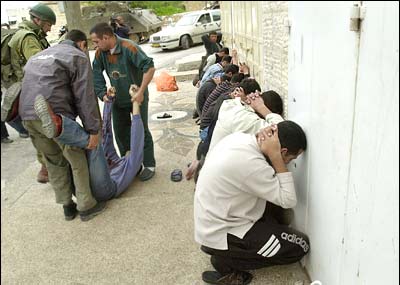
There was a curfew in Jenin, which wasn't lifted in the eight hours we were there, but we did meet a sea of men returning from an Israeli roll call of every man in the town over the age of 16. The town's mayor was among them, and was very angry and contemptuous of the UN and the international community. He said that there were 1,000 people injured or dead. He claimed it was a massacre which would go down in history like Sabra and Chatila in Lebanon, where up to 2,000 Palestinians were slaughtered and for which Ariel Sharon must hold a great deal of responsibility.
All the feeble calls of the international community have had no effect. The Israelis, as Sharon has made quite clear, will stop when they want to and not before. The fact that journalists get all the access they want to areas where the Israelis have suffered suicide bombings but are denied access to the occupied areas is deplorable. Independent monitors on the ground are essential.
No political or security objective can justify targeting and punishing civilians in this way.
It is not enough for the European countries to simply bleat in condemnation. They need to withdraw European ambassadors from Israel. They need to impose an immediate arms embargo, as Germany has done. They should consider what economic sanctions can be put in place. The EU could suspend its agreement giving Israel preferential trade terms, since the European public are certainly demanding a much tougher line. After all, British taxpayers' money already spent on infrastructure in the West Bank is being ground to dust by the Israeli army. This is the moment when the European Union should show its mettle and implement its own plan, regardless of the objections or intransigence of the United States.
Until Ariel Sharon is forced to permit a viable Palestinian state to come into existence, there cannot be an agreement on peace. Sooner or later, Israel will have to end its occupation and give land back to the Palestinians. At the moment, the Palestinian leadership is so beleaguered that they are not in a position to negotiate anything. The Israelis' present policy is not working, and the sooner they realise it the better.
The writer is the Labour MP for Cynon Valley, chairs the All-Party Parliamentary Group on Human Rights and is a member of the International Development Select Committee