
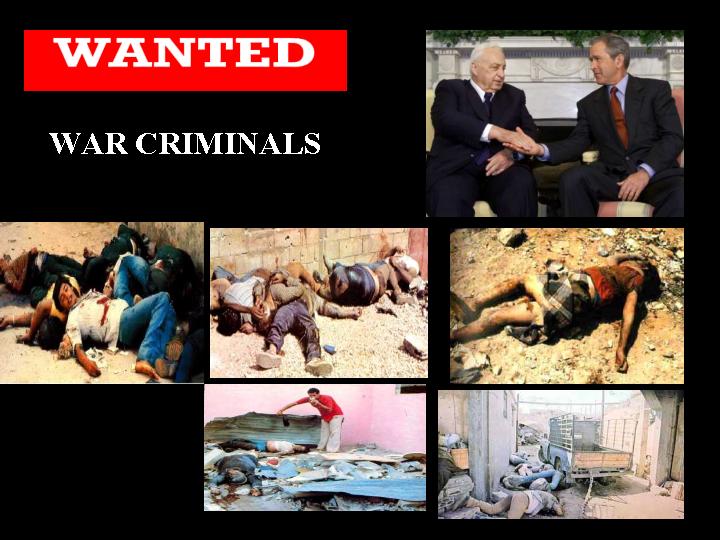
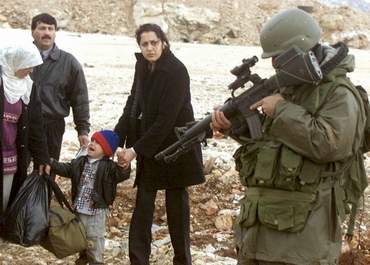
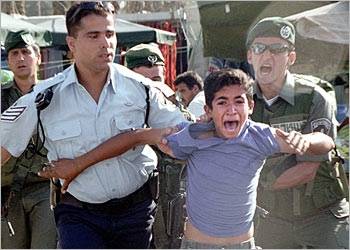
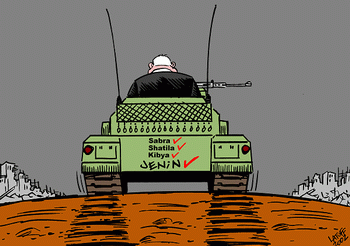
The master of offensive doctrine. Israel's most celebrated war criminal. Arik, who had proved himself to be the man who knows no mercy.
Gilad Atzmon
From its very early days, Zionist thought has been divided into two major schools. First, the heavy-handed school, which adopts military solutions to regional disagreements and conflicts. This school was initiated by the revisionist leader Ze'ev Jabotinsky. In 1923 Jabotinsky published two articles headed 'Iron Wall'. In the papers Jabotinsky argues that the Arabs would never accept the existence of a Jewish state, hence, the Jews must 'erect an iron wall of Jewish military force'. According to this philosophy, Zionism must enjoy an overwhelmingly superior power base to reduce any Arabic tendency to resist.
The other school is the school of reconciliation presented by moderate Zionists such as Moshe Sharet. This school tends to believe that all the regimes and political forces in the region are capable of accepting the existence of the Jewish state. Therefore, according to Sharet, all available diplomatic efforts should be made in order to achieve reconciliation with the Arab world.
Soon after the declaration of the state of Israel these two conflicting ideologies turned into a harsh political debate. In practice, Ben Gurion, the first Israeli PM, clearly adopted Jabotinsky's 'Iron Wall' philosophy. On the surface, this appears to have been a bizarre political move since Jabotinsky's philosophy was very much in contrast with the political thoughts of Ben Gurion's party. An analysis of the Israeli maneuvers and mode of operation in the 1948 war provide us with a clear picture of the Israeli endorsement of a military option alongside a denial of any diplomatic solution.
In order to implement the military option that derived from the 'Iron Wall' philosophy, Ben Gurion instructed the IDF to adopt an offensive military doctrine, a doctrine which would provide the region with a mighty display of Israel's overwhelming military superiority. The doctrine was based on two basic presuppositions:
1. Any confrontation between Arabs and Israelis had to take place over Arab land. In other words, the Israeli offensive had to take the battle to the Arab territories before the battle even started.
2. Because of Israel's relatively limited financial means, any confrontation had to bring victorious results in the shortest possible time. In other words, the Israeli army had to impose the most devastating damage on its Arab enemies.
The Israeli military and political leaders were soon to define a criterion which measured the success of the Israeli armed forces' implementation of the offensive doctrine. This criterion was defined as the IDF's 'force of deterrence'. It was a scale that determined the Arabs unwillingness to fight. The less the Arabs were encouraged to fight, the higher the score on the scale.
For Ben Gurion and his followers it was necessary to demonstrate to the Arab world a clear Israeli determination for a military solution. Any given battle had to end with a clear-cut Israeli victory. Moreover, the Arabs had to regard any confrontation as futile. The success of the Israeli offensive mode was dependent on the reduction of the Arabs' willingness to fight. This mode of Israeli military pattern was evident from the early stages of 1948 war, a war in which Israel subjected the Palestinian civilian population to a clear violation of any human code. The war ended with more than 700,000 Palestinian refugees and an armistice between Israel and its neighbors that was regarded by the Arabs as a clear military defeat.
Already in the early fifties Israel had managed to take the offensive doctrine one stage further. I am referring here to the retaliation mode that was characterized by a severe lack of proportion. According to Ben Gurion, any loss of Jewish life had to be paid for heavily. Arabs had to learn that the value of Jewish blood was far higher than that of their own. In order to achieve the best possible results, a young, assertive, aggressive and ambitious commander named Ariel Sharon was called for action. He was asked to form a small special commando unit that would present the Arab enemy (innocent civilians usually) with the full force of Israeli conviction and determination to win under any circumstances.
In 1953, following a murderous attack of a mother and her two children by Palestinian infiltrators who passed the Israeli border near to the Jordanian village of Quibya, Sharon and his commando unit, now named 'the 101', were called for action. Sharon was ordered to penetrate the village of Quibya, to blow up as many houses and to inflict as many casualties on its inhabitants as possible. Sharon was the right man for the job. The raid was a complete success. Quibya was reduced to pile of rubble. More than 50 houses were destroyed. Sixty-one civilians, most of them women and children, had been killed. A UN observer who visited the site came to a clear conclusion that the villagers had been forced to stay in their houses while they were blown up.
The Quibya massacre provoked international condemnation including an anti-Israeli resolution by the UN Security Council. In a debate within the Israeli government Moshe Sharet, the moderate foreign minister, called for the issue of an official statement expressing regret over the action. Ben Gurion, the PM, had a different idea.
In a radio broadcast the following day, he denied IDF involvement in the raid, he lied and blamed the action on Israeli villagers who retaliated beyond measure. As we know, Sharon's military career was not at all harmed, as a matter of fact, very much the opposite. Sharon and 'the 101' came to represent the new Hebraic military man: a murderous soldier who attacks beyond the enemy line, a soldier who goes far beyond orders even if it means divorcing himself from any familiar concept of mercy and humanity. Not only was Sharon's career not adversely affected, but he was now seen as the most promising young Israeli officer. In military terms he became a shining meteor, his promotion within the army ranks was the fastest possible.
It wouldn't be irrational to assume that this sort of swift promotion encouraged other young officers to follow the murderous example provided by Sharon and 'the 101'. The Quibya massacre was the first in a chain of retaliation raids conducted by the Israeli army. These raids shaped the Israeli offensive philosophy into a new form of murderous art: a pattern of thought that led to an endless confrontation with the Arab world but, furthermore, which contributed toward an ongoing transformation of the Israelis into an ignorant society, a society that is concerned solely with its own interest while denying that of others.
When we scrutinize Israeli political history, we can clearly see that from the perspective of Israel's internal politics, the offensive doctrine has two major advantages. First, it communicates with the Arabs in the only language the Arabs understand, i.e. violence. Second, it provokes strong condemnation from the international community, something that is translated within Israel into an immediate political gain.
With regard to the first of these advantages, incredibly the vast majority of Israeli people do believe that the Arabs understand violence only. Therefore, throughout the history of Israel there is little evidence of diplomatic efforts towards a peaceful solution for the Arab-Israeli conflict. Even the Oslo negotiation was taking place within very specific historical circumstances in which the PLO was in ruin politically and financially (following the support of Sadam Hussein in the Gulf War). If this was not enough, it was clear that from the very first stages of the Oslo implementations the Israelis used the military threat to exert pressure against the Palestinian authority and Palestinian people. When we examine the personal biographies of the Israeli cabinet members, both past and present, we discover that the vast majority of them are ex-military men. It is clear that only a state which decides to live by the sword and deeply believes in military solutions can put so many generals into ministerial and prime ministerial seats.
Consideration of the second advantage might be a bit embarrassing. Evidently, Israeli prime ministers love to be condemned by the international community. It is obvious that Israeli leaderships have learned how to transform foreign condemnation into clear political gain. Undoubtedly, in Israel, any foreign criticism of Israel is conditionally interpreted as 'gentile pathological anti-Semitic behavior'. Every leading Israeli politician learns how to use this tool during his first days in office. The main pattern was delivered by Ben Gurion:
'It doesn't't matter what the gentile says, what matters is what the Jews are doing.' With this ignorant statement the legendary Israeli PM managed to provide his voters with an instant reminder of the history of Jewish persecution, pushing the Jewish people deeper into their safe haven of complete segregation that leads toward the denial of the outer world. Moreover, since in Hebrew the word gentile (goy) is a devastating derogative, Ben Gurion's call to ignore the gentile clearly leads Israelis to celebrate their superiority over the rest of humankind. Ben Gurion's statement was a call for Israelis to unite behind their leadership and to reject any sort of foreign criticism. To conclude this point I would claim that in the case of Israel, the offensive doctrine leaves the international community completely helpless.
On the one hand, lack of criticism is taken by the Israeli public as an approval or a sign of weakness. On the other hand, any international condemnation leads eventually to a growth of public support toward the political leadership. This fact might explain the continuous shift to the right within Israeli politics. Further, it explains the international community's impotence against Israeli oppression and atrocities.
If we review Sharon's military and political career we discover that he has followed his mentor, Ben Gurion, religiously. Clearly, Sharon single-mindedly adopted the offensive doctrine in both his political and military life. As mentioned before, Sharon was the leading figure in forming and shaping the Israeli retaliation raids and commando form of attack. This strategy led to Israel's deep commando penetration into the Sinai desert in the 'Suez Operation' (1956).
Following Colonel Sharon's plans, Israeli paratroopers landed in the 'Mitle Pass' at the heart of the Sinai desert aiming to cause heavy losses to the Egyptian army. In practice, the battle cost too many Israeli lives. Thanks to some severe international pressure Israel had to pull back its forces. In military terms, the operation was regarded as a waste of human life. In the 1973 war, General Sharon led his brigade across the Suez Canal.
Again, the battle cost too many Israeli lives. During the battle Sharon refused to allow his higher command to show restraint. Sharon believed that Israeli soldiers on the western bank of the Suez would bring the Egyptians to their knees. In practice it prompted heavy international pressure. Soon Israel had to withdraw its forces. Furthermore, the ceasefire talks led to peace talks (1977) which resulted in Israel 'losing' Sinai forever.
Before the Lebanese war (1982), Sharon, then minister of defense, led the cabinet to believe that the Palestinian issue could be grounded forever by a military assault against the PLO in Lebanon. Clearly, he was determined to generate a light conflict, a mini war, with the Syrians in order to remove their forces from southern Lebanon. As we already know, the Israeli offensive doctrine does not differentiate between Arabs.
According to the 'Iron Wall' philosophy, Arabs are all the same, you kill as many as you can.
From very early on in the Lebanese campaign it was evident that Israel had been drawn into a vicious civil war between the different Lebanese ethnic and religious groups. As predicted by some Israeli intelligence experts, within a short time of the invasion of Lebanon the most terrible massacre of Palestinian refugees in Sabra and Shatila took place. The devastating massacre was carried out by Christian militias who got the approval to enter the refugee camps from the Israeli high command. While Israeli forces were not involved directly in the massacre itself, Israel was clearly considered responsible for the atrocities taking place within the invaded territory.
As expected, the massacre was strongly condemned by the international community. In Israel, the left-wing movement 'Peace Now' managed to bring thousands of people to the street to demonstrate against the government. In a speech to the Israeli parliament, reflecting upon the left's opposition to the Lebanese campaign, Menachem Begin, the PM at the time, complained that 'gentiles kill gentiles and the Jews are blaming each other'.
Again we confront the same Israeli right-wing pattern: a clear abuse of the outraged international reaction in order to delegitimate the Israeli left. In other words, Menachem Begin blamed the Israeli left for collaboration with the anti-Semitic 'gentiles' against the 'Jewish' Sharon. Again we can see an Israeli offense that generated outrage in the international community being turned within Israel into a political weapon against any opposition from the left or humanitarian voices.
It is important to mention that following the international condemnation as well as the left's campaign, Menachem Begin eventually agreed to appoint a commission for inquiries under the supreme court justice, Yitzchak Kahan. The commission found Sharon indirectly responsible for the massacre and recommended his removal from the ministry of defense. While in the short term this was regarded as a victory for the moderate school of thought, in the long term, in the eyes of the right wing, it proved Sharon's devotion to the 'Iron Wall' philosophy. In other words, it prepared him for his later role as Israeli prime minister.
The results of the Lebanese war are not yet clear since the war is not completely over. What we can say for sure is that it took the Israeli forces almost 20 years to get out of Lebanon. Undoubtedly, while in Lebanon, the Israeli army has managed to lose its 'power of deterrence'.
The Israeli army, the most equipped army in the Middle East, found itself completely defeated by the Hizbulah, a small devoted group of guerrilla fighters.
In the shades of the growing Israeli defeat in Lebanon, the Palestinian people within the occupied territories started to redevelop their nationalistic aspirations. Eventually in 1987 these aspirations had matured into a Palestinian uprising, the first Intifada.
Since the second week of the Lebanese war the Israeli 'power of deterrence' has deteriorated continuously. Clearly, the IDF never managed to establish successful fighting skills with which to confront the Lebanese civil resistance. Furthermore, following the Oslo accord Israeli civilians faced a growing threat of terror within Israel.
For the first time in Israel's history, the Israeli civilian population found itself within a war zone. This fact is of crucial importance. According to Israel's self-image, it is the Arab civilians who are supposed to die, definitely not the Israeli ones. In Israeli eyes, Jewish civilians are not supposed to die in any conflict for two main reasons:
1. It reminds them of the holocaust in which Jews were dying simply because they were Jews.
2. It is very much against the idea of an 'offensive doctrine'. Israel had got used to the fact that any confrontation with the Arab world was to take place over Arab land.
Suddenly, the confrontations had started to take place in the center of Israeli cities. This fact was regarded by most Israelis as a catastrophe and completely unacceptable.
In the light of the Palestinian terror, a very strong right-wing slogan was introduced - 'Let the IDF win' - which meant - let us raise the 'power of deterrence' - let us get back into our offensive doctrine - let us move the war from our city centers into Palestinian towns - let us make sure that we destroy the Palestinian will to fight - let us get out of control, let us get mad - let us re-erect the 'Iron Wall'. Who was the right man for the job? No doubt, Mr Ariel Sharon.
The master of offensive doctrine. Israel's most celebrated war criminal. Arik, who had proved himself to be the man who knows no mercy. We have to admit the Israelis were right: it took Sharon, as prime minister, just about a year in office to commit the great massacre in Jenin.
It is necessary to scrutinize the events in Jenin from the perspective of the offensive doctrine. The operation in the refugee camp was, 'more or less', the embodiment of what offensive doctrine is all about. It took place on, more or less, enemy land.
It was, more or less, very fast and it was, more or less, a 'clear-cut' victory. Apparently, the 'more or less' is crucial. Jenin is not really an enemy land. It is an Israeli invaded territory. Strangely enough, it appears as if the Israeli colonial forces are the first colonialists to have demolished their own colonies.
Clearly, it took the Israelis a bit too long to confess that the battle in Jenin was over. Evidently, the might of the Israeli armed forces was not enough to break the spirit of the very few determined Palestinian freedom fighters. Last but not least, if it was a clear victory, it is very unclear who the winner was.
Was it the Israelis? I would doubt it very much. As T. Larsen, the UN envoy to the Middle East, put it: 'in Jenin Israel has lost its moral ground'. As a result of this statement, Mr Larsen became a persona non grata in the Jewish state.
As a result of this statement, Israel demanded that Mr Larsen not participate in the UN inquiry into the events in Jenin. As a result of this statement the UN Secretary General, Kofi Annan, has become an anti-Semite in Israeli eyes and the entire investigation has been jeopardized by Israel.
If anything, it is clear that after Jenin, after presenting the Israelis with real fierce fighting, the Palestinians are determined to fight beyond what it would take to achieve their liberation.
I will try to describe the Jenin battle and to analyze the Israeli decision-making process in the light of the offensive paradigm. On the morning of April 3rd Israeli ground forces entered into the Jenin refugee camp. From very early on it was clear that this time they would encounter some fierce Palestinian fighting. The Israeli high command naturally provided extra support. More tanks and helicopter gunships were sent to support the battling ground forces.
At this point it is important to mention that it is very unusual to use tanks and helicopter gunships in highly populated areas, however, within the IDF offensive doctrine, the end (victory) is far more important than the means (war crimes).
In the meantime, Israeli commanders on the ground were under severe pressure to complete their mission. They began to use far heavier weaponry (air-to-ground missiles as well as tank shells), they cared less and less about who was getting killed as long as they were Arabs. Clearly, as a result, more civilians were hit. The scene on the ground started to look a bit unaesthetic.
The Israeli high command decided to seal the area. Press and rescue forces were not allowed in. Now the forces on the ground were working against time.
They had to provide a clear-cut conclusion. Naturally, they decided to wipe out the entire center of the camp that was suspected of being a 'pocket of resistance'.
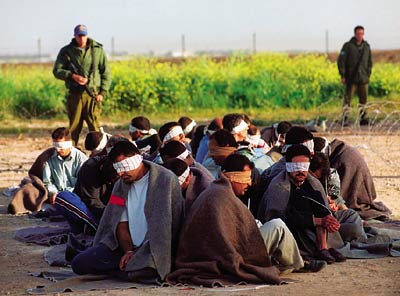
In doing so they killed many civilians, mainly old and disabled people who could not run away. When the battle was over Jenin had become a slaughter house, the streets were the most horrifying sight imaginable.
Civilian bodies were all over the place, many Palestinians were wounded, bleeding to death. Still, the Israelis showed no mercy, the Red Cross and other rescue forces were not allowed in. The Israelis had to decide whether to show some mercy, to be human and to save those who could be saved or whether to try to conceal the evidence of an unacceptable, shocking and inhuman crime. Naturally, following Sharon's overwhelming history of crimes against humanity, the decision was fairly simple.
The Israelis decided to bulldoze the center of the Jenin refugee camp. They turned the Jenin camp into a 'Palestinian Ground Zero'. Occupied houses were destroyed over their habitants. Sharon had committed a crime comparable to the Quibya massacre of 50 years earlier.
Although the similarities are very obvious, there are slight differences that should be identified. In Quibya Sharon was a platoon commander, in Jenin he had become an elected prime minister and had committed his crime in the name of all Israeli people.
As expected, as soon as international criticism was heard, Sharon defined the current battle as the 'existential war of the all Jewish nation'. According to Sharon, then, the massacre in Jenin was done not only in the name of the Israelis but in the name of all Jewish people.
If this was not enough, Sharon declared that very much like G. Bush he was conducting a holy war against terror. We must remember that this kind of approach is aimed at the American population, Sharon becomes American messenger or at least American platoon commander.
As we can see, both world Jewry and the American administration have avoided public criticism of Sharon, hence, we can conclude that Sharon has committed his war crimes in the name of the Jewish people and the American nation. Unless major Rabbis stand up and firmly denounce Sharon's atrocities, unless the American administration decides to stop supporting the Jewish state, we will be able to force that Sharon has indeed been acting in the name of the Jews and the American nation.
-- Gilad Atzmon
http://www.gilad.co.uk
The solution is the problem:
The US presents itself as the peace-broker in the Middle East.
The reality is different
Noam Chomsky
The Guardian
A year ago, the Hebrew University sociologist Baruch Kimmerling observed that "what we feared has come true - War appears an unavoidable fate", an "evil colonial" war.
His colleague Ze'ev Sternhell noted that the Israeli leadership was now engaged in "colonial policing, which recalls the takeover by the white police of the poor neighbourhoods of the blacks in South Africa during the apartheid era".
Both stress the obvious: there is no symmetry between the "ethno-national groups" in this conflict, which is centred in territories that have been under harsh military occupation for 35 years. The Oslo "peace process", begun in 1993, changed the modalities of the occupation, but not the basic concept.
Shortly before joining the Ehud Barak government, historian Shlomo Ben-Ami wrote that "the Oslo agreements were founded on a neo-colonialist basis, on a life of dependence of one on the other forever".
He soon became an architect of the US-Israel proposals at Camp David in 2000, which kept to this condition. At the time, West Bank Palestinians were confined to 200 scattered areas.
Bill Clinton and Israeli prime minister Barak did propose an improvement: consolidation to three cantons, under Israeli control, virtually separated from one another and from the fourth enclave, a small area of East Jerusalem,
the centre of Palestinian communi-cations. The fifth canton was Gaza. It is understandable that maps are not to be found in the US mainstream.
Nor is their prototype, the Bantustan "homelands" of apartheid South Africa, ever mentioned.
No one can seriously doubt that the US role will continue to be decisive.
It is crucial to understand what that role has been, and how it is internally perceived.
The version of the doves is presented by the editors of the New York Times, praising President Bush's "path-breaking speech" and the "emerging vision" he articulated.
Its first element is "ending Palestinian terrorism" immediately.
Some time later comes "freezing, then rolling back, Jewish settlements and negotiating new borders" to allow the establishment of a Palestinian state.
If Palestinian terror ends, Israelis will be encouraged to "take the Arab League's historic offer of full peace and recognition in exchange for an Israeli withdrawal more seriously".
But first Palestinian leaders must demonstrate that they are "legitimate diplomatic partners".
The real world has little resemblance to this self-serving portrayal - virtually copied from the 1980s, when the US and Israel were desperately seeking to evade PLO offers of negotiation and political settlement.
In the real world, the primary barrier to the "emerging vision" has been, and remains, unilateral US rejectionism. There is little new in the current "Arab League's historic offer".
It repeats the basic terms of a security council resolution of January 1976 which called for a political settlement on the internationally recognised borders "with appropriate arrangements ... to guarantee ... the sovereignty, territorial integrity, and political independence of all states in the area".
This was backed by virtually the entire world, including the Arab states and the PLO but opposed by Israel and vetoed by the US, thereby vetoing it from history.
Similar initiatives have since been blocked by the US and mostly suppressed in public commentary.
Not surprisingly, the guiding principle of the occupation has been incessant humiliation.
Israeli plans for Palestinians have followed the guidelines formulated by Moshe Dayan, one of the Labour leaders more sympathetic to the Palestinian plight.
Thirty years ago Dayan advised the cabinet that Israel should make it clear to refugees that "we have no solution, you shall continue to live like dogs, and whoever wishes may leave".
When challenged, he responded by citing Ben-Gurion, who said that "whoever approaches the Zionist problem from a moral aspect is not a Zionist". He could have also cited Chaim Weizmann, first president of Israel, who held that the fate of the "several hundred thousand negroes" in the Jewish homeland "is a matter of no consequence".
The Palestinians have long suffered torture, terror, destruction of property, displacement and settlement, and takeover of basic resources, crucially water. These policies have relied on decisive US support and European acquiescence. "The Barak government is leaving Sharon's government a surprising legacy," the Israeli press reported as the transition took place: "the highest number of housing starts in the territories since Ariel Sharon was minister of construction and settlement in 1992 before the Oslo agreements" - funding provided by the American taxpayer. It is regularly claimed that all peace proposals have been undermined by Arab refusal to accept the existence of Israel (the facts are quite different), and by terrorists like Arafat who have forfeited "our trust". How that trust may be regained is explained by Edward Walker, a Clinton Middle East adviser:
Arafat must announce that "we put our future and fate in the hands of the US" - which has led the campaign to undermine Palestinian rights for 30 years.
The basic problem then, as now, traces back to Washington, which has persistently backed Israel's rejection of a political settlement in terms of the broad international consensus. Current modifications of US rejectionism are tactical.
With plans for an attack on Iraq endangered, the US permitted a UN resolution calling for Israeli withdrawal from the newly-invaded territories "without delay" - meaning "as soon as possible", secretary of state Colin Powell explained at once.
Powell's arrival in Israel was delayed to allow the Israeli Defence Force to continue its destructive operations, facts hard to miss and confirmed by US officials.
When the current intifada broke out, Israel used US helicopters to attack civilian targets, killing and wounding dozens of Palestinians, hardly in self-defence.
Clinton responded by arranging what the Israeli newspaper Ha'aretz called "the largest purchase of military helicopters by the Israeli Air Force in a decade", along with spare parts for Apache attack helicopters.
A few weeks later, Israel began to use US helicopters for assassinations.
These extended last August to the first assassination of a political leader: Abu Ali Mustafa.
That passed in silence, but the reaction was quite different when Israeli cabinet minister Rehavam Ze'evi was killed in retaliation.
Bush is now praised for arranging the release of Arafat from his dungeon in return for US-UK supervision of the accused assassins of Ze'evi.
It is inconceivable that there should be any effort to punish those responsible for the Mustafa assassination.
Further contributions to enhancing terror took place last December, when Washington again vetoed a security council resolution calling for dispatch of international monitors.
Ten days earlier, the US boycotted an international conference in Geneva that once again concluded that the fourth Geneva convention applies to the occupied territories, so that many US-Israeli actions there are "grave breaches", hence serious war crimes.
As a "high contracting party", the US is obligated by solemn treaty to prosecute those responsible for such crimes, including its own leadership. Accordingly, all of this passes in silence.
But the US has not officially withdrawn its recognition that the conventions apply to the occupied territories, or its censure of Israeli violations as the "occupying power".
In October 2000 the security council reaffirmed the consensus, "call[ing] on Israel,
the occupying power, to abide scrupulously by its legal obligations..." The vote was 14-0. Clinton abstained.
Until such matters are permitted to enter mainstream discussion in the US, and their implications understood, it is meaningless to call for "US engagement in the peace process", and prospects for constructive action will remain grim.
A longer version of this article appears in Red Pepper.
Noam Chomsky
Copyright Guardian Newspapers Limited
After Jenin
Yitzhak Laor
What has the war between us and the Palestinians been about?
About the Israeli attempt to slice what's left of Palestine into four cantons, by building 'separation roads', new settlements and checkpoints. The rest is killing, terror, curfew, house demolitions and propaganda. Palestinian children live in fear and despair, their parents humiliated in front of them.
Palestinian society is being dismantled, and public opinion in the West blames it on the victims - always the easiest way to face the horror.
I know: my father was a German Jew.
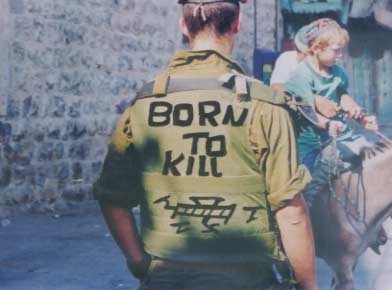
Disastrously, the Israel Defence Force is the country's imago. In the eyes of most Israelis, it is pure, stainless; worse, it is seen as being above any political interest.
Yet, like every army, it wants war, at least every once in a while. But whereas in other countries military power is balanced by civil society's institutions or by parts of the state itself (industry, banks, political parties etc), we in Israel have no such balance.
The IDF has no real rival within the state, not even when the Army's policy costs us our own lives (the lives of Palestinians, not to mention their welfare or dignity, are excluded from political discourse).
There's no doubt that Israel's 'assassination policy' - its killing of senior politicians
(Dr Thabet Thabet from Tulkarem, Abu Ali Mustafa from Ramallah) or of 'terrorists' (sometimes labelled as such only after being eliminated) - has poured petrol on the fire. People talk about it, yet no politician from the Right, the Centre, or even from the declining Zionist Left has dared speak out against it.
And despite critical articles in the press, the Army has kept on doing what it wanted to do. Now they have had what they were really aiming for: an all-out attack on the West Bank. Since 11 September the words 'war against terror' have been popular, which is why everything Israel does is a war against terror, including the looting of the Khalil Sakakini Cultural Centre in Ramallah.
I'm against terror, too. I don't want to die walking my son to the mall.
In fact I don't take him there anymore. I don't ride buses, and I'm scared that my family's turn will come, but I know that they - that is, our generals -
accept terrorist attacks as a 'reasonable price to pay' to reach a solution. What is their solution?
Peace - what else? Peace between the victorious Israelis and the defeated Palestinians.
The IDF's ruthlessness should be read against the background of its defeat in Lebanon, when it was driven out after long years of waging a dirty war.
Southern Lebanon was burned and destroyed by artillery and an Air Force that no terrorist organisation could fight against.
Yet 300 partisans - should I call them 'terrorists'? - drove us (that is, our Army) out twice. First in 1985, back into what our Army and press used to call our 'Security Zone' (the foreign media called it 'Israel's self-proclaimed security zone');
and then, two years ago, out of that same Security Zone. The generals who were beaten then are running the current war. They have lived that defeat every day. And now they can teach them - that is, the Arabs - their lesson.
Our heroes, armed with planes, helicopters and tanks, can arrest hundreds of people, concentrate them in camps behind barbed wire, without blankets or shelter, exploit the confusion to demolish more houses, fell more trees, take away more livelihoods.
The bulldozer, once a symbol of the building of a new country, has become a monster following the tanks, so that everybody can watch as another family's home, another future disappears.
Israelis look to punish anyone who undermines our image of ourselves as victims.
Nobody is allowed to take this image from us, especially not in the context of the war with the Palestinians, who are waging a war on 'our home' - that is, their 'non-home'.
When a Cabinet minister from a former socialist republic compared Yasir Arafat to Hitler, he was applauded. Why? Because this is the way the world should see us, rising from the ashes.
This is why we love Claude Lanzmann's Shoah (and even more his disgusting film about the IDF) and Schindler's List.
Tell us more about ourselves as victims, and how we must be forgiven for every atrocity we commit. As my friend Tanya Reinhart has written, 'it seems that what we have internalised' of the memory of the Holocaust 'is that any evil whose extent is smaller is acceptable'.
But this 'evil of the past' has a peculiar way of entering our present life.
On 25 January, three months before the IDF got its licence to invade the West Bank, Amir Oren, a senior military commentator for Ha'aretz, quoted a senior officer:
In order to prepare properly for the next campaign, one of the Israeli officers in the territories said not long ago that it is justified and in fact essential to learn from every possible source.
If the mission is to seize a densely populated refugee camp, or take over the kasbah in Nablus, and if the commander's obligation is to try to execute the mission without casualties on either side, then he must first analyse and internalise the lessons of earlier battles - even, however shocking it may sound, even how the German Army fought in the Warsaw Ghetto.
The officer indeed succeeded in shocking others, not least because he is not alone in taking this approach. Many of his comrades agree that in order to save Israelis now, it is right to make use of knowledge that originated in that terrible war, whose victims were their kin.
Israel may not have a colonial past but we do have our memory of evil.
Does this explain why Israeli soldiers stamped ID numbers on Palestinian arms? Or why the most recent Holocaust Day drew a ridiculous comparison between those of us in the besieged Warsaw Ghetto and those of us surrounding the besieged Jenin refugee camp?
The satisfaction over the 'victory' in Jenin was part of this constant lie.
Some twenty Israeli soldiers (most of them reservists) died in what was supposed to be a zero-casualty campaign, but the defenders of the camp were equipped only with rifles and explosives.
On the Israeli side, as usual, there were special units, moving from one alleyway to another, assisted by a drone which supplied sophisticated information to the commanders at the rear. When that didn't work, there was the shelling of the camp, then the deployment of US-supplied Apaches to destroy houses along with dozens (or hundreds) of inhabitants.
Was it a massacre? Like everything else in our corrupted life, it comes down to the number of dead: ten dead Israelis are a massacre; 50 Palestinians not enough to count.
The destruction of the camp, whether spontaneous or premeditated by Sharon & Co, reflects the determination of senior officers to finish their military service with a real achievement: the elimination of the Palestinian national movement, under the guise of the war against terror. But terror won't be beaten that way; on the contrary. Enslaving a nation, bringing it to its knees, simply doesn't work.
It never did. The long siege of the Church of the Nativity in Bethlehem is proof that the words 'Israeli generals' no longer refer to men capable of strategic thought, or anything like it.
Israeli generals may have fought some complicated battles in 1967, 1973 or even 1982, but in Bethlehem they have surrounded 200 young Palestinians for more than three weeks and let the whole world see their stubbornness and senseless cruelty.
How, you may ask, can a disobedient nation like Israel follow so foolish a high command?
Here's the beginning of an answer.
As the corpses lay rotting in Jenin, and small children were running around looking for food or their missing parents, and the wounded were still bleeding to death, with the IDF preventing any relief or UN officials from entering the camp (what did they have to hide?), the Ministry of Education issued an instruction to all schools that children should bring in parcels for the soldiers.
'The most important thing,' the teacher of my seven-year-old son said, 'is a letter for the soldiers.' Hundreds of thousands of children wrote such letters when the war against a civilian population was at its most extreme, under the critical observation of the world media. Imagine the ideological commitment of those children in the future.
This is just one aspect of our oppositionless society.
The Israeli imaginaire is constituted, before anything else, of the belief in Israeli supremacy.
When there is a cruel suicide bombing in a hotel in Netanya, we will respond on a greater scale, with a terrorist attack on them, no matter if it inflicts death or hunger on two million people who have no connection with that act, no matter if it will create a thousand more martyrs who will blow themselves up along with their victims.
The military logic behind this behaviour says: 'We have the power and we have to exercise it, otherwise our existence is in danger.' But the only danger is the danger facing the Palestinians.
Gas chambers are not the only way to destroy a nation. It is enough to destroy its social tissue, to starve dozens of villages, to develop high rates of infant mortality.
The West Bank is going through a Gaza-isation. Please don't shrug your shoulders. The one thing that might help to destroy the consensus in Israel is pressure from Western Europe, on which the Israeli elite is dependent in so many ways.
Yitzhak Laor is a poet who writes essays for the Jerusalem daily Ha'aretz.
A Meeting with Arafat
by: Uri Avnery
?They want us to enact a constitution? No problem! I shall ask Israel to send me a copy of theirs and copy it word for word!?
Arafat sent me an amused look. Israel, of course, has no constitution.
That was on Wednesday evening, after five Gush Shalom activists - Haim Hanegbi, Adam Keller, Oren Medicks, Rachel Avnery and I - had succeeded in reaching Ramallah (forbidden to Israelis) and entering the bombed, fortified compound of the Palestinian leader. There was a danger that Ariel Sharon, who was returning at the same time from Washington, would exploit the murderous suicide bombing in Rishon-Letzion the evening before in order to achieve his old aim: killing Yasser Arafat. That would have been a disaster for Israel and prevented peace for generations. We thought that the presence of Israelis in the compound might help to avert such an attack.
Immediately after Arafat had finished his meeting with the European emissary, Moratinos, during which they concluded the final agreement ending the siege of the Church of Nativity in Bethlehem, he received us for a long meeting. ?I shall give scholarships to the 13 who are to go abroad,? he remarked, as if continuing the previous conversation, and read us the document he had just signed.
Since meeting him in 1982 in besieged Beirut, in rather similar circumstances, I have met him many times. I found him relaxed, smiling, self-confident, a little tired.
He laughed when I described the ?reforms? that George W. Bush demands to be carried out in the Palestinian Authority: Palestine should become democratic like Saudi Arabia, there should be a separation of power like in Syria, it should be headed by a powerless president like Jordan, there must be a unified security service like in Egypt and an independent court like in Iraq.
The new Bush-Sharon idea of ?reforming? the structure of the Authority (meaning: the appointment of American agents), as a pre-condition for peace, does not seem to have made a deep impression on him. Actually, it is hard to decide whether this is a cynical pretext for postponing a solution or just a demonstration of monumental stupidity. ?There will be no Palestinian Hamid Karzai,? he said, alluding to the puppet-president the Americans have brought to Afghanistan from outside.
Never before has Arafat been so deeply entrenched in the innermost heart of the Palestinian people as now. His prestige has risen sky-high all over the Arab world, where the masses compare their own kings and presidents to the man who has endured six weeks of siege, some of them almost without food, without water and electricity, at a distance of two meters from the Israeli soldiers (we measured the distance ourselves), without flinching. The idea that somebody from the outside could turn him into a figurehead is ludicrous.
?The PLO stands above the Palestinian Authority, and I am the head of the PLO,? he reminded us. The PLO represents all the parts of the Palestinian people, while the PA was elected only by the inhabitants of the West Bank (including East Jerusalem) and the Gaza Strip.
During the meeting, senior officers entered several times and reported on Israeli troop concentrations around the Gaza Strip and Ramallah. It seemed as if Sharon?s attack could start at any moment. He paid attention and issued short orders. Yasser Abed Rabbo was present throughout the meeting, and other senior personalities entered from time to time and listened.
We asked about his reaction to the Rishon-Letzion suicide bombing that had happened 24 hours earlier. ?I have published a strongly-worded condemnation (Arafat used, for the first time, the Arab word ?irhab?, terrorism) and ordered the arrest of Hamas activists.? He replied. ?They have timed the attack exactly during the meeting in which Sharon asked Bush for permission to carry out his plans against the Palestinian Authority and myself. The Hamas leaders knew that they are helping Sharon. They want to destroy the Authority and don?t mind using Sharon for this purpose.?
?Think for yourselves,? he continued, ?Do I look such an imbecile as to put bombs under my own seat??
It was almost midnight when the meeting broke up. The soldiers invited us to a dinner of pitta, sardines, cheese and humus. During the long night in their company, we became an attraction in the compound, which houses more than a hundred armed soldiers of Force 17, who continued throughout the night to fortify the place with sandbags. Many of them crowded around us, showering us with questions that showed that they were immensely curious about the situation in Israel, as much as we were curious about the situation on their side.
We were sitting in a great circle in a hall, where all the furniture had been moved to the walls, talking and smoking. Haim became friendly with a youngster of 17, who had not seen his family in Jenin for four months, because of the blockade, and was very worried about their fate. Another has not seen his family in Gaza for two years. All his possessions have been burned in the fires that had broken out in the adjacent buildings, leaving him only the clothes on his back. Adam had a debate with a 25-year old who spoke good Hebrew and remembered nostalgically the Iraqi Jew who had employed him in the Beer-Sheva market. There was a man of 37 who had been arrested at 15 for throwing stones and spent 15 years in prison, and who is now serving as an officer.
Only one soldier did not join in, his face stiff. He listened, saying only that he does not believe that peace would ever come. And Rachel took pictures.
All of them wanted to know what the Israelis think, and first of all why Israel does not want peace. These terrible ?armed men? (as they are called in Israeli press-releases), with their various Kalashnikovs, some of them in civilian clothes (?all our uniforms were burned by your missiles?) spoke longingly about peace. After some hours of conversation Oren summed up: ?We could sign a peace treaty within five minutes.?
There was something surrealistic about the situation: all of them spoke about the Ra?is with unbounded admiration. Like us, they expected to be attacked any moment by the Israeli tanks, but they had a friendly conversation with the Israelis who had come their way.
When we lay down, at long last, on our mattresses, side by side with some ?internationals? from several countries who had also come to serve as ?human shields?, I was called to give a live interview by phone to al-Jazeera television, which brought the news of our being there into millions of homes all over the Arab world. Another little bridge for peace.
In the morning, after a quick wash (there was a long line for the bathroom) we strolled around the compound, guided by the courageous Netta Golan, who had been there throughout the long siege. A smell of urine and excrements filled all the rooms that had been occupied by our army. Somebody had painted Mezuzot on all the doorways. In one room there was a high pile of destroyed computers; everywhere the furniture was destroyed. On all the walls graffiti: the Israeli national anthem (with crude mistakes), the name of Israel in Arabic (wrong spelling), a slogan in English: ?Isreal (sic) rules?. In the walls, the gaping holes that have become a trade mark of the IDF, in spite of the fact that all doors had been open. Outside, heaps of crushed cars. On the side, the black, armored Chevrolet that President Clinton had given Arafat as a gift, squashed, with tank marks clearly visible on the roof. Everywhere the dirt, destruction and mindless vandalism of the ?most humane army in the world?.
It did not make us feel very proud.
APARTHEID
Israel is now the only state in the world in which the governing party officially advocates apartheid.
The Central Committee of the Likud party has officially adopted a resolution declaring that there will be no Palestinian State west of the Jordan river. This means that the 2.5 million inhabitants of the West Bank and the Gaza Strip will remain under direct or indirect occupation, without national rights. At the utmost, they will be given -- self government? in several isolated enclaves -- much like the blacks in the former South Africa, who were imprisoned in enclaves called "Bantustans".
In this respect, there is no difference at all between Binjamin Netanyahu and Ariel Sharon. Both have exactly the same aim. Everything else is nothing but a personal power struggle and tricks to deceive the world.
(Gush Shalom)