What Is Cub Scouting?
In 1930 the Boy Scouts of America launched a program for boys 9 to 11 years
of age. A key element of the program is an emphasis on caring, nurturing
relationships between boys and their parents, adult leaders, and friends.
Cub Scouting has nine purposes:
- Positive influence of character development and encourage spiritual growth
- Help boys develop habits and attitudes of good citizenship
- Encourage good sportsmanship and pride in growing strong in mind and body
- Improve understanding within the family
- Strengthen a boys ability to get along with other boys and respect other
people
- Foster a sense of personal achievement by helping boys develop new
interests and skills
- Show how to be helpful and to do one's best
- Provide fun and exciting new opportunities for boys to do
- Prepare boys to become Boy Scouts
Membership
Cub Scouting has program's for boys in the first through fifth grades (or
ages 7, 8, 9, or 10). Members join a Cub Scout pack and are assigned to a Den.
First-grade boys (Tiger Cubs) meet twice a month, while Wolf Cub Scouts (second
graders), Bear Cub Scouts (third graders), and Webelos Scouts (fourth and fifth
graders) meet weekly.
Once a month, all of the dens and family members gather for a pack meeting
under the direction of a Cubmaster and pack committee. The committee includes
parents of boys in the pack and den leaders.
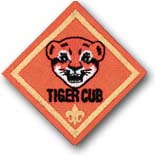 Tiger Cubs BSA
Tiger Cubs is a simple and fun program for first-grade boys and their
families. The Tiger Cub program introduces boys and their adult partners to the
excitement of Cub Scouting as they "Search, Discover, and Share" together.
The Tiger Cub and his adult partner meet twice a month with other Tiger Cubs
and adult partners in the den, using the planned "big idea" (or theme) for their
activity during one of the meetings. Each den meeting is hosted by a Tiger
Cub-adult partner team.
Recognition is Tiger Cubs is simple. For each big idea completed by the den,
an iron-on Tiger Track may be added to the front of the Tiger Cub T-shirt. Tiger
Cubs will also receive activity beads - one orange for each den activity
completed and one white bead for each five family activities completed.
Advancement Plan
Recognition is important to young boys. The Cub Scout advancement plan
provides fun for the boys, gives them a sense of personal achievement as they
earn badges, and strengthens family understanding as adult family members work
with boys on advancement projects.
-
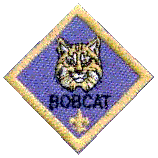 Bobcat
- The first rank, Bobcat rank is for all boys who join Cub Scouting. Along
the Bobcat Trail are the Cub Scout Promise, the Law of the Pack and the Cub
Scout motto. When your boy has followed the eight tracks of the Bobcat, he may
wear the Bobcat badge. It will be presented at a pack meeting.
-
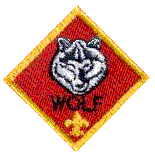 Wolf
Wolf
- The Wolf program is for boys who have completed first grade (or are age
8). After your Cub Scout has earned his Bobcat badge, he can start along the
Wolf Trail to earn the Wolf badge. Wolf rank is earned by completing 12
achievements from the Wolf Cub Scout Book.
Your Cub Scout can also search the Arrow Point Trail. Your boy can decide what
electives to work on and earn Arrow Points to wear beneath his Wolf badge. He
may earn as many Arrow Points as he wants until he completes the second grade.
-
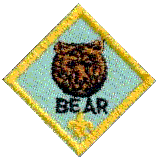 Bear
Bear
- The Bear rank is for boys who have completed second grade (or are age 9).
As the boys venture down the Bear Trail there are twenty-four Bear
achievements in four different categories. The Cub Scout must complete twelve
of these to earn the Bear badge. These requirements are somewhat more
difficult and challenging than those for Wolf rank.
The Cub Scout will also have twenty-four new Arrow Points to work on and to
wear beneath his Bear badge. He may earn as many Arrow Points as he wants
until he completes the third grade.
-
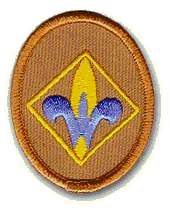 Webelos
- This program is for boys who have completed third grade (or are age 10). A
boy may begin working on the Webelos badge as soon as he joins a Webelos den.
This is the first step in his transition from the Webelos den to the Boy Scout
troop. As he completes the requirements found in the Webelos Scout Book, he
will work on activity badges, attend meetings led by adults, and become
familiar with the Boy Scout requirements - all leading to the Arrow of Light
Award.
 A Webelos Scout is required to earn 8 of the 20 activity badges. Certain
activity badges are required for earning the Webelos badge and Arrow of Light
Award. After completing the Webelos badge, the Scout may receive compass
points for earning additional activity badges.
A Webelos Scout is required to earn 8 of the 20 activity badges. Certain
activity badges are required for earning the Webelos badge and Arrow of Light
Award. After completing the Webelos badge, the Scout may receive compass
points for earning additional activity badges.