GHR's online KCard repository
KCard : Cognitive
Model
|
The NLP cognitive model
We think
the cognitive model is one of the most important concepts of NLP, as itself
it illustrates many of the presuppositions and techniques of NLP. The NLP
cognitive model is largely inspired by transformational grammar and relates
the persons "reference structure" to his "experiences"
(perception) and "surface structures" (expression). Generally,
the NLP cognitive model is considered "over simplified" by
neuroscience/psychology/etc. We think that just like the NLP presuppositions, the exactitude/correctness isn't really
the important point. The important point is that it gives a very useful
vision of people's cognitive functioning (even if the underlying details are
missing or simplified). Unfortunately,
it is very difficult to find a satisfactory full description of this model,
as it is generally quickly overviewed in most literature (and it is often mixed/confused with the Meta-Model, which is mostly a tool
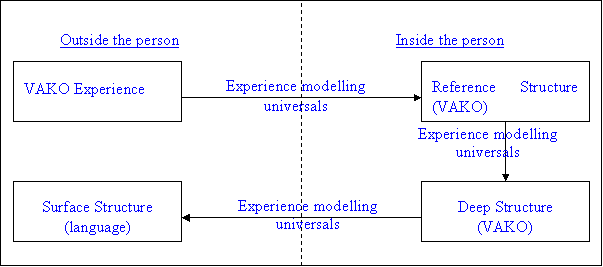
to explore the "reference structure"). The bellow figure attempts
to illustrate the full model with the different filtering phases which take
place:
VAKO experiences
(i.e. whatever's happening in the outside world and you receive via your
senses) are filtered (by what are called the experience modelling universals)
a first time before being stored in the reference structure. The reference
structure contains everything a person knows, his full life (smells, sights,
hearings, successes, failures, traumas, experiences, joys, pains,
…). But the reference structure differs from the real experience
because of filtering. The reference structure is assimilated to the
unconscious level (it is impossible to access your full reference structure
at a given moment). During
cognitive activity (thinking, remembering, talking, listening,
…) relevant portions of the reference structure are transferred with
filtering again to the deep structure. The deep structure is assimilated to
consciousness. You can consider anything you're conscious of at a given time
is within your deep structure. When
expressing yourself (talking, writing, …) the deep
structure is transferred (with filtering again) to the surface structure
(talking for example). Filtering
In order
to better illustrate this model, let's consider a few examples of filtering
which can occur in some situations, following the order of description above:
An
interesting number which is recurrent in literature is the "count"
of information a person can hold consciously. This number is said to be
around 7, this means that at any given time you can only have 7 pieces of
information a available for cognitive processing.
However, this the granularity of a piece of
information is difficult to define making this number little useful. |
Ideas to develop
|
 While talking
(with attention) with a friend you filter out many things happening (despite
the fact your VAKO senses receive them). You might not notice the sound of
the kettle boiling (but you did hear it physically), or you don't notice a
plane flying by (again, you did see it physically). These events will be
filtered from your VAKO experience and never enter your reference structure.
While talking
(with attention) with a friend you filter out many things happening (despite
the fact your VAKO senses receive them). You might not notice the sound of
the kettle boiling (but you did hear it physically), or you don't notice a
plane flying by (again, you did see it physically). These events will be
filtered from your VAKO experience and never enter your reference structure.