 |
 |
 |
|
|
|
 |
Glenohumeral Instability The humeral head of the patient cannot seem to keep centered on the glenoid socket. During a subluxation, the humeral head slips partially out of the fossa. However, with a dislocation, the humeral head actually slips completely off the glenoid, thus the articular surfaces no longer touch. Unstable shoulders—traumatic or atraumatic—are categorized as:
|
|||
Symptoms Expect patients with shoulder instability to report that their shoulder slips out of joint. Ask if they can willingly make their shoulder dislocate. You must determine whether the first episode of slipping occured after an injury. The hidden cause of TUBS is a tear of the glenoid labrum off the front of the glenoid which allows the humeral head to slip anteriorly.
| ||||
| Test
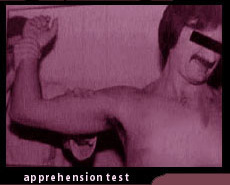
Apprehension test: Position the patient's arm into the throwing position. The test is positive if the patient feels apprehension that the shoulder will slip and if he has pain. It indicates presence of anterior shoulder instability. Sulcus sign: Stabilize the scapula as you pull down the patient's arm. The test is positive if an indentation develops between the acromion and humeral head. This suggests increased laxity in the glenohumeral joint. Laxity exam: Some patients are "double jointed," (lay term for capsular laxity). Ask patient to bend fingers past the knuckle while keeping the hand straight. Also, have the patient touch his/her right forearm with the right thumb. Patients who are able to do this suggest capsular laxity and are more prone to dislocate the shoulder voluntarily. Sensation: Check sensation around the tip of the shoulder (lateral deltoid area) to see if the axillary nerve has been injured.
| ||||
| Diagnostic Procedure
Regular shoulder radiographs are indicated to rule out underlying tumor or calcium deposit; graphs are usually normal. Arthography or an MRI scan is indicated in patients with no improvement after 3 months.
| ||||
| Treatment
NSAIDs and non-narcotic analgesics, along with physical therapy. Use the Jackins exercise proram (University of Washington [Jackins] exercises for stiff shoulers) and instruct the patient to undergo exercise four times a day with hopes of patient doing it twice a day. Supervision from a physical therapist once a week for six weeks is ideal, but success depends on the home exercises and the patient's commitment to them. After 12 weeks, shoulder manipulation under anesthesia may be indicated—with the exception of an insulin dependent diabetes mellitus patient requiring more aggressive arthroscopic capsular releases.
| ||||
| >>> on to Glenohumeral Instability
| ||||
| list � further reading � home � email me � |
||||