THE AGE, January 23, 2005
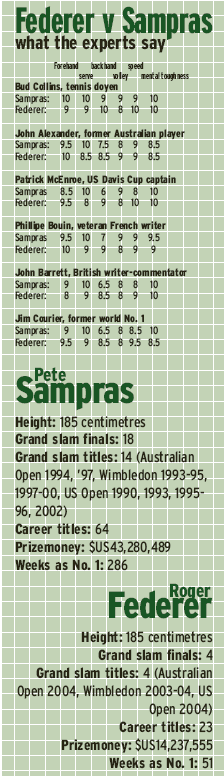
Roger Federer is playing the most magnificent tennis of his career, and, some say, of all time. So how would he fare against a rampaging Pete Sampras, the most successful player in the history of the men's game? Rohit Brijnath comtemplates a tantalising fantasy match, played out on Rod Laver Arena
Roger Federer is playing the most magnificent tennis of his career, and, some say, of all time. So how would he fare against a rampaging Pete Sampras, the most successful player in the history of the men's game? Rohit Brijnath comtemplates a tantalising fantasy match, played out on Rod Laver Arena.
In the locker room, a temporary peace sits between them. Presence is acknowledged, but it is not a day of saying much, and they sit like silent knights before this conclusive joust. It is the morning of the Australian Open final, the wind gently smoothens the hair outside, the sun burns, but they're not particularly attentive. The conditions don't interest them, only each other.
On court their dissimilarities will soon be evident, for one man's tennis sounds like martial music, the other's like a hymn. But as men, too, they are set apart. Says that Boston bard, Bud Collins: "Pete is self-contained, a room-service guy ... (he) maintains his own mystique. Roger is more cosmopolitan, he's European and speaks three-four languages." Federer might be found at the ballet, Sampras could have carried his racquet in a briefcase, for he is all business.
Sampras shrugs those wardrobesized shoulders in the locker room and pushes the doorway open into his zone. "With Pete, you can feel his intensity," says Patrick McEnroe. Federer plucks at his guts, allows himself a passing smile, a seemingly more comfortable and less monastic man. "Federer, it seems like nothing bothers him," said McEnroe.
Physically, the American is more imposing, but he does not look to exude any particular threat, says Jim Courier, who has inhabited the locker room with him in the moments before grand slam finals.
"He never really worried about intimidating except on court. For Pete it's all about between the lines."
Both men heft their bags and walk out - Sampras is in white, Federer in red, Nike in raptures - carrying also with them an aura of a heavyweight contest. They understand the occasion, they accord each other respect, they are alive to the knowledge that only their best game will do today.
Sampras is absent of fuss, even his ball bounce is restricted to just one before he unveils his serve, a stroke that carries with it more than a passing resemblance to a guillotine. The American will start more quickly, most say. He is a player of early statements, a case of "I am Sampras, who are you?" explains Philippe Bouin, of L'Equipe, who has been writing tennis for 25 years.
As Federer crouches at the other end, Sampras might unleash "two first serves", says Courier. McEnroe concurs. "Pete always comes out hard. Against Cedric Pioline (US Open final, 1993) his first serve was at 210 km/h or so, and later he said: �I just wanted to let him know I was coming.' Federer is more dominant when he gets his teeth in a match."
Federer takes a while to adjust to this pace, unhurriedly tuning his instrument in search of the right responsive notes. Former Davis Cup star John Alexander sees "Roger conceding early service games", and Sampras shuts him out of the first set.
The match is moving quickly, the points are often abrupt, or at least that is the way Sampras would prefer them. His racquet speaks in monosyllables, Federer's holds conversations.
The crowd is riveted by this collision of greatness and conflict of styles; both men different yet pleasing. Sampras' game has an easy symmetry and clean grace, an elegantly designed executioner. As opposed to Federer, who appears to coolly interrogate opponents and torture them with an almost casual beauty, death by Sampras is usually clinical. One's game is somewhat ascetic, the other's aesthetic.
Both men's faces offer nothing, demonstration is not their style; at best Sampras' tongue will loll, while Federer will occasionally halt to brush away a wandering lock of hair. Both are graduates from an older school of behaviour, impeccable in their manners. At best in victory we might see difference: Federer collapses to the court, Sampras mostly would never deign to sink to his knees before any man at any time.
Sampras, says Courier, "is bullying with his serve", but, who knows, possibly not coming in every time, perhaps even on first serves. Some of it is a function of the slower surface, some of it regard for Federer's superb returns.
A battle within a larger war is occurring here. Sampras in major finals did not have trouble holding serve, explains Courier, but Federer is known, for instance, for handling Andy Roddick's serve more comfortably than others. McEnroe adds that Federer is "difficult to ace" and refers to the past two Wimbledon finals, which are revealing.
In 2003, Mark Phillipoussis aced the Swiss only 14 times out of 70 first serves and 28 second serves hit in play; Roddick aced him only 11 times out of 81 first serves and 47 second serves hit in play. Both times Federer, whose serves are finely placed, outaced them.
Break points come and go, says Bouin, and both are good at saving them. The American saves one with a forehand on the dead run like a whiplash, the Swiss salvages another with a half-volley backhand flick with the ball behind his body.
Sampras punches a volley into an unreachable corner, Federer caresses one to an angle that would impress Euclid. With eyes closed, it is almost impossible to hear them for so soundlessly swift do they move.
Federer's dextrous wrist, alive with all manner of devils, conjures up a lob but only Sampras, on springed feet, can reach it. Both are exchanging strengths but also picking at weakness. Balls are lasered at each other's backhand, but as Courier says: "Pete's backhand is attackable and Federer's is not."
Separating them is almost nothing, and at a changeover a commentator quotes former Wimbledon champion Goran Ivanisevic: "Maybe the toughest player I ever play is Pete, because he is guy that gives you only one or two chances per match and if you don't take those chance, you finish. But I still think Federer is the biggest talent from all the players I play."
Federer takes the second set by threading two passing shots off either flank, Sampras with a rattle of volleys takes the third, the Swiss embroiders a backhand down the line for the fourth, and the match is poised. Lines are kissed, angles explored, every corner of the court painted by feet. The match is decided by inches and neither man readily gives any.
Where grass and the faster US Open court fed his game, here the more sluggish pace and elevated bounce at Rod Laver Arena is amputating a small part of the American's threat. Sampras does not want to rally here, but the Swiss, a walking encyclopaedia on shotmaking, at baseline or net, is spoilt for choice. He is, as McEnroe explained: "The best offensive and defensive player I've seen."
He begins, for McEnroe at least, to pick Sampras apart, and the longer it goes the worse it becomes, as Lleyton Hewitt might testify after last year's US Open final. Commentator-writer John Barrett, who has seen every Wimbledon final since World War II, sees Federer thinking on his feet a bit more quickly, and surprising the American by arriving at some of his apparent winners. Still as fast as Federer creates, Sampras is attempting to destroy.
On the volley he might, but otherwise Sampras does not bend; he is like some holy warrior on a single-minded mission to history. This man has written the textbook on winning. He is chipping, charging, teeing off on returns, missing a few, and while Federer may have "more variety, more spins, more margin of error" as McEnroe said, it is hard to pick between them. "Like going to the Louvre and choosing between Venus di Milo and the Mona Lisa," offers Collins.
In reality, into which we must slip only briefly, Sampras stands alone as the modern God, Zeus in long, white shorts. We are prone to genuflect now before Federer, whose completeness is dazzling, yet we stand unsure about whether his journey will take him to 14 slam titles and six years as No. 1. Whatever the fictional end to this match, the jury, bewitched perhaps, is still out on the Swiss.
In the match, both men reach deep within their reservoirs of will, proud in their refusal to wilt. As Courier insisted: "They're very similar in one respect. Both have an extra gear when they need it. They are the two best big-match players I have ever seen."
Sampras, whose five-set record in slams is 29-9, fingers sweat off his brow; Federer, with a 6-3 record, reaffixes his headband. Somehow, for this athletic ballet, seven sets appears more appropriate, and then, abruptly, it is over, the result coming swiftly for some, slower for others.
For McEnroe, a commanding Federer runs away with the fifth; for Courier, the Swiss rules on this particular court, but by the slimmest of margins. Alexander goes for the American, Bouin for the Swiss, Collins for Sampras, Barrett for Federer, most of them by an eyelash. Later that day, a statistician points out that each one won the same number of points.