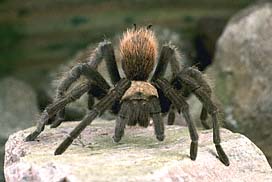
| Head and thorax grayish brown; abdomen brown-black, hairy. |
 |
| 2. |
 |
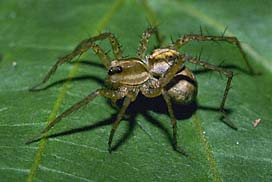
| gray-brown body with a dark center stripe on the abdomen; long, hairy legs; eight large, dark eyes of unequal size. |
 |
|
| 3. |
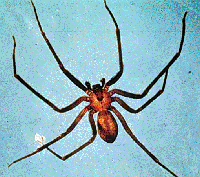
| soft-bodied, yellowish-tan to dark brown, about 1/4 to 1/2 inch long and have long, delicate grayish to dark brown legs covered with short, dark hairs. The leg span is about the size of a half dollar. Distinguishing characteristics are the presence of three pairs of eyes arranged in a semicircle on the forepart of the head and a violin-shaped, dark marking immediately behind the semicircle of eyes with the neck of the violin pointing towards the bulbous abdomen. |
| 1. |
| 4. |
|
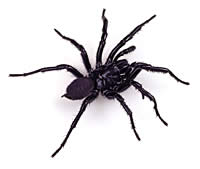
| fearsome reputation, aggressive behaviour, rearing and displaying their impressive fangs. It is true that males have a habit of wandering into backyards and falling into suburban swimming pools, where they can survive many hours. They also sometimes enter and become trapped in houses. Again, it is true this spider does have one of the most toxic venoms (to humans) of any spider. |
 |
| 5. |
|
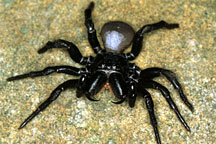
| closely related to trapdoor and funnel-web spiders but can be distinguished by their pronounced compact, squat shape and huge fang sheaths at the front of the head area. Most species are dark brown or black in colour, although the male of this spider species has a bright reddish-brown front part of the head or cephalothorax. The body size reaches around 35mm, with the male being distinctly smaller and less robust. The venom is very toxic and, although no human deaths have been recorded, a bite from a this spider should be considered potentially life threatening and medical attention should be sought immediately. |
 |
| 6. |
|
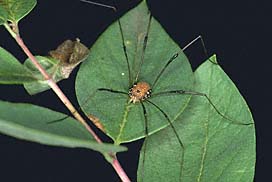
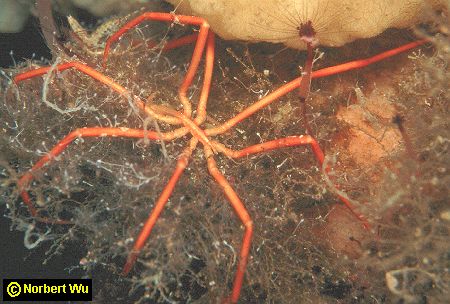
| Reddish-brown body with four pairs of long, thread-like legs |
 |
|
| 7. |
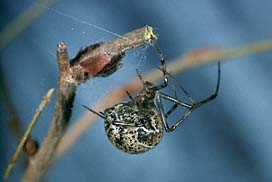
| A round, yellowish-brown body streaked with black and gray. This spider emerges in darkness to produce webs beneath ceilings or in window frames, taking advantage of every angle to set sticky strands where insects may get caught. |
 |
|
| 8. |
 |
|
| 9. |
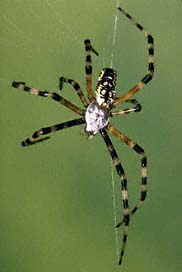
| Bold yellow-and-black markings large egg-shaped abdomen; long hairy legs with yellow-and-black bands. |
 |
|
| 10. |
 |
|
| 11. |
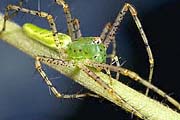
| Bright green, cream, or tan body; legs are yellow with black spines These spiders spend their time hunting for insects in bushes and low plants. They are fast runners, but can occasionally be seen lying in wait for prey beside flowers. They build no web for prey capture, but they do release a silk dragline as they hunt among leaves. |
 |
|
| 12. |
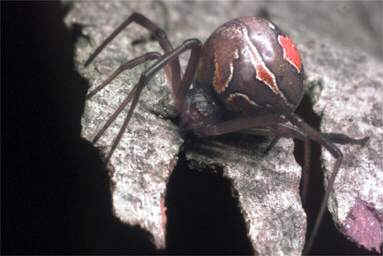
| one of the most poisonous spiders in the world. This spider is Australia's version of the black widow. So that means that you should probably stay clear from it. |
 |
|
| 13. |
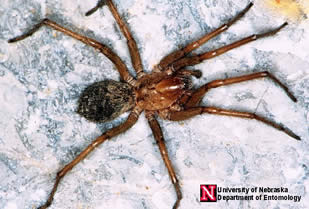
| are brown and measure roughly 12 to 18 mm in length. Their legs show no distinct rings and have short hairs. Their abdomens have several chevron shaped markings. Males are distinctively different from females in that they have two large palps that look like boxing gloves. |
 |
|
| 14. |
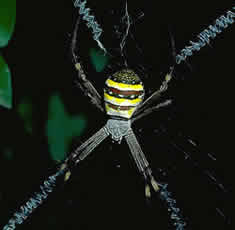
| named for their bright web decorations - zig-zag ribbons of bluish-white silk that form a full or partial cross through the centre of the orb web. Females have a silvery carapace and a silver, yellow, red and black banded upper abdomen with two longitudinal yellow stripes below. The spider sits with the legs in pairs. The brown and cream coloured males are smaller than females (body lengths 3 - 4 mm and 10 - 16 mm respectively). |
 |
|
| 15. |
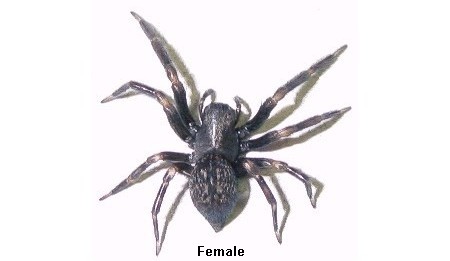 |
| frequently builds webs in the crevices around doors and windows. Uncertain; may cause mild illness and necrotising arachnidism |
|
| 16. |
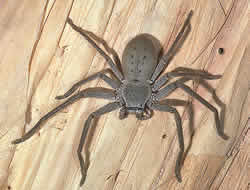
| found living under loose bark on trees, in crevices on rock walls and in logs, under rocks and slabs of bark on the ground, and on foliage. large, long-legged spiders, measuring up to 15 cm across the legs. They are mostly grey to brown, sometimes with banded legs. |
 |
|
| 17. |
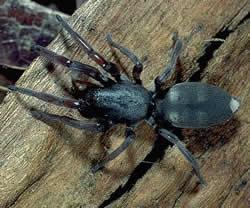
| dark reddish to grey, cigar-shaped body (males about 12 mm, females up to 18 mm long) and dark orange-brown banded legs. The grey dorsal abdomen bears two pairs of faint white spots (less distinct in adults) with a white spot at the tip; the male has a hard, narrow plate or scute on the front of the abdomen. |
 |
| 18. |
|
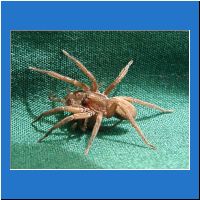
| Order Araneida Family Miturgidae Genus/Species Miturga spp. |
 |
|
| 19. |
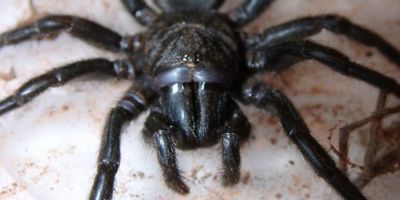 |
| MYGALOMORPHAE:NEMESIIDAE Subfamily Anaminae Aname Atra |
|
| 20. |
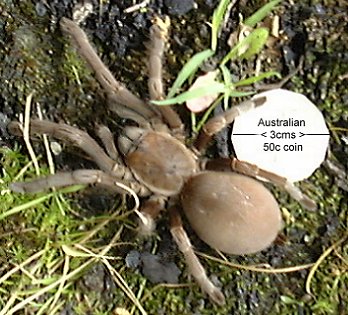
| one of Australia's largest spiders Selenocosmia Crassipes is its Latin name, and it is closely related to the Barking Spiders of South America. A mature female spider has body reaching a length of 6mm, the male is slightly smaller and slimmer than the female. The body of the male grows up to 40mm. The colour of the spider is various shades of rusty brown. |
 |
|

|
| 21. |
| Full size -50 cent piece; leg diameter - pin to matchstick. Mottled dark abdomen; head with silver or dark gold border. |
 |
|
| 22. |
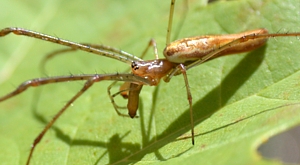
| FAMILY: Tetragnathidae AKA: Stretch Spiders, Tetragnathids |
 |
|
| 23. |
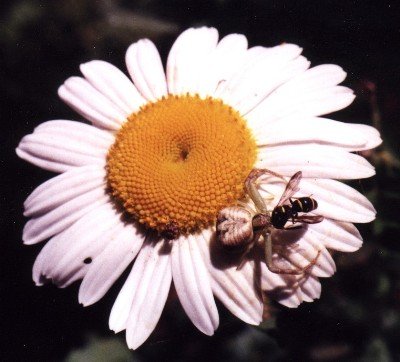 |
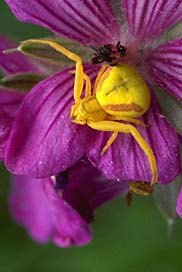
| Because they are often found on flowers, another name for these spiders is flower spiders. |
|
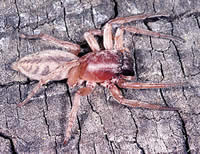 |
| body length of 9-15 mm. They make small cylindrical or ovoid silk retreat sacs. They have slender bodies, large jaws and long, thin legs, with the males being especially slender. Most are shades of cream, brown or yellow, with a darker stripe along the upper abdomen. The jaws of the male spider are particularly enlarged. |
| 24. |
|
| 25. |
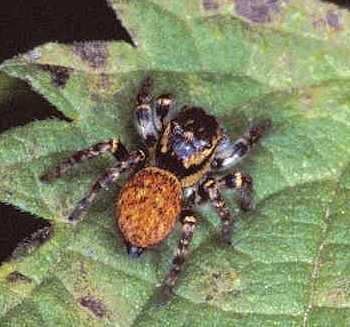
| body is beautifully colored with orange and yellow hairs. The spider can be spotted bushes in the southern parts of Europe |
 |
 |
|
| 26. |
 |
|
| 27. |
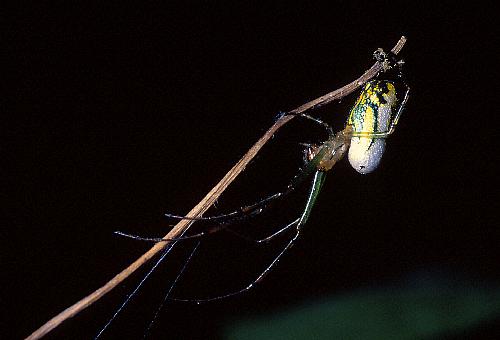
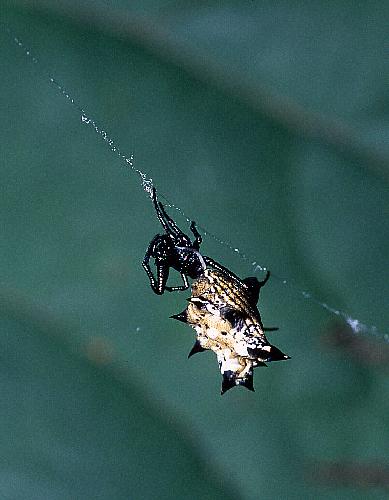
| This spider clings below its web or to a nearby twig until prey blunders into the web and shakes it. |
 |
 |
|
| 28. |
 |
|